The Real Cost of Parking a Domain (It's Not Just the Renewal Fee)
 Bret Siers
You bought a domain in 2021. Good idea, good name. You told yourself you'd build something when the timing was right. Every year the renewal email came, and every year you paid it without thinking too hard. $15 here. $15 there.
You've spent $75. Maybe $60. Whatever five years of renewals adds up to for your registrar. That's the number you'd give if someone asked what parking has cost you.
It's the wrong number. Not because the renewals aren't real. Because they're the smallest part of the bill.
Here's the full accounting.
Cost Category 1: The Renewal Fee
What it is: The annual fee paid to your registrar to maintain the domain registration.
Typical range: $10-20/year for most .com domains, $15/year being common. Premium registrars charge more. Discount registrars often have higher second-year prices after a discounted first year.
Five-year total: $50-100 for a typical .com domain.
This is the cost most domain owners can quote from memory. It is also the only cost that shows up on a credit card statement.
Verdict: This is the floor, not the ceiling.
Cost Category 2: Opportunity Cost of Undeveloped Signals
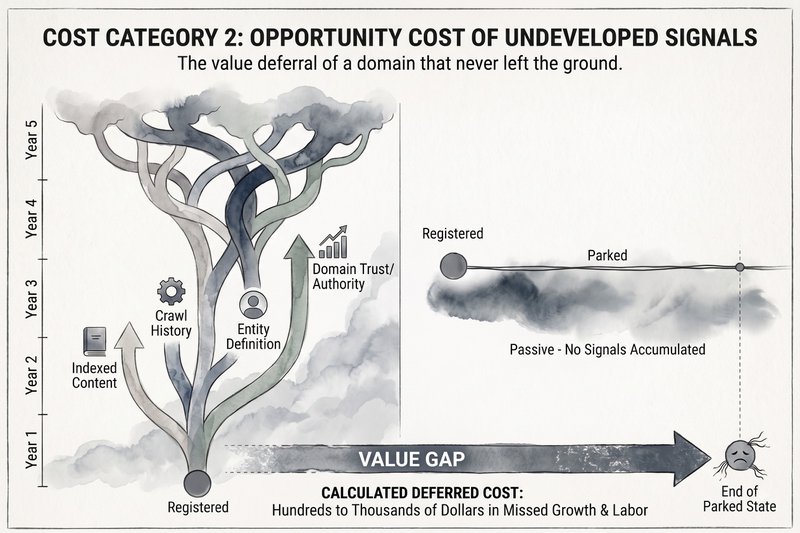
This is the cost that never shows up on a statement but compounds every month you don't address it.
What it is: The value a domain could have accumulated during the time it was parked. Age, crawl history, indexed content, entity definition. These are what make a domain easier to develop, easier to use for deliverability, and more recognizable to the systems that evaluate domain trust.
The compounding problem: Domain signals compound over time when they're being built. A domain that has been accumulating consistent, structured content signals for five years is meaningfully more valuable than a domain registered the same day with no content history. They share a birthday. They have completely different lives.
A passively parked domain doesn't accumulate these signals. It holds the domain age but builds no signal record. The same five years that could have built a real presence instead built nothing. That's a hard thing to sit with when you realize it.
How to think about the cost: If you eventually develop this domain, you're starting from near-zero on signal history despite years of ownership. The work you would have done in years one and two to establish presence, you'll do in year six instead. You didn't save time by waiting. You deferred the cost and added interest.
Rough dollar equivalent: Difficult to quantify precisely, but a launched domain with an established entity definition, two years of indexed content, and a consistent crawl history is measurably different from a cold domain starting fresh. Some domain investors value established signal history as worth 6-12 months of content development work. At any reasonable hourly rate, that represents hundreds or thousands of dollars in deferred labor.
Verdict: Not a cash outlay. A compounding opportunity you didn't take.
Cost Category 3: Malware and Reputation Liability
What it is: The risk that your parked domain is currently serving malicious content to visitors -- and the reputation damage that follows if it does.
Why this is a cost in 2026: This is not a theoretical risk. Parked domains operating on ad-supported parking platforms sit on infrastructure that has largely lost its legitimate revenue streams and replaced it with click fraud, phishing redirects, and malware distribution.
If your domain is one of the affected ones, here is what that costs:
Immediate reputation cost: The domain's IP address and name may be blacklisted by email security providers, browser safe browsing systems, and security databases. If you later try to send email from that domain or use it for any professional purpose, you will face deliverability blocks and security warnings that take months to clear.
Recovery cost: Getting off a blacklist requires auditing the malware source, removing it, and submitting removal requests to Google Safe Browsing, Spamhaus, MXToolbox Blacklist, SURBL, and others. The realistic time cost is 4-8 weeks of active management.
Rough dollar equivalent: If someone doing this work values their time at $50/hour, 40 hours of blacklist recovery and domain reputation repair is $2,000. That is not unusual for a domain with deep malware association.
Verdict: Probabilistically large. Most parked domain owners have not checked whether their domains are affected.
Cost Category 4: The Parking History Recovery Tax
This one gets worse the longer you ignore it. Every month of parking adds to the tab.
What it is: The extra time and effort required to establish a domain's credibility with search systems and AI crawlers after it has a parking history, compared to a domain that never had one.
How it works: Google and other systems track domain history. A domain that has served parking content for years has a classifiable parking history score. When you eventually develop that domain, that score doesn't reset on day one. As Google's John Mueller has acknowledged, recently developed domains with parking histories face a 1-3 week (and sometimes longer) re-evaluation period before the systems stop treating them as parking pages.
For a domain with a multi-year parking history, this re-evaluation may take months of consistent active content before the classification fully updates. You're not just building a new presence. You're overwriting an established one. And the system you're overwriting has been reinforced by every crawl that saw a parking page over those years.
The compounding version: A domain parked for one year has a shorter parking history than one parked for five years. The cost of five years of passive parking isn't five times the cost of one year. It's more than that, because the history score deepens with each crawl. The hole gets wider while you're not looking.
Rough dollar equivalent: Measured in content production and time, not a single cash cost. But for a domain with a five-year parking history, 60-90 days of active warming content to begin clearing that history, at $50-100 per piece of content produced externally, represents $300-900 of recovery investment. That's money you spend before you start building value. Not instead of.
Verdict: The longer you wait, the more expensive the reset.
The Full Cost Accounting
| Cost Category | Visible? | Typical Range |
|---|---|---|
| Renewal fee | Yes | $50-100 over 5 years |
| Opportunity cost (deferred signals) | No | $500-2,000+ equivalent in deferred work |
| Malware and reputation liability | No (until it hits) | $0 if lucky, $2,000+ if not |
| Parking history recovery tax | No | $300-900+ depending on depth of history |
The renewal fee you have been paying for five years is roughly $75. The total real cost of those five years of passive parking, in a scenario where you eventually want to use the domain for something real, is many times that number. The renewal fee is the only one of these costs that arrives as an invoice, which is exactly why it's the only one most owners count.
What Changes When You Start Warming
Launching a domain doesn't eliminate all of these costs overnight. But it stops the bleeding from the day you start.
An actively parked domain is building signal history, not missing it. It's not connected to a parking platform that serves malicious content. And it's not deepening a parking history score that will eventually cost more to clear.
The renewal fee stays the same. Everything else shifts. Category 2 reverses. Category 3 drops to zero. Category 4 starts shrinking instead of growing. The same $15/year renewal now represents an investment in something that's accumulating value, not something that's quietly eroding it.
The SiteWarming perspectiveSiteWarming's warming process addresses Categories 2, 3, and 4 directly. By replacing a parking page with a structured, signal-building presence, it stops the compounding decay on the day warming starts. And because warming builds signal history from day one, the cost of parking history recovery decreases the earlier you start. The $75 you spent on renewals is not the number that matters. The number that matters is what those five years of parking cost you in value you did not build. The Complete Guide to Domain Parking in 2026 covers how to check whether your domain is serving malware, which is the immediate next step. What is SiteWarming?
Image Credits
- Hero: Photo by Marcus Wallis on Unsplash
Share this article
Ready to Transform Your Domain Portfolio?
Start building real value with your domain investments today.