What to Do With a Parked Domain in 2026 (7 Options Ranked)
 Bret Siers
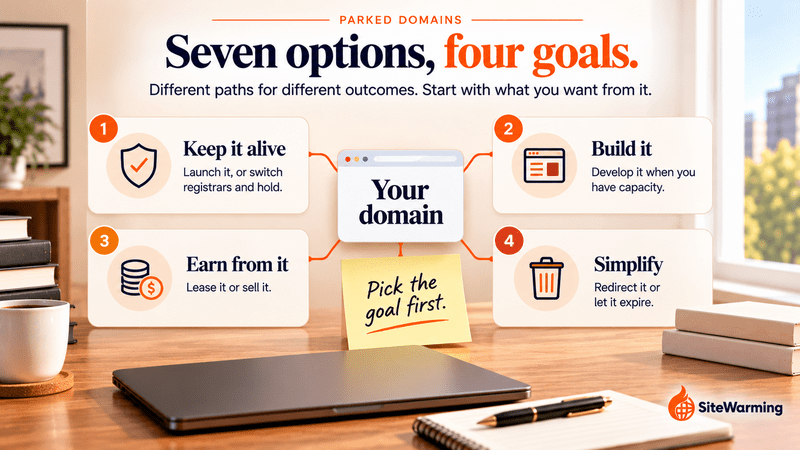
For most parked domains, launch them: replace the parking page with a short placeholder, Organization markup and a contact path. Then decide domain by domain whether to develop, lease, sell, redirect, switch registrars and hold, or let it expire. Passive parking, where an ad network monetizes a page you never touch, is no longer a safe default.
If you manage a handful of domains at a registrar, you know the pattern. Some you've renewed for years. Some you forgot you owned until the invoice arrived. A few still point at a parking page you set up when it seemed like the easy thing to do.
This guide ranks seven things you can do with a domain you're not using, by how well each one preserves or builds its value. Each option gets the same five parts: what it is, why it ranks where it does, who it's for, a verdict and a first action. You won't use the same option for every domain, so there's a quick-pick table first and a five-question test at the end.
Why is passive parking no longer a safe default?
Because the ad model behind it has been unwinding. IONOS said on November 11, 2025 that it had decided "to put Sedo GmbH, and thus the 'AdTech' segment, up for sale". Bodis said it would stop operating on January 31, 2026. Google Ads Help says Parked Domains (AFD) "will cease to be an ad surface within the Search Partner Network effective February 10, 2026." Research on parked pages, including a 2015 NDSS study of more than 8 million parked domains, has also documented that visitors can be exposed to malware and scams. The full picture is in The Complete Guide to Domain Parking in 2026, and The Third Option explains why launching beats both building and parking.
Which option fits which domain?
Use this table as a first pass, then read the option that matches.
| If this describes the domain | Start with |
|---|---|
| You can't build it yet but don't want to lose it | Option 1: Launch it |
| You have a clear product and the time to build it | Option 2: Develop it |
| A business or person in its niche could use the name | Option 3: Lease it |
| It has real commercial value, such as a short, brandable or keyword-rich name | Option 4: Sell it |
| It's a close variant of a site you already run | Option 5: Redirect it |
| You hold it for later but your registrar is costly or unreliable | Option 6: Switch registrars and hold actively |
| It has no future use and renewal isn't worth the fee | Option 7: Let it expire |
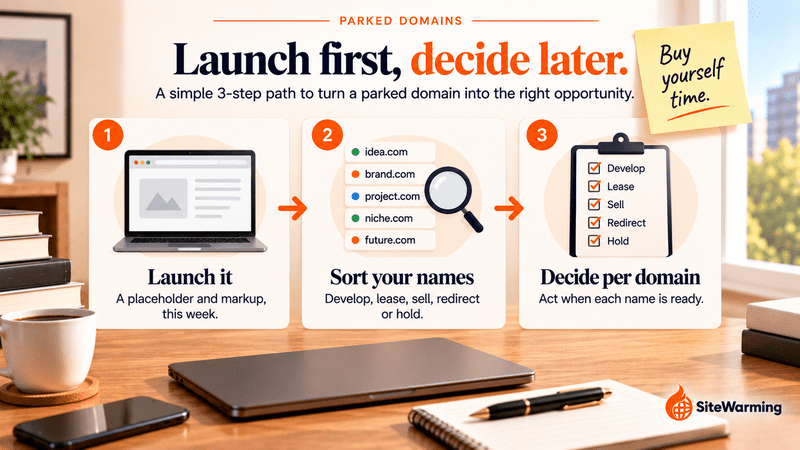
Option 1: What does it mean to launch a parked domain? (Best default)
What it is. Launching replaces the parking page with a minimal, intentional presence: a short page that says what the domain is, Organization markup, a robots.txt that allows crawling, a sitemap submitted in Google Search Console and a contact path. It isn't a full website.
Why it ranks first. It preserves the domain's value while you decide, it removes the exposure that comes with an ad-network page, and it keeps every other option open. A launched domain can still be developed, leased, sold or redirected later.
Who it's for. Any domain you aren't ready to build but don't want to lose. For most owners, that's most of the portfolio.
Verdict. The best default for most domains. Our launch walkthrough covers the five steps in detail.
First action. Remove the parking redirect, set up minimal hosting and publish a landing page that says what the domain is for.
Option 2: Should you develop it?
What it is. Build the site, product or business the domain was meant for.
Why it ranks second. It has the highest upside, and it's the only option that turns a name into something with its own audience. It ranks below launching because it needs time, money and a clear idea, and most people can't build every domain they own.
Who it's for. The one or two names you'll actually work on in the next year.
Verdict. Highest upside, but it requires capacity. If you can't start within a few months, launch it first.
First action. Write one paragraph describing what the site will do and who it's for. If you can't, the domain isn't ready to be developed. If you're unsure which names to pick, our guide to validating a niche idea before building is a useful filter.
Option 3: Should you lease it?
What it is. You let a business or individual use the domain for a recurring fee while you keep ownership. Our view is that short brandable names and local or industry-specific names are the most leasable, because they have an obvious user.
There are two different deals under the word "lease," and mixing them up is a common mistake.
| Straight lease | Lease to own | |
|---|---|---|
| Who pays | The tenant pays a recurring fee to use the name | The buyer pays in monthly installments |
| Who owns the name | You, throughout | Moves to the buyer once paid, as a sale on installment |
| When it ends | The lease ends and you can renew or relist it | The payments complete |
| Think of it as | Rental income | A sale paid over time |
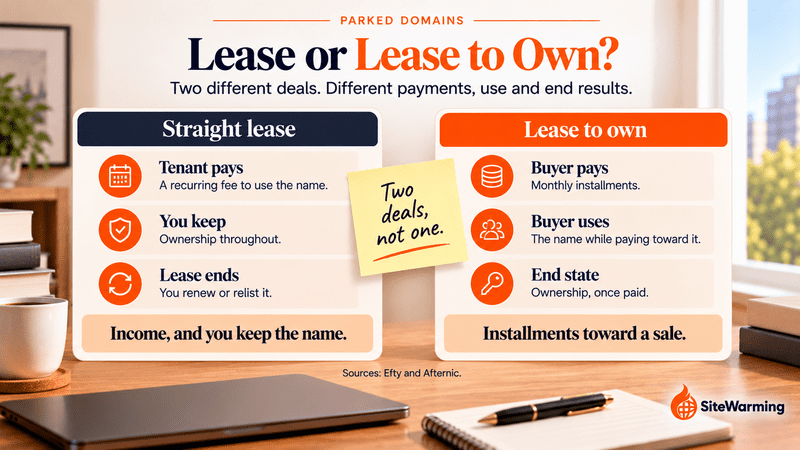
Efty is a marketplace that offers lease to own, and its guide describes it as letting a buyer "start using a domain name while paying toward ownership in monthly installments". Afternic also lists Lease to Own, with commission discounts of up to 15%, on its sell page. Efty's marketplace fees are not stated on the pages we read, so check them before listing.
Why it ranks third. It earns revenue without selling and keeps the name, which makes it underused. It ranks below launching because it depends on a counterparty showing up.
Who it's for. Owners of names with an obvious user, who'd rather earn than sell.
Verdict. Underused, and worth a few outreach emails before you list.
First action. Send three outreach emails to businesses in the domain's niche, offering a lease at a monthly price you'd accept.
Option 4: How do you sell it on the aftermarket?
What it is. List the domain on a marketplace such as Afternic or Sedo, or sell it directly. This suits names with real commercial value; generic names usually attract little interest.
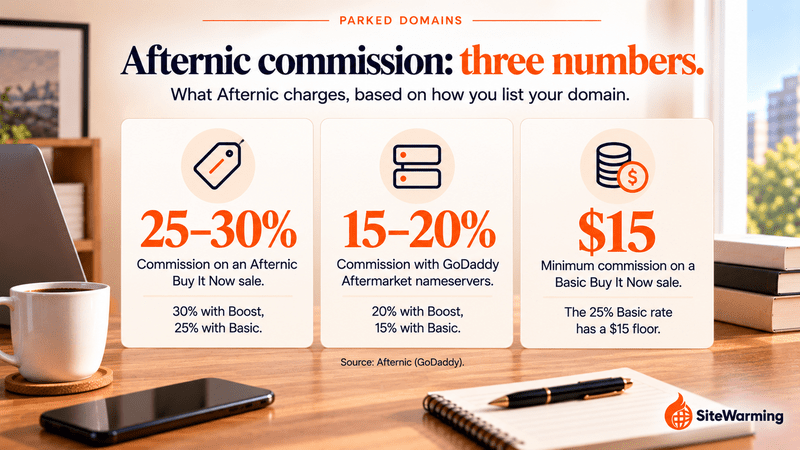
Fees vary by platform and by plan, so look at the net figure, not the list price.
| Platform | How it sells | Fees we could confirm |
|---|---|---|
| Afternic | Part of GoDaddy; free to join; listings syndicate to 100+ resellers | Buy It Now commission is 30% with Boost or 25% with Basic ($15 minimum); 20% or 15% with GoDaddy Aftermarket nameservers; Lease to Own commission discounts up to 15% |
| Sedo | Fixed price, auction or anonymous negotiation | Commission not stated on the page we read. |
| Efty | Marketplace with Lease to Own | Marketplace fees not stated on the pages we read. |
| Dan.com | Now redirects to Afternic (checked October 19, 2026) | Use Afternic's terms |
IONOS said in November 2025 that it decided to put Sedo up for sale, so check Sedo's current status before you list there.
To price a name, start with two estimates and a reality check. Estibot says it appraises "over 2 million domains per day", and GoDaddy's estimator values the domain name, not a site built on it. Our own guides on how GoDaddy, Estibot and Atom compare and how much your domain is worth go deeper, and SiteWarming's free sale-readiness report sorts up to 100 domains into sell, hold or develop first. Sell, hold or build a domain is the short version of that decision.
Why it ranks fourth. It turns a name into cash and ends your carrying cost, but the sale is irreversible and appraisals are only estimates.
Who it's for. Owners of domains with a plausible buyer, such as short, brandable or keyword-rich names.
Verdict. Right for valuable domains, and a poor fit for names with no obvious buyer.
First action. Check an estimator, then list only the domains with a plausible buyer and a price you'd accept after fees.
Option 5: Should you redirect it to your primary domain?
What it is. You point the domain's DNS or a server rule at a site you actively use, using a permanent (301) redirect.
Why it ranks fifth. It's low effort and it stops an unused name from sitting on a parking page. It's useful mainly for defensive registrations and close variants of your own brand, such as a common misspelling, and not for broad consolidation of unrelated names.
Who it's for. Owners with a main site and a few obvious variants.
Verdict. Situational. It's the right answer for related variants and the wrong answer for a name with its own future.
First action. Group your domains and redirect only where a clear primary destination exists. Our answers page on never-launched domains can help with the rest.
Option 6: Should you switch registrars and hold the domain actively?
What it is. You move the domain to a more reliable or lower-cost registrar and put a real page on it while you hold it for future development.
Why it ranks sixth. It's a conditional option. It only makes sense if you honestly expect to use the name and your current renewal cost or registrar service is the problem. Cloudflare Registrar, for example, says it uses "At-cost, wholesale pricing", so compare renewal prices, not first-year promotions.
Who it's for. Owners holding names for the long term who are overpaying or poorly served.
Verdict. Conditional, and it requires an honest judgment of the name's future value. Best Domain Registrars for Long-Term Ownership in 2026 compares the options, and domain transfer without breaking anything covers the move.
First action. List your domains with their renewal prices, then move the ones where the savings are clear.
Option 7: Should you let it expire?
What it is. You stop renewing the domain and accept the loss. It's legitimate, and for a name with no future it's often the right call.
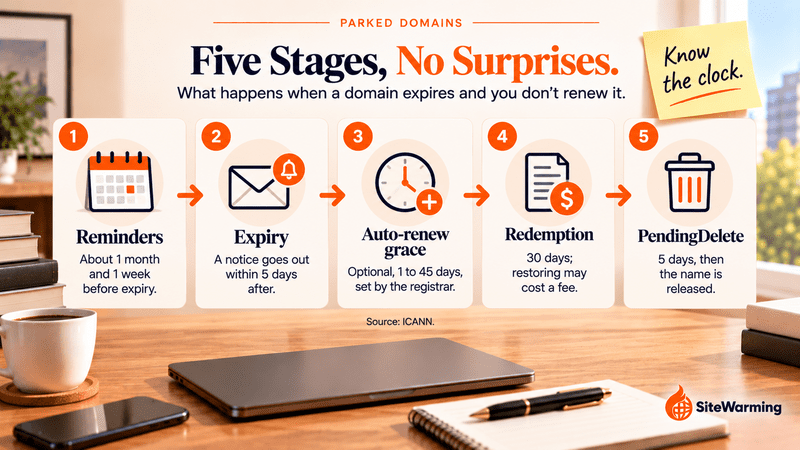
Why it ranks last. It's the only option that can't be undone once the sequence runs out. It's also free, and a domain you never use costs you something every year. Know the sequence first. ICANN's registrant guidance describes it this way:
- Your registrar should send two reminders, about one month and one week before expiry, and a notice within five days after.
- Some registrars give an optional Auto-Renew Grace Period of 1 to 45 days; the registrar sets it.
- A required 30-day Redemption Grace Period follows, and restoring the domain can cost a restore fee.
- After redemption the domain moves to PendingDelete for 5 days, and then it's released.
Who it's for. Owners of names they'd never use, lease, sell or redirect.
Verdict. Legitimate, and not a failure. What happens when a domain expires and should you renew an unused domain cover the timing in more detail.
First action. Before you stop renewing, check whether anyone links to or searches for the name, and decide on a date. Don't let a registrar's auto-renew decide for you.
How do you decide domain by domain?
Work through these five questions in order for each name. The first yes is your option.
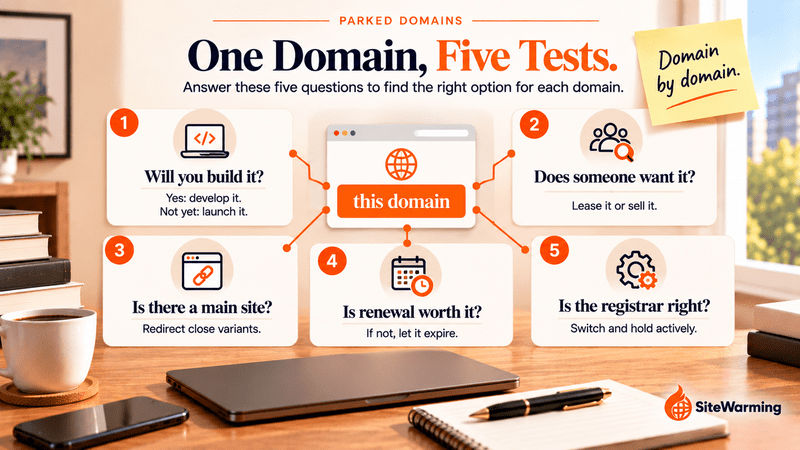
- Will you build it in the next year? If yes, develop it. If not yet, launch it.
- Does someone in its niche want it? Lease it if you want income and want to keep the name; sell it if you'd take a price.
- Is there a main site it belongs under? Redirect close variants.
- Is renewal worth the cost? If not, let it expire.
- Is your registrar the problem? Switch and hold actively.
The ranking in summary
| # | Option | Effort | Reversible | Verdict |
|---|---|---|---|---|
| 1 | Launch it | Low | Yes | Best default for most domains |
| 2 | Develop it | High | Mostly | Highest upside, requires capacity |
| 3 | Lease it | Medium | Yes | Underused, revenue without selling |
| 4 | Sell on the aftermarket | Medium | No | Right for valuable domains |
| 5 | Redirect to your primary domain | Low | Yes | Situational, for related variants |
| 6 | Switch registrars and hold actively | Medium | Yes | Conditional, requires an honest assessment |
| 7 | Let it expire | None | No | Legitimate, not a failure |
How does SiteWarming handle these options?
SiteWarming begins with Option 1. Its Launch & Warm step sets up DNS configuration, an HTTPS certificate, hosting, a page with structured data, AI-readable FAQs and a protected contact path, and then runs ongoing DNS and SSL checks and monthly content updates. Each domain gets a template: Future Build, Open or Actively Selling. The domain management view shows which names are live, dormant or approaching renewal, so the decisions above are easier to make, and it pulls in a HumbleWorth value for each one. If you're recovering a name that still looks parked in Google, this walkthrough covers the checks. The Free plan costs $0 for one warmed domain, Starter is $13 a month for 10, and you can start free.
Frequently asked questions about parked domains
What should I do with a parked domain?
For most domains, launch it: replace the parking page with a short entity page, Organization markup and a contact path. Then decide per domain whether to develop it, lease it, sell it, redirect it, switch registrars and hold it, or let it expire. Launching keeps every other option open while you decide.
Is it better to sell a parked domain or launch it?
Sell it if it has real commercial value and a plausible buyer, and if you'd accept a price after fees. Launch it if you aren't sure, because a launched domain can still be sold later. Sales are irreversible, so launching first costs little and keeps the choice open.
How much does it cost to sell a domain on Afternic?
Afternic's page lists a Buy It Now commission of 30% with Boost or 25% with Basic, with a $15 minimum on Basic. Listings that use GoDaddy Aftermarket nameservers pay 20% or 15%. Lease to Own sales get commission discounts of up to 15%. Check the page again before you list, because plans change.
What is the difference between leasing and lease to own?
A straight lease lets someone use the name for a recurring fee while you keep ownership. Lease to own is a sale paid in monthly installments: the buyer starts using the name while paying toward ownership. The first is rental income; the second is a sale spread over time.
Should I let an unused domain expire?
Yes, if it has no future use and renewal isn't worth the fee. ICANN's sequence gives you reminders, a required 30-day redemption period and 5 days of PendingDelete, though a registrar may charge a restore fee. Decide on a date before you stop renewing so auto-renew doesn't decide for you.
Is redirecting a parked domain to my main site a good idea?
It works for close variants of your own brand, such as a common misspelling, and for defensive registrations. It's the wrong choice for a name with its own future or for a pile of unrelated names. Use a permanent 301 redirect and send each domain to the most relevant page.
Is it worth switching registrars for domains I'm just holding?
Only if renewal cost or service is the actual problem and you expect to use the name. Compare renewal prices, not first-year promotions. Cloudflare Registrar says it charges at-cost, wholesale pricing, but check the registrar's current price for the extension you hold before you move.
How do I know what my domain is worth?
Use two or three estimators as a range, not a price. Estibot and GoDaddy's estimator value the domain name, not a site built on it, and they often disagree. SiteWarming's free sale-readiness report sorts up to 100 domains into sell, hold or develop first, and a platform's sale history is the best check.
Related reading
- The Complete Guide to Domain Parking in 2026: the wider landscape.
- The Third Option: Why You Don't Have to Choose Between Building and Parking: the case for launching.
- How to Recover a Domain Google Thinks Is Still Parked: what to check after you un-park.
- Best Domain Registrars for Long-Term Ownership in 2026: where to hold what you keep.
- Sell, hold or build a domain: a short decision guide.
- What to do with never-launched domains: the portfolio-level answer.
- What happens when a domain expires: the timeline after the expiry date.
Share this article
Ready to Transform Your Domain Portfolio?
Start building real value with your domain investments today.