How Much Is Your Domain Worth? Why Every Appraisal Disagrees
 Bret Siers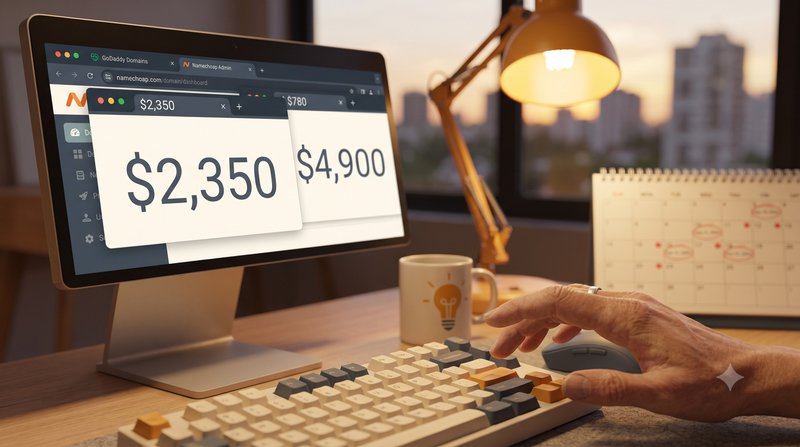
Photo by Behnam Norouzi on Unsplash
How Much Is Your Domain Worth? Why Every Appraisal Disagrees
Most owners are not appraising a domain because they have a buyer. They are appraising it because renewal is coming and they want to know if the name still deserves a place in the drawer.
That's the honest reason people type a domain into an appraisal tool. Not to sell. To understand.
A domain owner posted on Reddit's r/Domains community their appraisal results for healthfit.ai. Not because the number was exciting. Because the numbers were impossible. GoDaddy said $222. Atom said $29,500. Same domain. Same afternoon.
The question is not "Which number is right?" The better question is "What does the spread tell me?"
If you've ever typed your domain into an appraisal tool and felt a rush of either hope or deflation, you already know this feeling. The number hits, and for about three seconds, you believe it. Then you run a second tool. The number is completely different. And now you don't trust either one.
That confusion is not a bug. It's the honest state of domain valuation in 2026.
How Domain Appraisal Works (And Why Every Tool Gets a Different Number)
A domain appraisal is a statistical estimate of what a buyer would pay for a specific domain name, based on comparable sales, keyword attributes, and extension type.
Every tool approaches that question with different data. GoDaddy's model is trained on its own twenty-plus years of auction sales. It knows what common English .com names sell for because it has watched millions of them change hands. It skews conservative on premium or brandable names because its training data is dominated by mid-range transactions. Atom benchmarks against its own marketplace of curated brand-ready domains, with a different reference point and dataset. For the full breakdown of how each tool derives its number, see domain valuation tools compared.
So when Atom looks at healthfit.ai, it sees a short, clean brand name in a growing category and estimates accordingly. When GoDaddy looks at the same string, it sees a two-word .ai domain that doesn't match the patterns in its .com-heavy sales history.
Neither approach is wrong, exactly. But they produce numbers that look like they came from different planets. When you search "how much is my domain worth" and plug a name into a tool, you're not getting a price. You're getting one model's interpretation of a fundamentally ambiguous question.
What a Domain Value Calculator Actually Tells You
So you type your domain into a value calculator. A number appears. What did you just learn?
Less than you think. And more than nothing.
What you learned is one model's estimate, built on one dataset, with one set of assumptions about what "value" means. Some models look at word length, keyword presence, extension type, and comparable sales. Others layer in brandability scoring or auction history from specific marketplaces. Then the tool gives you a number. One number. Clean, specific, confident.
That number is, at best, the midpoint of a range the tool chose not to show you.
In a 2023 NamePros analysis of GoDaddy auction sales, the appraisal only explained a minority of actual sale-price movement (R-squared of 0.215, with only 41.4% of sales landing within a factor of two of the appraisal). Almost 80% of what determines what a domain actually sells for is invisible to the model. And the appraised number is more often an upper bound than a realistic starting point. The model systematically over-estimates relative to what names actually go for.
That's not a failure. That's how the model was built.
As one domain professional put it on Reddit's r/Domains: "There is no accurate domain name appraisal tool. The best appraisals are human-driven. But even then, a domain is worth what someone else is willing to pay."
What Actually Determines How Much a Domain Is Worth
If the tools disagree this badly, what actually matters?
Extension. A .com still carries a premium in most situations. A .ai or .io carries different weight depending on the buyer's industry. But the extension is a signal, not a sentence.
Length and memorability. Shorter is generally worth more, but not always. A four-letter .com with no pronounceable word might sell for less than a slightly longer name that sounds like a brand. Pronounceable beats clever. Memorable beats short.
Category alignment. A domain that matches a real industry or business need carries weight beyond what comparable sales suggest. healthfit.ai might be worth $300 to most buyers and much more to the one who just raised funding for a health-tech platform.
Comparable sales. What have similar names actually sold for? This is the closest thing to an objective anchor, but "similar" is subjective.
The buyer who hasn't shown up yet. A domain worth $500 to a casual browser might be worth fifty times that to a funded startup that needs exactly that name. The name didn't change. The buyer did. And no appraisal tool can predict who shows up next.
An appraisal tool can estimate the first four factors. It can't touch the fifth.
Why a Watched Range Matters More Than a Single Number
The temptation, after all of this, is to throw up your hands. Every tool disagrees. The real value depends on a buyer who may or may not exist yet. So why bother?
Because a watched range is a signal. And a signal is more than a guess.
If you run your domain through one tool and get a number, you have a guess. If you run it through several tools and get a range, you have a bracket. If you watch that bracket shift over time, across sources, you have something no single appraisal can give you: a direction.
A tight spread usually means the name is priced predictably. A wide spread means the name depends more on who finds it. The shape of the spread is information, not noise.
The name was not random when you bought it. And the question "what is it worth?" isn't really about finding a number. It's about understanding what you're holding.
This is also the argument for seeing all of your domains in one view with integrated valuations across registrars. When your domains live across GoDaddy, Namecheap, and Cloudflare, and the valuations live in browser tabs you opened once and forgot about, you have data but no signal. Signal comes from watching the range move across everything you own, over time, in one place.
This is why the answer is not more tools. It is more patience.
This is why SiteWarming pulls valuations from multiple sources into one view. Not to tell you a price, but to show you a range, and to let you watch that range shift over time. A single appraisal is a snapshot from one angle. Tracked valuations across sources are how a list of domains becomes a collection of assets you actually understand. What is SiteWarming?
Understanding What You Have
The question "how much is my domain worth?" comes from one of two places. Either you're curious, or you're deciding whether to keep paying the renewal.
If you're curious, stop looking for a single answer and start watching the range. Multiple tools. Tracked over time. Not because the range gives you a price, but because it gives you perspective on which domains the world values and which ones carry a kind of value no algorithm will ever see.
If you're deciding on renewal, the spread is context, not a verdict. A domain every tool values near zero might still be worth holding if the idea matters to you. A high appraisal doesn't mean someone is waiting with that check. The decision is about optionality. Do you want to keep the door open on this name?
The disagreement between tools isn't a flaw. It's information. The spread tells you what's certain and what's contested about how the world sees your name.
A watched range is a signal. An unwatched number is noise.
The number you got from one tool today is a guess. The range you watch across tools over time is the beginning of understanding what you actually have.
Share this article
Ready to Transform Your Domain Portfolio?
Start building real value with your domain investments today.