Why 6 Years of Content Beats 6 Months of Marketing
 Bret Siers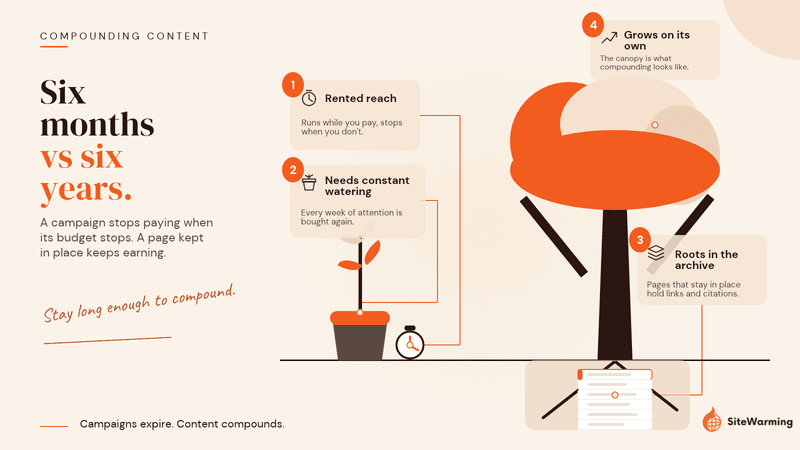
Six years of content beats six months of marketing because content compounds and campaigns expire. Ahrefs found the average page ranking #1 on Google is five years old, and only 1.74% of newly published pages reach the top 10 within a year. A campaign stops paying when its budget stops; a page kept in place keeps earning.
That is the whole argument. The rest of this piece is why it holds, how long it takes, and what it means if you are sitting on a domain you haven't built yet.
I've been watching one domain prove this for four years. Not one of mine. Someone else's.
They rank for nearly every question in their niche now. Their early posts weren't even good. But they stayed. And that's the part that matters.
The internet isn't getting more democratic for new content. The most defensible position on the internet isn't the best content. It's the stuff that was there first and never left.
How old are the pages that rank first on Google?
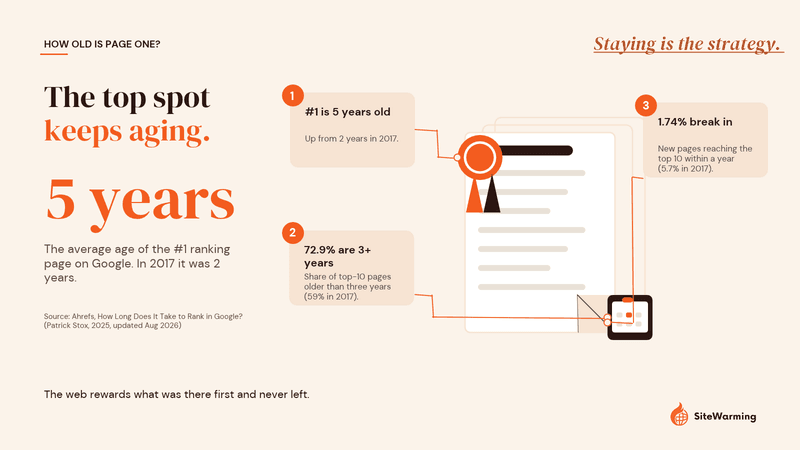
Older than most people expect, and getting older. In its 2025 study of top-ranking pages (updated in August 2026), Ahrefs found the average #1 result is five years old; in 2017 it was two (Ahrefs, Patrick Stox, 2025, updated 2026).
| What Ahrefs measured | 2017 | 2025 study (updated 2026) |
|---|---|---|
| Average age of the #1 ranking page | 2 years | 5 years |
| Share of top-10 pages more than 3 years old | 59% | 72.9% |
| Share of new pages that reach the top 10 within a year | 5.7% | 1.74% |
Source: Ahrefs: How Long Does It Take to Rank in Google?
Why do older pages rank higher? Not because age is a ranking factor on its own. A page that has been in place for five years has had five years to collect links, be cited, answer follow-up questions and prove it isn't going anywhere. A new page starts with none of that, which is why the early months of a new domain feel like the sandbox period new domains sit through.
What is compounding content?
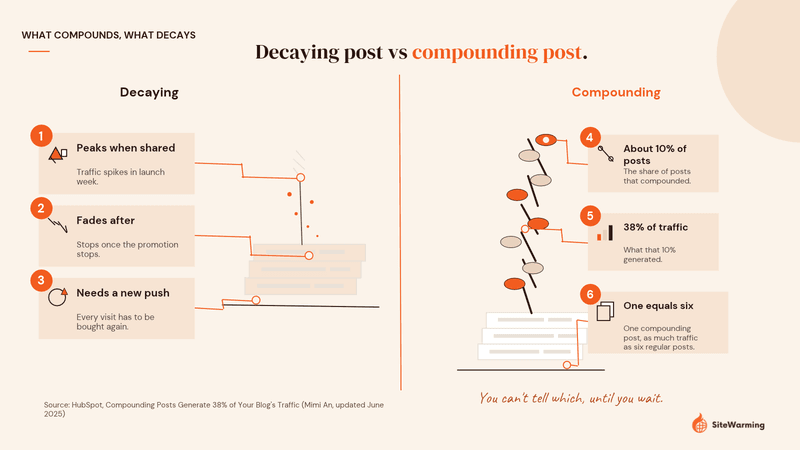
Compounding content is a page whose traffic grows over time without being promoted again, because search engines and readers keep finding it long after it is published. Its opposite, decaying content, peaks in the week it is shared and fades once the promotion stops.
HubSpot put numbers on the difference. Compounding posts made up about 10% of the posts it analysed but generated 38% of total blog traffic, and one compounding post brought in as much traffic as six regular posts (HubSpot, Mimi An, updated 2025). Its wider analysis of nearly 20,000 customer blog posts found the same pattern (HubSpot).
What you can't tell at publication is which pages will compound. That is the point. You only find out by leaving them in place long enough to see.
How long does content take to start working?
Longer than a campaign calendar allows, and the early months look like nothing. Google's own guidance on hiring an SEO put it plainly: "in most cases, SEOs need four months to a year to help your business first implement improvements and then see potential benefit" (Maile Ohye, Google, reported by Search Engine Roundtable, 2017). Compounding takes longer than "potential benefit".
| Stage | What you see | What is happening underneath |
|---|---|---|
| Month 6 | Content published. Pages indexed, maybe. Visibility numbers look flat. | Search engines are learning what the site is about and whether it stays. |
| Year 1 | More material. The domain looks like something rather than nothing. | A few pages start earning impressions for narrow questions. |
| Years 2–3 | A tide change, not a switch. Older pages start outperforming newer ones. | Links, citations and repeat visits accumulate on the pages that stayed. |
| Year 6 | You are the default answer in your space. | Newcomers need years to catch up, and most quit at month six. |
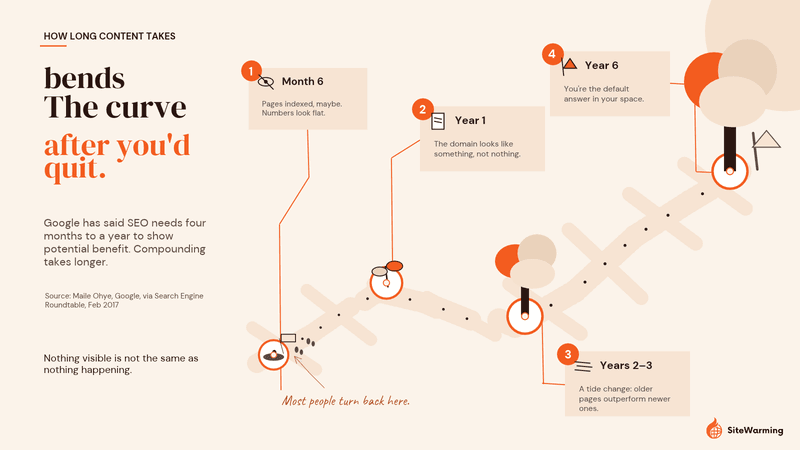
Nothing visible happens at month six. That is not failure; it is the part of the curve before it bends.
Here is the part that matters for the person at month six: the work you publish now is the work that compounds later. Stop at month six and you keep the cost and forfeit the curve.
Why does a campaign stop paying the day it stops?
Because paid reach is rented. An ad runs while the budget runs; when the budget ends, so do the impressions. Content you keep in place is owned: content isn't marketing that expires, and it keeps answering questions after you have moved on.
| Six months of marketing | Six years of content | |
|---|---|---|
| What you pay for | Reach, for as long as you pay | Pages, once, plus upkeep |
| What happens when you stop | Traffic stops with the budget | Pages keep being found |
| What you own at the end | Reports and a spend total | A body of work that ranks and gets cited |
| Who it rewards | Whoever outspends | Whoever stayed |
| Best used for | Launches, offers, time-bound news | Being the answer in a space |
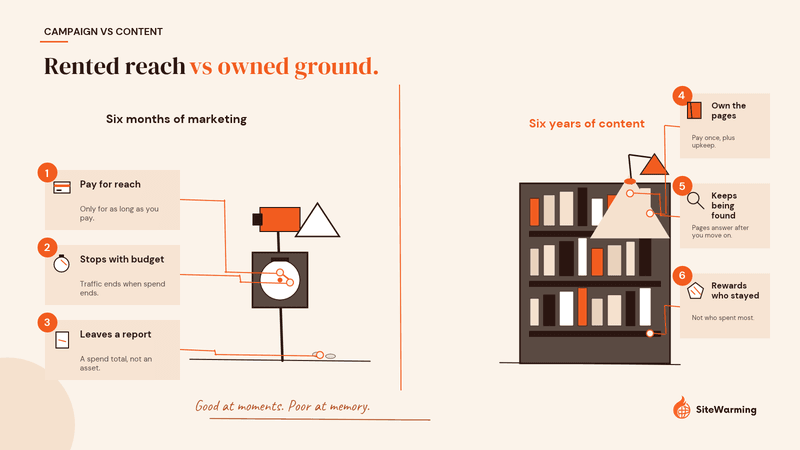
This is not an argument against marketing. Campaigns are good at moments. They are poor at memory, and memory is what the internet rewards over years. It is also what AI systems draw on: articles are what AI systems cite, and they cite what is still there.
What is the patience premium?
There is a concept in financial markets called the illiquidity premium: investors who hold assets they can't easily sell, such as private equity, real estate or long-dated instruments, are paid extra for tying their money up. BNP Paribas Asset Management found US private equity buyouts, including management fees, outperformed the S&P 500 by 2.3% to 3.4% a year between 1986 and 2017 (BNP Paribas AM, 2023).
The premium exists because most investors demand liquidity. They want out whenever they choose, and they give up return for that option. The few willing to wait are paid for waiting.
The patience premium is the compounding authority a domain earns by maintaining consistent presence in a market others have abandoned or ignored. It rewards people who stay where others leave.
Most domain owners abandon their content within months. Most niche sites go quiet after year one, usually around the time the renewal email arrives and the owner asks whether any of this is worth it. Meanwhile 72.9% of the pages in Google's top 10 are more than three years old (Ahrefs).
Think about it. Time is the one input you can't buy, borrow or hack. If the compounding mechanism doesn't kick in until year two or three, anyone who stays past month six has an advantage no competitor can replicate quickly, however big their budget.
Why do the markets nobody wants reward whoever stays?
Because on the internet almost everything gets found eventually, and in a quiet market there is nobody else to find.
Chris Anderson documented this in his Long Tail research, the observation that online, demand spreads across a huge number of niche items rather than concentrating on a few hits. Ecast, a digital-jukebox company, told him that 98% of the 10,000 albums on its jukeboxes sold at least one track every quarter (Chris Anderson, The Long Tail, Market Leader, 2006). Physical retail works the other way: in 2004, Wal-Mart had to sell at least 100,000 copies of a CD to cover its retail overhead, and less than 1% of CDs did that kind of volume (Chris Anderson, Wired, October 2004).
Think about it in tiers. First-tier markets are where everyone fights: big audiences, obvious demand, venture-backed competitors with real budgets. Second-tier markets are where smart operators go, adjacent spaces with real demand and less noise. Third-tier? Nobody bothers. If you want the full framework for claiming one, see how to build authority in a tier-3 market.
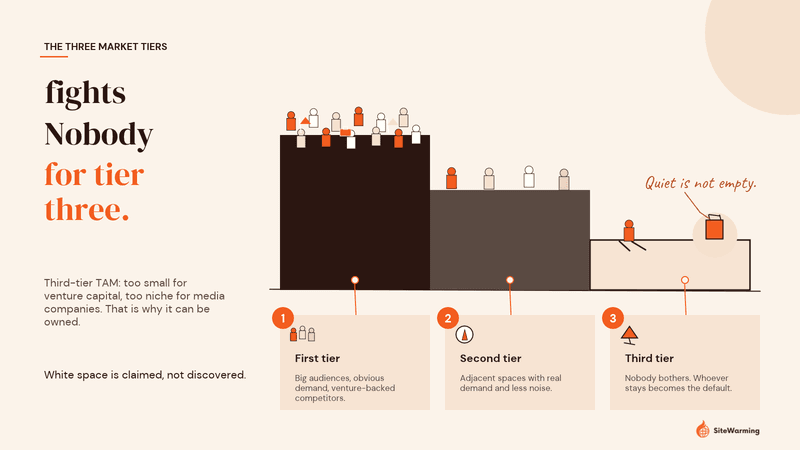
White space isn't discovered by luck. It's claimed by the patterns you establish before others do.
What if your market is tiny?
Here's where the Builder reading this usually pushes back: the market is too small to matter.
Third-tier TAM is the smallest addressable market layer, too small for venture capital, too niche for media companies. That is exactly why it can be owned.
Kevin Kelly proposed a useful frame for this in 2008. A creator needs only 1,000 true fans, people who will buy anything you make, to sustain a living: "If you keep the full $100 of each true fan, then you need only 1,000 of them to earn $100,000 per year" (Kevin Kelly, 1,000 True Fans, 2008). We go deeper on what 1,000 true fans means for a small audience in a separate piece.
Anderson and Kelly are saying the same thing from different angles. The internet makes small markets reachable, and small markets are enough.
A domain in a third-tier market with three years of consistent content isn't competing with anyone. It is accumulating citations, links and trust in a space where nobody else is trying. Those signals compound.
The value appreciation happens in the background. It doesn't look like a hockey stick. It looks like trust building so slowly you almost can't see it, which is how you make a domain appreciate over time.
And when the patience premium actually produces an audience? Long-tail audiences become infrastructure.
What should a dormant domain publish first so it compounds?
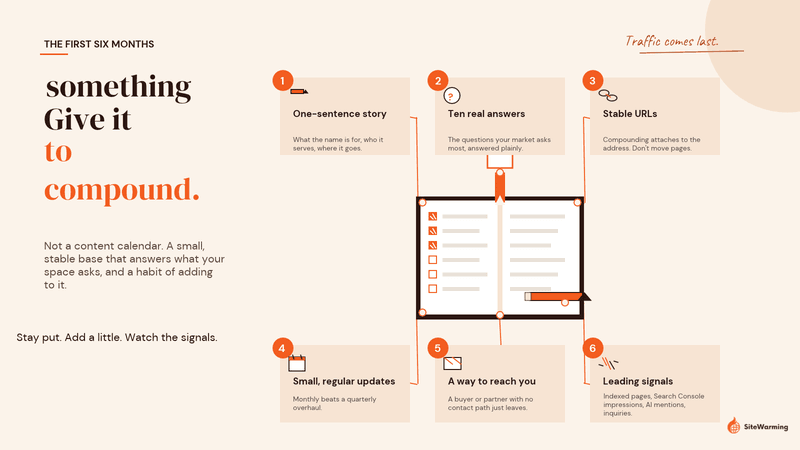
Not a content calendar. A small, stable base that answers the questions your space actually asks, and a habit of adding to it. For a domain you haven't built yet:
- Write the one-sentence story. What the name is for, who it serves and where it could go. Every page after this hangs off that sentence.
- Answer the ten questions your market asks most. One clear answer each, in plain language. These are the pages most likely to compound, because the questions don't change.
- Keep every URL where it is. Compounding attaches to the address. Moving or deleting pages resets the clock.
- Add something small on a schedule. A monthly update beats a quarterly overhaul; small, regular updates are what tell search engines and readers the site is alive.
- Give people a way to reach you. A buyer, partner or collaborator who finds you and has no contact path just leaves.
- Watch the leading signals, not the traffic. In the first year, look for pages indexed, impressions in Google Search Console, first mentions in AI answers and the first inquiry. Traffic comes last.
What stops content from compounding?
Most content that fails to compound was stopped, not beaten. The usual causes:
- Judging it at month six. The curve hasn't bent yet.
- Deleting or moving pages at renewal time. Every move throws away the links and history the page had earned.
- Pivoting the topic every year. Authority attaches to a subject; a new subject starts from zero.
- Monetizing before trust exists. Ads and aggressive offers on a thin site teach visitors and search engines the wrong thing, see why monetizing too early backfires.
- Letting the domain lapse. Nothing compounds on a name you no longer own.
Why is this stewardship, not marketing?
Marketing campaigns have end dates. Stewardship doesn't.
The difference between "I'm marketing to this audience" and "I'm serving this space" is the difference between six months and six years. It is the same difference we draw between speculation and stewardship in how people hold domains.
The Builder reading this has probably been sitting on a domain for a market that feels too small to take seriously. I get it. Three years of quiet is a long time to hold a conviction.
But patience isn't the strategy. Patience is what happens when you've chosen the right space and decided to serve it instead of extract from it. You're not waiting for something to happen. You're building the thing that makes it happen.
The question isn't "Can I afford to wait six years?" It's "Can I afford to be the one who left at month six?" Because the campaign ends. The content stays.
How does SiteWarming help a domain start compounding before you build it?
Compounding needs two things: knowing which names deserve six years, and putting something real on them in the meantime. SiteWarming does both.
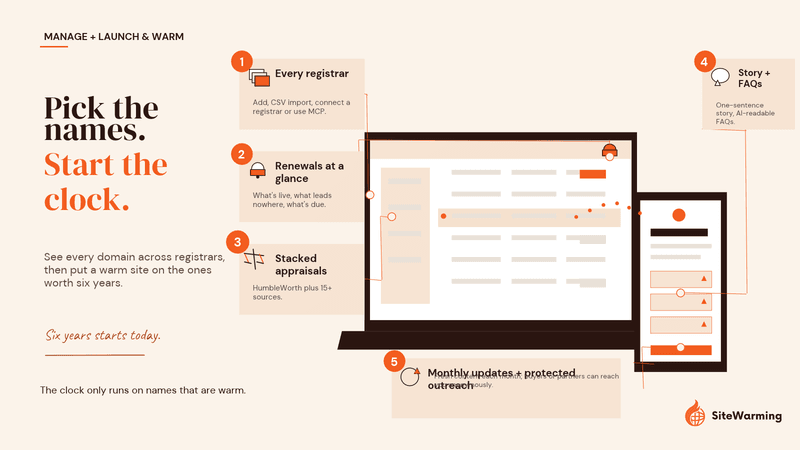
- See the whole portfolio first. Our domain portfolio management tool brings every registrar into one place, by single add, CSV import, registrar connection or the MCP server, and shows what's live, what leads nowhere and what's approaching renewal. It auto-fetches a value with HumbleWorth and lets you stack appraisals from 15+ sources, so you can decide which names are worth keeping and whether it is worth renewing the rest.
- Start the clock on the names worth keeping. Launch & Warm puts a warm site on a dormant domain: pick an intent (Future Build, Open but not listed, or Actively Selling), write the one-sentence story, and it adds structured story data, AI-readable FAQs, DNS, HTTPS, hosting, ongoing DNS and SSL checks, and monthly content updates. Protected outreach lets a would-be buyer or partner reach you anonymously, so the option can be exercised when it arrives.
SiteWarming exists because most ideas never get the chance to compound. Domains sit dark while the vision behind them fades. What is SiteWarming?
The most valuable thing about a domain isn't what's on it today. It's what has been accumulating on it.
The internet remembers consistency longer than it remembers brilliance.
Sometimes I think about that domain I've been watching. They're the default now. Not because they're the best. Because they're the only one who stayed.
If you're sitting on a domain in a market that feels too small, too quiet, too niche for anyone to care about, that's not a disadvantage.
You're not crazy. You're early.
Frequently asked questions
What is compounding content? Compounding content is a page whose organic traffic keeps growing after publication without new promotion, because search engines and readers keep finding it. In HubSpot's analysis, compounding posts were about 10% of posts but produced 38% of blog traffic, and one compounding post matched the traffic of six regular posts. Decaying content, by contrast, peaks when shared and fades once promotion stops.
How long does it take for content marketing to work? Expect months before anything shows and two to three years before compounding is obvious. Google's Maile Ohye said SEOs typically need four months to a year to implement improvements and see potential benefit. Ahrefs found only 1.74% of newly published pages reach Google's top 10 within a year, and the average #1 result is five years old.
Why do older pages rank higher on Google? Age alone is not the reason. Older pages have had years to collect links, citations, and evidence that they are maintained and stay put. That accumulation is hard for a new page to match quickly. Ahrefs' 2025 study found 72.9% of pages in Google's top 10 are more than three years old, up from 59% in 2017.
Is content marketing better than paid advertising? They do different jobs. Paid advertising buys reach for as long as you pay and stops when the budget stops, which suits launches, offers and time-bound news. Content you keep in place is owned and keeps being found for years, which suits becoming the answer in a space. For a dormant domain with no launch date, content is the one that builds value.
Is it worth creating content for a very small niche? Often, yes, because nobody else is. Kevin Kelly's "1,000 True Fans" argues that 1,000 people paying $100 a year is a $100,000 living, and Chris Anderson's Long Tail research found 98% of 10,000 jukebox albums sold at least one track a quarter. A small, underserved market rewards whoever stays consistently present.
What is the patience premium? The patience premium is the compounding authority a domain earns by staying consistently present in a market others have abandoned or ignored. It borrows from the illiquidity premium in finance, where investors willing to lock up capital are paid extra; BNP Paribas found US buyouts beat the S&P 500 by 2.3% to 3.4% a year from 1986 to 2017.
Can SiteWarming help content compound on a domain I haven't built yet? Yes. The domain portfolio management tool shows every name across registrars, with renewals and stacked appraisals, so you can choose which names deserve years of presence. Launch & Warm then puts a warm site on those names with a one-sentence story, structured data, AI-readable FAQs, monthly content updates and protected outreach, so the clock starts before you build.
Share this article
Ready to Transform Your Domain Portfolio?
Start building real value with your domain investments today.