Do Blogs Still Help SEO in 2026? (Yes, Here's Why)
 Bret Siers
Yes, blogs still help SEO in 2026, but their job has changed. AI systems like ChatGPT and Google's AI Overviews don't generate answers from nothing; they retrieve and cite existing web content through a process called RAG (Retrieval-Augmented Generation). Long-form articles are what gets retrieved. Thin pages and homepages rarely do.
Honestly, I hear a version of this constantly now, usually from founders who are tired. "Why should I spend ten hours writing a deep article when ChatGPT can generate the answer in ten seconds?" It's a reasonable question, and a real one. If the interface is a summary, it's easy to assume the work is just producing summaries too, that you're building a library in a world that only wants bullet points.
But there's a logical flaw in that anxiety. ChatGPT isn't magic. It doesn't pull answers from the ether, it pulls them from somewhere. When you ask an AI a question, it doesn't "know" the answer the way a person knows something. It retrieves material, then composes an answer from what it finds. The internet is the reference shelf.
That's the reality check that should recalibrate your mental model: in an Ahrefs analysis of ChatGPT's top 1,000 citations, Wikipedia alone accounted for 29.7% of them, more than any other single source, with homepages and landing pages a distant second at 23.8% (Ahrefs, 2025). That's not a trivia fact. It's a map of what the system trusts: comprehensive, structured, written explanations still sit closest to "primary source" on the open web, ahead of homepages by a wide margin. So no, AI isn't replacing articles. It's elevating them into infrastructure. The question was never whether you should write. It's whether what you write is good enough to be retrieved and cited.
Does AI Replace Articles, or Just Cite Them?
To understand why articles still matter, you have to understand what's happening upstream of the answer. A useful simplification is RAG: Retrieval-Augmented Generation, the process most AI answer engines (ChatGPT, Google's AI Overviews, Perplexity) use to ground their answers in real content instead of generating purely from memory. Think of it like an open-book test. The AI is the student. The internet is the textbook. If the textbook is blank, the student fails. Your articles are the textbook.
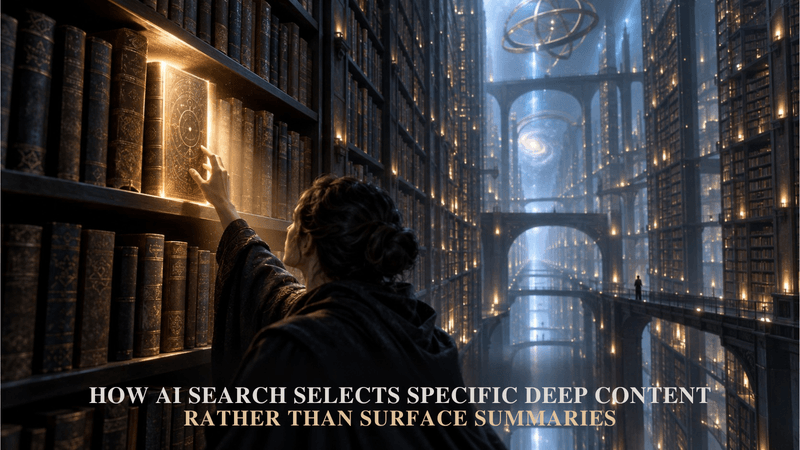
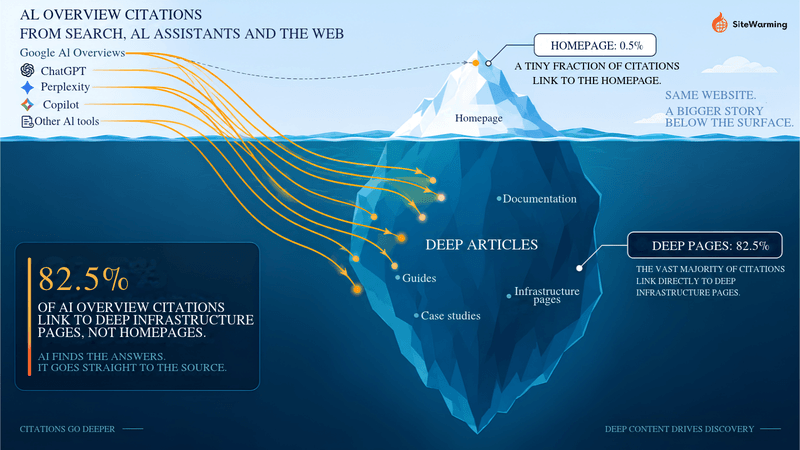
And the systems have preferences about what they cite. They tend to bypass vague brand pages and reach for specific, deep explanations. One of the clearest signals: in a BrightEdge analysis of Google AI Overview citations, 82.5% linked to deep content pages, pages two or more clicks from the homepage, while only 0.5% linked to homepages directly (BrightEdge, via Search Engine Land).
That's a critical distinction for founders. Your homepage is your handshake. It tells people who you are. Your articles are your brain. They tell systems what you know. If you stop writing deep content, you're not "pausing marketing." You're removing your brain from the index.
This is also why the "two audiences" framing matters: humans read for meaning and conviction, machines read for extraction and confidence. We've written a full breakdown of what that means for how you structure a page: the internet now has two audiences.
How Many Searches Now Show an AI Answer Instead of Blue Links?
This isn't a "someday" shift. It's already the default experience. As of Advanced Web Ranking's November 2025 dataset (an 8,000-keyword sample), Google AI Overviews, the AI-generated summary Google now shows above traditional search results for many queries, now appear in 60.32% of U.S. queries, a figure that has roughly doubled since August 2024 (Advanced Web Ranking).
So the majority of the time someone searches a concept in your space, an AI layer mediates what they see first. That doesn't mean nobody clicks anymore. It means the path has changed:
- The summary answers the basic version of the question.
- Citations become the credibility layer.
- Clicks are reserved for depth, edge cases, and decisions.
Which leads to a blunt consequence: if you don't have source material, you don't exist inside the summary.
I've watched this pattern repeat across dozens of dormant domains: the domain sits dark while the owner waits for "the right time" to write. That silence has a real cost: a parked domain isn't just quiet, it's often invisible to the AI systems doing the retrieving in the first place. Warming, writing the first honest, structured page about what a domain is for, is choosing to make an idea legible before you feel ready. Quietly. On purpose. In an AI-mediated web, that legibility starts as written pages that can be retrieved and cited: the bones before the body. That's the same idea behind what is SiteWarming, and it's what Launch & Warm deploys automatically the moment a domain goes live.
What Makes an Article Citable by AI?
A lot of people hear "AI citations" and assume the answer is "write longer." Here's the thing: length helps sometimes, but only as a proxy for what machines and humans actually want, coverage, structure, and clarity.
One data point is worth knowing here: Backlinko and HubSpot's analysis of 912 million blog posts found that content over 3,000 words earns 77.2% more referring-domain links than content under 1,000 words (Backlinko/HubSpot, 2019): a 2019 dataset, so treat it as directional rather than current. Beyond that one figure, be skeptical of any specific "ideal word count" range you see quoted elsewhere: we checked, and couldn't find a consistent number across sources worth repeating as fact. The same caution applies to FAQ schema: marking up your questions and answers plausibly helps AI systems extract them cleanly, but we couldn't confirm a specific multiplier for how much it moves AI Overview appearance, so we're not going to hand you a number we can't stand behind.
The point isn't "hit 2,000 words." The point is: answers that are complete enough to be referenced tend to attract links, and structure that's easy to parse tends to get extracted.
How to Make Your Content More Citable
- Answer the question in the first 60 words: in plain language, before any anecdote.
- Name your key entities on first use (define acronyms, name tools, name studies).
- Attribute every statistic to a named, dated source: no orphaned numbers.
- Use FAQ schema on pages that answer more than one distinct question.
- Break up prose with at least one table or numbered list per major section.
- Put a visible "last updated" date on anything citing a moving statistic.
Common Mistakes That Make Content Un-Citable
- Chasing a word count instead of a coverage target: padding, not substance, is what gets skipped.
- Stating a statistic with no source, so neither a reader nor an AI system can verify it.
- Writing headlines and headers that are clever but don't contain the words someone actually searches.
- Publishing once and never revisiting a page whose core numbers are time-sensitive.
- Skipping structured data (FAQ, Article schema) on pages that are answering real questions.
The Numbers Behind This
| Claim | Verified figure | Source |
|---|---|---|
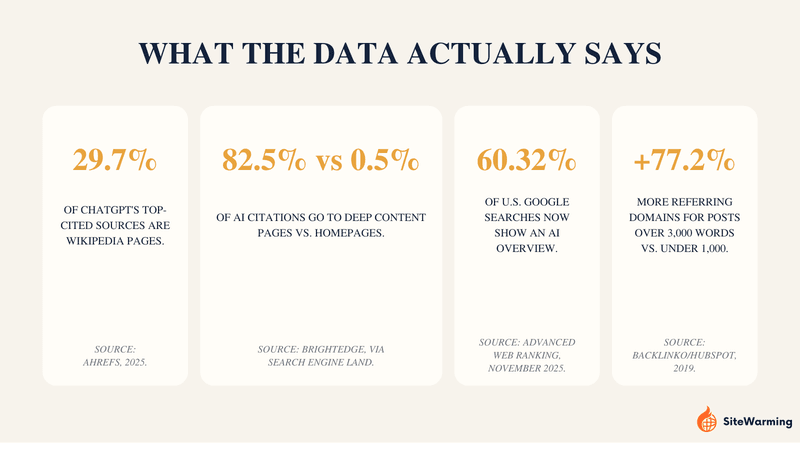
| Wikipedia's share of ChatGPT's top citations | 29.7% (largest single source) | Ahrefs, 2025 |
| AI Overview citations linking to deep pages vs. homepages | 82.5% deep pages / 0.5% homepages | BrightEdge, via Search Engine Land |
| U.S. queries now showing a Google AI Overview | 60.32% | Advanced Web Ranking, Nov 2025 |
| Backlink advantage of 3,000+ word posts vs. under 1,000 words | +77.2% referring domains | Backlinko/HubSpot, 2019 |
Why Treat Articles as Infrastructure, Not Marketing?
Stop treating articles like a promotional chore. Treat them like knowledge infrastructure. You're building the library the internet will consult when someone asks a question in your category: not next week, over years.
This is, in plain terms, what answer engine optimisation (AEO) and generative engine optimisation (GEO) actually are: not new tricks, but the discipline of writing so that both a person and a machine can extract, trust, and repeat what you said. The world doesn't need more 500-word hot takes. It needs primary sources: deep, structured explanations of how things work, written in a way that can be retrieved, cited, and trusted.
AI isn't replacing articles. It's creating demand for better ones. If you're sitting on domains that have never had a real page written on them, that gap is the actual cost of waiting: see plans.
And the question at the end of all of this is simple: are you building something worth citing, or something that disappears after the scroll?
Frequently asked questions
Do blogs still help SEO in 2026? Yes. AI search and traditional search both depend on retrieving existing written content: AI Overviews appear in 60.32% of U.S. queries (Advanced Web Ranking, Nov 2025), and every one of those overviews still has to cite something. A blog is what gets cited.
Do AI tools like ChatGPT cite blog articles? Yes, when the writing is specific and well-structured. AI answer engines favor deep, individual pages over homepages: 82.5% of Google AI Overview citations link to deep content pages, versus 0.5% to homepages (BrightEdge, via Search Engine Land).
What is RAG (Retrieval-Augmented Generation)? RAG is the process most AI answer engines use to ground their responses in real content instead of generating purely from training data. The AI retrieves relevant pages from the web, then composes an answer from what it finds, like an open-book exam where the internet is the textbook.
How long should a blog post be to get cited by AI? There's no confirmed minimum. What's verified: content over 3,000 words earns 77.2% more referring-domain links than content under 1,000 words (Backlinko/HubSpot, 2019). Length helps as a proxy for coverage, not as a target on its own.
Does FAQ schema help a page appear in AI Overviews? FAQ schema (FAQPage structured data) makes a page's questions and answers machine-readable, which generally aids answer-engine extraction. We could not verify a specific multiplier for AI Overview appearance, treat any exact figure here with caution until a named study confirms it.
Is content marketing dead because of AI? No, its function changed. AI systems retrieve and cite existing content rather than inventing answers from nothing, so a domain or brand with no written material has nothing for those systems to find or cite. Content is now closer to infrastructure than promotion.
Share this article
Ready to Transform Your Domain Portfolio?
Start building real value with your domain investments today.