How to Optimize Domains for Both Google and AI Search
 Bret Siers
AI search optimization means structuring a page so both people and machines, Google, ChatGPT, Perplexity, can read it accurately. The fastest way is adding structured data (JSON-LD schema) that labels your headings, author, dates and answers explicitly, so discovery systems can extract and cite your content instead of guessing at it.
You wrote something good. You published it. The humans who find it understand it perfectly.
But increasingly, the humans who find it aren't finding it themselves. A system is finding it for them, summarizing it, and handing them an answer. Sometimes it cites you. Often it doesn't.
For twenty years, we built the web for human eyes. We worried about font sizes, headline punchiness, and whether the first paragraph had enough pull. We assumed that if a human understood it, discovery systems would catch up eventually.
That assumption is less reliable now.
Your content is already being consumed by systems you can't control. The question isn't whether they're reading your site. The question is whether they can tell what they're looking at.
What changed in 2025?
Cloudflare has been unusually direct about how messy this has gotten. In August 2025, it publicly documented what it described as stealth crawling behavior attributed to Perplexity, including claims of user-agent spoofing, IP rotation, and ignoring robots.txt directives entirely (Cloudflare, August 2025, widely reported including by Search Engine Journal).
You don't have to take a side in that fight to learn the lesson.
Machine readers are here. And they are literal.
What's different about how AI systems read your page?
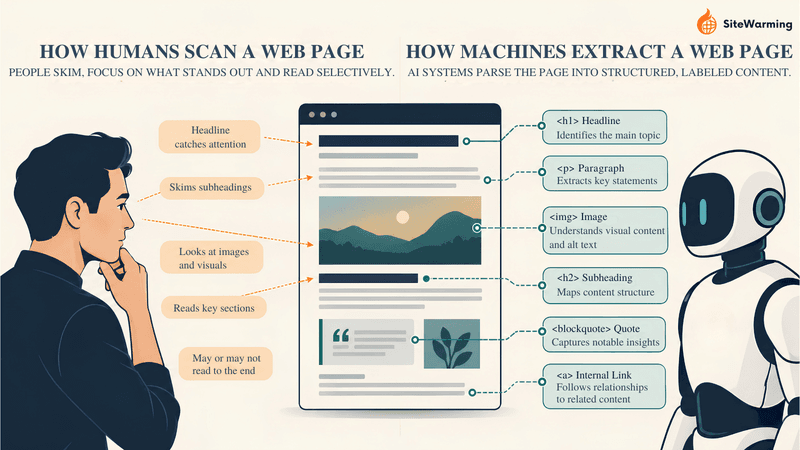
Humans are forgiving readers.
We scan big text first. We infer meaning from layout and images. We fill gaps. We can tell what matters, even when the page is a little messy.
Machines don't scan. They parse.
To a crawler or an LLM retrieval system, a beautiful page with weak structure can look like a wall of undifferentiated text. The machine has to guess what is a headline, what is an author, what is a product, what is a date, what is the actual answer.
And machines aren't trying to be impressed. They're trying to be certain.
Structure is how you reduce their uncertainty about what the page is.
OpenAI documents this directly: it runs several distinct crawlers and user agents for different jobs, GPTBot for training data, OAI-SearchBot for search-result inclusion, OAI-AdsBot for ad-safety checks, and a site owner can allow or block each one separately through robots.txt (OpenAI, developers.openai.com/api/docs/bots).
Different purposes, same requirement: clarity they can extract.
If you have two similar articles and one is formatted like a flat block of text while the other has clear headings, explicit metadata, and machine-readable labels, the second one is easier to interpret. The first one is a puzzle. The second one is a map.
A page can be clear to a human and still be invisible to a machine.
Signals are an asset. Structure is how you make the signal legible. I wrote more about the signal itself, why quality beats quantity in a domain portfolio, in Signals Are the Asset, Volume Is a Vanity Metric. That piece is about what makes a signal worth sending. This one is about whether anything can read the signal you've already got.
What is structured data, and why do people call it "schema"?
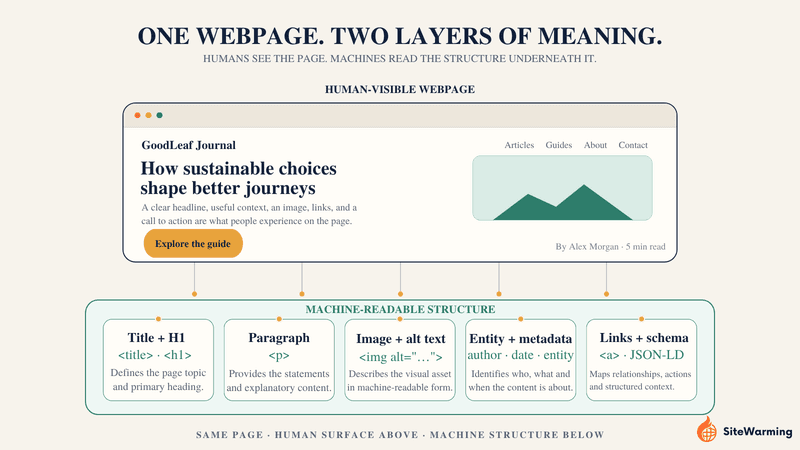
The technical term for this translation layer is "structured data" or "schema." It sounds like an advanced tactic until you translate it into plain language: it's digital subtitles. It's a small, machine-readable explanation of what the page means.
- This string is the author.
- This number is the price.
- This section is the FAQ answer.
- This page is a product. This other page is an article.
This isn't fringe. The most recent Web Data Commons crawl of the web (October 2024) found structured data live on more than 16.5 million pay-level domains, encoded in nearly 74 billion triples across the web's microdata, RDFa, JSON-LD, and microformat markup (Web Data Commons, October 2024 Structured Data Extraction Report). That's not a niche technique reserved for big tech, it's the baseline a large share of the web's better-resourced sites has already adopted.
That scale matters because it quietly changes the baseline. Machines are being trained on a web where a lot of meaning is explicitly labeled. If your domain is unlabeled, you're asking systems to guess.
Google's guidance is blunt about the easiest path. It recommends JSON-LD for structured data whenever a site's setup allows it, because it's the easiest format for website owners to implement and maintain at scale (Google Search Central, Introduction to structured data).
The founder takeaway isn't "go build a perfect schema layer."
It's simpler: stop shipping ambiguity. Make the page's identity explicit.
How do you actually add structured data to a page?
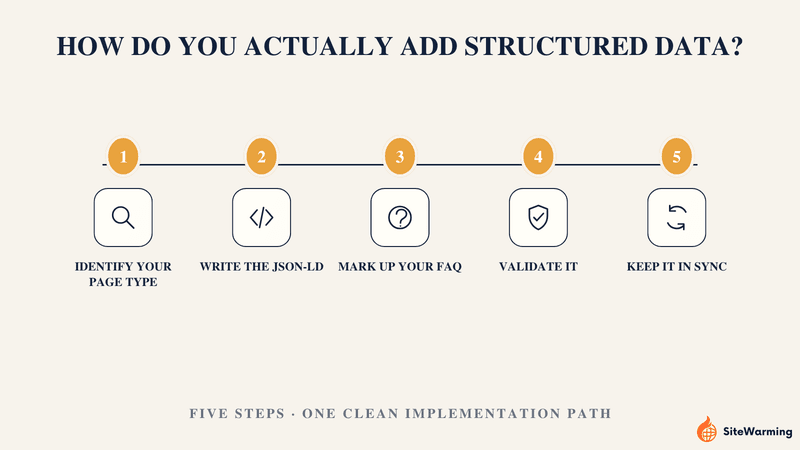
In practice, it's five steps:
- Identify the page's type. Article, Product, FAQ, Organization and dozens more are all defined at schema.org, pick the one that actually matches the page.
- Write the JSON-LD block. Add a
<script type="application/ld+json">element to the page's<head>describing that type, filling in the fields discovery systems actually look for, headline, author, datePublished, description. A minimal example for an article looks like this:
{
  "@context": "https://schema.org",
  "@type": "Article",
  "headline": "Your page's headline",
  "author": { "@type": "Person", "name": "Your name" },
  "datePublished": "2026-09-17"
}
- Mark up any real FAQ as FAQPage schema. That's the format most often pulled directly into AI Overviews and voice answers.
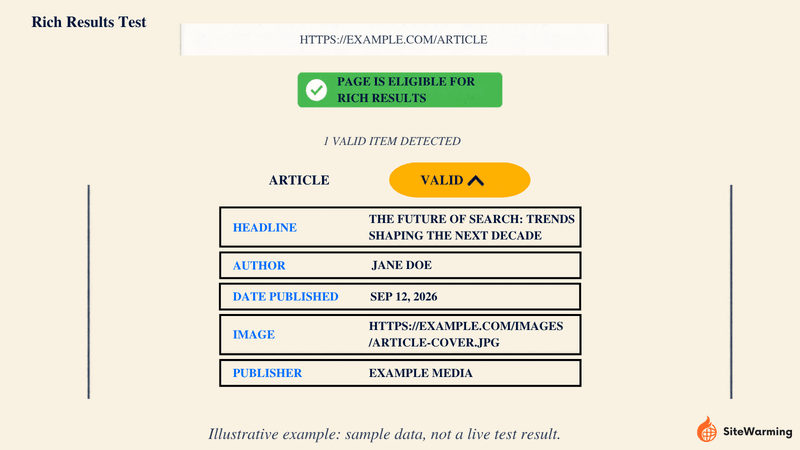
- Validate before you publish. Google's Rich Results Test and the Schema Markup Validator at validator.schema.org will both tell you if the JSON-LD is malformed. An invalid block is worse than no block, it can simply be ignored.
- Keep the markup in sync with the visible page. Google's structured data guidelines are explicit: markup has to be a true representation of the page content, and content described in schema that isn't actually visible to readers can lose rich-result eligibility entirely (Google Search Central, Structured data general guidelines). Schema is a description of what's already there, not a place to hide keywords.
The older discovery path looked like this:
- Someone searches
- They click a link
- They land on your page
- Your page either holds them or it doesn't
That model still exists. But a second model now sits beside it:
- Someone asks a system a question
- The system synthesizes an answer
- The system may cite sources
- The person may never click at all
People call the discipline of winning that second path "Answer Engine Optimization (AEO)." I don't love the acronym because it implies a new bag of tricks. Its cousin, "Generative Engine Optimization (GEO)," gets used almost interchangeably: GEO usually refers specifically to being quoted accurately inside a generative AI response, while AEO covers the broader goal of being chosen as the direct answer, snippet or voice response.
Here's the honest version of how the three relate:
| SEO | AEO | GEO | |
|---|---|---|---|
| Goal | Rank in search results | Get chosen as the direct answer | Get cited or quoted inside an AI-generated response |
| What you optimize | Keywords, backlinks, page experience | Definitional clarity, structured data, snippet-friendly formatting | Quotable, sourced, self-contained claims an LLM can lift |
| Where it shows up | Google/Bing results pages | Featured snippets, voice answers, "People also ask" | ChatGPT, Perplexity, Google AI Overviews, AI Mode |
In practice these overlap more than they compete. The same clearly-labeled, well-structured page tends to win at all three, which is really the whole argument of this piece.
It's not a trick. It's being the clearest source of truth in the room.
And clarity, at machine speed, is mostly a packaging problem:
- Can the system identify what your page is?
- Can it extract the relevant part without misreading it?
- Can it attribute it cleanly?
This is where structured data becomes more than a "search thing." It becomes a legibility layer for machine-mediated discovery.
Google says structured data helps it understand the content on a page and can surface that content in a richer appearance in search results, called a rich result (Google Search Central, Structured data search gallery).
Those rich results can look cosmetic. They're not. They are a proof point that the system can reliably interpret your page.
Interpretability is a signal.
We pulled this thread further, for the most extreme case, in Why ChatGPT and AI Tools Can't See Parked Domains: a parked domain with zero content and zero structure is the floor, total invisibility to AI by default. This article is the general rule that applies to every page you've actually built, not just the empty ones.
Do you need special SEO for AI Overviews or AI Mode?
The predictable response to this shift is panic buying: new tools, new dashboards, new promises that you can "optimize for AI."
You generally don't need them.
Google states plainly that there are no additional requirements to appear in AI Overviews or AI Mode, and no special optimizations necessary (Google Search Central, AI features in Search). The guidance is essentially: keep following fundamental best practices.
So the gap isn't between "human visibility" and "AI visibility."
The gap is between structured and unstructured. Between pages that hold still long enough to be interpreted and pages that require a mind to infer their meaning.
If you are already doing good work and you make it legible, you're ahead of most of the internet's noise. Not because you gamed anything. Because you made the idea readable.
How does this apply if you're sitting on an unbuilt domain?
We've lived the loop: buy the domain in clarity, then renew it while the idea stays dark. Warming is choosing to make an idea legible before you feel ready. Quietly. On purpose. Discovery systems learn from repeated observation, and empty space becomes a durable signal. Warming turns ownership into presence early. If you haven't read the foundational piece on this, start with What is SiteWarming?
This is also, mechanically, what Launch & Warm does for you: when you warm a domain, it auto-generates the structured data, FAQs, and schema this article is describing, and deploys it along with DNS and SSL, see how Launch & Warm applies this automatically. You don't have to hand-write JSON-LD for every domain sitting in your portfolio.
What happens if your page has no structure?
The consequences are quiet, then compounding.
Your site won't look broken. It will just fail to appear in the moments that matter, when someone asks a system to summarize the category you're in.
When a potential partner asks for the best explanations in your niche, your name won't show up. Not because you weren't smart, but because your work wasn't extractable with confidence.
When a customer compares options, a system may cite your competitor's pricing page, not because their product is better, but because their page is clearly labeled in ways machines can interpret as an offer. Yours might be obvious to a human and still ambiguous to a parser.
This is what stewardship looks like in practice. Related: From Ownership to Stewardship, on managing a whole portfolio this way rather than one domain at a time.
You don't need to become an engineer. You don't need new rituals.
You need to speak clearly enough that both audiences can hear you.
Both audiences matter now.
Frequently asked questions
What is AI search optimization (AEO)? Answer engine optimization (AEO) is structuring and labeling a page so an AI system, Google AI Overviews, ChatGPT, Perplexity, can extract a direct answer and attribute it correctly, rather than piecing meaning together from an unstructured page.
Do I need special SEO for AI Overviews or AI Mode? No. Google states there are no additional requirements to appear in AI Overviews or AI Mode, and no special optimizations necessary beyond following its normal search guidelines (Google Search Central, AI features in Search). The advantage goes to pages that are already well-structured, not to pages using new "AI SEO" tactics.
What is structured data (schema markup)? Structured data is a machine-readable label, usually written as JSON-LD, that explicitly tells a crawler or AI system what a piece of content is: this is the author, this is the price, this is the FAQ answer, this page is an article. Google recommends JSON-LD specifically because it's the easiest format for site owners to implement and maintain (Google Search Central, Introduction to structured data).
Can ChatGPT or Perplexity read my website without schema markup? Usually, yes, in the sense that they can crawl and parse the visible text, but without structured data, a system has to infer what's a headline, an author, a date, or an answer, the same way a human skimming a messy page does. Structured data removes that guesswork, which is why the same content, structured explicitly, is easier for a system to cite with confidence.
How do I add structured data to my page? Identify the page's type (Article, FAQ, Product, Organization), add a <script type="application/ld+json"> block in the page head with that type's fields filled in, validate it with Google's Rich Results Test or validator.schema.org before publishing, and keep the markup in sync with what's actually visible on the page, mismatched schema is treated as a spam signal, not a shortcut (Google Search Central, Structured data general guidelines).
What's the difference between SEO, AEO, and GEO? SEO optimizes a page to rank in search results; AEO optimizes it to be chosen as the direct answer (a featured snippet, a voice answer); GEO optimizes it to be quoted accurately inside a generative AI response. In practice, the same well-structured, clearly-labeled page tends to win at all three; they're not competing strategies, they're the same discipline pointed at three different discovery surfaces.
Share this article
Ready to Transform Your Domain Portfolio?
Start building real value with your domain investments today.