Domain Trust Signals vs. Traffic Volume: What Actually Builds Domain Value
 Bret Siers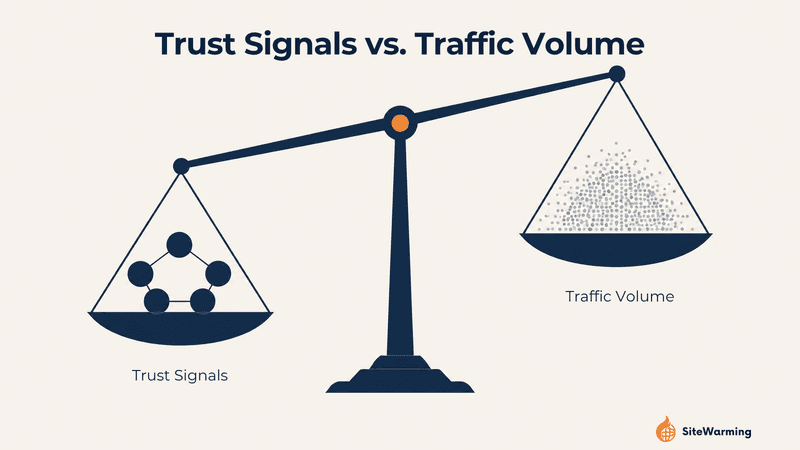
Domain value comes from trust signals, not traffic volume. A domain earns lasting value when it demonstrates experience, expertise, authoritativeness and trust (E-E-A-T) to both search engines and readers, not when it attracts the most visitors. Fifty engaged visitors who convert beat fifty thousand who bounce, because signals compound and vanity traffic doesn't.
Does traffic volume actually build domain value?
I checked my analytics last month and saw 53 visitors. Then I looked at a competitor pulling 50,000 a month and felt the familiar gut-punch: I'm doing this wrong.
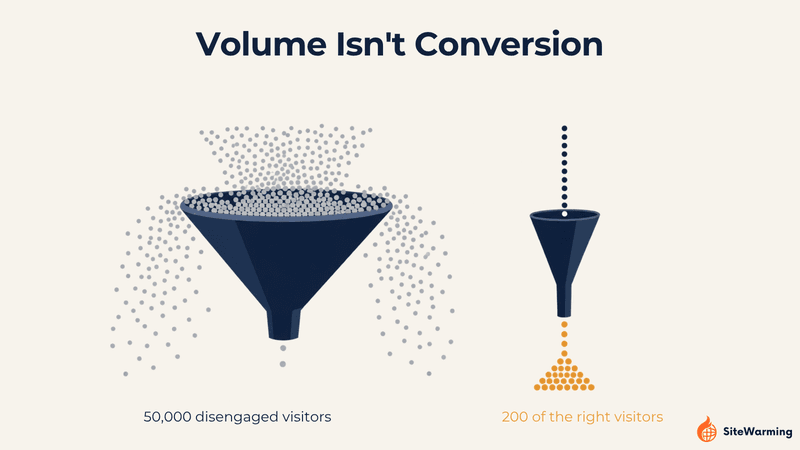
I wasn't. Ruler Analytics puts the average website conversion rate at 5.13% across 13 industries, drawn from more than five million tracked conversions (Ruler Analytics, May 2026). But an average is the wrong instrument here. A conversion rate is a ratio, and the thing that moves it hardest isn't how many people arrive, it's how closely what they wanted matches what they found. Fifty thousand disengaged visitors and two hundred people actively looking for what you built do not convert at the same rate, and the distance between those two rates is the entire argument of this post.
Domain value doesn't form from spikes. It forms from durable signals of quality. I'd rather have 200 visitors who are actually looking for what I built than 50,000 who bounced in from somewhere unrelated and never came back.
What do visitor counts actually measure?
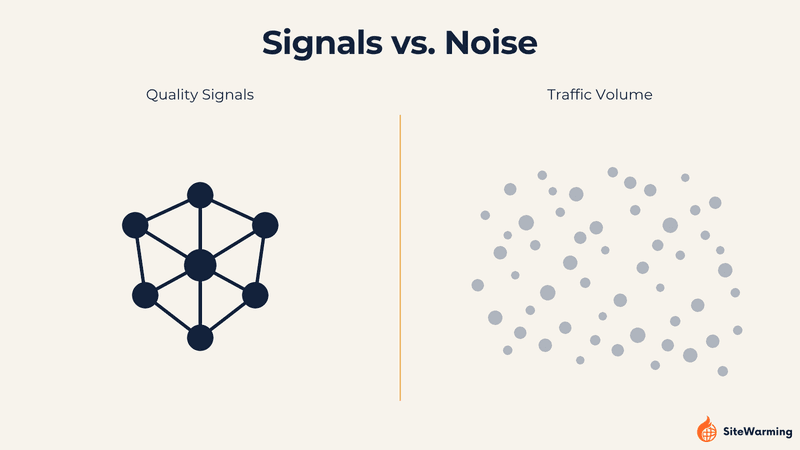
Visitor counts measure attention, not trust. Attention is easy to rent; a burst of referral traffic, a viral post, a paid spike. Trust is different: it builds recognition, and recognition is what brings people back without being asked.
Google's own documentation is blunt about the difference. E-E-A-T isn't a lever you pull or a score you set. A system, search engine or AI model, can't validate credentials through self-declaration. It has to infer trust from what's actually observable on the page and around it (Google Search Central, Creating helpful, reliable, people-first content).
You can buy attention. You can manufacture a spike. You cannot manufacture recognition.
Why do search and AI systems care about signals, not scale?
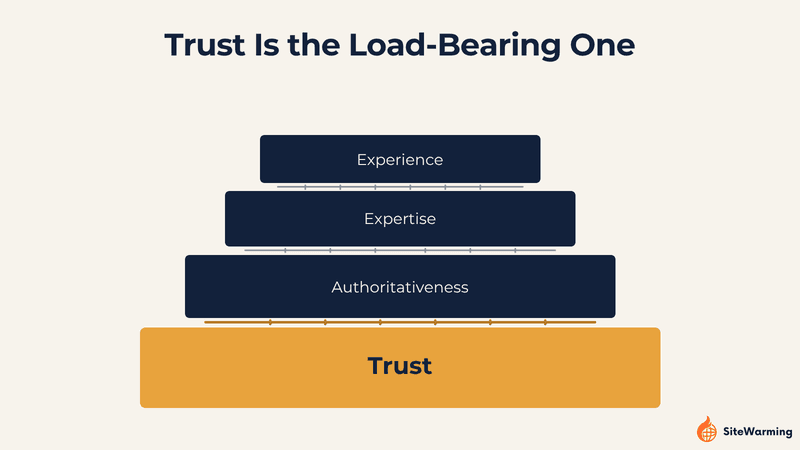
Google breaks trust down into four components, and it's worth translating each one out of SEO jargon and into plain terms:
- Experience: Proximity to the subject matter. Have you actually done the thing you're writing about?
- Expertise: Enough understanding to be useful, not just correct.
- Authoritativeness: Recognition from credible third parties, not self-declared.
- Trust: Reliability when someone actually depends on what you've said.
Google is explicit that of the four, trust is the one that matters most: "Of these aspects, trust is most important. The others contribute to trust" (Google Search Central). That reframes the whole exercise: trust is the asset. Visitor volume is the noise the asset makes when it's working.
That's the same idea Trust Is a System works from the other direction; trust as something systems can measure, not something you simply assert about yourself. If you want the mechanics of how AI search engines specifically arrive at that judgment, how AI search engines decide domain trust covers it.
What quality signals actually compound?
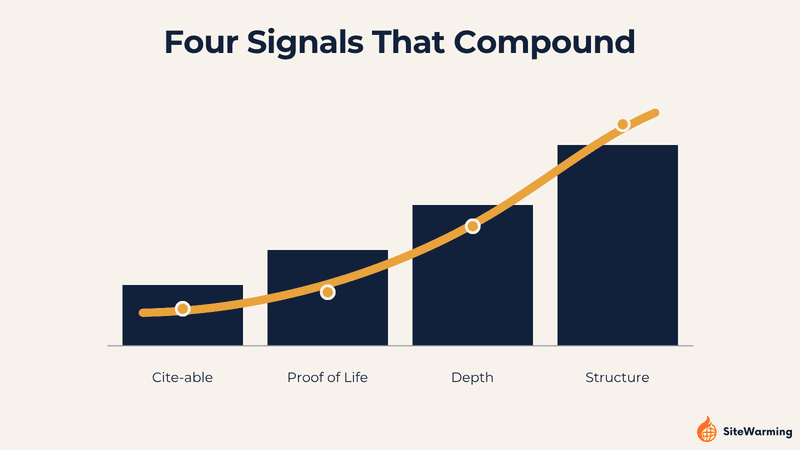
Four signals show up again and again in domains that hold value over time.
1. Being cite-able
Ideas stated clearly, with sources that are transparent rather than buried, get referenced accurately without a reader needing to caveat them. If someone can't quote your page without guessing at what you meant, they won't quote it at all.
2. Consistent proof of life
You don't need constant output. You need a pulse: a clear center that's still there when someone checks back. A domain that goes quiet for a year and then dumps ten posts in a week reads as less trustworthy than one that adds a paragraph every month.
3. Depth that reduces doubt
Depth isn't length. A 3,000-word post that still leaves the reader unsure what you actually think isn't deep, it's padded. Depth is when the page answers the follow-up question before the reader has to ask it, without sending them elsewhere to finish understanding you.
4. Structure that improves legibility
Headings that match the questions readers actually have, one clear meaning per page and consistent terminology throughout, this isn't aesthetics, it's interpretability. A page that's easy to parse is easier for a system to trust, because it's easier to confirm what the page is actually claiming.
Why does a small, right audience beat a large, wrong one?
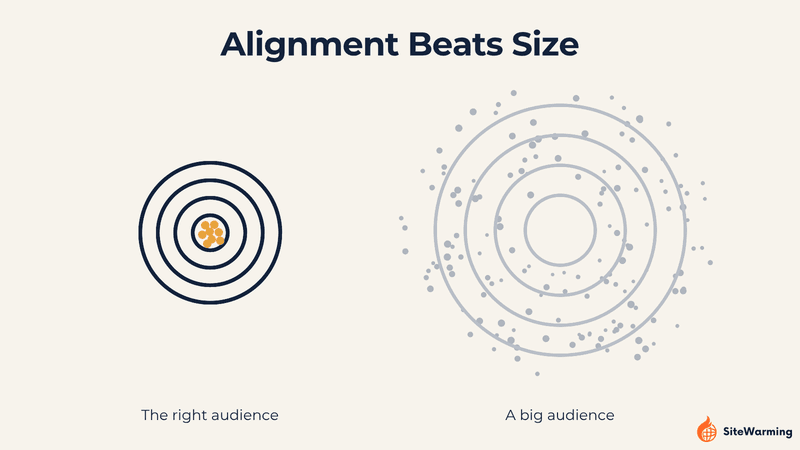
Audience alignment, not audience size, is what predicts engagement. Kevin Kelly made this argument for creators in 1,000 True Fans back in 2008 and it holds for domains just as well, the model works through alignment, not through hitting a round number. We've written about how 1,000 true fans applies to small audiences and why small, focused audiences are often more valuable if you want that argument in full.
A smaller, genuinely engaged community sustains serious work through repeat visits and organic referral in a way a large, mismatched audience never does. A domain known for one specific thing, serving one specific audience exceptionally well, becomes an authority in a way a domain chasing broad traffic never will.
A domain built for viral attention is fragile. It might spike. It might even feel successful for a week. But fragility shows up later as churn: plenty of arrivals, no memory of any of them.
This matters even more now that discovery increasingly runs through AI systems as well as search engines, those systems are easier to move with clarity than with noise. See The Internet Now Has Two Audiences for what that means for structuring a page for a human reader and a model reading it at the same time. Warming, SiteWarming's term for this, is choosing to make an idea legible before you feel ready to fully build it, quietly, on purpose. Discovery systems learn from repeated observation, and even a small, honest footprint becomes a durable signal over time. (See What is SiteWarming? if the term is new to you.)
Vanity metrics vs. quality signals
| Vanity metrics (traffic volume) | Quality signals (trust) | |
|---|---|---|
| What it measures | Attention | Recognition |
| How it's acquired | Bought or borrowed; ads, referral spikes, virality | Built through repetition and consistency |
| What happens after the spike | Churn; arrivals with no memory | Return visits, organic reference |
| How systems read it | Easy to manufacture, easy to discount | Hard to fake, compounds over time |
| What it does for domain value | Nothing durable | Builds the actual asset |
What does this mean for your domains?
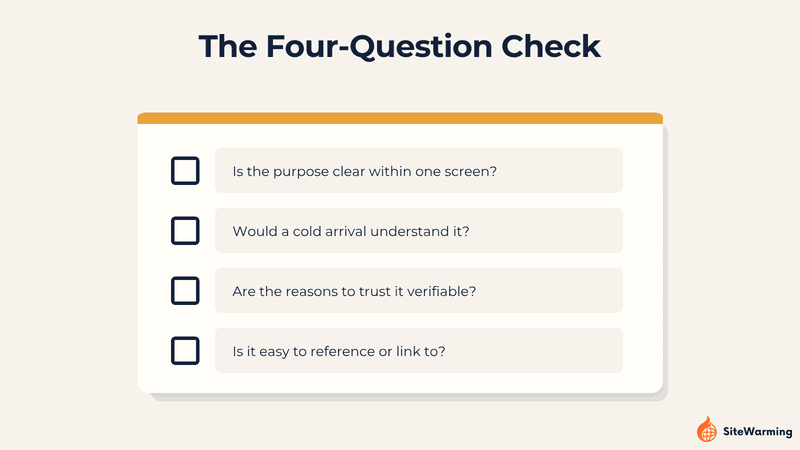
Don't let a low visitor count read as failure for a domain that isn't trying to be everything to everyone, a low number is often filtering doing its job. Instead of checking traffic first, check these:
- Does the domain communicate its purpose and its audience within one screen?
- Would a cold arrival understand the shape of the idea without extra context?
- Are the reasons to trust the domain actually verifiable, not just asserted?
- Is it easy for someone else to reference or link to what's here?
If the domain is part of a larger portfolio, the same logic applies at the portfolio level; see Why a Domain Without Social Proof Is Half an Asset for the identity-consistency piece of this and Why Most Domains Never Get Discovered if the real problem is that nobody can find the domain at all yet.
Prioritize references that make sense in the world, from places that already hold trust, over any kind of link-building tactic. When you check in on a domain, the questions worth asking aren't "how many people came"; they're who came, did they stay, did they return, and did they trust what they found enough to reference it elsewhere.
If you'd rather not track that by hand across a portfolio, see how SiteWarming handles it.
Frequently asked questions
Does more website traffic mean a domain is more valuable? Not by itself. Traffic measures attention, which can be bought or borrowed in a burst. Domain value comes from trust signals: E-E-A-T, consistency, citability, that compound over time and don't disappear when a traffic spike ends.
What is E-E-A-T and does it apply to domains that aren't fully built out? E-E-A-T stands for Experience, Expertise, Authoritativeness, and Trust; Google's framework for how search systems evaluate whether content, and by extension a domain, can be relied on. It applies to any page a system can crawl, including a lightly built or "warmed" domain, not just a fully developed site.
Why does my domain have low traffic but still get told it's valuable? Low traffic on a domain that's clearly scoped to a specific audience is often the audience filtering correctly, not a failure. A domain that's legible, consistent, and cite-able can hold real value with a small number of the right visitors.
How do I build trust signals for a brand-new domain? Start with legibility: state the purpose and audience in one screen, keep terminology consistent, and add a small, steady cadence of updates rather than one large launch. Trust builds from repetition a system can observe, not from a single announcement.
Share this article
Ready to Transform Your Domain Portfolio?
Start building real value with your domain investments today.