Why Most Domains Never Get Discovered (And How to Fix It)
 Bret Siers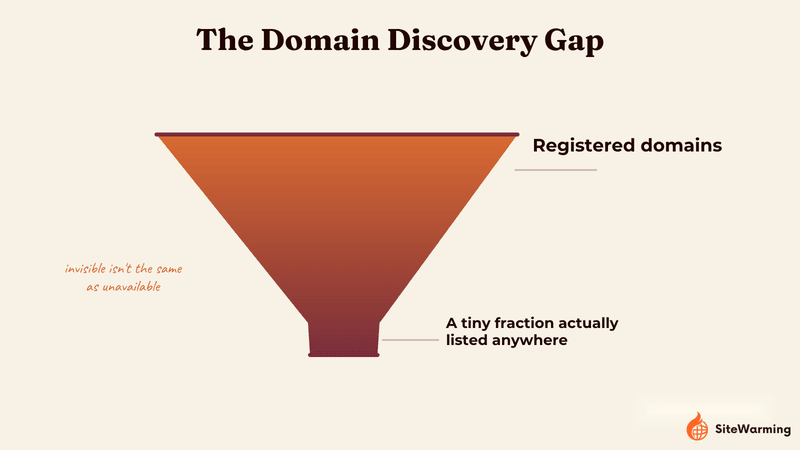
Most registered domains are never discovered because the domain market has no real discovery layer, no equivalent of a real-estate MLS. Marketplaces like Sedo and Afternic only list domains their owners have already decided to sell, which is a small fraction of the roughly 134 million unlisted .com domains sitting untouched right now.
I tried to buy a domain last year. Not a premium name. Not a one-word .com worth six figures. Just a clean two-word name that matched something I was working on.
It was registered. I could see that much. Typed it into a browser and got a parking page: the generic kind with a search bar and auto-generated links to nothing relevant. No contact information. No "for sale" banner. No indication that a human had touched this domain in years.
So I did the usual things. Checked Sedo. Not listed. Checked Afternic. Not there either. Ran a WHOIS lookup. Privacy-masked. Registrar placeholder email. No name. No phone. No way in.
The domain exists. Someone is paying to keep it alive. And there is no mechanism on the internet to connect me to that person.
Here's the thing. That's not just one weird domain. That's most domains.
There are 159.4 million .com registrations as of Q3 2025. The two biggest marketplaces, Sedo and Afternic, list an estimated 20 to 30 million domains combined. Across all TLDs, not just .com.
The marketplace gap isn't a crack. It's wild. The overwhelming majority of registered domains aren't listed for sale anywhere. Not on a marketplace. Not on a broker's sheet. Not available. Not unavailable. Just not findable.
This isn't a supply problem. It's a discovery problem. And honestly, that changes everything.
Here's why that should matter to you even if you're not trying to buy or sell anything right now: if you're holding a portfolio of domains you haven't built on, this is the exact same mechanism working against you from the other direction. The reason nobody can find that domain to buy it is structurally identical to the reason nobody, not a customer, not a search engine, not an AI assistant, can find your domain to do anything with it. Invisibility doesn't care which side of the transaction you're on. It just means nothing happens.
The Domain You Want Exists
Most people assume if a domain isn't for sale, the owner doesn't want to sell. That they're building something. That you're looking at an occupied house with the lights on.
Sometimes that's true. But most of the time? The reality is simpler and stranger. The owner hasn't made any decision at all.
They bought the domain attached to an idea. Maybe a side project. Maybe a business concept that felt urgent at 2 AM. Then life happened. The idea didn't die, it just never got built. And the domain entered a holding pattern that, for most owners, never ends.
A lot of those unlisted domains belong to people who accidentally became collectors: they kept buying names attached to ideas without ever meaning to build a collection. They're not investors. They're not speculators. They're founders and hobbyists sitting on names they care about but can't get to. The domain sits in their registrar dashboard like a tab they forgot they opened.
I get it. I've got domains like that. You probably do too.
The marketplaces aren't broken. Sedo and Afternic work fine for what they are. The failure is structural. The market only sees what's been listed. And most domains have never been listed anywhere.
Why Most Domains Aren't Listed
If the domains exist and the owners exist, why doesn't the market connect them?
Because listing means you've decided to sell. And most domain owners haven't decided anything. They're just... holding.
Listing feels like giving up. Most domain owners aren't domain investors. They're founders with side projects, hobbyists with half-formed ideas, people who registered a name "just in case." Putting a domain on a marketplace feels like admitting you've given up on the idea behind it. And most people would rather quietly renew for another year than make that admission.
Marketplace fees create friction. Afternic charges 15 to 30 percent commission depending on the plan. Sedo charges 10 to 20 percent. For someone who isn't actively trying to sell, the effort of setting up an account, messing with DNS, and picking a price just isn't worth it. The barrier isn't high in absolute terms. It's high relative to the motivation, which is zero.
The parking default absorbs everything else. A 2023 APNIC study scanning 334 million domain names found that 58.5 million, 17.5 percent, were parked. Displaying placeholder content rather than real websites. Among legacy gTLDs like .com, .net, and .org, parking rates reached up to 30 percent. Researchers noted that was a lower bound. They likely missed smaller parking services entirely.
A parked domain isn't a "for sale" sign. It's the absence of any sign. It's what happens when no decision is made.
And then there's the identity problem. A domain carries what it's named after. The owner still identifies with the idea the name represents. The domain is an option on a future self. And when there's no expiration date on the option, nobody ever exercises it. Listing feels like giving up in the wrong direction. So the domain sits: owned, renewed, doing nothing, in a state that serves nobody. Not the owner, not the person looking, not the idea that never connects with the person who would build it.
The Friction Tax
Both sides pay a cost here. And neither side chose to pay it. The friction tax is the compounding price that buyers and owners pay when domains are invisible to each other. Not a fee anyone charges. A structural drag that makes transactions harder, slower, and less likely to happen at all.
The buyer's tax is obvious. You can't buy what you can't find.
| Path to an unlisted domain | Typical cost | Typical outcome |
|---|---|---|
| WHOIS lookup | Free | Increasingly returns a privacy-masked contact, not a person |
| Cold outreach to a registrar placeholder | Time only | Single-digit response rates |
| GoDaddy Domain Broker Service | Initiation fee + 20% commission | 30-day attempt window, no guarantee |
| Waiting for it to expire and be re-listed | Free, but slow | Months to years, and someone else may catch it first |
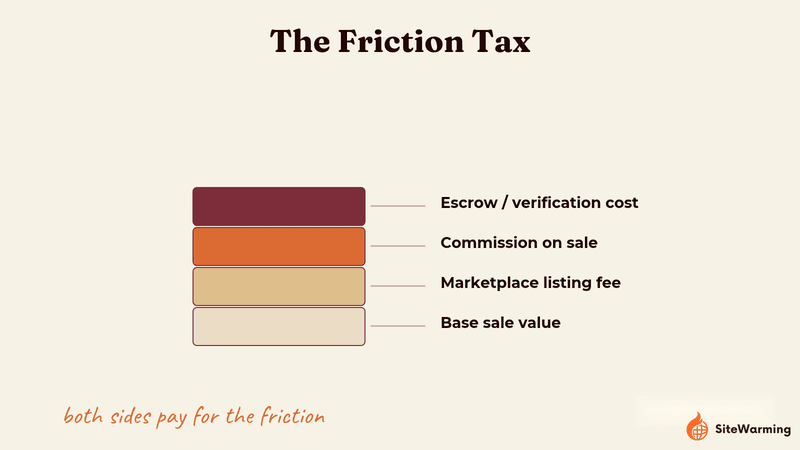
The buyer pays in time, fees, and deals that never materialize because they couldn't locate the other side.
The owner's tax is the one nobody talks about. They don't even know they're paying for it.
There's a study that actually puts a number on this. Bright MLS and Drexel University looked at over a million home sales and found that homes listed on the MLS sold for 17.5 percent more than comparable homes sold off-market. That's nearly $54,000 per transaction in 2022. And the gap's getting worse: 13.3 percent in 2019, 18.3 percent by 2022.
Now, real estate and domains aren't the same: homes are physical, locally bound, and have regulatory infrastructure that domains don't. But the directional point holds: invisibility costs sellers even when discovery infrastructure exists. The MLS exists. Agents exist. Listing is straightforward. And even with all of that, going off-market still costs sellers 17.5 percent.
Domains have no MLS. No universal listing system. No way to just see what's out there. If being off-market costs sellers 17.5 percent in a market that has infrastructure, what does it cost in a market with none?
The honest answer: the transaction never happens. The owner's friction tax in domains isn't a discount. It's total invisibility. You can't sell at a discount when no buyer knows you exist.
And the market itself pays a tax. NameBio recorded approximately 144,700 domain sales in 2024, totaling roughly $185 million. The global domain base reached 386.9 million registrations by the end of 2025. Publicly reported aftermarket sales represent approximately 0.037 percent of all registered domains changing hands in a given year.
Even accounting for unreported private sales; double the number, triple it: aftermarket activity is a rounding error relative to the total registered base. This is not a functioning market in the traditional sense. It's a market where almost nothing transacts. Not because nothing has value, but because there is no mechanism to surface it.
That's what happens when you treat an infrastructure market like a lottery: no transparency, no discovery layer, just hope that the right buyer stumbles into the right listing at the right time.
Off-Market Is Not a Feature. It's a Failure Mode.
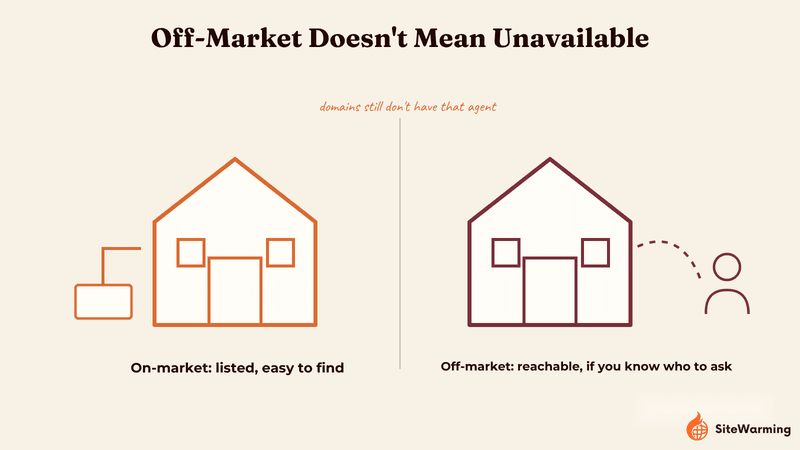
In real estate, "off-market" is a strategy. A seller chooses a private listing for control; curated buyer pool, no public price history, faster close. They have access to the MLS and choose not to use it. That is a decision.
In domains, off-market means the domain was never on-market to begin with. There's no opt-out because there was never an opt-in. The owner didn't choose invisibility. They just never chose visibility. And those aren't the same thing.
A real estate seller can choose to skip the MLS. A domain owner doesn't have an MLS to skip. They're not making a strategic choice. They're experiencing the absence of any system that would let them make one.
And the last fallback mechanism for finding unlisted owners is disappearing. In August 2025, GoDaddy announced it would no longer collect or display Administrative, Billing, or Technical contact details for most domains. This follows years of post-GDPR WHOIS erosion that has made even basic domain lookups return privacy-masked contacts or generic registrar placeholders. The old argument, "you can always WHOIS a domain and contact the owner," is now structurally false for most registrations.
And marketplaces aren't expanding to fill the gap. Dan.com shut down in June 2025 and merged its inventory into Afternic. Fewer marketplaces. Narrower discovery paths.
A domain that no one can find can't contribute value to anyone, including the person paying to keep it registered. If you own something valuable, part of that responsibility is being findable. That's not a marketplace problem. That's a stewardship problem.
Off-market in real estate is a feature. Off-market in domains is a failure mode. And right now, it's the default for the roughly 134 million .com names that sit outside the marketplaces; that's the 159.4 million total .com registrations, minus the 20–30 million estimated to be listed on Sedo and Afternic combined.
What this means if you're the one holding the domain
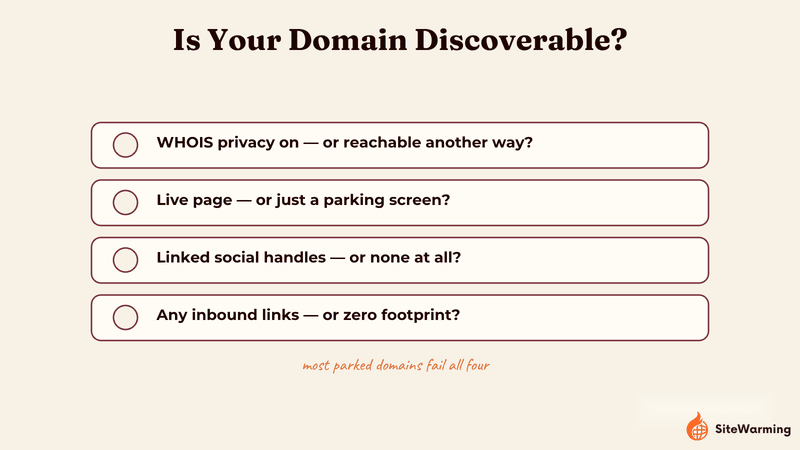
If you own domains you haven't built on, the marketplace-discovery gap above isn't just background context; it's a preview of what happens to your own domain by default.
Right now, if someone searched for a name close to yours, or tried to find the owner of your parked domain the way I tried to find that one, they'd hit the exact same wall: a parking page, a privacy-masked WHOIS record, no way in. That's true whether or not you'd ever consider selling. The absence of a discovery mechanism doesn't just block buyers; it blocks anyone trying to reach you: a potential customer, a collaborator, a search engine trying to decide whether your domain is worth surfacing.
Three things actually change that:
- Put a real, minimal footprint on the domain: even a single page, so there's something for a person or a system to find besides a parking page.
- Make yourself reachable without relying on WHOIS, since privacy masking and the GoDaddy contact-detail change mean WHOIS increasingly resolves to nobody.
- Decide on purpose whether a domain is active, for sale, or being released, rather than letting silence make that decision for you by default.
What Discovery Would Actually Look Like
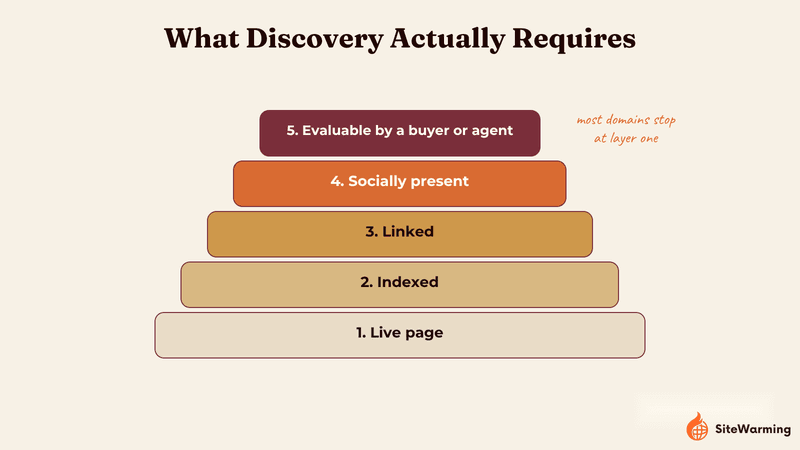
Not another marketplace. Marketplaces serve sellers who've already decided to sell. The problem is the 134 million .com owners who haven't decided anything. No marketplace is designed for someone who hasn't made a decision yet.
So what's actually missing? Something closer to visibility, just being able to see what's out there.
A domain that has presence, even minimal presence, sends a signal that someone is behind it. Not a "for sale" sign. Not a landing page with a price tag. Just evidence of care. A footprint. Something that says: this name belongs to someone, and that someone is reachable.
That signal alone changes everything. A warm domain: one with a real footprint, is findable in ways a parked domain never will be. Not because it's listed for sale. Because it's observable. A domain that resolves to a single page with a contact path and a last-updated date is more discoverable than a domain that resolves to a parking page. That's not a technology problem. It's just the difference between presence and absence.
Domain discovery doesn't exist yet. Not as a product. Not even as a category. The domain market needs something like what the MLS provides for real estate: not a listing service, but a way to see what's out there. Where a domain's existence, activity, and accessibility are visible to anyone exploring the space.
Visibility for discovery, not just search. The current system only serves owners who actively want to sell. It fails everyone else: the owner who might sell, the buyer who can't find and the idea that never connects with the person who would build it.
And here's what makes this urgent: as AI agents start handling more acquisition work, the friction doesn't go down. It goes up. Automated systems need signals to work with. An agent can negotiate, evaluate, and transact but it can't negotiate for what it can't find. No signals, no discovery.
SiteWarming exists because 134 million domains shouldn't be invisible. An accelerating domain is a domain that can be found; not listed on a marketplace, but present in discovery systems, legible to the evaluation layer that decides what gets seen. Most valuable domains aren't listed anywhere. Warming is what makes them visible.
The domain market doesn't have a supply problem. It has a discovery problem. And honestly, discovery is a design problem, not a sales problem.
Somewhere right now, someone is renewing a domain they'd consider selling. The idea faded. They just haven't done anything about it because doing something requires effort they can't justify for an uncertain outcome.
Somewhere else, someone is searching for exactly that domain. They have the idea. They have the energy. They'd pay a fair price. But there's no way to find the person on the other side.
Neither of them knows the other exists.
That's not scarcity. That's friction. And friction is fixable; not with another marketplace for people who've already decided to sell, but with infrastructure that makes the whole market visible.
The domain market isn't broken because people don't care. It's broken because care has no infrastructure. Honestly, that should make someone angry enough to build it.
Frequently asked questions
How do I find out who owns a domain that isn't listed for sale? A WHOIS lookup is the traditional starting point, but it increasingly returns a privacy-masked contact or a bare registrar placeholder rather than a real name, especially since GoDaddy stopped displaying most administrative and technical contact details in August 2025. A domain broker service (typically an initiation fee plus around 20% commission) is the more reliable, though slower and costlier, path.
Is there an MLS-style service for domains? Not yet. Sedo and Afternic function as marketplaces, but they only list domains whose owners have actively decided to sell; an estimated 20 to 30 million out of roughly 159 million .com registrations. Nothing currently gives visibility into the much larger pool of domains that are simply unlisted rather than unavailable.
Why don't more domain owners list their domains for sale? Mostly because listing requires an active decision to give up on an idea and most owners haven't made that decision, they're still holding the option open. Marketplace commissions (10–30%) and the setup effort involved add friction on top of that, on a task with essentially zero built-in motivation.
Is it worth using a domain broker to buy an unlisted domain? It can be, if the domain is specific enough that no other name will do; brokers can sometimes reach owners that public lookups can't. But expect a real cost (an initiation fee plus roughly 20% commission), a multi-week process with no guarantee, and the possibility that the owner simply never responds.
If I own an undeveloped domain, does any of this affect me even if I'm not selling? Yes. The same discovery gap that keeps buyers from finding your domain also keeps it invisible to search engines, AI systems, and potential customers. Giving the domain even a minimal real footprint is what breaks that invisibility, independent of whether you ever intend to sell it.
Share this article
Ready to Transform Your Domain Portfolio?
Start building real value with your domain investments today.