When Agents Do the Shopping: How Agentic Commerce Reads Your Domain
 Bret Siers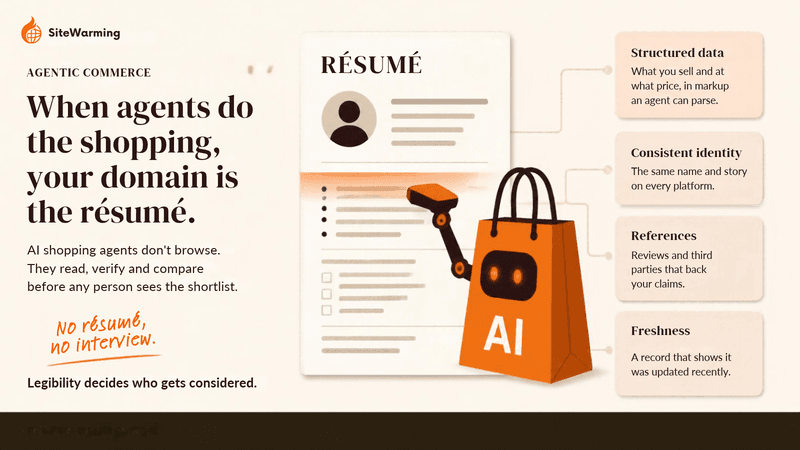
Agentic commerce is shopping in which AI agents such as Amazon Rufus, Google AI Mode and Gemini, ChatGPT and Perplexity research, compare and sometimes buy on a person's behalf. Those agents do not browse. They read structured product data, merchant policies and consistent entity signals, and a domain they cannot read, verify or trust never makes the shortlist.
I bought something online last month without thinking about how I found it. A recommendation appeared. It felt relevant. I clicked, I compared, I bought. Normal.
But the thing that found it for me might not have been a search engine. And it definitely wasn't a friend.
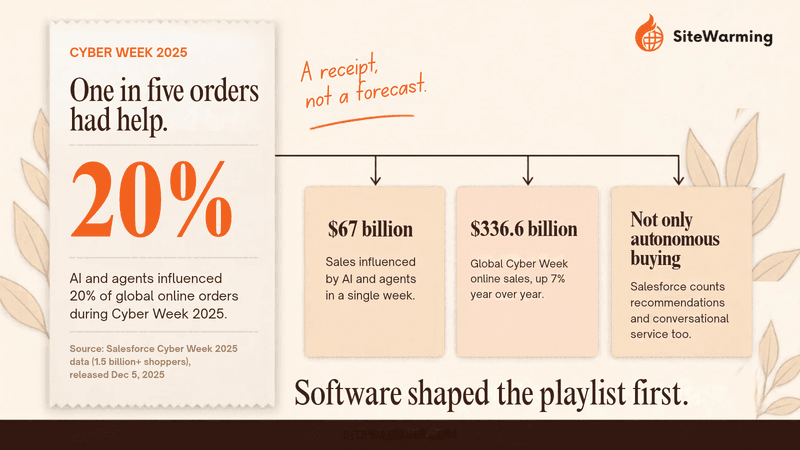
During Cyber Week 2025, AI and agents influenced 20% of global online orders, driving $67 billion in sales, according to Salesforce data covering more than 1.5 billion shoppers (Salesforce, Dec 5, 2025). Global online sales that week hit $336.6 billion, up 7% year over year. Salesforce counts personalized recommendations and conversational customer service, not only fully autonomous buying. Either way, software shaped the shortlist before a person made the choice.
That number is not a forecast. It is a receipt.
The question isn't whether AI agents will reshape commerce. They already have. The question is whether your domain is legible to the thing that's now doing the shopping.
What is agentic commerce?
Agentic commerce is commerce in which an AI agent acts for the buyer: it interprets what the person wants, searches, compares, checks claims and, increasingly, completes the purchase. McKinsey describes it as "shopping powered by intelligent AI agents capable of anticipating, personalizing, and automating every step of the process" (McKinsey, Oct 17, 2025).
Three terms come up constantly, so here they are once:
- AI shopping agent: software that shops on a person's behalf, such as Amazon Rufus, Google's shopping features in AI Mode and Gemini, ChatGPT's merchant apps, or Perplexity's shopping assistant.
- Agentic commerce protocol: an open standard that lets agents and merchants talk to each other in a predictable way, covering product discovery, checkout and payment.
- Agent legibility: whether an AI agent can read, verify and act on what your domain represents. It's the property this whole article is about.
Agentic commerce sits next to generative engine optimization, but it isn't the same thing. GEO is about being cited in an answer. Agentic commerce is about being chosen in a transaction.
How big is agentic commerce already?
The early numbers are measured, not projected, and the projections are large even at the low end.
| Figure | What it measures | Source |
|---|---|---|
| 20% of global orders, $67 billion | Cyber Week 2025 sales influenced by AI and agents | Salesforce, Dec 5, 2025 |
| 250 million shoppers | People who used Amazon Rufus in 2025 | Fortune, Nov 2, 2025 |
| ~23% of Americans | Bought something via AI in the past month | Morgan Stanley, Dec 8, 2025 |
| $190 billion to $385 billion by 2030 | U.S. e-commerce spending through agents, 10%-20% of online retail | Morgan Stanley, Dec 8, 2025 |
| Up to $1 trillion (U.S.); $3 trillion to $5 trillion (global) by 2030 | Retail revenue orchestrated by agentic commerce | McKinsey, Oct 17, 2025 |
McKinsey's word is "orchestrated," and it matters. My reading: this is mostly not new spending. It's commerce that already exists, routed through a new intermediary.
Projections vary widely, which reflects real uncertainty about the pace of adoption. But even the conservative figures describe a structural shift in how commerce moves, not early-adopter behavior.
Why is your domain now your resume?
When a hiring manager reads a resume, they don't browse it for vibes. They scan for credentials. They check consistency. They verify claims against references. If something doesn't add up, they move to the next candidate. No rejection email. They just stop reading.
AI shopping agents evaluate domains the same way.
They query structured data. They check whether the entity behind the domain is consistent across platforms. They evaluate content depth. They verify claims against external signals. They aren't "visiting your website." They're reading your resume.
The domain-as-resume is the shift from domains as human-facing destinations to domains as machine-readable credentials. When the primary evaluator is an agent, your domain's value is set by its legibility, verifiability and structural completeness, the same way a resume is judged by credentials, not aesthetics.
Agents aren't a secondary layer of evaluation. They're becoming the primary one: the intermediary that decides whether the human ever sees you at all. When the machine is also the buyer's proxy, legibility isn't about visibility anymore. It's about transactions.
If the agent can't read your resume, you don't get the interview.
How do AI shopping agents shop if they don't browse?
Amazon Rufus does not open a browser and scroll through product pages. It queries product data, compares structured attributes, reads review sentiment, checks price history and presents a recommendation.
On Amazon's Q3 2025 earnings call on October 30, 2025, Andy Jassy said 250 million shoppers had used Rufus that year, with monthly active users up 140% and interactions up 210% year over year. Customers who engage with Rufus are 60% more likely to complete a purchase, and Amazon expects it to drive over $10 billion in annual incremental sales (Fortune, Nov 2, 2025).
Let that settle. A quarter of a billion people are already shopping through an agent on a single platform. People who open a shopping assistant are, of course, closer to buying to begin with. Even so, the pattern works for the shopper and for the platform.
This is the behavior model every shopping agent shares:
- Query. Turn the person's request into structured questions: category, attributes, price range, delivery date.
- Verify. Check that the seller, the product and the claims hold up against data and third-party signals.
- Compare. Rank the options that passed verification on the attributes that matter to the person.
- Transact. Hand the person a shortlist or, where the platform allows, complete the checkout.
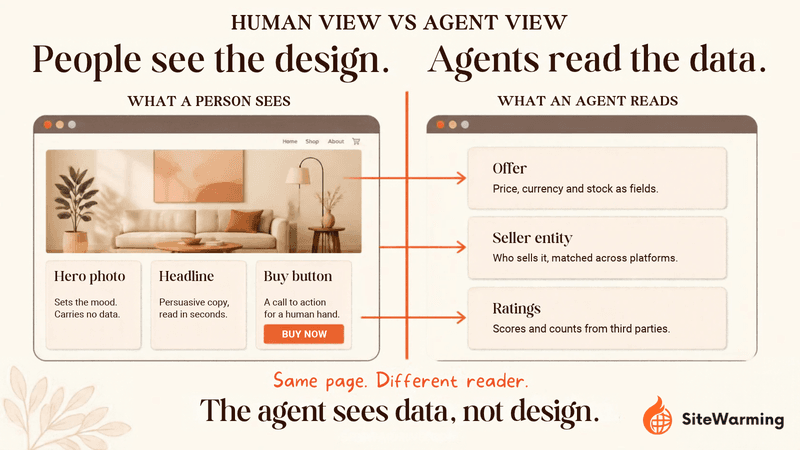
No scrolling. No homepage. No "above the fold." The agent sees data, not design.
Which AI shopping agents are live in 2026?
Rufus isn't alone. The major platforms all follow the same query-verify-compare-transact pattern. None of them browse. Here is where each stood as of September 2026.
| Agent | Operator | What it does | Status (dated) |
|---|---|---|---|
| Rufus | Amazon | Shopping assistant inside Amazon | 250 million shoppers in 2025 (Fortune, Nov 2, 2025) |
| AI Mode, Gemini, Universal Cart | Agentic checkout via UCP; a cross-merchant cart | Universal Cart announced May 19, 2026, rolling out in the U.S. across Search and the Gemini app (Google, May 19, 2026) | |
| ChatGPT | OpenAI | Product discovery; purchases through merchant apps | Instant Checkout launched Sept 29, 2025 (OpenAI); pulled back March 4, 2026, with purchases now routed through apps such as Instacart and Target (Forbes, Mar 10, 2026) |
| Perplexity shopping and Comet | Perplexity | Shopping answers; Instant Buy with PayPal | Instant Buy launched Nov 25, 2025 for U.S. users, retailer stays merchant of record (PayPal, Nov 25, 2025) |
The ChatGPT row is the useful lesson. OpenAI's in-chat checkout lasted about five months before transactions moved back into merchant-controlled environments (Checkout.com, Apr 20, 2026). Where the purchase happens is still being negotiated. What the agent reads to decide who makes the shortlist is not.
What are the agentic commerce protocols (UCP, ACP, AP2, Visa and Mastercard)?
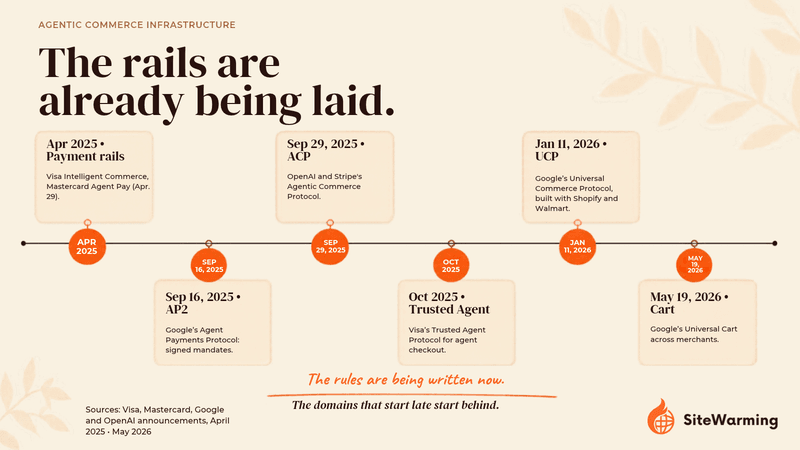
The infrastructure is catching up with the behavior. Google announced the Universal Commerce Protocol (UCP) at NRF 2026 on January 11, 2026, the biggest retail trade event in the world. Sundar Pichai introduced it as an open standard "built together with industry leaders Shopify, Etsy, Wayfair, Target and Walmart, and endorsed by 20+ more," designed to work with Agent2Agent, the Agent Payments Protocol and Model Context Protocol (MCP) (Google, Jan 11, 2026; TechCrunch, Jan 11, 2026).
That's not a whitepaper. It's a launched standard with institutional co-signers, and it sits among several others:
| Protocol or program | Who | Launched | What it standardizes |
|---|---|---|---|
| Visa Intelligent Commerce | Visa | April 2025 | Secure, AI-enabled payments on Visa credentials (Visa, Dec 18, 2025) |
| Mastercard Agent Pay | Mastercard | April 29, 2025 | Agentic Tokens; trusted agents must be "registered and verified" before they can pay (Mastercard, Apr 29, 2025) |
| Agent Payments Protocol (AP2) | Google, with 60+ organizations | September 16, 2025 | Cryptographically signed "Mandates" that prove what the user authorized (Google Cloud, Sept 16, 2025) |
| Agentic Commerce Protocol (ACP) | OpenAI and Stripe | September 29, 2025 | How agents, people and businesses complete purchases together (OpenAI, Sept 29, 2025) |
| Trusted Agent Protocol | Visa | October 2025 | An open framework on existing web infrastructure for safe agent-driven checkout (Visa, Dec 18, 2025) |
| Universal Commerce Protocol (UCP) | Google, with Shopify, Etsy, Wayfair, Target, Walmart | January 11, 2026 | Discovery, checkout and post-purchase between agents and merchants (Google Developers Blog, Jan 11, 2026) |
Mastercard said all U.S. cardholders would be enabled for Agent Pay by the 2025 holiday season (Mastercard, Sept 2025). By May 2026, Google was expanding UCP checkout to Canada, Australia and the U.K. and bringing it to YouTube in the U.S. (Google, May 19, 2026).
What does UCP actually read on your domain?
Here the resume metaphor stops being a metaphor. Under UCP, "businesses publish the services they support and corresponding capabilities in a standard JSON manifest located at /.well-known/ucp" (Google Developers Blog, Jan 11, 2026). The agent reads a file on your domain to learn what you offer and how to transact with you.
Google's own UCP checkout adds commerce requirements on top: a Merchant Center account in good standing with approved products, a defined return policy, at least one customer-support contact, and a checkout-eligibility attribute on each product in the feed (Google UCP guide, updated July 21, 2026).
Every one of those is a verifiable claim about the business behind the domain. The standard assumes agents will check, and it was built to make checking fast, reliable and universal.
What do AI shopping agents check before they recommend you?
So the infrastructure exists and the protocols are live. What, specifically, does a commerce agent look at when deciding whether to recommend you?
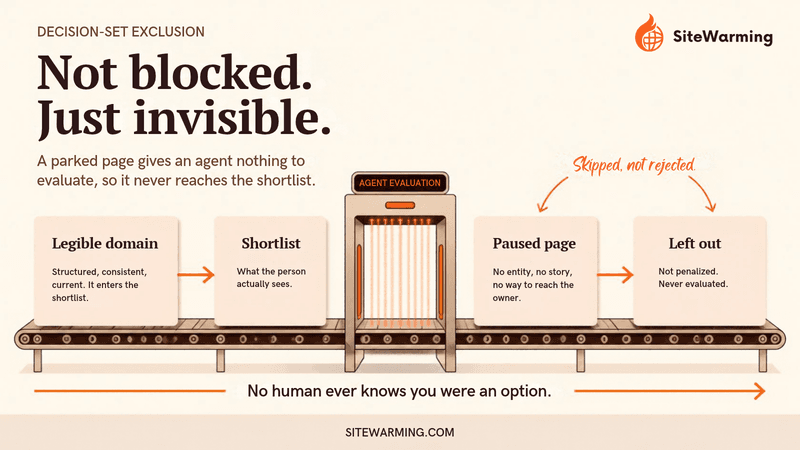
The checklist is structural, not aesthetic. Vague calls to "optimize for AI" aren't useful, so here it is specifically:
| Signal | What the agent reads | Where it lives |
|---|---|---|
| Structured data | Product, Offer, AggregateRating and Organization markup: what you sell, at what price, with what reputation | JSON-LD on your pages; product feeds |
| Entity consistency | Whether name, description, address and contact match everywhere | Your domain, Google Business Profile, Bing Places, social profiles |
| Content depth | Substantive, current content that answers real questions | Your pages |
| Review signals | Third-party corroboration of your claims | Review platforms, marketplaces, press |
| Freshness | When the record last changed | Page dates, feeds, update history |
| Domain history | How long the domain has existed and what it has carried | Registration and archive history |
A few of these need more than a table cell.
Entity consistency is where most domains fail quietly. If your schema says one thing and your business profile says another, the agent registers a discrepancy. It doesn't penalize you. It ignores you. The full identity stack is covered in our piece on how AI agents verify a business.
Content depth means actual subject matter an agent can use to build confidence in what the domain represents. Not placeholder text.
Freshness matters because an agent evaluating a domain that hasn't changed in three years is evaluating a snapshot, not a living record.
Domain history is a proxy for credibility when other indicators are thin. It's one reason AI search engines weigh some domains as more trustworthy than others.
Does schema markup help with AI shopping agents?
The nuance matters here, and the Analyst in you will catch it anyway: the evidence on schema and AI visibility is mixed.
Ahrefs tracked 1,885 pages that added JSON-LD and found no major lift in citations on any platform: -4.6% in Google AI Overviews, +2.4% in AI Mode and +2.2% in ChatGPT, the last two not statistically significant (Ahrefs, May 11, 2026). Language models mostly process visible text, not metadata tags.
Shopping is different from citation. Google says product structured data can surface price, availability and ratings in Search, and that "providing both structured data on web pages and a Merchant Center feed maximizes your eligibility to experiences" (Google Search Central). If you want the practical side, start with schema markup for small websites.
My assessment: schema is necessary infrastructure, not a ranking trick. The real signal is entity coherence, whether your domain tells the same story everywhere an agent looks. Schema, feeds, business profiles, social presence, content, reviews. If they disagree, the agent doesn't ask for clarification. It moves on.
What this amounts to is a trust architecture. Agents don't trust pretty websites. They trust verifiable entities: domains where the claims stack up across multiple independent checkpoints. The shift from "does this look legitimate?" to "can this be verified?" is the foundational change agentic commerce introduces.
So you know what agents check, and you know the protocols exist. The next question is harder. What happens to the domains that don't pass?
What happens to brands AI agents can't see?
Here's what absence actually looks like.
If your domain has no structured data, the agent cannot parse your products. If your entity profile is inconsistent, the agent cannot trust your claims. If your content is thin or stale, the agent has nothing to verify against. If your domain is parked, sitting dark with a registrar placeholder page, the agent sees a blank resume. There's nothing to evaluate and nothing to compare. You're not in the decision set.
The Amazon-Perplexity dispute makes the identity question concrete. In November 2025 Amazon sued Perplexity in federal court in California over its Comet browser agent, alleging Perplexity "deliberately disguised Comet's AI agent as a regular Google Chrome browser session" instead of identifying itself (GeekWire, Mar 2026). Perplexity's defense was that consumers should be free to use any AI assistant they choose.
The courts have gone both ways. A district court granted Amazon a preliminary injunction on March 9, 2026. On August 4, 2026, the Ninth Circuit vacated it, holding that it was the user who "accessed" Amazon's computers, with the help of Perplexity's agent (Cooley, Aug 6, 2026). The legal fight is about agent identity: who is this, and who are they representing?
The mirror-image problem is the one that affects most domains. When an agent can't identify your domain, when it has no structured identity, no verifiable entity profile, no machine-readable content, the agent doesn't sue you. It doesn't flag you. It skips you. You're not blocked. You're invisible.
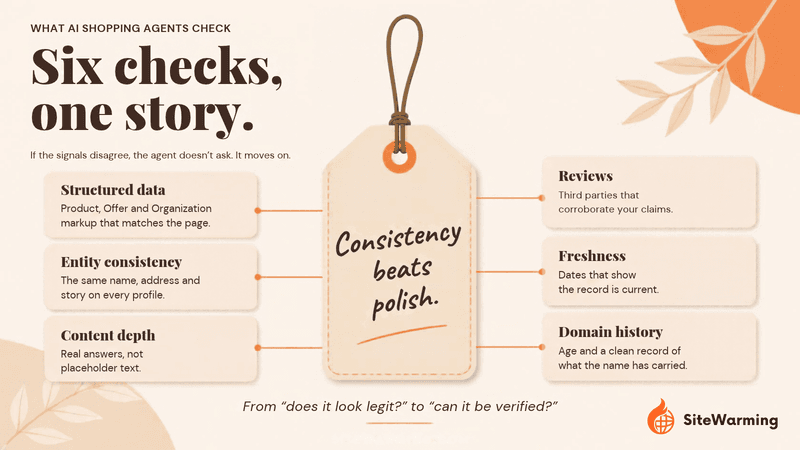
This invisibility is categorically different from the old kind. In the search-dominated web, being invisible meant you didn't appear on page one. You still existed, and someone could still type your URL. In the agent web, decision-set exclusion is harder: you are excluded from the evaluation before any human is involved. The agent never considers you. The human never knows you were an option. You're not losing a position. You're losing the right to be evaluated.
If AI can't read a parked domain, agents certainly won't shop there. And the timing matters. A domain that is invisible to agents while agent commerce standardizes its protocols is missing the window when the rules are being written. Entity profiles and content records accumulate over time. The domains that start late start behind.
The opposite problem is just as real: domains that are technically active but structured to sell rather than to serve. Agent legibility isn't only about being machine-readable. It's about being machine-trustworthy. A domain loaded with thin content and aggressive monetization may be parseable but structurally suspicious, which is exactly why monetizing too early poisons domains. Agents evaluate the cumulative record, not the current moment.
The question isn't whether your domain ranks. It's whether it has agent legibility: can an AI agent read, verify and act on what your domain represents?
What does agentic commerce mean for domains you haven't built yet?
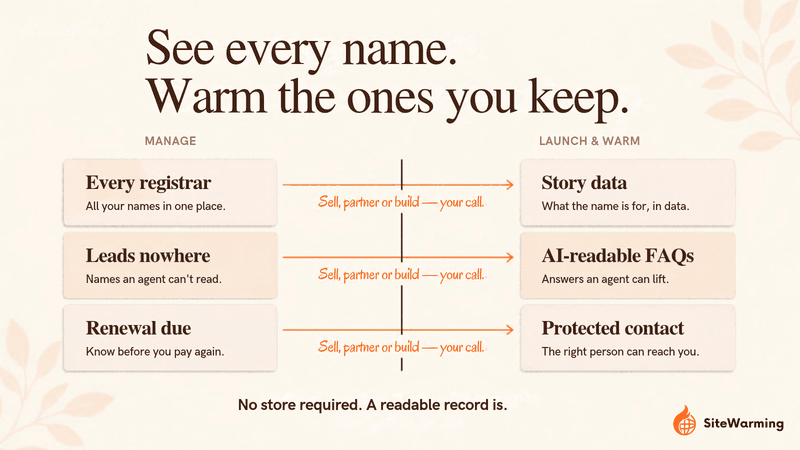
Most founders I talk to don't run one store. They hold a portfolio: a few live projects and a longer list of names registered for ideas they haven't built. Agents don't only shortlist products. They shortlist suppliers, services, partners and, when someone asks, names.
A dark name gives an agent nothing. No entity, no story, no dates, no way to reach the owner. It's the blank resume from the last section, repeated across every domain you renew and never develop. You still pay the renewal; the agent still moves on.
You don't need a store on every name. You need to know which names lead nowhere, and a readable record on the ones worth keeping. How agents find an unused domain and reach the person behind it is its own subject, covered in whether an agent can find and reach an unused domain. A domain portfolio management tool is the fastest way to see the first part.
How do you prepare your domain for agentic commerce?
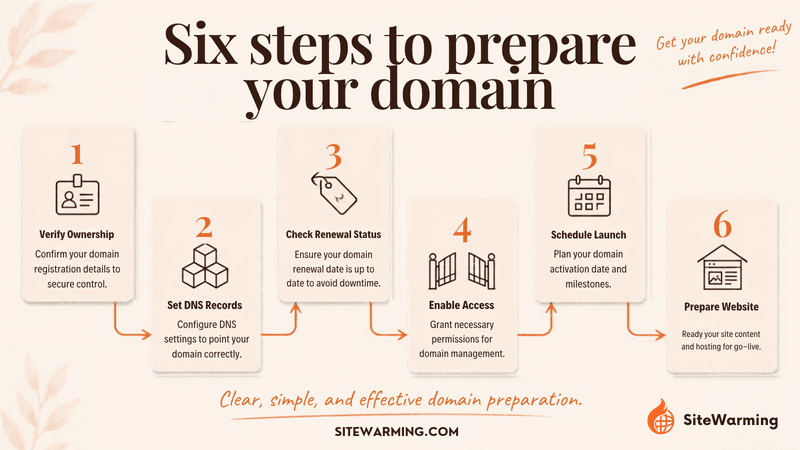
This isn't about adopting a new tool or "AI-proofing your website." It's about recognizing that the audience for your domain has changed, and the new audience reads differently. The domains that will be legible in the agent era share structural characteristics, not aesthetic ones. In order of what agents check first:
- Make your entity say the same thing everywhere. Same name, description, address and contact on your domain, Google Business Profile, Bing Places and social profiles. This is the most important step and the most neglected. A domain with good content and no schema can still be legible if its entity is consistent; perfect schema with contradictory profiles produces a confused record.
- Publish structured data that matches the page. JSON-LD describing what the domain is and what it offers: Organization everywhere, Product and Offer where you sell. Not because schema is magic, but because it's how machines parse the page. The basics are in our guide to make a website machine-readable.
- If you sell, give agents the commerce layer. A product feed, a stated return policy and a customer-support contact are what Google's UCP checkout requires (Google UCP guide). If you're on a commerce platform, check whether it publishes the UCP manifest for you.
- Let the right crawlers and agents in. An agent can't evaluate a page it's blocked from reading. Review your robots.txt and firewall defaults against how AI crawlers decide what to index.
- Keep the record current. Show publish and update dates, refresh content that has gone stale, and keep feeds in sync with the site. Thin pages, dated content and placeholder text aren't neutral. They're evidence of absence.
- Put a readable page on every domain you keep. A parked page is a blank resume. A short, structured page that says what the name is for, who it's for and how to reach you gives the agent something to evaluate. The same page also helps you get cited in ChatGPT and Perplexity answers.
None of this is entirely new. The structural argument has been building for a while: domains need to be readable by both humans and machines, entity profiles accumulate whether you build them deliberately or not, the evaluator for most decisions is no longer human, and the domains that accidentally became aggregators did so because they were already structurally legible.
Agentic commerce is the commercial consequence of those observations. When agents do the shopping, the domains agents can read are the ones that get the business. The ones that can't be read don't get penalized. They simply don't exist in the evaluation layer.
Who wins when agents do the shopping?
The internet just hired a purchasing department. It doesn't browse your website. It reads your credentials, checks your references and decides whether you're worth recommending, all before any human knows you exist.
Sometimes I think the domains that will do best in this shift aren't the ones that saw it coming. They're the ones that were already legible. Already doing the quiet, unglamorous work of being real. Consistent across platforms. Clear about what they offer. Present in the ways that matter, even when nobody seemed to be checking.
It turns out something was always checking. We just didn't know its name yet.
The protocols being written right now, UCP, AP2, Agent2Agent, and the agent frameworks Visa and Mastercard are building, aren't the end of the shift. They are the foundation for a decade of change in what domain identity means and who gets to participate. The protocols will evolve and the evaluation criteria will sharpen. The foundational requirement won't change: to be considered, you must first be legible.
How does SiteWarming help AI agents read your domains?
Agent legibility starts with two questions: which of your domains can an agent read at all, and what should the ones worth keeping say? SiteWarming answers them with two tools.
See the whole portfolio. The domain portfolio management tool puts every registrar in one place. Add names one by one, import a CSV, connect a registrar or use the MCP server. It shows what's live, what leads nowhere and what's approaching renewal at a glance, and it auto-fetches a value with HumbleWorth, then lets you stack appraisals from 15+ sources. The names that lead nowhere are the blank resumes.
Act on the names worth keeping. Launch & Warm puts a warm site on a dormant domain in one of three intent templates: Future Build, Open, not listed, or Actively Selling. Each carries a one-sentence story, structured story data, AI-readable FAQs, domain analysis, clear availability context and a protected contact path, with DNS, HTTPS, hosting, ongoing DNS and SSL checks and monthly content updates handled for you.
What it doesn't do: build a store, a checkout or a UCP feed. What it does: turn a name that would be a blank page into a current, consistent record that people and agents can read, with a way for the right buyer, builder or partner to reach you. Sell, partner or build, your call.
Frequently asked questions
What is agentic commerce?
Agentic commerce is shopping in which an AI agent acts for the buyer. It interprets what the person wants, searches, compares options, checks claims and, where the platform allows, completes the purchase. Amazon Rufus, Google AI Mode and Gemini, ChatGPT and Perplexity all work this way. The agent reads structured data and verification signals rather than browsing pages the way a person would.
How do AI shopping agents decide what to recommend?
They follow a query, verify, compare and transact pattern. The agent turns the request into structured attributes, checks that the seller and product hold up, ranks what passed on the attributes the person cares about, then presents a shortlist or completes checkout. The signals it leans on are structured data, entity consistency, content depth, reviews, freshness and domain history.
How big is agentic commerce in 2026?
Salesforce found AI and agents influenced 20% of global Cyber Week 2025 orders, or $67 billion in sales. Amazon said 250 million shoppers used Rufus in 2025. Morgan Stanley projects $190 billion to $385 billion in U.S. e-commerce through agents by 2030, and McKinsey projects up to $1 trillion in U.S. retail revenue orchestrated by agents and $3 trillion to $5 trillion globally.
What is the Universal Commerce Protocol (UCP)?
UCP is an open standard for agentic commerce that Google announced at NRF on January 11, 2026, built with Shopify, Etsy, Wayfair, Target and Walmart and endorsed by more than 20 other companies. Businesses publish a JSON manifest at /.well-known/ucp on their domain so agents can discover what they offer and how to check out. It works alongside Agent2Agent, AP2 and MCP.
Does schema markup help with AI shopping agents?
It helps shopping more than citations. An Ahrefs study of 1,885 pages published in May 2026 found adding JSON-LD produced no major lift in AI citations. For shopping, Google says combining product structured data with a Merchant Center feed maximizes eligibility for its product experiences. Treat schema as necessary infrastructure, and make sure it matches your business profiles everywhere else.
What happened to ChatGPT Instant Checkout?
OpenAI launched Instant Checkout with the Agentic Commerce Protocol on September 29, 2025, starting with U.S. Etsy sellers. It pulled back on March 4, 2026, and ChatGPT now routes purchases through merchant apps such as Instacart and Target, with checkout happening in merchant-controlled environments. Product discovery in ChatGPT continues, so what the agent can read about you still decides whether you appear.
Can AI shopping agents see a parked domain?
They can reach it, but there is nothing to evaluate. A registrar placeholder page has no structured data, no entity, no current content and no way to reach the owner, so the agent has no reason to include it in a shortlist. The domain is not blocked or penalized. It is simply left out of the evaluation before any person sees the options.
How does SiteWarming help domains get read by AI agents?
SiteWarming's domain portfolio management tool shows every domain across registrars in one place, including which names are live and which lead nowhere. Launch & Warm then puts a warm site on the names worth keeping, with structured story data, AI-readable FAQs, HTTPS, monthly content updates and a protected contact path. It does not build a store or checkout feed; it gives agents a current, consistent record to read.
Share this article
Ready to Transform Your Domain Portfolio?
Start building real value with your domain investments today.