Identity in an Agentic Web: How AI Agents Verify Your Business
 Bret Siers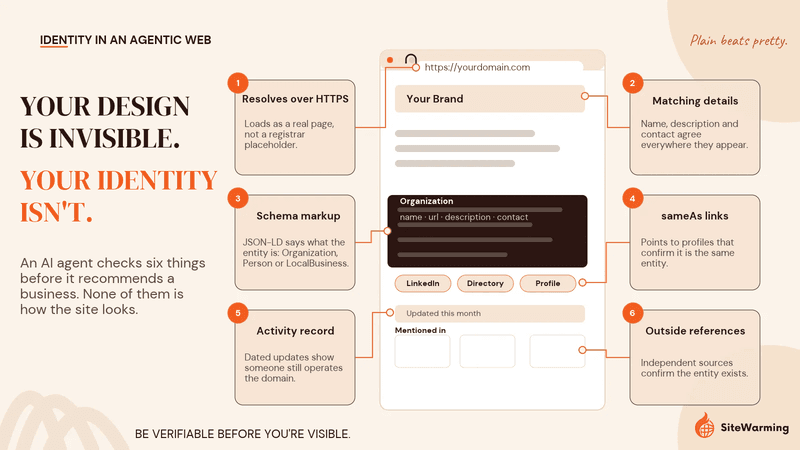
AI agents verify a business by reading what a machine can check, not what people admire: JSON-LD schema that declares what the entity is, sameAs links to independent profiles, identity details that match everywhere, a visible record of activity, and references from other sources. Together those signals form agentic identity. Missing or conflicting signals mean the agent moves on.
Two merchants. Same product. Same price. An AI shopping agent looks at both.
The first has a beautiful site. Custom typography, magazine-quality brand storytelling, ten years of design refinement in every detail.
The second has a basic layout. But it carries JSON-LD schema markup that states what kind of entity it is, links to public knowledge bases and verified business directories, and describes its products the same way everywhere they appear.
The agent doesn't see the design. It reads structured data, walks the entity graph and checks the outside references. It recommends the second merchant.
This isn't a thought experiment. The world's two largest card networks have already built cryptographic identity systems for AI shopping agents. Visa's Trusted Agent Protocol locks every request from a trusted agent "to a merchant's specific website and the exact page" it's interacting with. Nobody in that exchange is evaluating anyone's branding. They're confirming identity.
The evaluator changed. Most domain owners haven't noticed.
Why doesn't an AI agent see your brand?
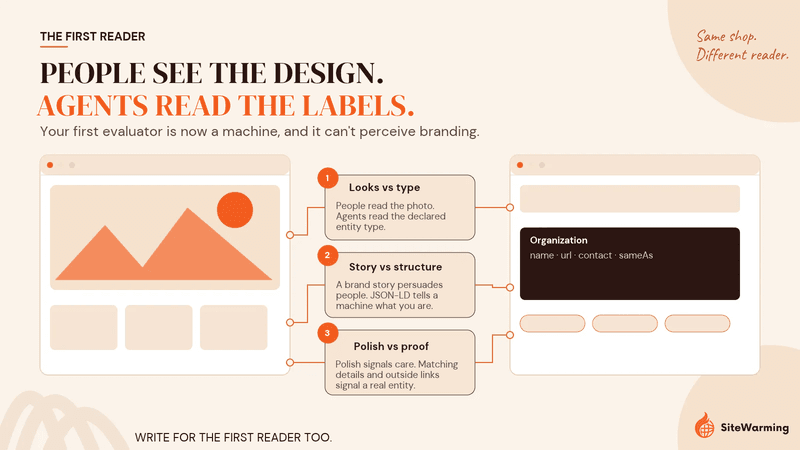
For two decades, deciding whether to trust a website worked like deciding whether to trust a restaurant. You judged the look, the polish, the consistency. Whole industries grew up around that judgment: brand guidelines, design systems, visual identity frameworks. All of it was built for one evaluator, a human looking at a screen.
AI agents don't scroll. They process structured data.
When ChatGPT or Perplexity assesses a page, aesthetics don't enter into it. The questions are mechanical. Is there a knowledge graph entry for this entity? Does the schema markup resolve? Do independent sources describe the same entity the same way?
Retailers are finding this out the hard way. When Adobe ran US retail sites through its AI Content Visibility Checker, the average homepage scored 75%, meaning roughly a quarter of its content was not readable by machines, and product pages averaged 66% (Adobe, April 2026). Those are pages built by teams with design budgets. The agent still can't read a quarter of them.
Research on generative engines points the same way. The study that named Generative Engine Optimization, by researchers from Princeton and IIT Delhi (Aggarwal et al.), found that adding citations, quotations and statistics can boost a source's visibility in AI-generated answers by up to 40%. For lower-ranked sites the effect was larger: adding cited sources lifted visibility by 115.1% for the website ranked fifth in search results, while the top-ranked site lost 30.3%. The advantage came from how verifiable and legible the content was. Nobody's branding improved.
Look at who AI actually cites. Profound's analysis of more than 700,000 ChatGPT conversations (US users, October to December 2025, published February 2026) found Wikipedia in nearly 1 in 6 conversations that carried citations, and behind about 5% of all citations. Encyclopedic, verifiable, visually plain. The system rewards clear identity, not polish.
Branding still matters to humans. But the first reader, the agent, can't perceive it. AI systems couldn't read parked domains. Agents go one step further: they can't verify an entity that has no structured identity to check.
The first reader is a machine. The machine reads identity infrastructure, the structured layer underneath the page. (If you want the broader case for writing for both human readers and machines, start with how to optimize for both Google and AI search. This post is about the narrower question of verification.)
Who verifies whom in agentic commerce?
Here's the part most coverage gets backwards. The payment networks' new protocols verify the agent to the merchant. They don't verify the merchant to the agent.
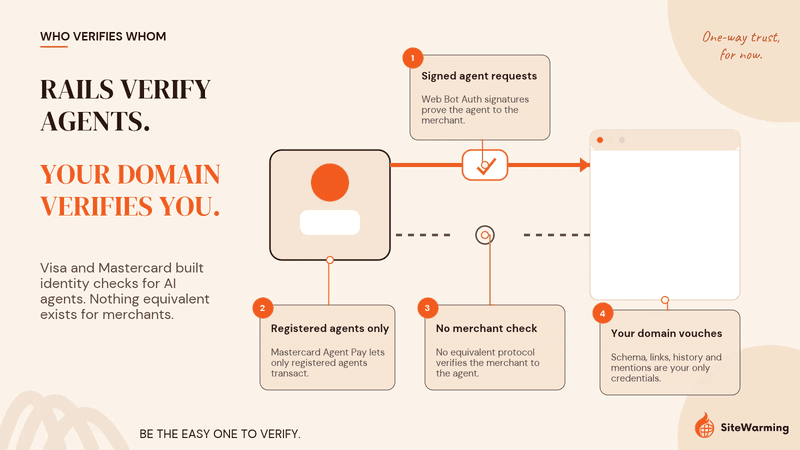
- Visa's Trusted Agent Protocol (announced October 14, 2025, developed with Cloudflare) lets approved agents pass information to merchants using "agent-specific cryptographic signatures." Visa calls it a way for an agent "to prove its identity and associated authorization directly to merchants," and still describes it as "in the process of development and deployment" (Visa Developer). By December 2025, Visa said partners had completed hundreds of real-world agent-initiated transactions.
- Mastercard Agent Pay centres on "registering and verifying AI agents before they are permitted to transact on the Mastercard network," using agentic tokens and purchase-intent data that covers "cart contents, transaction limits and validity windows" (Mastercard). Its product page now states the rule in five words: "Only registered agents can transact" (Mastercard Agent Pay).
- Both run on Web Bot Auth, an agent-authentication layer built on HTTP Message Signatures (RFC 9421), a standard way to attach a cryptographic signature to a web request (Cloudflare).
- The checkout protocols point the same way. Google's Agent Payments Protocol (AP2), donated to the FIDO Alliance in April 2026, keeps a tamper-proof record of what the user authorised an agent to do. The Agentic Commerce Protocol, created by Stripe, OpenAI and Meta, standardises checkout and delegated payment between agents and businesses. The Universal Commerce Protocol has the merchant publish a capability profile at
/.well-known/ucpon its own domain, including public keys for its messages. All three make agent transactions work. None of them independently confirms that the business is who it says it is.
| Direction | Who is checked | How | Status in September 2026 |
|---|---|---|---|
| Merchant verifies agent | The AI agent | Cryptographic signatures (Web Bot Auth), registered agents, agentic tokens | Built and rolling out: Visa Trusted Agent Protocol (in development and deployment), Mastercard Agent Pay (only registered agents transact) |
| Agent verifies merchant | Your business | Public, machine-readable signals on and about your domain | No equivalent trust check. Checkout protocols such as UCP let a merchant self-declare its capabilities on its own domain; nothing independently confirms the merchant is real. |
That second row is the gap. As Chris Jones of PSE Consulting put it in The Paypers (July 2026), "the payment industry is investing heavily in verifying AI agents as trusted buyers, but almost no equivalent mechanism exists to verify merchants as trusted sellers."
So when an agent has to decide whether you are real, there's no cryptographic handshake to lean on. It reads your domain. Your schema, your entity links, your consistency, your history and what others say about you are the whole of your credentials.
What do AI agents check before they recommend a business?
What agents look at is better documented than most people assume, and the priorities are consistent. There are five checks.
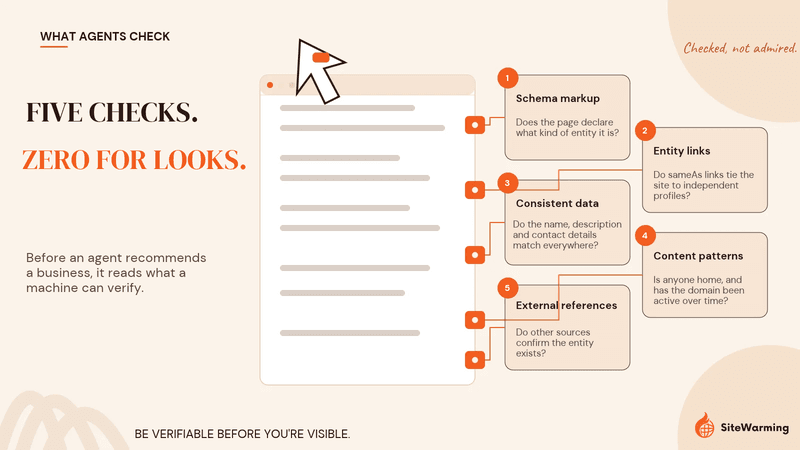
1. Schema markup: does the page say what it is?
JSON-LD is a block of code in the page head that describes the page in Schema.org vocabulary: this is an Organization, this is what it offers, these are its official profiles. Google says Organization markup helps it "better understand your organization's administrative details and disambiguate your organization in search results" (Google Search Central).
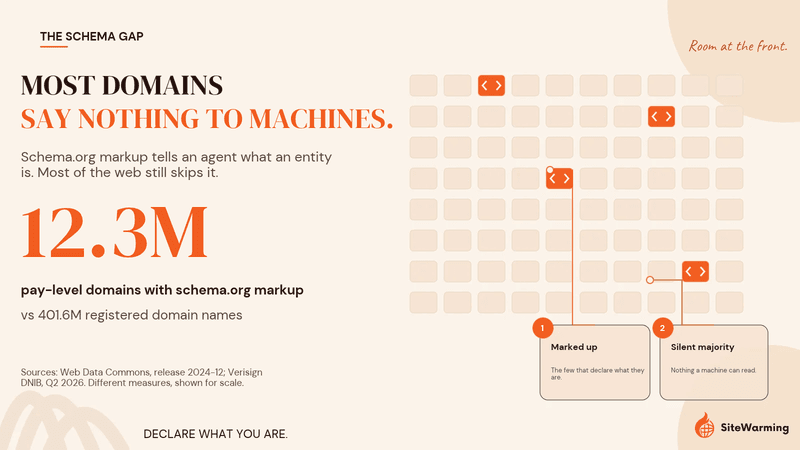
Most of the web still hasn't done it. In its most recent schema.org extraction (release 2024-12), Web Data Commons found schema.org markup on about 12.3 million pay-level domains. Verisign's Q2 2026 Domain Name Industry Brief counts 401.6 million registered domain names. The two datasets measure different things, but the order of magnitude is clear: marked-up domains are a small minority.
Schema is identity plumbing, not a ranking trick. Ahrefs tracked 1,885 pages that added schema between August 2025 and March 2026 and, in a study published in May 2026, found "no major uplift in citations on any platform," Google AI Mode and ChatGPT included. That fits the argument here rather than undercutting it. Schema tells a machine what you are. It doesn't make anyone believe you. That job belongs to the other four checks.
2. Entity linking: can the machine confirm you're the same "you" everywhere?
Schema.org defines sameAs as the "URL of a reference Web page that unambiguously indicates the item's identity," such as a Wikipedia page, a Wikidata entry or an official site (Schema.org). It's how a domain tells a machine that this company, this LinkedIn page and this directory listing are the same entity.
{
  "@context": "https://schema.org",
  "@type": "Organization",
  "name": "Example Co",
  "url": "https://www.example.com",
  "sameAs": [
    "https://www.linkedin.com/company/example-co",
    "https://www.wikidata.org/wiki/Q00000000"
  ]
}
When a site links its entities to external knowledge bases consistently, machines can tell it apart from similarly named entities and attribute information correctly. In a January 2026 case study, Schema App reported that adding entity links on its own site lifted Google AI Overview visibility for entity-related queries by 19.72% between October and December 2025. It's a vendor measuring its own product, so treat it as direction rather than proof, but the mechanism is the one that matters here: disambiguation. For which types to add first, see the structured data every domain should have before launch.
3. Consistent identity data: do your details agree with each other?
For a business, name, address and identifying details that match across platforms are a verification signal. An agent that finds three sources with three different descriptions doesn't conclude "rich brand voice." It concludes "unresolved entity."
4. Content patterns: is anyone home, and for how long?
Discovery systems track publishing consistency, depth and freshness over time, and they notice absence as much as presence. A domain that has existed for six years but published nothing for five tells a different story from one that has been active the whole time.
5. External references: does anyone else vouch for you?
Independent sources that confirm the entity exists are the one signal you can't manufacture yourself. News mentions, directories, industry sources and citations from other sites are evidence that the rest of the world acknowledges you. It's the same logic as the Princeton finding: content that cites and is cited is easier to trust. Trust built through verifiable signals is the principle. Agents just check it mechanically.
What is agentic identity?
These five signals add up to something that needs a name:
Agentic identity is the machine-readable sum of structured data, entity links, verification signals and activity patterns that AI agents use to evaluate whether a domain represents a real, transactable entity. It is distinct from brand identity (what humans perceive) and domain identity (what registrars record).
Your brand identity is what a human feels when they see your logo. Your domain identity is what a registrar records when you renew; that record is now being asked a second question, "is this real?" Your agentic identity is what a machine can actually verify about you. More and more, the last one decides whether you're visible.
| Brand identity | Domain identity | Agentic identity | |
|---|---|---|---|
| Who reads it | People | Registrars, DNS | AI agents and answer engines |
| What it's made of | Logo, design, voice, story | Registration record, DNS, age | Schema, sameAs links, consistent data, activity, outside references |
| What it answers | "Do I like and trust this?" | "Who controls this name?" | "Can I verify this is a real, transactable entity?" |
| Can you fake it? | Partly | No | Only the self-declared parts |
A note on the term: in security writing, "agentic identity" or "AI agent identity" usually means the identity of the agent itself. Okta defines it as "an autonomous system's unique, verifiable digital identity." That's the first row of the table in the previous section. This post is about the other side: the identity of the business the agent is evaluating.
Is verification the new branding?
None of this is theoretical. The infrastructure already exists, and it's built for verification, not for branding.
Start with transactions. Visa and Mastercard both chose cryptographic identity for agents, not better-looking checkout pages. Mastercard's framework even carries the buyer's intent as data: what's in the cart, the transaction limits, how long the authorisation is valid. The two largest payment networks each built verification systems for AI agents. Neither involves brand evaluation. Both are about entity verification.
Then standards. On February 17, 2026, NIST, the US agency that sets standards for encryption and identity, launched the AI Agent Standards Initiative through its Center for AI Standards and Innovation (CAISI). The initiative's page, last updated in August 2026, lists research into "agent authentication and identity infrastructure" as one of its three pillars. Its National Cybersecurity Center of Excellence published a concept paper on agent identity and authorization arguing that "identification, authentication, and authorization" should be applied so that agents "are known, trusted, and properly governed." Comments have closed, and the NCCoE project is reviewing them before drafting a project description. NIST publishes standards for identity, authentication and interoperability, not aesthetics. When that institution puts agent identity on its priority list, identity has become infrastructure rather than marketing.
The Cloud Security Alliance followed with the Agentic Trust Framework (February 2, 2026), which applies Zero Trust to AI agents. The principle is "never trust, always verify."
Then the numbers. Adobe measured traffic from AI sources to US retail sites up 393% year over year in the first quarter of 2026. As recently as March 2025, that traffic converted 38% worse than other visitors (Adobe, April 2026). By July 2026, AI-driven retail traffic was up 62% year over year and AI-referred visitors converted 60% better than non-AI traffic (Adobe Digital Insights, August 2026). An IBM and National Retail Federation study of more than 18,000 consumers in 23 countries found 45% already turn to AI during their buying journeys.
Agents are already transacting, already evaluating, and already selecting entities based on verifiable identity. The shift happened at the infrastructure layer while most domain owners were thinking about typography.
What is the identity stack AI agents read?
The signals agents evaluate aren't random. They stack. Each layer makes you more legible, and each depends on the ones below it.
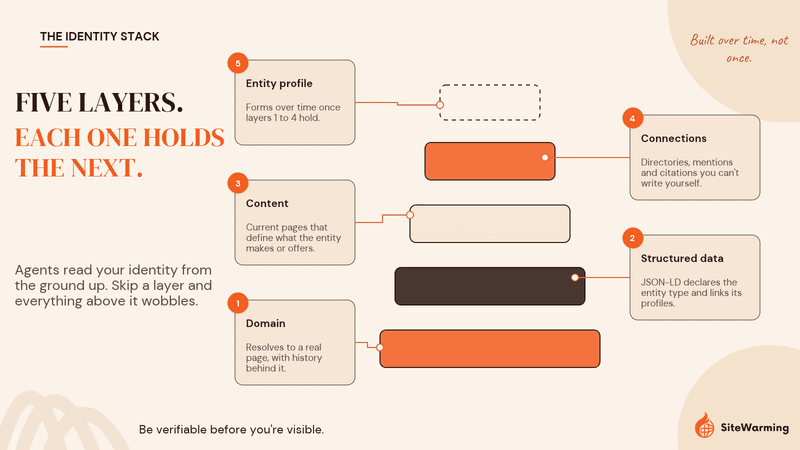
Layer 1: Domain
Does it resolve? Is it active? How long has it existed? Domain age and activity history are the foundation. A domain that resolves to a registrar placeholder looks, to an agent, much like a domain registered yesterday. Parked domains fail here, because they resolve to nothing an agent can interpret.
Layer 2: Structured data
Is there JSON-LD? Does it declare the entity type (Organization, Person, LocalBusiness)? Does it use sameAs to link to authoritative outside sources? This layer makes the entity machine-readable. The gap between "has a website" and "has a structured identity" is where most domains fall through.
Layer 3: Content
Does the content show what this entity makes, knows or offers? Is it current? Content with explicit definitions and verifiable claims gets cited more; that's the 40% lift in the Princeton study. This layer is about definitional clarity, content that answers "what is this entity?" in terms a machine can parse.
Most domain owners stop here, if they get here at all.
Layer 4: Connections
Do outside sources reference this entity? News, directories, industry sites? External references work as verification precisely because you can't produce them yourself. They're evidence that other entities in the world acknowledge you exist.
Layer 5: Entity profile
Has the entity built up enough signal across Layers 1 to 4 that discovery systems keep a persistent profile of it? Is there a knowledge graph entry? Can it be told apart from similar names? You don't build this layer directly. It forms over time, as the memory the internet keeps about a domain whether or not the owner takes part. The profile accumulates either way.
| Layer | The question the agent asks | Fails when | What fixes it |
|---|---|---|---|
| 1. Domain | Does this resolve to something real, and for how long? | Parked, placeholder or dead | A live page that states what the domain is |
| 2. Structured data | What type of entity is this, and where else does it exist? | No JSON-LD, no sameAs | Organization/WebSite schema with sameAs links |
| 3. Content | What does it make, know or offer? | Thin, stale or undefined | Current pages that define the entity plainly |
| 4. Connections | Does anyone else confirm it? | Self-declared only | Directory listings, mentions, citations |
| 5. Entity profile | Is there a persistent profile distinct from lookalikes? | Not enough signal in 1–4 | Time plus continuity across 1–4 |
This is the stack an agent reads when it decides whether you're verifiable.
Each layer is necessary. None is enough on its own. A domain with strong content and no schema is only partly legible. A domain with schema and no content is a skeleton with labels. A domain with both but no outside references is self-declared and unverified.
The stack builds over time. You don't configure it once. It keeps forming.
What does a parked domain look like to an AI agent?
It looks like nothing. That's the problem.
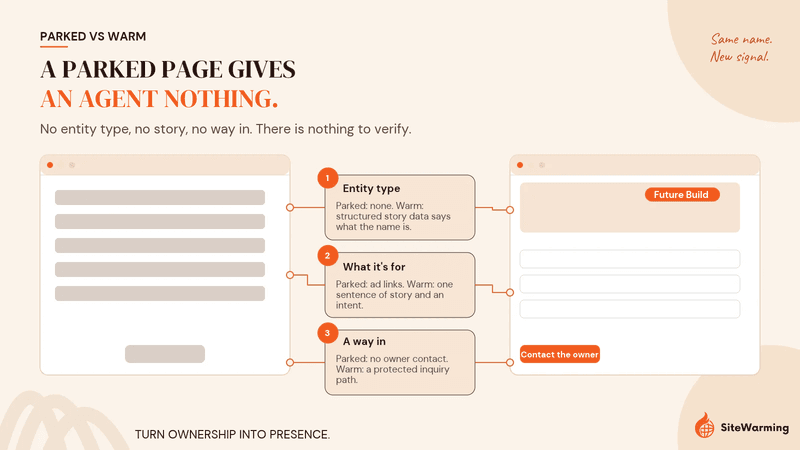
If you're a founder who registers names faster than you build on them, most of your portfolio sits at Layer 1 or below. A parked page or registrar placeholder has no entity type, no sameAs, no content that says what the name is for, and no one referencing it. There's nothing to verify, so there's nothing to recommend.
You never see the cost. Someone who wanted the name, a buyer, a partner or an agent working for either, looks, finds nothing it can confirm, and moves on. No inquiry arrives. The renewal still does. If you saw value in the name, someone else probably did too. They just couldn't find a real entity behind it.
You don't need a full product to fix this. A domain gets past Layers 1 and 2 as soon as it resolves to a real page that says what it is, in words and in structured data, with a way to reach the owner. That single page is what a warm site from Launch & Warm puts on a name you haven't built yet.
How do you check your own agentic identity?
You can run the basic check on one domain in about fifteen minutes.
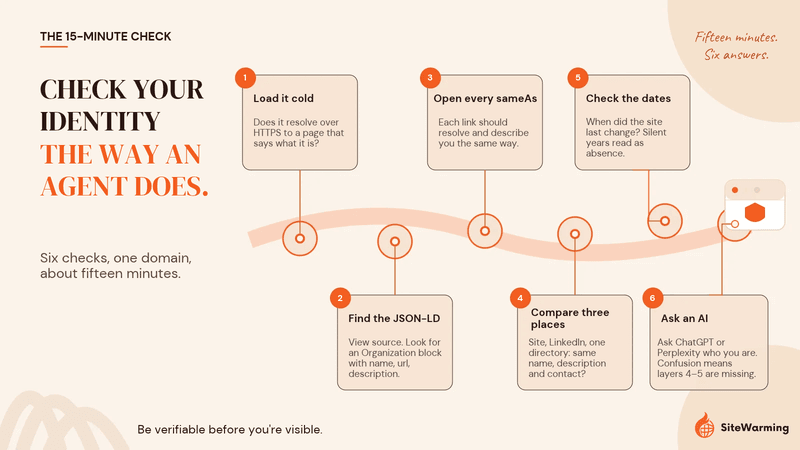
- Load the domain as a stranger would. Does it resolve over HTTPS to a page that says, in the first lines, what this entity is? If you see a parking page or a registrar placeholder, stop. You're failing Layer 1.
- View the page source and look for
application/ld+json. Is there an Organization (or Person, or LocalBusiness) block with aname, aurland adescription? - Check the
sameAslist. Open every URL in it. Does each resolve, and does each describe you the same way? - Compare your identity data in three places. Put your name, one-line description and contact details from your site, your LinkedIn page and one directory side by side. Any mismatch is a signal an agent will read as "unresolved."
- Check the dates. When was the site last updated? When was the last published page? Five silent years read as absence.
- Ask an AI assistant who you are. Type your business or domain name into ChatGPT or Perplexity. If it confuses you with a similarly named entity, or has nothing to say, Layers 4 and 5 are missing.
For the full version, with semantic HTML, robots.txt, sitemaps and meta tags, use the 30-minute machine-readability audit. If you hold dozens or hundreds of names across several registrars, run step 1 across the whole portfolio first. Seeing every domain across every registrar in one view, including which ones are live, which lead nowhere and which renew soon, tells you where the Layer 1 failures are before you spend time on the rest.
What does this mean for domain owners?
Your domain is your agent-readable identity. Not your social accounts, not your brand guidelines, not your logo. The domain and the structured content on it are what an agent checks first.
When an agent can't verify you, it can't recommend you. Not because you did anything wrong, but because it can't read you.
The obvious objection: "Branding and design are what make a business look trustworthy online." They make it look trustworthy to humans. But the first evaluator is no longer human. It reads identity infrastructure, not design. Branding without verification is a billboard in a language the evaluator doesn't speak.
The gap between structured and unstructured domains is measurable. Schema markup still sits on a small minority of domains. AI-referred traffic to retail sites keeps growing and now converts better than other traffic. Visa and Mastercard already require cryptographic identity from agents. The window for early positioning is narrowing.
The same evaluation pattern already drives email deliverability, where filters now look for evidence of a real presence on the domain, not just authentication records. It's extending into how agents choose what to cite, recommend and buy from. The surface keeps widening. The question stays the same: is there evidence of a real entity here?
Because so few domains have built this layer, owners who build it now hold a position that compounds. Not by gaming a system, but by being legible. Entity verification is quietly replacing brand reputation as the price of entry. This isn't a trend that reverses. Structural shifts accumulate.
For domain owners, the question has moved from "Will I need to deal with this?" to "What will an agent find when it checks?"
That gap, between owning a domain and having an identity on it, is where ideas become invisible. Not because they're bad, but because a machine can't read them.
The agent can't see your design. It can't read your tagline. It reads your identity infrastructure (structured data, entity links, verification signals) and decides whether you're worth recommending.
For most of the internet's history, identity was self-declared. Your brand was your identity. Your design was your proof. That worked because the evaluator was human, and humans read those signals fluently.
Identity was always what mattered. Humans judged it through aesthetics because that's what they could process quickly. Agents judge it through structure because that's what they can process completely.
The question hasn't changed. The evaluator has. In an agentic web, identity isn't self-declaration. It's verifiable fact. The difference between those two things is about to matter more than it ever has.
And most people are only at the start of building the second one.
How do you give every domain you own a verifiable identity?
The identity stack is manageable for one domain. The hard part is scale. Founders who buy names faster than they build end up with dark domains that no buyer, partner or agent can find, while the renewals keep arriving. Domainers hold hundreds of names across registrars, with renewal dates they can't miss and no clear view of which names deserve attention. The question becomes which domains to fix first, and SiteWarming splits that into seeing and acting.
See the whole portfolio. Our domain management tool puts every domain from every registrar in one view. You can add names one at a time, bulk-import a CSV, connect a registrar or use the MCP server. It shows which names are live, which lead nowhere and which are approaching renewal, and it fetches a HumbleWorth valuation and stacks appraisals from 15+ sources. That is a Layer 1 audit of your whole portfolio, plus the evidence for deciding which names to keep, warm, sell or drop.
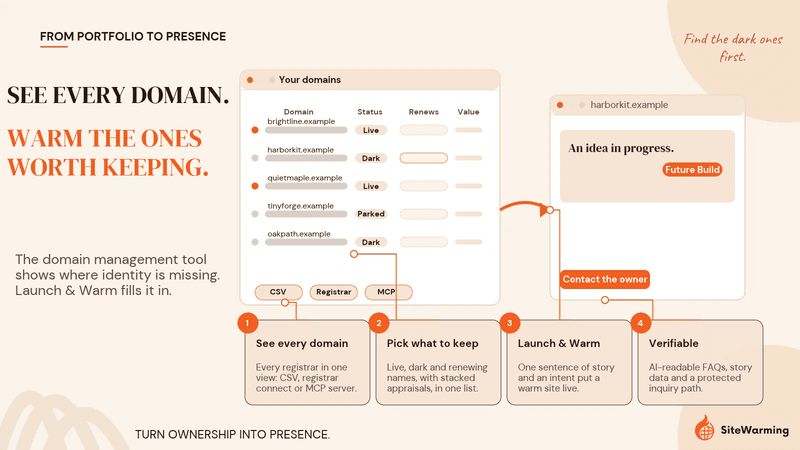
Act on the names worth keeping. Launch & Warm gives each of those domains the identity layer this post describes. You tell the domain's story in one sentence and choose an intent: Future Build, Open or Actively Selling. A warm site goes live with domain analysis, AI-readable FAQs, structured story data and a protected, anonymous inquiry path for buyers or partners, while DNS, HTTPS, hosting and ongoing DNS and SSL checks are handled for you. Layers 1 and 2 are covered the day the page goes live, and the monthly content updates start the activity record that the upper layers grow from.
The result is the parked-domain problem in reverse: when a buyer, a partner or an agent working for either checks the name, there is a real entity to find and a way to reach you.
Frequently asked questions
How do AI agents verify that a business is real? There is no cryptographic check for merchants yet, so agents read public signals. They look for JSON-LD schema that declares the entity type, sameAs links to independent profiles, name and contact details that match across sources, a record of recent activity, and references from other sites. When those signals are missing or contradict each other, the agent treats the business as unresolved and moves on.
What is agentic identity? Agentic identity is the machine-readable sum of structured data, entity links, verification signals and activity patterns that AI agents use to decide whether a domain represents a real, transactable entity. It differs from brand identity, which is what people perceive, and domain identity, which is what a registrar records. In security writing the same phrase often means the identity of the agent itself.
What is Visa's Trusted Agent Protocol? Visa's Trusted Agent Protocol, announced on October 14, 2025 and developed with Cloudflare, lets approved AI agents prove their identity to merchants with agent-specific cryptographic signatures. Each request is locked to the merchant's website and the exact page involved. Visa still lists it as in development and deployment. It verifies the agent to the merchant, not the merchant to the agent, so your domain still has to do that work.
Does schema markup help AI agents find my business? Schema markup helps machines understand what your business is and tell it apart from similar names. Google says Organization markup helps it disambiguate your organization. On its own it is not a citation lever: an Ahrefs study of 1,885 pages that added schema found no meaningful lift in AI citations. Treat schema as the identity layer that the other signals build on.
What does sameAs mean in schema markup? sameAs is a Schema.org property that lists URLs of reference pages which unambiguously identify an entity, such as its Wikipedia or Wikidata entry, LinkedIn page or official directory listings. Adding sameAs to your Organization schema tells machines that your website and those profiles describe the same business, which reduces confusion with similarly named entities.
Do you need a full website for AI agents to verify a domain? No. An agent needs something it can check, not a finished product. One live page over HTTPS that says what the domain is for, carries structured data declaring the entity, links to any profiles that confirm it, shows a recent date and offers a way to reach the owner clears the first two layers of the identity stack. A parked page clears none of them.
Share this article
Ready to Transform Your Domain Portfolio?
Start building real value with your domain investments today.