The Beginner's Guide to Making Your Website Machine-Readable
 Bret Siers
You built a website. You chose the colors, wrote the copy, agonized over the layout. You launched it and felt that specific relief of having something real on the internet.
Then you ran Google's Rich Results Test for the first time. And the screen came back blank.
Zero structured data. Zero rich results eligible. Forty pages of content, three years of work, and the machines visiting your site had been walking away with nothing the entire time.
I get it. That moment stings. Because you did the hard part. You built something worth reading. But nobody told you there were two audiences, and you'd only been talking to one of them.
The machines aren't just search engines anymore. They're the systems behind ChatGPT, Perplexity, Gemini. They're deciding who gets cited when someone asks for recommendations in your industry. And they can't read a beautiful page that doesn't speak their language.
This guide is every layer of that language. What it is. Why it matters now. And how to fix it in an afternoon.
What Machine Readability Actually Means
You already know what human readability looks like. Clean layouts, readable fonts, a navigation bar that makes sense. You optimize for how things look and feel.
Machine readability is something else entirely. It's whether Google's crawler, OpenAI's GPTBot, or Perplexity's indexer can extract actual meaning from your page. Not read the words. Extract the structure.
Here's the thing: a page can be stunning to humans and nearly invisible to machines at the same time. You've probably seen this yourself. A site that looks professional, reads well, feels polished. And the machines visiting it walk away with almost nothing useful.
What are machines looking for when they visit?
- Semantic structure. Does your HTML use proper heading tags (H1, H2, H3) in a logical hierarchy, or is everything styled with CSS and
<div>tags? - Schema markup. Does your page include JSON-LD that tells machines what type of content this is, who wrote it, what it's about, how to contact you?
- Entity signals. Do you consistently name your organization, your location, your people in structured, parseable ways?
- Metadata. Title tags, meta descriptions, Open Graph tags, canonical URLs. These are machine instructions, not just display text.
- Crawlability. Can machines even access your pages? Or are you blocking them accidentally through misconfigured robots.txt, JavaScript-heavy rendering, or Cloudflare settings?
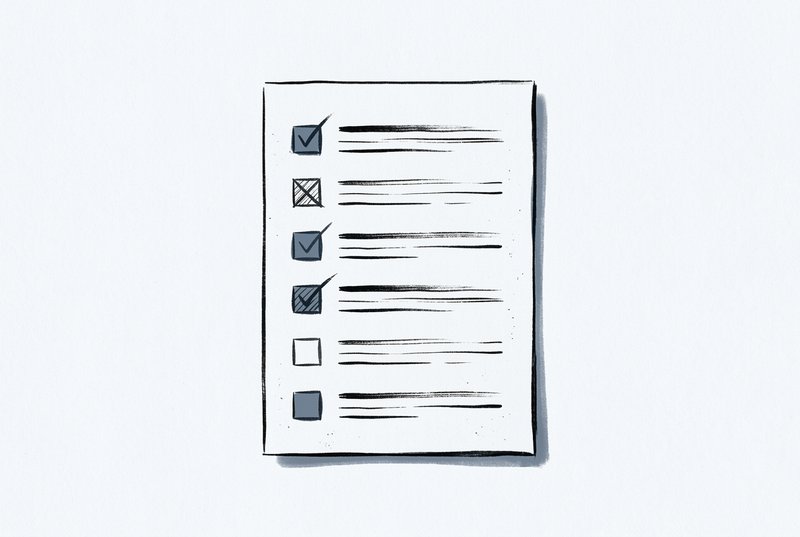
That's the checklist. And most sites fail on three or more of those items without knowing it.
Google has maintained two separate evaluation pipelines since 2019: a human quality rater system and a machine-crawling pipeline. Human raters assess content quality. Machine crawlers assess structure, signals, and parsability. You need to satisfy both audiences. Most people only know about the first one.
Googlebot crawls approximately 15 billion pages per day, according to Google's own technical documentation. At that scale, your site gets visited for seconds, not minutes. The crawler needs to extract meaning instantly. If it can't, it moves on. No second chances.
AI systems are even less patient. They're working from indexed data and training sets. A page that doesn't signal its structure, its purpose, and its entity clearly doesn't get summarized, cited, or recommended. It just gets skipped.
The Three Layers of Machine Readability
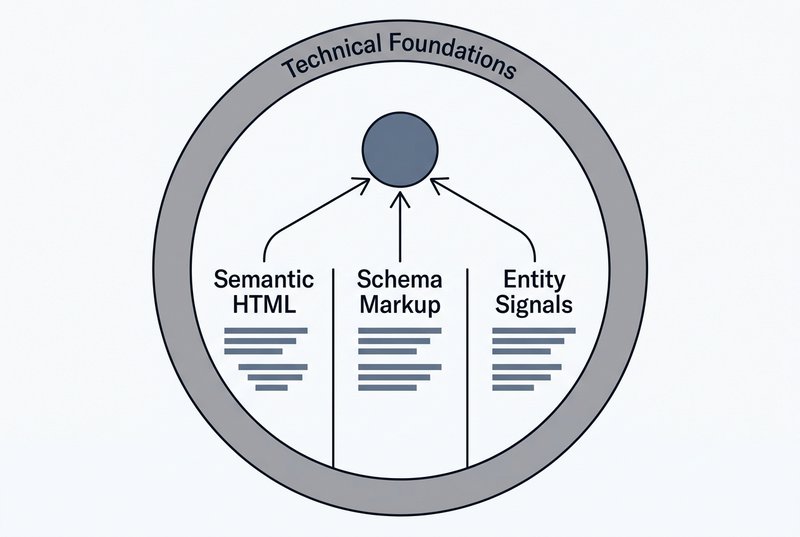
Think of machine readability as a stack with three levels. You need all three. Most sites have one. Some have none.
Layer 1: Semantic HTML (The Foundation)
This is the one you'd assume your website already handles. And it might. But I've seen sites built by professional agencies that fail this check completely.
Before schema markup, before AI optimization, your HTML needs to communicate structure to machines through proper element usage. That means your page has exactly one <h1> tag that names the page clearly. Your <h2> tags are section headers, not styled decorative text. Your navigation uses <nav> elements. Your articles are wrapped in <article> tags. Your site header uses <header>. Your footer uses <footer>.
When machines see proper semantic HTML, they understand the hierarchy of your content without needing to interpret your CSS. They know where the main content lives, where the navigation sits, where the important headers are.
Most websites built with drag-and-drop builders do this poorly. They generate what developers call <div> soup: every element wrapped in generic containers with no semantic meaning. The design looks fine. The machine reads noise. And you'd never know from looking at your own site.
The quick audit: Right-click any page, view source. Search for your <h1> tag. If there are multiple, fix that. Check whether your navigation has a <nav> element. Check whether your main content is wrapped in <main>. If it's all <div> tags, you have work to do. The good news: this is usually fixable in your CMS settings.
Layer 2: Schema Markup (The Signal Layer)
If Layer 1 is speaking clearly, Layer 2 is introducing yourself. Schema markup is structured data, written in JSON-LD format, that tells crawlers exactly what type of thing your page represents. It's how you go from "there's text on this page" to "this is an article by this author, published on this date, about this topic."
Schema.org is the vocabulary. It was developed and is maintained jointly by Google, Bing, Yahoo, and Yandex. That cross-engine standard means implementing schema markup signals your content to every major discovery system simultaneously. One implementation, every machine listening.
The five schema types every site needs:
Organization tells machines who you are.
{
  "@context": "https://schema.org",
  "@type": "Organization",
  "name": "Your Company Name",
  "url": "https://yoursite.com",
  "logo": "https://yoursite.com/logo.png",
  "contactPoint": {
    "@type": "ContactPoint",
    "telephone": "+1-555-000-0000",
    "contactType": "customer service"
  }
}
WebSite enables sitelinks search box and tells machines the site structure.
{
  "@context": "https://schema.org",
  "@type": "WebSite",
  "name": "Your Site Name",
  "url": "https://yoursite.com"
}
Article marks your content as a specific authored piece.
{
  "@context": "https://schema.org",
  "@type": "Article",
  "headline": "Your Article Title",
  "author": {
    "@type": "Person",
    "name": "Author Name"
  },
  "datePublished": "2026-03-21",
  "dateModified": "2026-03-21"
}
FAQPage is one of the highest-value schema types for AI citation. Machines parse FAQ schema to extract clean question-and-answer pairs.
{
  "@context": "https://schema.org",
  "@type": "FAQPage",
  "mainEntity": [
    {
      "@type": "Question",
      "name": "What is machine readability?",
      "acceptedAnswer": {
        "@type": "Answer",
        "text": "Machine readability is the degree to which automated systems can extract structured meaning from your web content."
      }
    }
  ]
}
BreadcrumbList tells machines where this page sits in your site hierarchy.
{
  "@context": "https://schema.org",
  "@type": "BreadcrumbList",
  "itemListElement": [
    {"@type": "ListItem", "position": 1, "name": "Home", "item": "https://yoursite.com"},
    {"@type": "ListItem", "position": 2, "name": "Blog", "item": "https://yoursite.com/blog"},
    {"@type": "ListItem", "position": 3, "name": "This Article", "item": "https://yoursite.com/blog/this-article"}
  ]
}
These go in your page's <head> or at the bottom of your <body> in <script type="application/ld+json"> tags. They're invisible to human readers. They're the primary language AI systems use to understand your pages.
For a deeper dive on exactly which schema types matter for small sites and why, read Schema Markup for Small Websites: Do You Actually Need It?. The short answer: yes.
Layer 3: Entity Signals (The Trust Layer)
This is the layer that catches people off guard. You can nail Layers 1 and 2 and still wonder why machines aren't citing you with confidence. When that happens, the answer is almost always here.
Schema markup tells machines what your page is. Entity signals tell machines who you are. Not just on one page. Consistently, across the web.
Here's what I mean by entity: a clearly defined, uniquely identifiable thing. A person, organization, place, or concept. Google builds entity graphs. AI systems use entity recognition. When your organization is consistently named and described the same way across your site, your schema markup, your social profiles, and any external mentions, machines build a confident picture of who you are. When those signals are fuzzy, the picture is fuzzy too.
I've seen this trip up people who've done everything else right. They have good content. They have schema markup. But their company is "Acme" on the homepage, "Acme Co." on the about page, and "ACME Technologies" in their schema. The machine sees three entities, not one.
What consistent entity signals look like:
- Your organization name is identical across your website, your schema markup, your social profiles, and any directories you appear in.
- Your author bylines match your schema Person markup.
- Your address (if you're a local business) is formatted identically everywhere.
- Your area of expertise is consistently described in the same language.
The machines aren't punishing you for inconsistency. They're just more likely to cite the source they understand clearly. Consistency is confidence. Confidence is citation.
The 30-Minute Machine Readability Audit
Here's the thing: you can run this entire audit in under 30 minutes. And most people who do discover something uncomfortable. They have Layer 1 problems, no Layer 2, and have never thought about Layer 3. That's not a failure. It's just a gap nobody told them about. Now you know, so let's close it.
Step 1: Check Your Semantic HTML (5 minutes)
Go to any page on your site. Right-click, view page source. Search for these elements:
<h1>should appear exactly once per page<nav>should wrap your navigation<main>or<article>should wrap your primary content<header>and<footer>should be present
If your page source is mostly <div> and <span> tags with class names, your semantic structure needs work.
Fix: In most CMS platforms, you can correct this through theme settings or custom HTML blocks. In WordPress, the block editor uses semantic tags by default. Older page builder sites often need manual correction.
Step 2: Test Your Schema Markup (5 minutes)
Go to Google's Rich Results Test and enter your URL.
What you want to see: detected schema types, no errors, eligible rich result types listed.
What most sites see: "No items detected." This means machines arrive at your page and find no structured data at all.
Google's Rich Results Test shows you exactly which rich results a page qualifies for based on its structured data. It's a free tool. It takes 30 seconds to run. Run it on your homepage, your main article or product page, and your contact page.
Step 3: Check Your robots.txt (5 minutes)
Go to yoursite.com/robots.txt. Read it.
If it says User-agent: * / Disallow: /, you're blocking every crawler from every page. That's the nuclear option and it's more common than you think, especially on staging sites that were never un-locked.
You also want to check whether you're inadvertently blocking AI-specific crawlers. GPTBot (OpenAI's crawler), ClaudeBot (Anthropic's crawler), and PerplexityBot all read robots.txt. If your security plugin or CDN is blocking these agents, you're invisible to the AI systems they feed.
For a full explanation of how AI crawlers behave and how to configure access intelligently, see How AI Crawlers Decide What to Index (And What They Skip).
Step 4: Verify Your Sitemap (5 minutes)
Go to yoursite.com/sitemap.xml. If you get a 404, you don't have a sitemap submitted.
A sitemap tells machines which pages exist on your site and when they were last updated. Without it, crawlers discover your pages through link-following. That's slower and less reliable, and pages buried deep in your site may never get indexed.
Submit your sitemap to Google Search Console and Bing Webmaster Tools. Both are free. Both give you confirmation that machines know your pages exist.
Step 5: Check Your Meta Tags (5 minutes)
If you've made it this far, you already know more about your site's machine readability than most site owners ever learn. This next one is quick.
For each major page, check that you have:
- A unique
<title>tag (not duplicated across pages) - A
<meta name="description">that summarizes the page in 150-160 characters - Open Graph tags (
og:title,og:description,og:image) for social sharing parsing
These aren't visible to your site visitors. They're metadata instructions for machines. When they're missing or duplicated, machines have lower confidence in what your page is about.
Step 6: Run the Entity Consistency Check (10 minutes)
Pick your organization name as it appears on your homepage. Now search for it across:
- Your About page
- Your schema Organization markup (if you have it)
- Your contact page
- Any social profiles linked from your site
Are they identical? Same spelling, same capitalization, same format?
If they're inconsistent ("Acme Co." vs "Acme Company" vs "ACME"), that's entity fragmentation. Fix it by standardizing the exact string everywhere and matching it in your schema markup.
The Machine Readability Checklist
Run through this after completing the audit above.
Layer 1: Semantic HTML
- Single
<h1>per page - Navigation wrapped in
<nav> - Main content in
<main>or<article> - Heading hierarchy is logical (H1 > H2 > H3, no skipping)
- No duplicate title tags across pages
Layer 2: Schema Markup
- Organization schema on homepage
- WebSite schema on homepage
- Article or BlogPosting schema on all articles
- FAQPage schema on any pages with Q&A content
- BreadcrumbList schema on interior pages
- Validated with Google's Rich Results Test (zero errors)
Layer 3: Entity Signals
- Organization name is identical everywhere on the site
- Author names match their schema Person markup
- Local address (if applicable) is formatted identically everywhere
- Topic/expertise language is consistent across pages
Technical Foundations
- robots.txt exists and doesn't block all crawlers
- Sitemap exists at
/sitemap.xmland is submitted to Search Console - No JavaScript rendering issues blocking content from machines
- Canonical tags are set on all pages
What to Add Next
Once you've completed the baseline audit and added the five core schema types, here's how you expand:
For local businesses: Add LocalBusiness schema with your NAP (name, address, phone) and business hours. This is the highest-value schema type for local discovery.
For sites with reviews: Add Review or AggregateRating schema. Machines parse this for knowledge panels and answer summaries.
For sites with products: Add Product and Offer schema. E-commerce sites that skip this are invisible to AI product comparison queries.
For sites with events: Add Event schema with dates, locations, and descriptions. AI calendaring and recommendation systems parse this directly.
The path forward for any of this is the same: add the JSON-LD to your page head, validate with Google's Rich Results Test, monitor in Search Console for errors.
The Two-Audience Reality
Here's what makes machine readability different from every other improvement you can make to your site.
Humans compensate. They scroll past broken layouts. They forgive confusing menus. They'll find you through word of mouth or a memorable URL even if your site is a mess. Humans are generous that way.
Machines don't compensate. They arrive, they parse, they leave. If the signals aren't there, you don't exist in that system's understanding of the world. There's no second visit. There's no benefit of the doubt.
The internet now has two audiences. One reads for meaning. The other reads for signal. And in 2026, the signal-reading audience is growing faster.
So here's the honest question: if someone is asking ChatGPT or Perplexity about your industry right now, are they seeing your name? Or are they seeing the three competitors who spent an afternoon adding JSON-LD to their pages six months ago?
The gap between "built for humans" and "readable by machines" isn't a technical abyss. It's the checklist you just ran. Most of the fixes take an afternoon. The hardest part is knowing the gap exists. Now you do.
For how to address that specifically, see What Is GEO? A Guide to Generative Engine Optimization in 2026 and How to Get Your Site Into ChatGPT and Perplexity Answers.
And if your domain has been sitting without any content at all, the machine readability problem starts further back than this guide. See Why AI Can't Read Your Parked Domain and Can a Domain With No Content Show Up in AI Search? for why the starting point matters.
The sites that figure this out first don't need to outspend anyone. They just need machines to understand what they're about. That's the whole thing.
The SiteWarming perspectiveMachine readability isn't a technical project you do once. It's the foundation every other form of visibility is built on. When SiteWarming activates a domain, machine readability is built into the foundation from the start: semantic structure, schema markup, entity signals, crawl access, sitemap registration. The gap between an active domain and a dark one isn't content volume. It's whether the machines reading the internet know your idea is real. What is SiteWarming?
Related Reading
- What Is GEO? A Guide to Generative Engine Optimization in 2026
- Why AI Search Engines Ignore Most Websites (And What to Do About It)
- How to Get Your Site Into ChatGPT and Perplexity Answers
- Schema Markup for Small Websites: Do You Actually Need It?
- How AI Crawlers Decide What to Index (And What They Skip)
- Can a Domain With No Content Show Up in AI Search?
- Two Audiences of Every Domain
- Why AI Can't Read Your Parked Domain
Image Credits
- Hero: Photo by Nicolas HIPPERT on Unsplash
Share this article
Ready to Transform Your Domain Portfolio?
Start building real value with your domain investments today.