Does Structured Data Help AI Search? What Schema Markup Really Does for Your Domain
 Bret Siers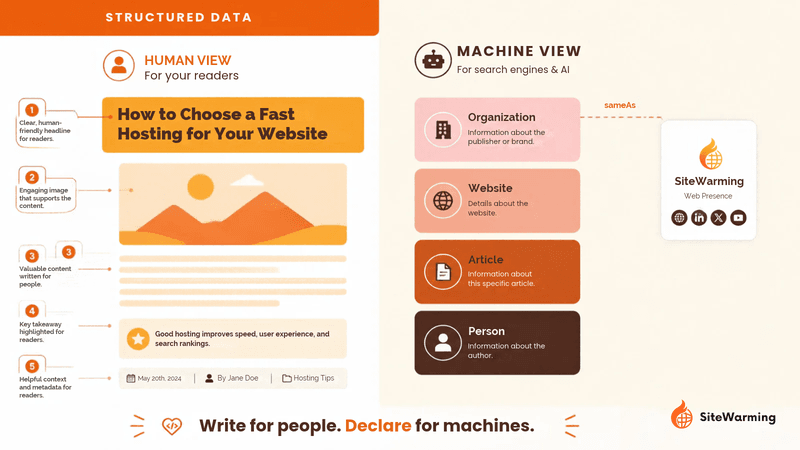
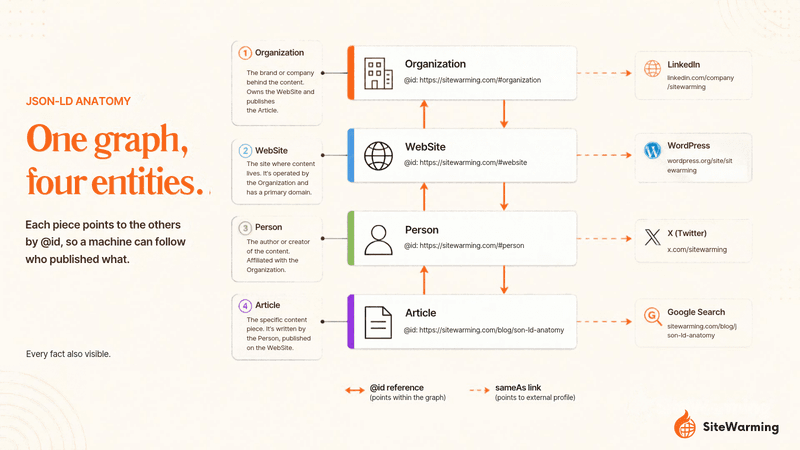
as a machine reads it, with schema entities labeled
Structured data helps machines identify who published a page, who wrote it and what entities it describes. It is not a proven citation booster: Ahrefs' controlled 2026 study of 1,885 pages found no meaningful lift from adding schema, and Google says its AI features need no special markup. Treat JSON-LD as an identity layer, not a shortcut.
I published a piece on one of my domains last year. Spent real time on it. Wrote something I was genuinely proud of, put it on a domain I'd been accelerating for months. Then I asked ChatGPT a question my article directly answered.
My domain didn't appear. Not in the answer. Not in the citations. Not anywhere.
The content existed. It was indexed. But the AI system pulled from three other sources that said essentially the same thing, with less depth. The difference I could find wasn't better writing. It was JSON-LD schema markup declaring what the content was, who wrote it, what entities it referenced.
That gap between "exists" and "gets cited" sat with me for days. I kept going back to it. Not because I was frustrated about the visibility. Because I realized the problem wasn't my writing. It was that I'd never introduced my writing to the machines reading it.
Then I did what I should have done first: I went looking for the evidence. It is more mixed than the confident statistics circulating online suggest, and that changes how I would tell you to think about schema. This article is what I found, what I still believe, and the minimum a domain should carry, including a domain with no site on it yet.
What is structured data, and what is structured content?
The phrase "structured content" gets thrown around loosely, so let me define it precisely.
Structured content is content that carries machine-readable descriptions of what it is, who created it, and what entities it represents. It enables discovery systems, AI models, and evaluation systems to parse, cite, and verify it without human interpretation.
It's not a separate layer from the content humans read. It's the same content, translated into a vocabulary machines understand.
That vocabulary has a name: Schema.org. It was created in 2011 by the major search engines, Bing, Google and Yahoo, and later joined by Yandex, as ACM Queue's history of the project puts it. Not one company's proprietary format. A shared language, agreed upon by competing search engines, for describing what things are.
The scale tells the story. The current Schema.org release, V30.1 (September 16, 2026), lists 826 types, 1,540 properties, 19 datatypes, 96 enumerations and 544 enumeration members. Those counts change with every release, so check the page before you quote them. That's not a markup trick. That's a taxonomy for describing reality in terms machines can interpret.
The implementation format that matters is JSON-LD: JavaScript Object Notation for Linked Data. It sits alongside your HTML in a script block, describing the page's content in machine-readable terms without modifying the visible page at all. Google recommends JSON-LD "as it's the easiest solution for website owners to implement and maintain at scale," while noting that all three formats (JSON-LD, Microdata and RDFa) are equally fine as long as the markup is valid. Adoption follows that advice: W3Techs reports JSON-LD on 55.7% of all websites as of September 2026, and the 2024 Web Almanac found it on 41% of pages, up from 34% in 2022.
For domain owners, the schema types that matter most are straightforward:
| Schema type | What it declares | Where it goes |
|---|---|---|
| Organization | Who you are, what you do, where your verified presence lives | Homepage or About page |
| Person | Who is behind the domain and the content | Inside Article and Organization markup |
| Article | What you published, who wrote it, when, about what | Every article |
| WebSite | What this domain is as a navigable entity | Homepage |
| FAQPage | Which questions the page answers | Pages with a real FAQ (see the rich-result caveat below) |
These don't change how your page looks to a human visitor. They create a machine-readable identity layer. Not a visual layer. An interpretive one. The machine no longer has to guess what your page is. You told it directly.
Without them, your content exists but can't introduce itself.
Does structured data actually help AI search citations?
Not in the way most articles claim, and I include my own earlier version of this post in that. The honest answer has four parts.
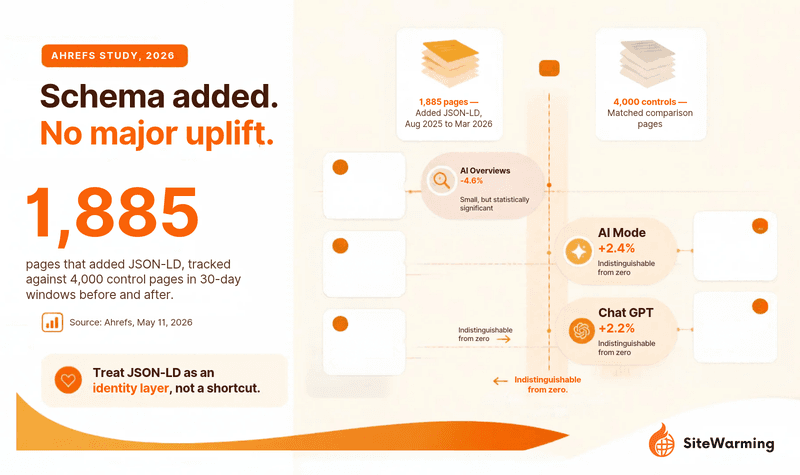
1. The best controlled study found no meaningful citation lift. In May 2026, Ahrefs published a study that tracked 1,885 pages that added JSON-LD schema between August 2025 and March 2026, against 4,000 control pages, using a matched difference-in-differences design and 30-day windows before and after. Citations in Google AI Overviews moved -4.6% (statistically significant but small), while Google AI Mode (+2.4%) and ChatGPT (+2.2%) were indistinguishable from zero. Ahrefs' own conclusion: adding schema produced no major uplift in citations on any platform. The caveat that matters: the study only covered pages already earning 100 or more AI Overview citations a month, so it says little about pages the systems have not yet noticed. It also notes that 53% of AI-cited pages use schema, which reflects correlation. Sites that invest in schema tend to invest in everything else too.
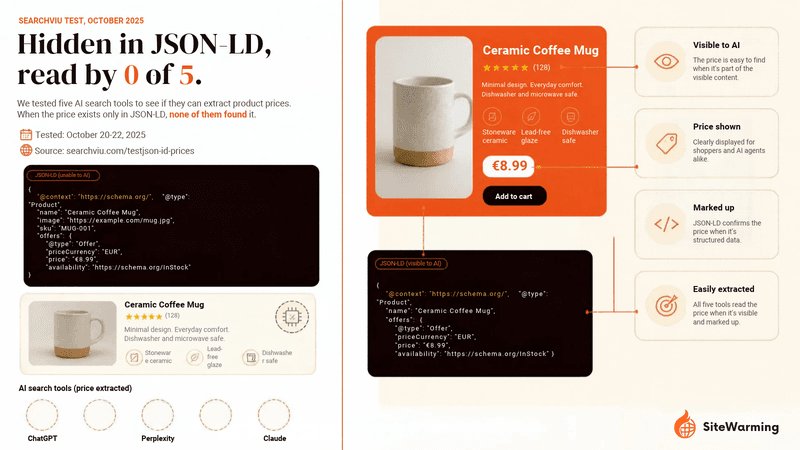
2. Direct-fetch AI assistants may not read JSON-LD at all. SearchVIU tested ChatGPT, Claude, Gemini, Perplexity and Google AI Mode in October 2025 on a purpose-built page. A price that appeared only in JSON-LD (EUR8.99) was extracted by none of the five. Hidden Microdata and hidden RDFa prices were not recognized either. Their headline finding: JSON-LD schema is not read by AI chatbots during direct fetch, though it could still be used earlier, at indexing, particularly by search-integrated systems. I need to correct what I wrote before. SearchVIU did not show that these assistants process schema. It showed they ignore structured data that isn't also visible on the page.
3. Google says AI features need no special markup. Its AI features documentation states: "There's also no special schema.org structured data that you need to add," and that you don't need new machine-readable files, AI text files or markup to appear in AI Overviews and AI Mode.
4. The platforms that do use it use it to understand content. Google says structured data provides "explicit clues about the meaning of a page" and helps it learn about the people, books or companies in the markup. At SMX Munich, Microsoft's Fabrice Canel said schema markup helps Microsoft's LLMs understand your content (Search Engine Land, March 20, 2025). Understanding is not the same claim as citing.
| Claim | What the evidence supports | Verdict |
|---|---|---|
| Adding schema raises AI citations | Ahrefs' controlled study: no meaningful lift | Not supported |
| AI assistants read JSON-LD when they fetch a page | SearchVIU: none of five extracted a JSON-LD-only price | Not supported for direct fetch |
| Google needs special schema for AI Overviews | Google: no special schema.org markup required | Not required |
| Schema helps search engines understand a page | Google and Microsoft both say so | Supported |
| Markup must match visible content | Google's guidelines: don't mark up content that isn't visible | Required |
You may also have seen three numbers attached to BrightEdge: that 82.5% of AI Overview citations come from pages with structured data, that marked-up pages are three times more likely to be cited, and that schema brings a 44% citation increase. The first version of this article repeated them. I went to the BrightEdge article they are attributed to, and none of the three appears there. It says only that pages marked up clearly are easier for Google to parse into its knowledge graph, making them more likely to be cited. That is a vendor's qualitative claim, from a company that sells structured data tooling, with no measurement behind it. An independent evidence review by Daniel K. Cheung reaches the same conclusion about the 44% figure and finds that the controlled studies show null or slightly negative results. I removed the numbers rather than repeat them.
So why does structured data still matter?
Because citation is not the only job it does. It is the cheapest way to state, once and unambiguously, who you are.
An AI system or search engine that meets a domain has to decide what it is looking at. A Person with a sameAs link to a LinkedIn profile, an Organization with a stable @id, an Article that names its author and dates: these let a system resolve your page to an entity it can check, instead of inferring one from prose. That is disambiguation, and it is the part of the story that survives every study above. It is also the part I think my ChatGPT experience was really about. I cannot prove schema was why the other three sources won. I can say that my page gave a machine less to verify than theirs did.
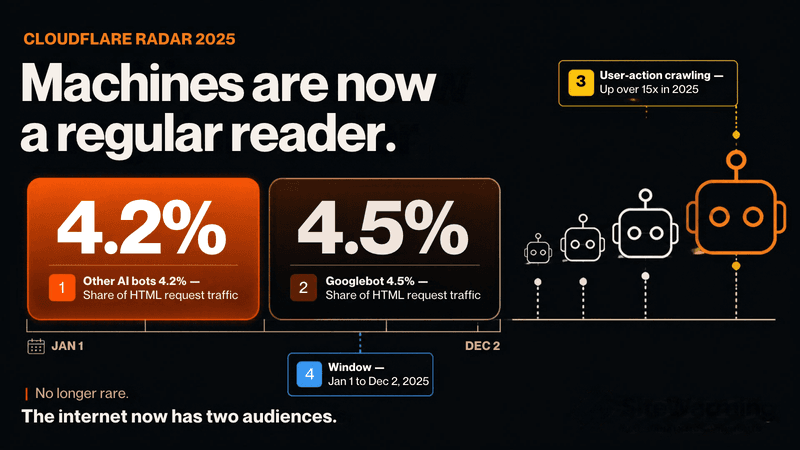
Machine readers are no longer rare. In its 2025 Year in Review, Cloudflare reported that while other AI bots accounted for 4.2% of HTML request traffic, Googlebot alone accounted for 4.5%, and that AI "user action" crawling, bots that fetch a page in real time when someone asks an AI assistant a question, increased by over 15x in 2025 (data from January 1 to December 2, 2025).
That last number is the one worth sitting with. There is a class of reader that visits your domain not because a person clicked a link, but because someone asked an AI system a question and the system came to your page looking for the answer. When it arrives, it isn't reading your page the way you read it.
Do machines read structure or style?
Structure. When a human visits your page, they see design. Layout. Typography. Images. They infer meaning from visual hierarchy. Understanding is automatic. A machine sees HTML, and most HTML describes how things look, not what things are. A <div> with class="hero-section" tells a machine nothing about the entity it represents. A beautifully formatted FAQ section without FAQPage markup is just paragraphs with question marks in them.
The SearchVIU result adds the rule that matters most in practice. Google's structured data guidelines say it plainly: "Don't mark up content that is not visible to readers of the page." Structure reinforces visible content. It doesn't replace it. Structure without substance is invisible. Substance without structure is noise.
The internet now has two audiences. The human audience reads the content. The machine audience reads the structure. Both must exist on the same page. Two formats for the same information. The human format is what you write. The machine format is what you declare.
What happened to rich results, and did schema stop mattering?
Structured data was sold to website owners as a visibility tactic. Add FAQ schema to get expandable snippets in search results. Add Article schema to get the headline displayed with a thumbnail. The pitch was simple: more visual real estate on the results page. Then Google took the visual rewards away, one feature at a time.
| Date | What Google changed | Source |
|---|---|---|
| Aug 2023 | FAQ rich results limited to well-known, authoritative government and health sites; HowTo rich results restricted to desktop, then removed from desktop on September 14 | Search Engine Journal; Seer Interactive |
| Nov 21, 2024 | Sitelinks search box removed | Search Engine Land |
| June 2025 | Seven features phased out: Book Actions, Course Info, Claim Review, Estimated Salary, Learning Video, Special Announcement, Vehicle Listing | Search Engine Journal |
| Nov 2025 | Practice problem markup no longer shown | Google Search Central changelog |
| May 7, 2026 | FAQ rich results stop appearing in Google Search entirely | Google's FAQ documentation |
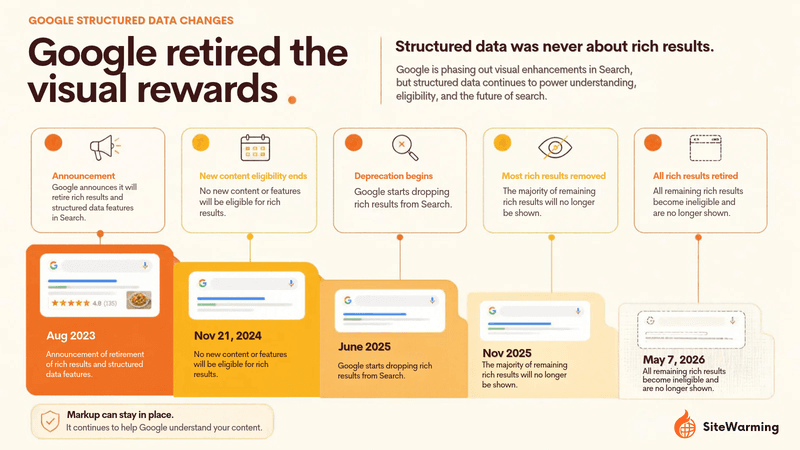
Two things in that table are worth knowing. First, Google has not removed everything: Article, Breadcrumb, Organization, Q&A and Dataset remain in its Search Gallery, which was last updated June 15, 2026. Second, Google was explicit that removal does not make old markup a liability. On the sitelinks search box it said "there's no need" to remove it, and that unsupported structured data "won't cause issues in Search." For FAQ, Google's documentation says the markup can stay in place.
What happened next is the part that matters. People who had added schema purely for the visual rewards started removing it. The display hack was gone, so the schema was gone. I think that is where most people get the story wrong. They see the rich results disappear and assume the schema became worthless. But schema markup isn't a way to decorate search results. It's a communication protocol with machines. It tells discovery systems what your content is, who created it, and what questions it answers. Whether or not that information generates a visual snippet is secondary.
The reframe is this: structured data was never about rich results. Rich results were one temporary expression of a permanent need. The permanent need is that machines need a way to understand what content represents. Schema markup is one way. It was always an identity layer. We just called it a display trick because display was the only visible output.
Why do studies showing a schema benefit look so convincing?
Because, as the Cheung review above puts it, the studies that show a benefit lack a control group, while the ones with controls find null or slightly negative results. Pages that carry rich, correct schema also tend to be pages with strong authors, current content and clear headings. When a system cites them, schema gets the credit for work done by everything around it.
That does not make the tactical advice go away. It changes what I would promise you. I would not tell you schema will make an AI system cite you. I would tell you three things I still hold to:
- A domain without declared identity gives a machine nothing to verify. Every claim it makes about you comes from inference.
- Schema costs an afternoon, and the downside is small. Ahrefs' one negative figure was a small decline on AI Overviews, and Google says unused structured data does not cause problems in Search.
- The visible page is what gets read. Put the answer, the author and the date on the page first. Then declare them.
What is the minimum structured data a domain needs?
If your domain has content but no structure, machines see noise. They can extract text, sure. But they cannot verify what it represents. They cannot confidently attribute it. They cannot build a reliable entity profile from it. The minimum that makes a domain legible is not complicated. It is specific.
Organization schema on your homepage. This declares who you are, what you do, and where your verified presence lives. Google recommends placing it on your home page or a single page that describes your organization, and lists name, url, logo, sameAs, description and contactPoint among the recommended properties. The sameAs property links your organization to authoritative external profiles: LinkedIn, social accounts, Wikidata if you have an entry. The @id property creates a unique internal reference so systems can disambiguate you from any other entity with a similar name. That is entity verification in practice: you're not just saying you exist, you're providing external references a system can check. Adoption is thin. In the 2024 Web Almanac, Organization appeared in JSON-LD on only 7.16% of mobile pages.
Article schema on each piece of content. Google's Article guidance recommends author (with name and url), datePublished, dateModified, headline and image, with dates in ISO 8601 and each author listed separately. The author gets a Person entity with its own sameAs links. The publisher points back to the Organization. Without this, an article is just text. With it, the article is an attributable entity.
WebSite schema. This declares the domain as a distinct entity with a name and a URL. I used to recommend adding SearchAction here too. Don't bother: it existed to power the sitelinks search box, which Google removed in November 2024.
FAQPage schema, if the page has a real FAQ. Google no longer shows FAQ rich results, so this is no longer about snippets. It remains valid, and it states plainly which questions the page answers. Add it when the FAQ is genuinely on the page, and don't expect a visual result.
What does a minimal Organization and Article example look like?
Here is a copyable starting point. It uses one @graph so the pieces reference each other by @id. Replace the example.com values with your own, and make sure every fact in it also appears on the visible page.
{
  "@context": "https://schema.org",
  "@graph": [
    {
      "@type": "Organization",
      "@id": "https://www.example.com/#organization",
      "name": "Example Studio",
      "url": "https://www.example.com/",
      "logo": "https://www.example.com/images/logo.png",
      "description": "Example Studio publishes practical guides for independent founders.",
      "sameAs": [
        "https://www.linkedin.com/company/example-studio"
      ],
      "contactPoint": {
        "@type": "ContactPoint",
        "contactType": "customer support",
        "email": "hello@example.com"
      }
    },
    {
      "@type": "WebSite",
      "@id": "https://www.example.com/#website",
      "url": "https://www.example.com/",
      "name": "Example Studio",
      "publisher": { "@id": "https://www.example.com/#organization" }
    },
    {
      "@type": "Person",
      "@id": "https://www.example.com/about/#jane-doe",
      "name": "Jane Doe",
      "url": "https://www.example.com/about/",
      "sameAs": [
        "https://www.linkedin.com/in/jane-doe-example"
      ]
    },
    {
      "@type": "Article",
      "@id": "https://www.example.com/blog/first-guide/#article",
      "headline": "A practical guide for independent founders",
      "url": "https://www.example.com/blog/first-guide/",
      "datePublished": "2026-09-29",
      "dateModified": "2026-09-29",
      "image": "https://www.example.com/images/first-guide.webp",
      "author": { "@id": "https://www.example.com/about/#jane-doe" },
      "publisher": { "@id": "https://www.example.com/#organization" },
      "isPartOf": { "@id": "https://www.example.com/#website" }
    }
  ]
}
Paste it into a <script type="application/ld+json"> block in the page head. Then run the page through Google's Rich Results Test, which shows which rich results a page's structured data can generate, and the Schema Markup Validator, which validates any schema.org markup, including types Google does not use.
What should you mark up on a domain that has no site yet?
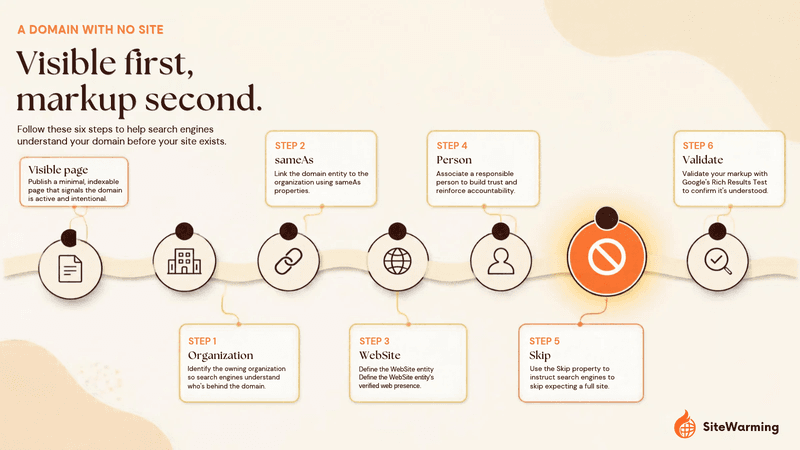
This is the case most guides skip, and it is the one my readers live in. If you hold names you have not built, the question is not which schema to add to a blog. It is what a machine can learn about a domain whose page is empty, parked or missing. Usually nothing, and AI tools often can't see parked domains at all. Our guide to what structured data every domain should have before launch covers the five types in depth. This is the short checklist.
- Put something visible on the page first. A domain name, one plain sentence about what it is for, and a way to reach you. Markup can only describe what a visitor can see.
- Add Organization markup that matches that sentence.
name,url,description,logoif you have one, and a contact path. - Link out with
sameAs. Point to a LinkedIn profile or other real presence that names you and the domain. An identity with no external references is a claim nobody can check. - Add WebSite markup. Name and URL, connected to the Organization by
@id. - Add a Person entity for the owner if you are comfortable being named, so an author or contact resolves to a real person.
- Skip what you cannot support. No LocalBusiness without a real business location, no reviews you do not have, no FAQPage without a visible FAQ.
- Validate, then revisit when the page changes. Run the Rich Results Test and the Schema Markup Validator, and update the markup whenever the visible page changes.
How do you manage and warm the domains that need this?
Structure is easy to add to one domain. It is hard to keep track of across forty. That is where the tooling comes in, and where our own products fit.
How does the SiteWarming domain tool help?
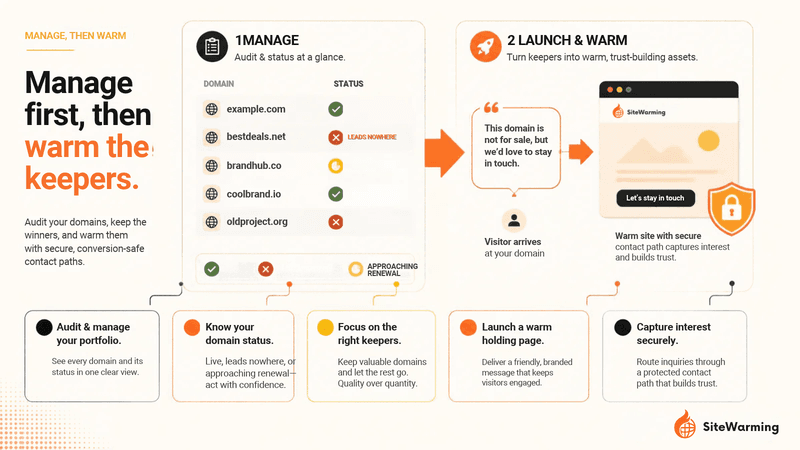
The SiteWarming domain management tool puts every domain you own, across every registrar, in one view: what's live, what leads nowhere, and what is approaching renewal. You can add domains one at a time, bulk-import a CSV, or connect a registrar. That view is how you find the names with nothing on them, which are the ones where a machine has nothing to read. It also shows what each name is worth and when it renews, so you can decide which names deserve any identity work at all. If you are not sure which names to keep, the free Domain Renewal Analysis sorts up to 150 domains and shows which are worth keeping, and the domain health check guide scores each domain across five parts, including visibility and next action. Plans and limits are on the pricing page.
What does Launch & Warm do for a domain with no site?
For the names worth keeping, Launch & Warm puts a real, structured page on the domain. You describe the idea in a sentence, choose whether the name is for building, open to contact or for sale, and SiteWarming builds a warm site: a live, structured page that people, search engines and AI can all understand. It includes structured story data, AI-readable FAQs and a protected contact path, so the option to sell, partner or build can actually be exercised. You don't need to know what JSON-LD is to launch one, and the gap between "exists" and "understood" shouldn't depend on it. I would not promise you a citation. I would promise you that a machine arriving at a warmed domain finds a page that says what it is, which is the one thing an empty or parked page cannot do. The how it works page walks through the setup, and what SiteWarming is explains the idea from the start.
What does this mean for the content you publish?
The misconception I hear most often is that serving machines requires separate content: hidden markup, technical meta layers, a parallel version of your site that only bots see. The reality is the opposite, and the SearchVIU test is the evidence. Write content humans want to read, then describe that content in terms machines can parse. Same information. Two encoding layers.
In practice:
- The FAQ humans read on your page is the FAQ you mark up, if you mark it up at all.
- The About page humans browse is the page your Organization markup lives on, with
sameAslinks to your real profiles. - The article humans share carries Article markup with author,
datePublishedanddateModified, so a system can attribute and date it.
This is also why articles still matter: the structure makes them referenceable, and the substance is what there is to reference. If you want the wider view on how machines read a site, our beginner's guide to a machine-readable website covers semantic HTML and entity consistency, and schema markup for small websites covers the case for smaller sites. For how crawlers choose what to fetch, see how AI crawlers decide what to index.
I'll say the part I believe most, and it is an opinion, not a finding. Domain presence matters well beyond search. We've argued that a domain's web presence also affects whether its email gets delivered. And I expect agents that transact on your behalf to check who you are before they act, which is the argument in Identity in an Agentic Web. Declared identity is the thread that runs through all of it. Nobody has proven that schema is the deciding signal. It is the cheapest one you control.
Content without structure is a conversation only humans can hear. And humans are no longer the first ones in the room.
The machine arrives first. It crawls. It parses. It decides what your content is and whether it can be attributed, not based on how well you wrote it, but on whether it can tell what you wrote and who wrote it.
The question isn't whether you've published enough. It's whether what you published can be read by the systems that decide who gets heard. You wrote the content. You just forgot to introduce yourself to the machines reading it. Do that, and keep your expectations honest: it's the threshold, not the guarantee.
Frequently asked questions
Does structured data help AI search?
It helps search engines understand a page, but the evidence that it raises AI citations is weak. Ahrefs' 2026 controlled study of 1,885 pages found no major citation uplift on Google AI Overviews, AI Mode or ChatGPT, and Google says AI features need no special schema. Use it for clear identity, not as a citation lever.
Do ChatGPT, Claude and Gemini read JSON-LD?
Not reliably when they fetch a page directly. In SearchVIU's October 2025 test, none of five AI systems extracted a price that existed only in JSON-LD. Systems tied to a search index may use schema earlier, at indexing. Keep every important fact visible on the page as well.
Which schema types should a domain add first?
Start with Organization on the homepage, WebSite, and Article with a Person author on each piece of content. Google's documentation recommends Organization markup on the home page or a single page describing the organization, and lists name, url, logo, sameAs and contactPoint among the recommended properties.
Is FAQPage schema still worth adding after May 2026?
Only for clarity, not for snippets. Google stopped showing FAQ rich results on May 7, 2026, after restricting them to government and health sites in August 2023. FAQPage markup remains valid and Google's documentation says it can stay in place. Add it when a real FAQ is on the page.
Does schema markup improve Google rankings?
Google's documentation frames structured data as explicit clues about a page's meaning and as the way to become eligible for rich results; I found no Google statement that markup boosts rankings. Unsupported structured data does not cause issues in Search, so there is no need to strip it.
What is sameAs in schema markup, and why does it matter?
sameAs is a property that lists URLs of your profiles on other websites, such as LinkedIn or social accounts. It lets a machine connect your Organization or Person to external pages it can check. Google lists it among the recommended Organization properties.
Can a domain with no website carry structured data?
Markup must describe visible content, so the domain needs a visible page first. Google's guidelines say not to mark up content that isn't visible to readers. Add a plain sentence about the domain and a contact path, then Organization and WebSite markup that matches it.
How do I test my structured data?
Run the page through Google's Rich Results Test, which shows the rich results the markup can generate, and the Schema Markup Validator, which checks any schema.org markup. Fix errors, then re-test after every change to the visible page.
How does SiteWarming help me manage domains that need this work?
The SiteWarming domain management tool shows every domain you own across every registrar in one view: what's live, what leads nowhere and what's approaching renewal. You can add domains singly, import a CSV or connect a registrar, and use the free Domain Renewal Analysis to see which names are worth keeping.
What does Launch & Warm do for a domain that has no site?
Launch & Warm puts a live, structured warm site on a domain you have not built, from one sentence about the idea. It includes structured story data, AI-readable FAQs and a protected contact path, so people, search engines and AI can understand the domain and interested parties can reach you.
Share this article
Ready to Transform Your Domain Portfolio?
Start building real value with your domain investments today.