How AI Search Engines Decide Which Domains to Trust
 Bret Siers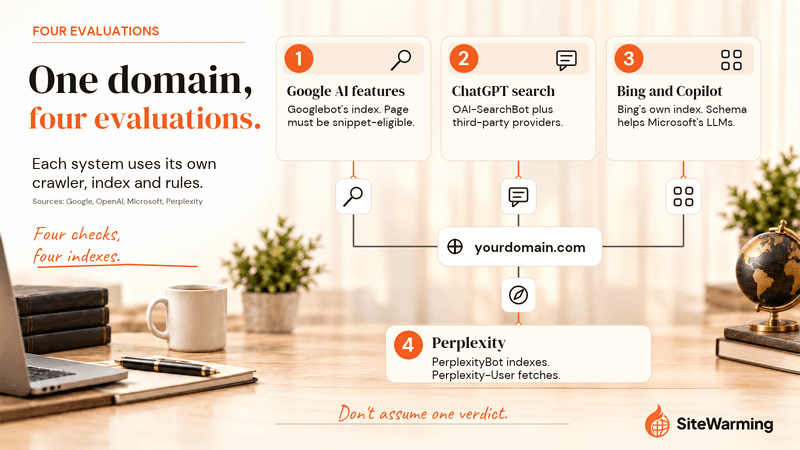
AI search engines don't share one verdict on trust. Google, ChatGPT search, Bing and Copilot, and Perplexity each use their own crawler, index and rules to choose sources. What they reward in common is a page they can read, attribute and verify: clear authorship, specific answers, recent updates and access for their bots.
A friend ran a niche review site for four years. She had real expertise and loyal readers. One day she asked ChatGPT about a product she'd reviewed extensively, and it cited three other sources: two aggregator sites that summarized her work and a Reddit thread that quoted her without attribution. Google still listed her site in the same position it always had. The AI system had never registered that she existed.
That gap is getting more expensive. In a Pew Research Center study of 900 U.S. adults and 68,879 unique Google searches in March 2025, users who saw an AI summary clicked a traditional result in 8% of visits, against 15% for those who didn't, and only 1% of visits clicked a link inside the summary. Pew found that about one in five searches (18%) produced an AI summary. And TechCrunch reported on February 27, 2026 that OpenAI had announced 900 million weekly active users for ChatGPT.
Here, "trust" means whether a system will choose your page as a source: crawl it, index it, retrieve it and cite it. None of these engines publishes a trust score for domains, so we separate what each one documents from what we infer. A domain faces four separate evaluations, because four systems run their own crawler and index: Google (including AI Overviews and AI Mode, which share Google's index), ChatGPT search, Bing and Copilot, and Perplexity.
How does Google decide which domains to trust?
Our shorthand is that Google asks the neighborhood. For years it has weighed what the rest of the web says about a page, most famously through links. That shorthand is ours, not a Google term, and it leaves out much of how Google's systems work. In our view, a domain with a decade of accumulated connections has earned a buffer. The documents below say what Google commits to in writing.
Does Google require special optimization for AI Overviews and AI Mode?
No. Google's AI features documentation says that "to be eligible to be shown as a supporting link in AI Overviews or AI Mode, a page must be indexed and eligible to be shown in Google Search with a snippet." It adds: "There are no additional requirements to appear in AI Overviews or AI Mode, nor other special optimizations necessary," and "there's also no special schema.org structured data that you need to add." The page says both features may use a "query fan-out" technique, which means they can run several related searches to assemble an answer. The page was last updated December 10, 2025, so re-check it before you rely on the wording.
What did Google's March 2024 spam policies change?
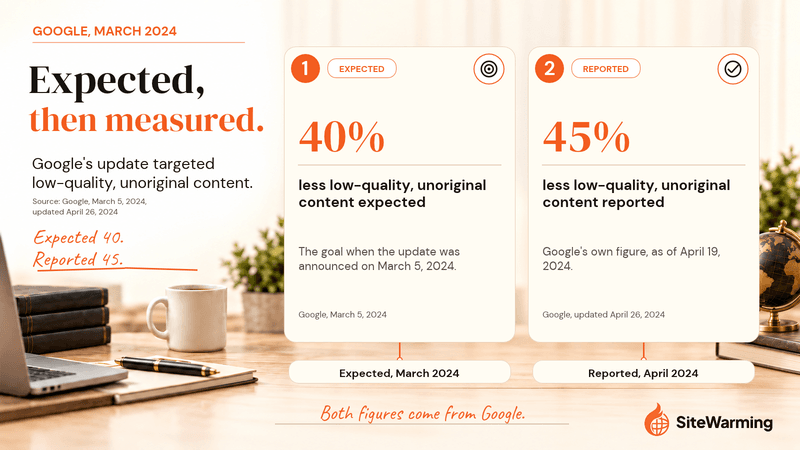
Google's March 5, 2024 announcement said the update, combined with earlier efforts, was expected to reduce low-quality, unoriginal content in search results by 40%. An April 26, 2024 update to the same post reported 45% less, as of April 19. Expected 40%, reported 45%: those are the two figures, and the second is Google's own after-the-fact measurement.
The same announcement introduced three spam policies. Scaled content abuse covers content produced at scale to boost ranking, whether automation, humans or both are involved. Expired domain abuse covers domains bought and repurposed to host low-quality content. Site reputation abuse covers third-party content published on a trusted site primarily to exploit its ranking. Scaled content abuse and expired domain abuse applied from March 5, 2024. Google gave site owners two months' notice before it began enforcing the site reputation policy on May 5, 2024.
Three details are easy to mix up.
- AI-generated content isn't banned. Google's February 2023 guidance said its focus is "the quality of content, rather than how content is produced," as quoted by Search Engine Land. What the March 2024 policy targets is volume produced mainly to manipulate ranking. Check the quote against Google's own post before you reuse it.
- The deindexing numbers come from analysts, not Google. Search Engine Journal reported that SEO Ian Nuttall checked 49,345 sites within days and found 837, about 1.7%, removed from Google's index, and that Originality.ai found all of them showed signs of AI-generated content. Google didn't publish a count.
- The CNN and USA Today penalties belong to the site reputation policy, not the core update. Search Engine Land reported on May 6, 2024 that CNN, USA Today, the LA Times and Fortune lost visibility for coupon-directory sections. Press Gazette later reported a second wave in November 2024 that reached commerce sections at Forbes, CNN, the Wall Street Journal and others, after Google widened the policy to affiliate content "regardless of whether there is first-party involvement or oversight." Sections of those sites vanished from results; the domains didn't.
What does this mean for a domain that's new or neglected?
Expired domain abuse is the policy that matters most to anyone who buys or holds names. A domain with an old history isn't a shortcut, and a domain left to lapse can be picked up by someone who misuses it, which is why an expired domain can hurt your brand. Whether new domains serve a probation period is a separate question we cover in the sandbox tax.
How do ChatGPT, Bing and Copilot, and Perplexity pick their sources?
Each engine sees a different internet. A domain can be visible in one and absent from another, because each has its own crawler, index and rules for what it will fetch.
Does ChatGPT search run on Bing?
Not only. In May 2023, Microsoft announced that it was "bringing Bing to ChatGPT as the default search experience." That supports a 2023 integration, not how ChatGPT search works now. OpenAI's introduction of ChatGPT search says it "leverages third-party search providers, as well as content provided directly by our partners," and its Help Center lists Microsoft and Shopify as partners. To be included, the Help Center says to "allow OAI-Searchbot to crawl the site," and it adds that "placement is not guaranteed." Search launched to paying users on October 31, 2024, reached all logged-in users on December 16, 2024 and opened to everyone without a signup on February 5, 2025.
The picture is still moving. Peec AI, a vendor, published research in September 2026 reporting that OpenAI runs its own index, which it calls Labrador, and blends it with Google, Microsoft and other providers. That's a single vendor's analysis of server-side event data, so treat it as a lead, not a fact.
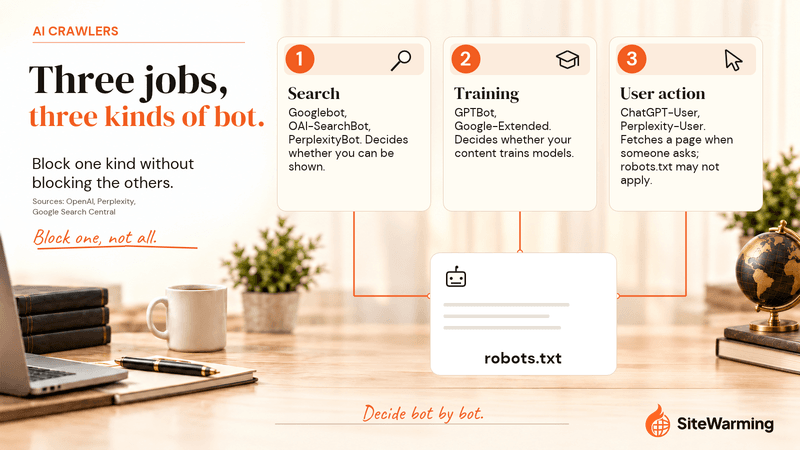
OpenAI documents three crawlers, each with its own robots.txt rule. OAI-SearchBot feeds ChatGPT search, and "sites that are opted out of OAI-SearchBot will not be shown in ChatGPT search answers, though can still appear as navigational links." GPTBot is for training: "Disallowing GPTBot indicates a site's content should not be used in training generative AI foundation models." ChatGPT-User fetches pages when a person asks, and OpenAI says that because "these actions are initiated by a user, robots.txt rules may not apply."
What does Bing and Copilot reward?
Microsoft is the one engine in this group whose representative has said on the record that structured data helps its AI. At SMX Munich on March 20, 2025, Microsoft's Fabrice Canel said that "schema markup helps Microsoft's LLMs understand your content," as reported by Search Engine Land. He also said that "Gen AIs value fresh content in particular, partly as a reference check of their LLM training data," and recommended IndexNow, a protocol that tells search engines when a page changes. Search Influence reports that Bing Webmaster Tools added an AI Performance report in public preview in February 2026, showing how often Copilot cites your content. That's a secondary source, so confirm it in Bing Webmaster Tools before you plan around it.
How does Perplexity decide what to fetch?
Perplexity's bot documentation describes two agents. PerplexityBot is "designed to surface and link websites in search results on Perplexity," and "it is not used to crawl content for AI foundation models." Perplexity-User "supports user actions within Perplexity": when a person asks a question, it might visit a page. Because that request is user-initiated, Perplexity says it "generally ignores robots.txt rules."
Which crawler does what?
The three kinds of bot map to three different decisions, and your robots.txt answers each separately.
| Engine | Search crawler | Training crawler or token | User-initiated fetch | What the vendor documents |
|---|---|---|---|---|
| Google (Search, AI Overviews, AI Mode) | Googlebot | Google-Extended (token) | Not documented here | Page must be indexed and snippet-eligible; no special markup |
| ChatGPT search | OAI-SearchBot | GPTBot | ChatGPT-User | Third-party providers plus partners; allow OAI-SearchBot to be included |
| Bing and Copilot | Bing's crawler | Not documented here | Not documented here | Schema helps Microsoft's LLMs; IndexNow for freshness |
| Perplexity | PerplexityBot | None (not used for training) | Perplexity-User | PerplexityBot surfaces and links sites; Perplexity-User may ignore robots.txt |
Can robots.txt control which AI systems see your site?
Partly, and which control applies depends on the bot. Access rules are still shifting, so re-check each vendor's documentation before you edit your file.
What does Google-Extended control?
Google's crawler documentation says Google-Extended manages whether content "may be used for training future generations of Gemini models" and for grounding in Gemini Apps and Grounding with Google Search on Vertex AI. It also says that "Google-Extended does not impact a site's inclusion in Google Search nor is it used as a ranking signal in Google Search." It isn't the control for AI Overviews. For those, Google's AI features page says the control is robots.txt directives for Googlebot, with nosnippet, data-nosnippet, max-snippet and noindex limiting what can be shown.
Is there a separate control for Google's generative AI features?
Yes, as of this year. On March 19, 2026, Computing reported that Google was developing tools to let sites opt out of generative AI features in Search, and on June 3, 2026, TechSpot reported that the UK Competition and Markets Authority had required Google to introduce them, with nine months to implement. Search Engine Journal describes the result as a property-specific setting in Search Console that excludes a site from AI Overviews, AI Mode and generative AI features in Discover, announced June 3 and rolled out worldwide by August 31, 2026. It says "the setting is not used as a ranking signal elsewhere in Search" and "has no impact on AI training, which is governed by the separate Google-Extended control." Search Engine Land reported the same rollout on August 31, 2026. The release also added Search Console AI performance reports, which Search Engine Journal says show impressions for AI Overviews, AI Mode and Discover but no click data at launch.
How fast is AI crawling growing?
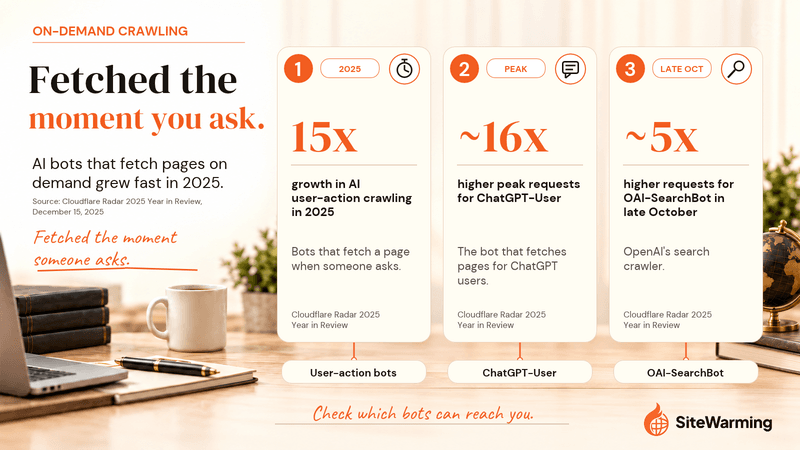
Quickly, and mostly in the kind that answers a live question. Cloudflare's 2025 year in review says that "AI 'user action' crawling increased by over 15x in 2025," with ChatGPT-User peak request volumes about 16 times higher than at the start of the year and an OAI-SearchBot spike in late October about five times higher. It also reports that AI crawlers were the most frequently fully disallowed user agents in robots.txt files. That matters for the decision in front of you: a blanket block on AI bots can also remove you from the answers people request in real time. Decide bot by bot.
Does freshness matter more than reputation in AI search?
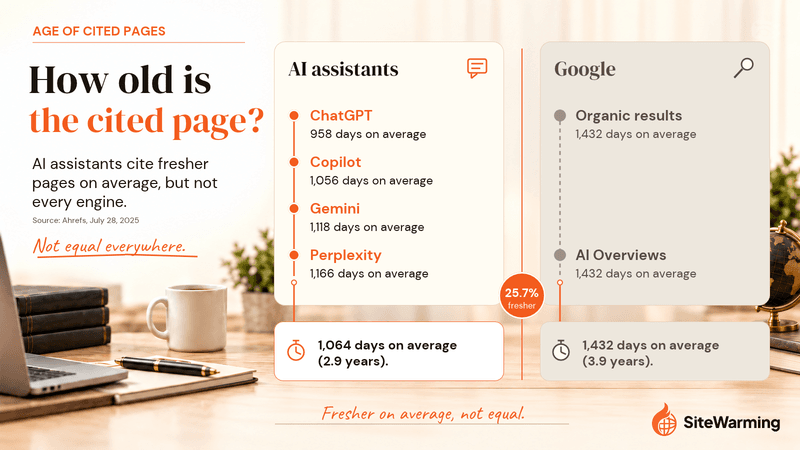
It matters, but the data doesn't say it beats everything else. An Ahrefs study published July 28, 2025 analyzed 16.975 million cited URLs across ChatGPT, Perplexity, Gemini, Copilot, AI Overviews and organic Google. AI assistants cited pages that averaged 1,064 days since publication (2.9 years), against 1,432 days (3.9 years) for organic Google, which Ahrefs calls 25.7% fresher. On last-updated dates, the gap was 909 days against 1,047 days, or 13.1%.
| Where the page was cited | Average days since publication |
|---|---|
| ChatGPT | 958 |
| Copilot | 1,056 |
| Gemini | 1,118 |
| Perplexity | 1,166 |
| AI Overviews | 1,432 |
| Organic Google (average) | 1,432 |
Two cautions. The study measures the age of cited pages, not why they were chosen, and it doesn't state its collection period. And recency isn't equal everywhere: AI Overviews match organic Google on publication age. Microsoft's Canel said that generative AI systems "value fresh content in particular," which fits the pattern for Copilot and ChatGPT. Our reading is that a page that's current and clear has an edge over one that's older and unmaintained, and that a decade of history doesn't offset a page that stopped being true. We cover the update cadence in why continuity builds trust and the cost of neglect in the myth of "set and forget".
Does structured data help AI search engines trust a domain?
It depends on the engine, and none of them calls it a ranking lever. Google says there's "no special schema.org structured data that you need to add" for AI Overviews or AI Mode, and that structured data should match the visible text on the page. Microsoft's Canel said schema markup helps its LLMs understand content. OpenAI's and Perplexity's bot documentation says nothing about schema, and we found no official statement from either. Our advice follows from that: use structured data to make your site accurate and unambiguous for machines, keep it consistent with what's on the page, and don't expect it to substitute for content worth citing. For the types that matter before launch, see what structured data to have before activation, and for why machines read a site differently from people, the two audiences of every domain.
Do Reddit and Quora dominate AI citations?
Only in some places. Ahrefs' Brand Radar analysis from June 2025 found that "Reddit and Quora rank high only in AI Overviews (7.4% & 3.6%). They don't crack the top-10 in ChatGPT or Perplexity," where Wikipedia led at 16.3% and 12.5%. A Semrush 13-week study running July 14 to October 12, 2025 found that Reddit's share of ChatGPT responses fell from about 60% in early August to about 10% by mid-September, while AI Mode and Perplexity stayed stable. In an October 9, 2025 release, Semrush put Quora at number four among the most-cited domains in AI Mode, in 7.25% of responses. So the picture is uneven by engine and moves over time. Our reading of why they do well when they do is that they hold first-hand accounts from people who've actually done the thing, and that's the kind of evidence a system can attribute.
What do all four evaluations reward?
The engines differ on crawlers and indexes. On what they want from a page, the documented overlap is larger.
| What the page needs | What the sources say |
|---|---|
| Access for the right bot | Google needs the page indexed and snippet-eligible; OpenAI says to allow OAI-SearchBot; Perplexity documents PerplexityBot |
| Clear authorship | Google asks whether it's "self-evident to your visitors who authored your content" and whether bylines lead to more information about the author |
| First-hand, specific content | Google's spam policies target scaled, unoriginal content; its guidance asks how a result was produced and why |
| Currency | Ahrefs: AI assistants cite fresher pages on average; Canel: generative AI values fresh content |
| Structured data that matches the page | Google: match visible text; Microsoft: helps its LLMs |
The authorship questions come from Google's helpful content guidance, last updated October 5, 2026, so re-check the wording before you quote it. The same page says content should be created "primarily to help people." In our view, the question behind all four systems is the one a careful reader asks: who wrote this, and have they actually done what they describe? That's our reading, not a quote from any of them.
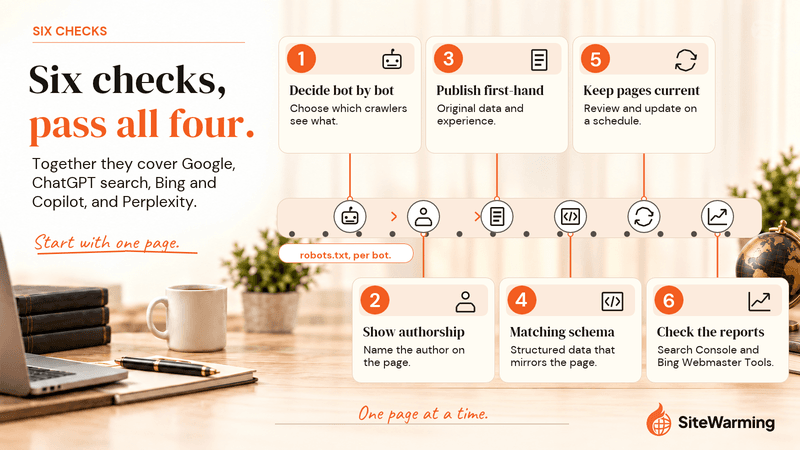
How do you pass all four evaluations? Six checks
None of these steps requires a special tool. They're either documented by the engines or follow directly from what they say.
- Decide bot by bot. Allow the search crawlers you want to be cited by (Googlebot, OAI-SearchBot, PerplexityBot) and make a separate choice about training crawlers such as GPTBot and Google-Extended. Remember that ChatGPT-User and Perplexity-User fetch on a person's behalf and may not follow robots.txt.
- Make authorship visible. Put a real byline on every article, link it to information about the author, and show a publication date and an updated date. Google's helpful content guidance asks exactly these questions.
- Publish specific, first-hand material. Say what you tested, saw or measured. Scaled, unoriginal content is what Google's March 2024 policies target, and first-hand accounts are what systems can attribute.
- Add structured data that matches the page. Use Article, Organization and FAQ markup where it describes what's visible. Google asks for a match with the visible text and Microsoft says schema helps its LLMs. Our guide to what structured data to have before activation covers the types.
- Keep pages current. Review what you've published on a schedule, fix what's out of date and, for Bing, consider IndexNow so changes are noticed quickly. A parked domain gives every engine nothing to read.
- Check what the engines report. Use the AI performance reports in Search Console and, if it's available to you, the AI Performance report in Bing Webmaster Tools. They show impressions and citations, not rankings, so read them as visibility checks.
What does this mean if you hold many domains?
A portfolio of undeveloped names tends to fail all four checks at once, and not because anyone decided to. A domain with no page has nothing for Googlebot, OAI-SearchBot or PerplexityBot to index and no author to attribute. That's a harder version of the review-site story. In her case, the work was there. The proof was there. The machine just couldn't read it. A parked domain has neither the work nor the proof.
This is what SiteWarming is built around. Launch & Warm gives the domains worth keeping readable pages, a contact path and a consistent publishing record from the day they're activated. The domain health check shows where each domain stands, and what SiteWarming is explains the approach. For the identity side of the same problem, see the next decade of domain identity. And in our view, depth on one subject gives a system a clear signal to cite, which is why small, focused audiences are more valuable than broad ones.
What's the point of all this?
The AI search ecosystem is still forming, and its rules are being written in public. Each evaluation's bar is lower than most people assume. What it takes is a readable page, a named author, specific content and a reason to be current. You don't need to pass them all this month. You do need to start.
Frequently asked questions about AI search and domain trust
How do AI search engines decide which sites to trust?
There isn't one shared method. Google, ChatGPT search, Bing and Copilot, and Perplexity each use their own crawler, index and rules. Documented overlap: a page must be accessible to the engine's bot, readable, clearly attributed and current. None of them publishes a trust score for domains.
Does ChatGPT search use Bing?
Not only. Microsoft announced in May 2023 that Bing would be ChatGPT's default search experience, but OpenAI now says ChatGPT search uses third-party search providers and partner content, and lists Microsoft and Shopify among its partners. A vendor study also reports an OpenAI-run index. Treat the exact mix as unconfirmed.
Do I need special markup to appear in Google AI Overviews?
No. Google's documentation says a page must be indexed and eligible to appear in Search with a snippet, and that there are no additional requirements or special optimizations for AI Overviews or AI Mode. It also says no special schema.org structured data is needed, but any markup should match the visible text.
What is the difference between GPTBot, OAI-SearchBot and ChatGPT-User?
OpenAI uses three crawlers with separate robots.txt rules. OAI-SearchBot supports ChatGPT search results, GPTBot is used for training foundation models, and ChatGPT-User fetches pages when a person asks. Because ChatGPT-User actions are user-initiated, OpenAI says robots.txt rules may not apply to it.
Does blocking Google-Extended remove my site from AI Overviews?
No. Google says Google-Extended governs use of content for Gemini training and grounding and does not affect inclusion in Google Search or act as a ranking signal. Since August 2026, a separate Search Console setting lets site owners opt out of AI Overviews, AI Mode and generative AI features in Discover.
Does fresher content get cited more by AI search?
On average, yes. Ahrefs analyzed 16.975 million cited URLs in 2025 and found AI assistants cited pages averaging 1,064 days since publication, against 1,432 for organic Google, or 25.7% fresher. The pattern varies by engine, and AI Overviews matched organic Google. The study shows association, not cause.
Does schema markup help AI search engines?
It depends on the engine. Google says no special schema is needed for AI Overviews or AI Mode, while Microsoft's Fabrice Canel said in March 2025 that schema markup helps Microsoft's LLMs understand content. OpenAI and Perplexity haven't documented a position. Use markup for accuracy, and keep it matching the page.
Do Reddit and Quora dominate AI citations?
Only on some engines. Ahrefs found in June 2025 that Reddit and Quora ranked high only in AI Overviews, at 7.4% and 3.6%, and didn't reach the top ten in ChatGPT or Perplexity. Semrush later found Reddit's share of ChatGPT responses fell from about 60% to about 10% between August and mid-September 2025.
Related reading
Share this article
Ready to Transform Your Domain Portfolio?
Start building real value with your domain investments today.