Static Pages Don't Build Trust. Continuity Does.
 Bret Siers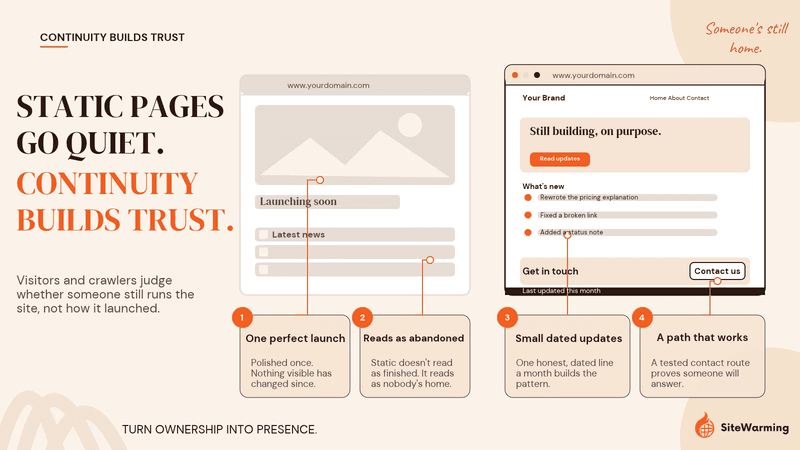
Continuity builds trust because people and search systems judge a website by whether someone is still looking after it, not by how polished it looked on launch day. A small, dated, honest update each month, a short review each quarter and a full sweep once a year signal an active operator far more reliably than one perfect launch.
You spent three months on the launch. Every pixel is polished. Every line was debated. The site went live.
Then silence.
Six months later you check in and it feels the same: no meaningful discovery lift, no real sense of momentum, no clear signal that the site is doing its job. The "perfect launch" is already stale.
Here's the brutal truth about digital real estate: the launch wasn't the trust moment. Every day since.
Trust isn't a snapshot. It's a movie. It's built on repeated observation.
What does continuity mean for a website?
Continuity is the visible, dated record that someone is still operating a site: the changes, corrections, notes and refreshed explanations that accumulate after launch. It is not publishing volume. A site with one honest update a month has continuity. A site that published fifty posts in launch week and nothing since does not.
When a potential customer, partner, or discovery system looks at a domain, they aren't only checking if it exists. They're checking if it's alive.
Static doesn't read as "finished." Static reads as "nobody's home."
Static perfection is fragility. Continuity is strength.
Why doesn't a perfect launch build trust?
Founders treat domains like buildings. You cut the ribbon, you move on, you assume the structure earns confidence by existing.
But the internet isn't a real estate registry. It's an information ecosystem, and information decays. I've written separately about what that decay actually costs a domain owner. The short version: nothing stays the way you left it.
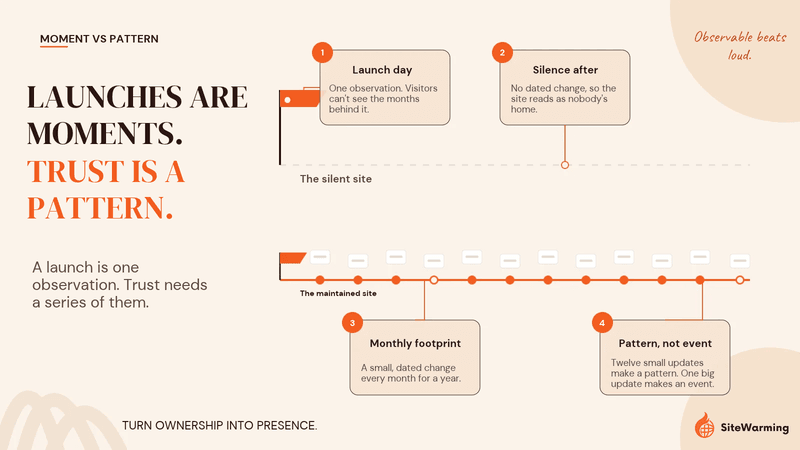
A launch is one observation. Trust needs a series of them. A visitor who lands on your site today has no way to know you spent three months on it. What they can see is whether anything has happened since.
The site that shipped imperfectly, then left a small, dated footprint every month for a year, usually earns more confidence than the perfect site that went silent. Not because it's louder. Because it's observable.
Launches are moments. Trust is a pattern.
Does an outdated website hurt credibility?
Yes, and the research on the human side of this is uncomfortable. It has also been consistent for more than twenty years.
- Stanford's Web Credibility Project put it plainly in its guidelines: "Update your site's content often (at least show it's been reviewed recently)." (Stanford Web Credibility Guidelines, B.J. Fogg, 2002)
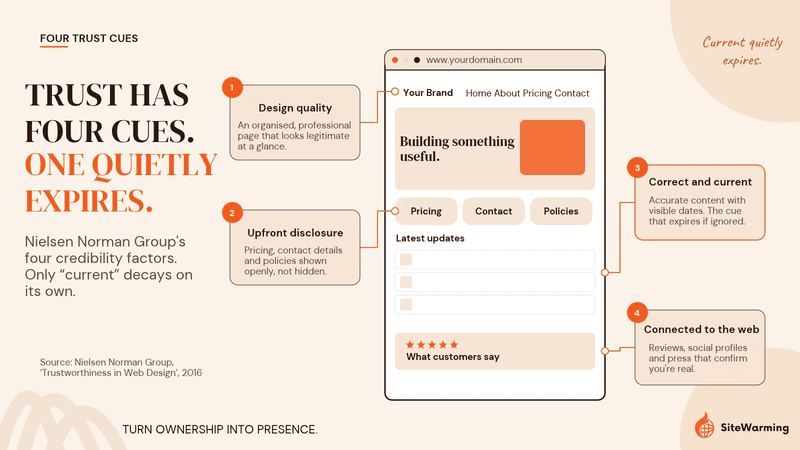
- Nielsen Norman Group lists four ways a site communicates trustworthiness: design quality, upfront disclosure, content that is comprehensive, correct and current, and connection to the rest of the web. (NN/g, "Trustworthiness in Web Design", Aurora Harley, 2016)
- ProtoFuse makes the point about silence directly: when a site has no recent posts, updates or news, "no news is good news" does not apply. Visitors start to wonder whether the company is fading out. (ProtoFuse, "Outdated Websites: 10 Perceptions that Damage Credibility")
That phrase "current content" matters more than people want it to.
It doesn't mean you need to publish constantly. It means the site has to show signs of stewardship. A maintained site signals an operator behind the wheel. An unchanged site signals uncertainty.
Verification is the new trust mechanic, and it only works when it's repeated. Verification isn't a badge. It's ongoing proof. I go deeper on this in why trust is a system you build from checkable signals, not a feeling.
Does Google reward fresh content?
Sometimes, and the distinction matters. A lot of founders translate this whole topic into a single anxious query: "SEO."
Here's the cleaner frame: visibility systems prefer what stays legible.
Google documents "query deserves freshness" systems "designed to show fresher content for queries where it would be expected." Its own examples are someone searching for a movie that has just been released, who wants recent reviews, and a search for "earthquake" right after one has happened, when news should outrank preparation guides. Those are moments where old data is wrong data. (Google Search Central, "A guide to Google Search ranking systems")
Search Engine Land describes query deserves freshness (QDF) as the part of Google's algorithm that "prioritizes newer content in search results when a searched topic is trending, rapidly evolving, or changing over time." (Search Engine Land, "Query deserves freshness (QDF)")
Three important things drop out of that.
- Freshness is not a universal rule. Some topics are stable, and a well-made page can hold its value for years.
- Freshness is absolutely real when the world is changing. If your page describes prices, features, rules or anything that moves, an old version is a wrong version.
- Faked freshness doesn't work. Google's guidance on helpful content asks site owners directly: "Are you changing the date of pages to make them seem fresh when the content has not substantially changed?" It also answers its own question about bulk-adding or removing content to look fresh: "No, it won't." (Google Search Central, "Creating helpful, reliable, people-first content")
So the goal isn't "post more." The goal is to avoid training systems to treat your domain as a dead end.
Google's core updates documentation makes the time dimension explicit: "As content on the web changes, we assess and update our systems to keep pace." (Google Search Central, "Google Search's core updates")
The web changes whether you participate or not.
When does freshness matter, and when doesn't it?
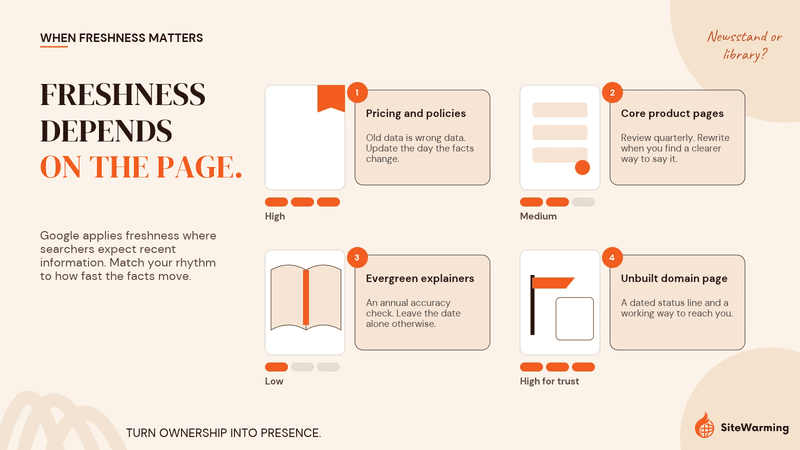
| Page or topic | How much freshness matters | What continuity looks like |
|---|---|---|
| Pricing, features, policies, anything time-sensitive | High: an old version is a wrong version | Update the day the facts change and show a "Last updated" date |
| Core product, service or "what we do" pages | Medium | Review quarterly; rewrite when you find a clearer way to say it |
| Evergreen explainers and definitions | Low | An annual accuracy check; leave the date alone unless you changed substance |
| A holding page on a domain you haven't built yet | High for trust: a visitor's first question is whether anyone owns this | A dated line on status and intent, plus a working way to reach you |
Do AI search engines prefer fresher content?
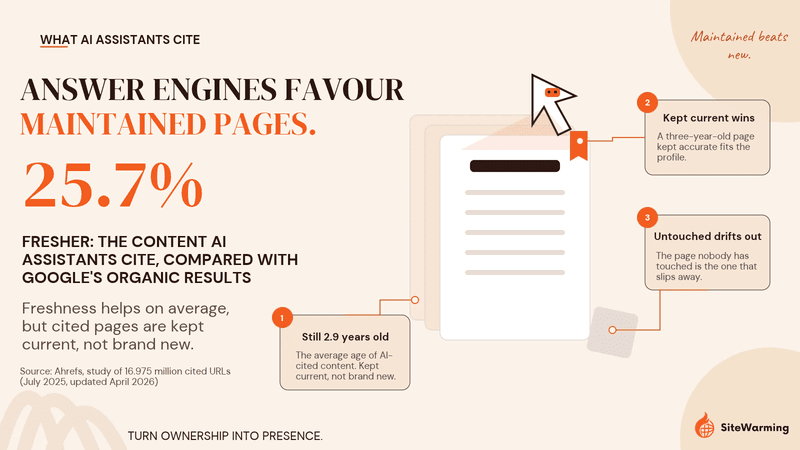
On average, yes, but the lesson is the same one Google teaches: maintained beats new.
Ahrefs analysed 16.975 million URLs cited by ChatGPT, Perplexity, Gemini, Copilot and Google AI Overviews and found that AI assistants cite content that is 25.7% fresher than the pages in Google's organic results. The same study found the cited content was still 2.9 years old on average, and the authors treat freshness as one factor among many. (Ahrefs, "Do AI Assistants Prefer to Cite 'Fresh' Content?", Ryan Law and Xibeijia Guan, published July 2025, updated April 2026)
Read that carefully. Answer engines are not rewarding whatever was published this morning. They lean toward pages that are still current. A three-year-old page that has been kept accurate fits that profile. A three-year-old page nobody has touched is the one that drifts out.
Seer Interactive's server-log study points the same way and adds the nuance that matters here. Nearly 65% of the AI bot hits it analysed went to content published within the past year, but the bias was strongest in financial services, while energy and decking sites still saw bots return to older instructional pages. (Seer Interactive, "AI Brand Visibility and Content Recency", Sonny Vasquez, June 2025) Freshness is judged by topic, which is exactly why the table above matters.
I've laid out how AI search engines decide which domains to trust in more detail. Continuity is the part of that you control.
Which continuity signals actually count?
A few signals that work even for quiet products, and what each one tells the two audiences reading your site:
| Continuity signal | What a person reads | What a crawler or AI system reads |
|---|---|---|
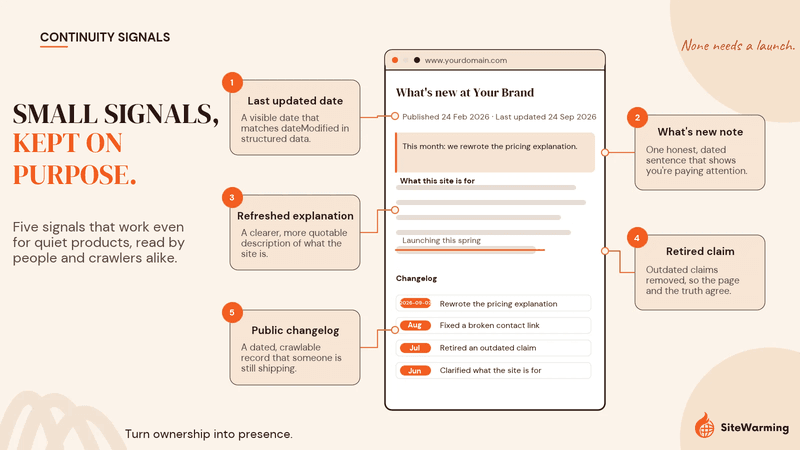
| A public changelog, updated monthly or quarterly | Someone is still shipping | A dated, crawlable record of change |
| A "What's new" note with a date and one honest sentence | The operator is paying attention | A recent, specific statement about the business |
| A refreshed explanation on a core page, because you learned a better way to say it | The people behind this understand their own product | A clearer, more quotable description of what the site is |
| Retiring outdated claims instead of letting them rot | This site is careful with facts | Fewer contradictions between what the page says and what's true |
| A visible "Published" and "Last updated" line on pages where accuracy matters | I can judge how current this is | A date that matches the page's structured data |
A changelog, for anyone who hasn't kept one, is "a curated, chronologically ordered list of notable changes" (Keep a Changelog). It doesn't need to be technical. "2026-09-02: Rewrote the pricing explanation after three customers asked the same question" is a changelog entry.
On dates, Google's own guidance is to show a visible date labelled "Published" or "Last updated," and to make sure it matches the datePublished and dateModified values in your structured data. (Google Search Central, "Influencing your byline dates in Google Search")
These are the observable version of what I call domain trust signals: the evidence that stacks up whether or not anyone is watching that day.
What doesn't count as continuity?
The common mistakes all try to fake the pattern instead of producing it:
- Bumping the date without changing the page. Google names this directly in its helpful content guidance, and a reader who notices the mismatch trusts you less, not more.
- Bursts of volume. Twenty posts in one week, then nothing for a year, is a launch with extra steps. Google says adding lots of content just to seem fresh won't help.
- A footer copyright year that updates itself. It proves your template runs, not that anyone is home.
- An abandoned blog. Three posts from two years ago tell the visitor exactly when you stopped. ProtoFuse makes the same point about stale news sections. If you can't keep a blog going, a short dated "What's new" line is more honest.
How do small updates compound into credibility?
This is the part most founders miss: continuity has compounding behavior.
Not because the updates are magical, but because repeated observation creates a durable signal. Every dated change is one more data point that says the same thing: this domain is operated. Twelve small updates across a year make a pattern. One large update makes an event.
Continuity is not volume. Continuity is proof of stewardship.
A maintained domain is also stronger when the wider web echoes that you're real, which is why social proof multiplies continuity. Nielsen Norman Group's fourth trust cue, connection to the rest of the web, is the outside half of the same pattern.
How often should you update your website?
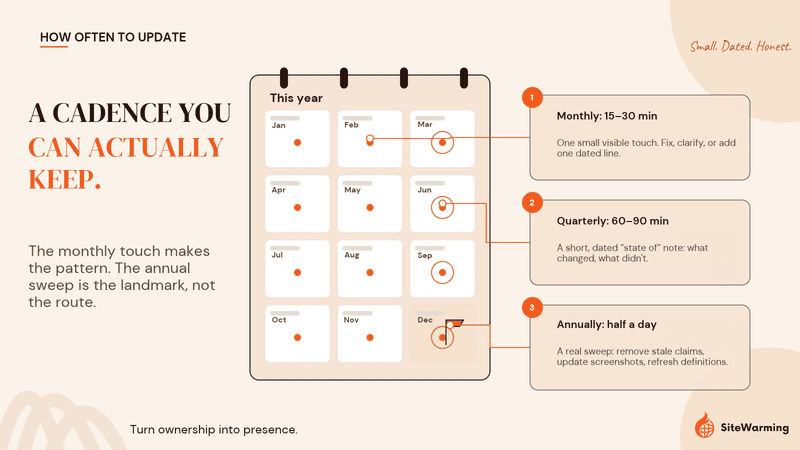
Operators don't win by hustling daily. They win by building a cadence they can actually sustain. Here's one that doesn't turn into a second job:
| Cadence | Time | What to do |
|---|---|---|
| Monthly | 15–30 minutes | One small, visible touch. Fix something. Clarify something. Add one dated line that reflects reality. |
| Quarterly | 60–90 minutes | A short "state of" note. What changed, what didn't, what you're paying attention to. Dated. Honest. Small. |
| Annually | Half a day | A real sweep. Remove stale claims. Update screenshots. Refresh the definitions that became unclear. |
The monthly touch is the one that makes the pattern, so here is how I'd run it:
- Open the one page that matters most. Usually the homepage or the page that explains what the site is.
- Change one real thing. Fix a broken link, sharpen a sentence, correct a detail that has gone out of date.
- Write one dated line about it. Put it in your changelog or "What's new" note.
- Update "Last updated" only if the substance changed. If you did, make sure the structured data's
dateModifiedmatches. - Test your contact path. Send yourself a message through the form or address a visitor would use. A current page with a dead inbox still reads as nobody's home.
What if you own more domains than you can update?
Then the cadence has to become a system, not a calendar reminder per domain. Scale forces stewardship to become a system.
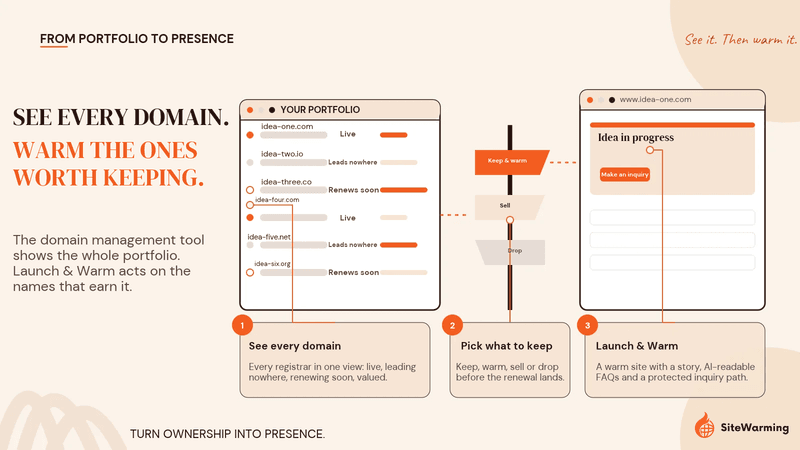
Start by knowing which domains are live, which lead nowhere and which renew soon. If you're a domainer with hundreds of names spread across registrars, or a founder who registered names faster than you could build on them, no single registrar account gives you that list. Our domain management tool does: add names one at a time, bulk-import a CSV, connect a registrar or use the MCP server, and every domain sits in one view, with renewal reminders at 90, 60 and 30 days so each renewal arrives as a decision rather than a surprise. A domain health check then scores each name on ownership, renewal, security, visibility and purpose, so you spend your monthly half hour on the names that deserve it.
Not every domain needs the full cadence. Every domain you keep renewing needs some sign of life.
What does continuity look like on a domain you haven't built yet?
Most of the domains I see never got a launch at all. They were bought in a moment of clarity and have been renewed in the dark ever since.
The same rule applies. A registrar parking page or an empty server tells a visitor, a would-be buyer or a crawler exactly one thing: nobody's home. I've compared parked pages, 404s and empty sites side by side, and none of them builds a pattern.
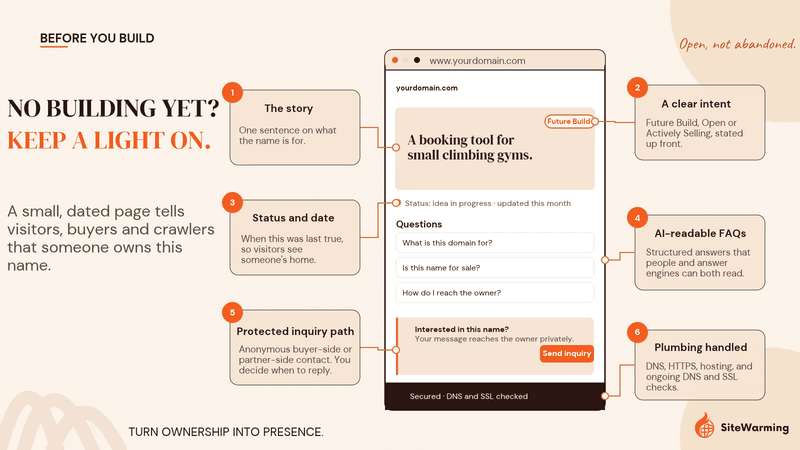
What does build one is small: a page that says what the name is for, what its status is, when that was last true, and how to reach the owner. A domain can be open without being listed for sale and still be reachable.
We've lived the loop: buy the domain in clarity, then renew it while the idea stays dark. Warming is choosing to make an idea legible before you feel ready. Quietly. On purpose. Discovery systems learn from repeated observation, and empty space becomes a durable signal. Warming turns ownership into presence early.
That's what we built Launch & Warm to do. It puts a warm site on the name that says what it's for and what you intend, keeps the dated record growing with monthly content updates, and gives a would-be buyer or partner a protected, anonymous way to reach you. If you want the background first, start with what SiteWarming is.
How does continuity become memory?
This is the bridge forward: continuity becomes memory. The record builds over time, and the internet's signal layer learns who is still here.
Continuity isn't just presence. It's how the internet remembers. If you want the mechanics behind that idea, here's the deeper cut: content is not marketing, it's memory.
How do you apply continuity across every domain you own?
Continuity is easy to agree with and hard to run across twenty or two hundred names. The work splits into two jobs, and we built a product for each.
The first job is seeing. You can't keep a pattern going on domains you've lost track of. The SiteWarming domain management tool puts every name from every registrar in one view, shows which are live, which lead nowhere and which renew soon, and fetches a HumbleWorth valuation for each name the moment it's added, then stacks appraisals from 15+ sources, including GoDaddy, EstiBot, Sedo, Flippa and brokers. That's how a domainer decides which names to keep, warm, sell or drop before the renewal lands, instead of renewing everything out of fear.
The second job is acting on the names worth keeping. Launch & Warm is continuity for a domain you haven't built: you tell the domain's story in one sentence, choose Future Build, Open or Actively Selling, and a warm site goes live with domain analysis, AI-readable FAQs, structured story data and a protected, anonymous inquiry path. Monthly content updates keep the dated record growing, and DNS, HTTPS, hosting and ongoing DNS and SSL checks are handled.
For a founder, that closes a quiet loss. If you saw value in a name, someone else probably did too. Today they land on nothing, move on, and you never learn they came, while you keep paying the renewal. A warm, maintained page gives them a story, a date and a way to reach you.
See the whole portfolio. Warm the names worth keeping. Keep the pattern going.
Launches are moments. Trust is a pattern.
Frequently asked questions
How often should you update your website? For most small sites, a small visible update every month, a short review every quarter and a full content sweep once a year is enough. The monthly touch matters most because it creates the pattern. Time-sensitive pages such as pricing or policies should change the day the facts change, whatever the calendar says.
Does updating your website help SEO? It helps when the update makes the page more accurate or more useful. Google runs freshness systems for queries where recent information is expected, such as news or new releases. For stable topics, a well-made page can hold its value. Google states that adding or removing content only to seem fresh won't improve rankings.
Does an outdated website hurt credibility? Yes. Stanford's Web Credibility Guidelines recommend updating content often, or at least showing it has been reviewed recently. Nielsen Norman Group lists current content as one of four core trust cues. When a site shows no recent activity, visitors tend to wonder whether the business is still operating, which is the opposite of what a founder wants.
Does changing the date on a page make it look fresh to Google? No. Google's helpful content guidance specifically asks whether you are changing page dates to seem fresh when the content has not substantially changed. Change the visible "Last updated" date only after a real edit, and keep it consistent with the dateModified value in the page's structured data, as Google's byline date guidance recommends.
Do AI assistants prefer fresh content? On average, yes. Ahrefs' study of 16.975 million cited URLs, first published in July 2025 and updated in April 2026, found content cited by AI assistants was 25.7% fresher than Google's organic results. The same cited content was still 2.9 years old on average, so the advantage goes to pages that are kept current, not only to pages that are brand new.
What is a public changelog? A public changelog is a dated, chronological list of notable changes to a product or website, published where visitors can see it. It doesn't need to be technical. One honest line per change, with a date, is enough to show a person or a crawler that the site is still being operated.
What should you put on a domain you haven't built yet? A short page that says what the name is for, what its status is, when that was last true and how to reach the owner. That is enough to show a visitor, a buyer or a crawler that someone is home. Add a dated line whenever the status changes, and test the contact path so a real inquiry actually reaches you.
Share this article
Ready to Transform Your Domain Portfolio?
Start building real value with your domain investments today.