Open, Not Listed: Make Your Domain Reachable Without Becoming a Seller
 Bret Siers
Photo by Pawel Czerwinski on Unsplash
Open, Not Listed: Make Your Domain Reachable Without Becoming a Seller
You probably remember the night you registered it.
Maybe it was late. The name had been rattling around your head for weeks, and you finally typed it in half expecting it to be taken. It wasn't. So you bought it, and for a moment the whole thing felt real. The product, the brand, the idea you believed in. You owned the front door to something.
Then life kept moving. Work got loud. Other things got urgent. The idea didn't die. It just went quiet, and the name you bought on a night when anything felt possible has been sitting in the dark ever since.
Here is what nobody tells you. That domain isn't doing nothing. If someone happens to find it, it sends a signal, and the signal it sends is "nobody's home."
Most of the advice you will find treats your options as two. Build the whole thing now, or put it up for sale. This piece is about the third option, the one almost nobody names: you can make a domain reachable without listing it for sale. You leave a quiet, credible path for the right person to start a conversation. No price tag, no marketplace, no announcement that you are a seller. That state has a name. Open, Not Listed. The rest of this is what it means, why it matters, and why the conviction you had that night is worth preserving exactly this way.
The Dead End That Runs Both Ways
Think about what actually happens when someone goes looking for your domain.
Say a person somewhere has the same idea you had, or close to it. They have been turning a name over in their head, and yours is the one they land on. They type it into a browser the way you did that night. And they get a blank page, or a parking screen with three ads for car insurance.
So they do what anyone does. They open a new tab and search for who owns it. They hit a wall. The registration is privacy masked, the contact is a proxy, the trail goes cold. The path from an interested person to the owner is broken at almost every step, which is the whole reason who owns this domain is its own small heartbreak from the other side of the screen. They send one message into the void, hear nothing, and move on. They pick a different name.
You never knew it happened.
That is the part that stays with me. The dead end runs in both directions. The person who wanted in hit a wall and gave up. And you, the owner, never got to decide anything, because no signal ever reached you. The opportunity wasn't rejected. It just never arrived. Nobody sends you a report that says three people looked for this name last month and left. There is no missed-call log for a domain.
There is a post that has been seen more than 1.3 million times that captures this in a single line. Someone trying to reach a company writes, "The website went down. The domain's in Pauline's name. Pauline left two years ago." That is the whole story. A name that held something that mattered, and the one person who could open the door is gone, and everyone on the outside is just knocking on a locked door.
I don't share that to scare you. I share it because most of us are Pauline to someone. Quietly, without meaning to be. Not because we stopped caring about the idea, but because there was never a way for the knock to reach us.
You're Not the Exception. This Is the Normal State.
If you are feeling a little called out, let me take the weight off.
You are not unusual, and you are not behind. A domain sitting quiet is not a personal failing. It is the most common condition a registered domain is in. When researchers at APNIC scanned 334 million domains, they found that at least 17.5 percent of them were parked, and they called that a floor, not a ceiling. Tens of millions of names, owned by people who meant to get to them, just like you.
So the quiet "I should have done something with that by now" you might be feeling is close to universal. A huge share of the internet is people who bought a name because something mattered and haven't gotten back to it. You are in enormous company.
Take relief from that number, not guilt. The problem was never you. The problem is that there has not been a good middle option. A parking page is not neutral. It actively tells every visitor, human or machine, that nobody is home, and yet for most owners it has felt like the only alternative to building a whole website they don't have time for. Of course the name went dark. The path out was never obvious.
So let's make it obvious.
The False Choice: Dark, or For Sale
Here is what trips people up. When someone finally decides to do something with a quiet domain, they assume there are only two doors.
The first door is to leave it dark. Keep paying the renewal, feel the small twinge when the email arrives, keep the idea frozen exactly where it was the night you bought it. Invisible. Unreachable. Safe in a way, but going nowhere.
The second door is to list it. Put it up for sale, choose a marketplace, name a price, field low-ball messages from brokers, and start thinking of the thing you believed in as inventory. For a lot of people this feels like betrayal. You didn't register the name to trade it. You registered it because something mattered, and posting it on a shelf with a number on it feels like admitting the idea is over.
So you are stuck between invisible and for sale. The first asks you to give up the opportunity. The second asks you to give up the conviction. And because neither feels right, most people do nothing. The name stays dark, the clock keeps running, and every person who might have wanted to talk to you keeps hitting that wall.
The choice is false. Like most false choices, it survives only because nobody names the third thing.
There's a Third Way: Open, Not Listed
Here is the distinction that breaks the whole thing open, so let me say it plainly.
Listed means you have put the domain on a shelf with a price tag. You have decided it is for sale, named a number, and placed it in a catalog for strangers to browse past. That is a real choice, and a fine one if you make it on purpose. But it is a seller's choice, and you are not a seller.
Open means you have left a quiet, credible way for the right person to start a conversation. No price tag. No marketplace. No "for sale" banner. Just presence, and a path in. The name says a real person is behind it and there is a reason it is being held. Someone with genuine interest can reach you. Everyone else simply sees a name that is clearly alive.
Open is not the same as available. Available says "make me an offer." Open says "I'm here, and you can find me." One is a transaction waiting to happen. The other is a door that isn't locked, the same way your home has a doorbell without a price in the window.
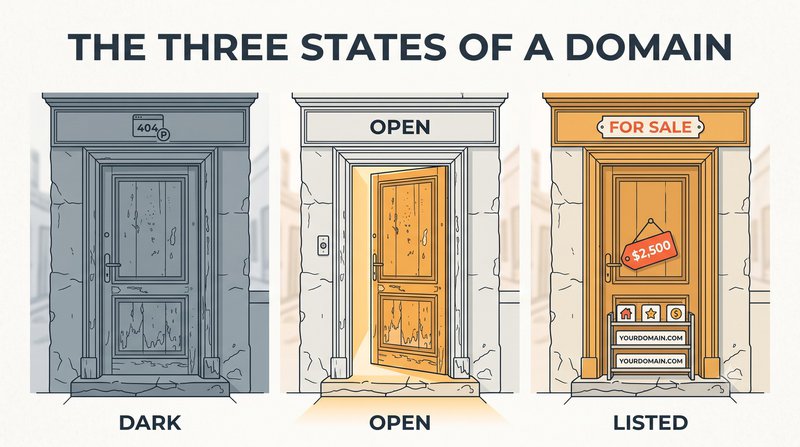
That center door is the whole point. It keeps your optionality intact without forcing you to decide anything today. You haven't committed to selling. You haven't committed to building by Friday. You have simply stopped being invisible. If the right person shows up, you get to decide. And if nobody ever does, you have lost nothing, because the idea is still yours and the name is still warm.
Open Is How the Market Already Works
If "Open, Not Listed" sounds like a nice idea that doesn't exist in the real world, here is the part that surprises people. The most serious domain transactions often start through reachability, not public listings. It doesn't advertise itself, because the whole point is to not be on a shelf.
Some of the most consequential domain transfers never begin as public listings. They begin because the owner can be reached. AI.com, one of the highest-value domain sales on record, is the kind of name people cite. The most valuable domains aren't sitting anywhere you would think to look, and that is not an accident. It is the posture. The owner stays the owner right up until the moment they choose otherwise, and the choice belongs entirely to them. That is what Open looks like at the very top.
So how does a knock reach you if there is no marketplace inbox? Through a small family of ordinary mechanisms. A simple page that says a real person owns this name and is open to a conversation. A make-offer signal that lets someone raise their hand without a price ever being posted. None of it requires you to become a seller, and there is a fuller teardown in the signals someone wants your domain. Reachability has always mattered more than most casual owners realize.
The SiteWarming perspective
Open, Not Listed isn't a button you press. It is a state your domain lives in. Present, signaled, reachable, with no price tag and no marketplace. You shouldn't have to choose between invisible and for sale, and you shouldn't have to hand-build a page just to stop being a blank wall. You keep the conviction that made you register the name. The system keeps the domain warm and findable, so opportunity has a way in while you decide on your own time. What is SiteWarming?
The Idea Is the Asset Worth Keeping Open
Step back from the mechanics, because the real asset here was never the URL.
The asset is the idea. The conviction that made you reach for the name that night, the flash of "this could be something" that felt worth twelve dollars and a moment of belief. That is the thing worth preserving. The domain is just where the conviction lives. When the name goes dark, the conviction goes dark with it, slowly, until one day it is a renewal charge you don't remember the reason for.
Open is how you keep that idea alive without having to act on it before you are ready. And the timing of "ready" is shifting. The next person who comes looking for your name might not even be a person. When agents do the shopping on someone's behalf, a dark name is invisible to them too. A person at least notices the door is locked. A machine doesn't knock twice. It marks the name as nothing and moves on. Open handles both. The door stays unlocked whether the knock comes from a person or a program.
You don't have to wire any of that up tonight, and you don't have to build everything to stop being a blank page. The first move is small. It is the step from dark to present, the calm version of which is from dark to active. You don't have to build everything. You just have to stop being a dead end.
So here is where this lands. You don't have to choose between abandoning the idea and selling it off. Those were never the only two options, no matter how the conversation is usually framed. There is a third state, and it is the one that actually matches how you feel about the name. Keep it open. Let it be reachable. Let it be clearly alive, so that if the right person, or the right moment, ever comes looking, there is a way in.
You believed in the idea once. That belief is the asset. Leave the light on, and you get to keep it. The choice you almost gave away by going dark stays yours.
The name mattered when you registered it. It still does. It just needs to stop being a dead end, so the option you have been holding stays a real option.
Share this article
Ready to Transform Your Domain Portfolio?
Start building real value with your domain investments today.