When Agents Do the Shopping: The Future of Domain Discovery
 Bret Siers
Photo by Markus Spiske on Unsplash
When Agents Do the Shopping: The Future of Domain Discovery
A dark domain is already invisible to the person who gave up searching. Now it is invisible to the agent shopping on their behalf.
There is a third way to hold a domain. Not dark and invisible, not listed and for sale, but Open: discoverable and reachable, without becoming a seller. Open, Not Listed means this. Listed puts the domain on a shelf with a price tag. Open leaves a quiet, credible way to be reached, with no marketplace and no for-sale sign.
The conversation about AI agents is enormous, and almost none of it is about you. In one social-listening scan, the agent conversation drew tens of millions of views, most of it about bubbles, jobs, and which lab wins. Underneath all that noise sits one small, concrete question that actually lands on a domain owner's desk. When an agent does the shopping, finds, compares, and buys on someone's behalf, can it find your domain? And once it finds it, can it reach you?
That is not a purely future question anymore. The early infrastructure is now real enough that domain owners should understand the direction.
The machine can already do the shopping
One thing turned this from a future idea to a present one. The end-to-end stack for a machine buyer is not a demo. It shipped.
On April 30, 2026, Stripe and Cloudflare launched a protocol that lets an AI agent register a domain and pay for it end to end, with no human at the dashboard. The spend is scoped and capped per provider, so this is careful, not reckless. But it is real, and it is running.
Cloudflare named the consequence directly. Its design assumes a service exposes a machine-readable catalog so agents can find it.
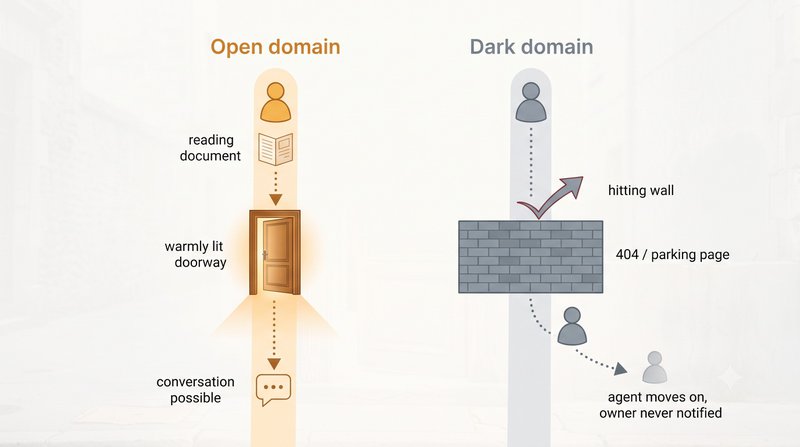
Sit with that for a second. Discoverable to these agents. An agent buying infrastructure does not browse like a person. It reads a catalog and follows a path. If your domain is dark, a parking page with three ads and no signal, it is not just invisible to the person who gave up looking for you. It is now invisible to the agents shopping on that person's behalf. The agent does not knock twice. It checks for a path, finds none, and moves to the next option on its list. The owner never knows the query happened.
This is the same shift that the internet now has two audiences names plainly. There are human readers and there are machine readers, and a dark domain is unreadable to both. The agentic stack just gave the machine audience a wallet, and it raised the stakes on being legible. The deeper version of this, the rebuild of the web for readers that are not people, is what when agents do the shopping lays out in full.
And here is the calm part. Being Open quietly covers this. You do not have to learn the protocol. You do not have to scramble to keep up with a launch you read about last month. You have to not be a blank page.
The front door is reachability, not a price tag
The most expensive domain sale ever disclosed is worth looking at, but not for the reason you would expect.
In early 2026, Crypto.com's CEO paid roughly 70 million dollars for AI.com and used a Super Bowl ad to launch a consumer agent product on top of it. The price is the headline. The point is underneath it. He did not buy AI.com to resell it. He bought it to be the front door for autonomous agents, a stable place the agent returns to, a point of contact in a system that assumes trust through identity and address. The name is the entry point. The reachability is the asset.
I want to be careful here, because this is exactly where a piece like this can tip over into the wrong story. This is not a "premium domains sell for millions, go list yours" pitch. That would miss everything. The lesson in AI.com is not the number. It is the role. A domain became the identity layer for an agent product, the thing other agents find and trust and route through. Whatever you paid for your name, that is the function that is becoming valuable. Not the resale figure. The fact that something out there can locate you and start a conversation.
A person trying to do this by hand already runs into walls. That is the whole subject of who owns this domain, the human version of agentic discovery. A buyer searches, hits a privacy mask, sends a note into the void, and gives up. The agent version is faster and colder. It checks for a machine-readable path, finds none, and simply moves on. No second attempt. No note in an inbox you never check. Reachability is the asset. The price was never the point.
Machines are the new discovery layer
There is a quieter shift happening above the purchase, at the moment of discovery itself.
When a founder asks "what name should I use for this idea?", they used to brainstorm and check availability by hand. Now they ask a model. AI naming tools like Namelix generate brandable names and check availability in one motion. GoDaddy runs an AI Domain Search that personalizes suggestions from a one-line description of the business, alongside a fleet of agentic helpers for small businesses, and there is even a ChatGPT domain-name generator. The first leg of the funnel, the part where a name even enters someone's consideration, is being routed through models.
This changes what it means for a domain to be discoverable. Discovery is no longer only about whether a page surfaces in a list of results. It is about whether the domain, and the idea behind it, is legible to a model. A model recommends names it can make sense of. It favors the ones with meaning attached, recognizable words, a clear story, surrounding context it can read. A domain that has been sitting dark for three years has none of that. It is a string of characters with nothing behind it. A domain that is active, with a little structure and a clear signal of what it is for, is legible to the systems doing the recommending.
This connects directly to how a domain earns its way into a machine's answer at all, which is the work of getting your site into ChatGPT and Perplexity, pointed at a name you have not built out yet. Discoverability, in this world, is just legibility to a model. That is the whole game, and it is a much calmer game than the hype suggests. The demand is real, .ai registrations surged in 2025, up more than 60 percent year over year, so this is not a passing spike. But the move it asks of you is small. Be readable. Be reachable. Have a story a machine can repeat.
The SiteWarming perspective
None of this asks you to become a developer or a seller. It asks one thing of a domain you already own, that it not be a blank page. An active domain has structure a person can read, signals a machine can index, and context a model can interpret. Those are not features built for the human audience alone. They are what makes a name legible to the agents, tools, and models now sitting between a buyer's intention and the domain they are looking for. That is what being Open looks like in the agent era. You keep the idea. The system keeps it reachable. What is SiteWarming?
The domain you haven't built yet
So bring it back to the name sitting in your account. The one you registered because the idea was real, and then life kept moving.
You do not need to predict which protocol wins. You do not need a product, a launch, or a price. You do not even need to know yet what the domain will become. That part stays yours to decide, and keeping it Open is how you hold that choice open. Optionality is the point of holding it that way in the first place, and Open, Not Listed is exactly about keeping the choice alive without ever putting yourself on a shelf.
What makes this easy to carry is simple. The future does not require you to do more. It requires you to not go dark. A domain that is reachable can be found by a person who has been looking for that exact name for months. And now it can be found by the agent shopping on that person's behalf, the one that checks for a path and either finds one or moves on.
The idea you have not built yet should still be reachable. Not because you plan to sell it. Because the next person who comes looking for it may not be a person at all. Keep the door open, and the future can find its own way in.
Share this article
Ready to Transform Your Domain Portfolio?
Start building real value with your domain investments today.