Does Domain Parking Hurt SEO? What Google Actually Sees in 2026
 Bret Siers
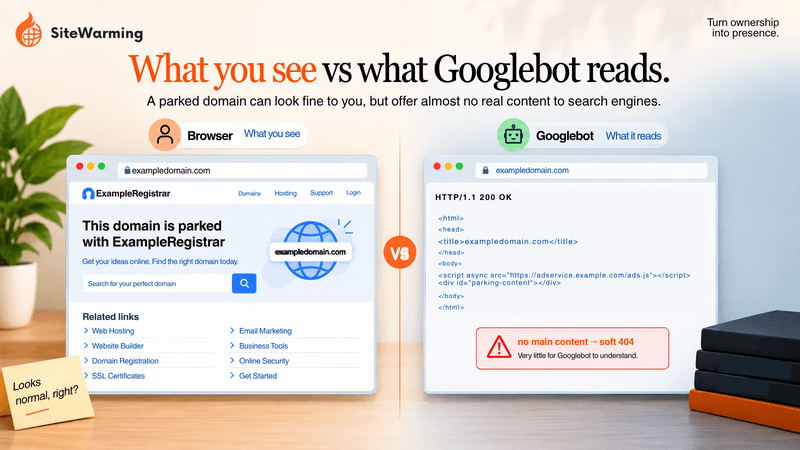
Short answer: Domain parking doesn't trigger a penalty. It does something quieter and more expensive. A parking page has no main content, so Google typically treats it as a soft 404, declines to index it and gradually crawls the domain less often. Repeat that for a year or two and you've taught discovery systems that the domain isn't a real destination. When you finally launch, that lesson takes weeks to months to unlearn. And since Google shut down AdSense for Domains in February 2026, parking no longer even pays for the privilege.
You know that email.
"Your domain is about to renew."
It shows up at the exact wrong time, right when you're trying to be a functional adult and not a person who collects ideas like baseball cards. You look at the name, you remember why you bought it, and you feel two things at once.
Guilt, because you still haven't built anything. Relief, because at least you didn't lose it.
And the story you tell yourself is simple: I'm paying for it, so it's safe. It's sitting on a shelf until I'm ready.
Here's the thing. That shelf isn't neutral.
Large-scale measurement work from APNIC and researchers at TU Munich counted 58.5 million parked domains, about 17.5% of everything they observed, in a September 2023 snapshot. That's not an edge case. That's default behaviour at internet scale.
If you're doing this, you're not weird.
But you are training the internet to ignore you.
Not emotionally. Mechanically.
And the renewal fee, as it turns out, is the smallest cost you're paying. If you want to see that number for your own portfolio before you read any further, run a renewal analysis on the domains you're holding.
What happens to a domain when you park it?
A parked domain "works." It resolves. It loads a page. Sometimes it's ads, sometimes it's a generic placeholder, sometimes it's a registrar-branded "coming soon." From your side, it feels like harmless waiting.
Discovery systems don't interpret it as waiting. They interpret it as a repeated signal: no main content here.
Why Google treats parking pages as soft 404s
A soft 404 is a page that returns a success code while behaving like an error. It loads fine. It contains nothing that functions as main content.
Google's documentation on HTTP status codes is direct about this: a 200 response doesn't guarantee indexing. If what comes back suggests an empty page or an error state, Search Console reports it as a soft 404, and those pages don't get indexed.
A parking page isn't literally empty. It has stuff on it.
But it's empty in the way that matters. No clear purpose. No original value. No stable intent.
A parked domain returns a 200 and means a 404.
What crawl decay actually looks like
The loop is predictable and it's slow enough that you never notice it happening.
Google shows up. It finds a page that doesn't behave like a real destination. It declines to index it. And then, this is the part that costs you, it comes back less often.
First the interval is days. Then weeks. Then the domain is something the crawler checks on occasionally, out of habit, the way you check on a house nobody lives in.
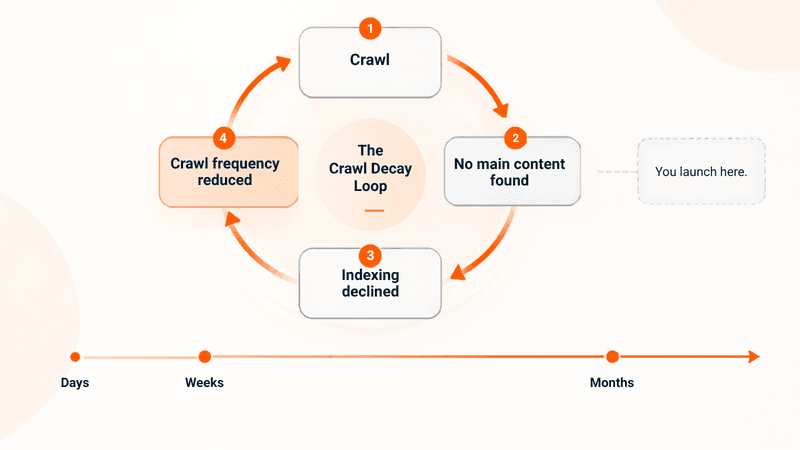
That's the part founders don't feel while they're paying the renewal. You assume you're holding an asset in pristine condition.
Meanwhile the world is building a history that says: this is not a real site.
This is how discovery systems learn patterns that become hard to unlearn.
What changed in 2025 to 2026: parking's ad engine was switched off
For most of two decades, parking had one honest defence. It paid. A few dollars a month per name, enough that a portfolio could cover its own renewals without anyone lifting a finger.
That defence is gone.
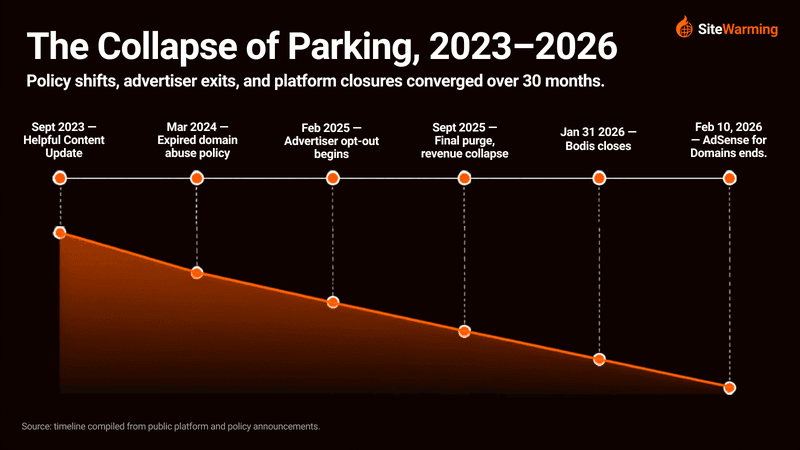
Google spent 2025 dismantling AdSense for Domains, the ad product the entire parking industry was built on. Advertisers were opted out in batches throughout the year. The final purge landed in September 2025 and took revenue down to pennies. On February 10, 2026, Google removed parked domains as an ad surface in the Search Partner Network entirely.
The wreckage is easy to inventory. Bodis shut down on January 31, 2026. IONOS put Sedo up for sale after its quarterly revenue fell 66%. Team Internet cut more than 200 jobs and watched its search revenue fall 63% in the first half of 2026.
Parking stopped being free the moment it stopped paying.
Here's the part that should actually worry you, though. When the legitimate ad money left, the traffic didn't. Security firm Infoblox found that more than 90% of the parked-domain traffic it studied now leads to scams or malware. ICANN's security research team began measuring parked-domain redirection in March 2026 and found roughly 5.5% of a random sample potentially harmful.
So the question has changed shape. It used to be: is parking costing me visibility?
Now it's also: do I know what my domain is currently showing the people who land on it?
If your name is sitting on a parking platform, your dashboard will not tell you.Here's the full 2023–2026 collapse timeline.
Does Google remember that a domain used to be parked?
When you finally decide to build, you expect a fresh start.
Sometimes you don't get one.
Back in 2020, John Mueller of Google Search addressed this exact scenario: moving onto a domain that had been parked or otherwise repeatedly non-indexable. His point was simple. If Google has consistently seen a domain as parked, it takes time for systems to update that understanding, and during that window crawling and indexing can lag.
Google got firmer about domain history after that. The March 2024 core update introduced a formal expired domain abuse policy aimed at people buying up expired names to harvest whatever reputation was left on them. The message underneath it applies to everyone: a domain's past is data, not noise.
This is the part that makes founders spiral.
You launch something real. You write. You share it. And then it feels like nothing's happening. Is it the idea? Is it the product? Is it you?
Sometimes it's none of those. Sometimes it's just history.
Parking isn't a pause button. It's a pattern you're teaching, and un-teaching takes time.
Why your registrar never warned you
If this is real, why isn't it common knowledge?
Because the default experience is designed around registrar incentives, not your future visibility.
Not a conspiracy. Just economics.
Who actually profits from a parked domain
The same APNIC and TU Munich research put 28.69 million domains on GoDaddy's free parking service as of September 2023, more than half the entire parking market once its paid service was included.
That tells you something uncomfortable. "Do nothing" isn't just tolerated. It's productised.
What's stranger is what happened next: the revenue that justified those free parking products collapsed in 2025, and the products didn't. They're still the default. They're still one click. See what GoDaddy parking actually does with your domain, and what the alternative looks like.
This is where the emotional loop locks in.
You bought the domain in a moment of clarity. Then life happened. Now renewals show up. You keep paying because letting it drop feels like admitting the idea died.
Is this just how building goes? Or is this how we slowly turn belief into a subscription?
That renewal email isn't a billing notice. It's a yearly audit of your original intention.
How long does it take to recover a previously parked domain?
Founders don't usually care about domain theory. They care about launch week.
And launch week is brutal when your domain has a long recorded history of "nothing here."
A realistic recovery timeline
Nobody can give you exact dates, and anyone who does is guessing. But the shape of it is consistent enough to plan around.
Week one: you publish, submit the URL in Search Console, and submit a sitemap. Nothing visible happens. This is normal and it is not a sign anything is wrong.
Weeks two to four: the first meaningful crawl lands. The domain gets re-evaluated on what's there now rather than what was there for the last three years. Some pages get indexed. Brand-name searches start returning you instead of nothing.
Months two to four: crawl frequency climbs back as the system learns there's something worth returning for. Non-brand queries start producing impressions.
The variable that moves this most isn't a trick. It's how long the domain sat dark, and whether anything new has appeared since you launched. A domain that publishes once and goes quiet teaches the same old lesson in a new outfit.
Even if you publish real content today, discovery systems don't instantly trust you today. They update based on repeated observation, not your internal intention.
That's why "I'll get to it someday" has a cost. It's quiet, and it's cumulative.
If the domain has already lapsed rather than just gone quiet, the clock works differently: here's what happens in the 30 days after a domain expires.
Parked vs 404 vs redirect vs warmed: what each one signals
Four states, four completely different messages. Most owners think they're choosing between "parked" and "built." They're actually choosing between these.
| Parked page | 404 / dead | 301 redirect | Warmed page | |
|---|---|---|---|---|
| Returns | 200 OK, no real content | 404 / 410 | 3xx to another domain | 200 OK with real content |
| How Google treats it | Soft 404, usually unindexed | Dropped from the index | Signals consolidate to the target | Eligible for indexing |
| Crawl frequency over time | Declines | Declines | Follows the target | Maintained or grows |
| Signals the domain keeps | None | None | Passed on, not retained | Accumulates here |
| Can AI systems describe it | No | No | Describes the target instead | Yes |
| Earns money in 2026 | No, AFD ended Feb 10, 2026 | No | No | Not directly, but it's an asset |
| Cost to reverse later | Weeks to months of re-crawl lag | Similar | Low | None, it's already live |
The technical differences between parking pages, 404s and empty sites matter more than most founders realise.
What AI search engines see when they hit a parked domain
Search engines were the only audience that mattered when parking became a habit. They aren't anymore.
When someone asks an AI assistant about a company, a product or a category, the systems behind that answer go and read pages. They need main content to work with. A description. A purpose. A stated audience.
A parking page gives them a domain name and an ad script. There's nothing to summarise, so nothing gets said about you.
This is worse than ranking poorly. A page that ranks tenth still exists in the record. A parked domain doesn't enter the conversation at all, and when an AI system is asked to name the options in a category, absence is indistinguishable from not existing.
More on why AI can't read your parked domain.
We care about the gap between buying a name and building the thing. That gap is where ideas become invisible. Warming is giving an idea a small, honest footprint before the full build exists. Not hype. Just presence. What is SiteWarming?
What to do instead of parking
The fix is not "build a full site." The bar is lower than that. And you don't actually have to choose between building everything and watching the name rot: there's a third option.
If you're going to hold the domain, give it a pulse.
The minimum viable page checklist
What this is: one plain sentence, no revolutionising. You write one sentence about the idea. That's the whole input. SiteWarming asks you to share the reason you bought the domain, and turns that story into the foundation of the warm site. No copywriting, no blank page, no deciding what the homepage should say.
Who it's for: name the person. Audience is a field in the story, not an afterthought. And if you own forty domains in the same space, Niche DNA lets you group them by topic and give each cluster a focused audience profile, so every domain in that group gets sharper context automatically.
Why it exists: the reason you bought the name in the first place. The reason becomes the site, rather than a line of small print on a parking page. Based on your intent, SiteWarming launches one of three templates: Future Build for domains you may want to develop later, Open for domains that aren't listed but are reachable by the right builder or partner, and Actively Selling for domains already listed elsewhere, routed to the marketplace listing.
How to contact you: a real route, not a form that goes nowhere. A protected contact path ships with the launch. Inquiries arrive anonymized from the buyer or partner side, conversations can go toward build, sell or partnership, and you decide when and how to respond. The private anonymized inbox is on the free plan, not held back for paid tiers.
A title tag and meta description: written by you, not generated by a registrar. The story you wrote is what the metadata is built from, so the snippet in search describes your idea rather than "this domain is parked."
150+ words of real content on an indexable page. A warm site clears that on day one. Each template includes domain analysis, structured story data, AI-readable FAQs, and clear availability context. The part a checklist can't cover is what happens in month two: the site keeps getting fresh updates so it never goes stale, one update a month by default, with bi-weekly, weekly, or a 10-post boost cadence available per domain.
HTTPS, working and not expired. This is the line where SiteWarming has the clearest advantage, because "not expired" is a maintenance problem, not a setup problem. Launching hands off DNS configuration, the HTTPS certificate, and hosting for every domain at once, and then keeps running ongoing DNS and SSL checks. Nobody has to remember a renewal date.
Submitted to Google Search Console and Bing Webmaster Tools. Warm sites are built to be found by search and by AI, and structured context plus FAQs are there so both people and AI can understand the idea.
How to check what Google currently sees on your domain
Don't take my word for any of this. Five minutes, four checks:
Search site:yourdomain.com in Google. If nothing comes back, nothing is indexed. That's your baseline.
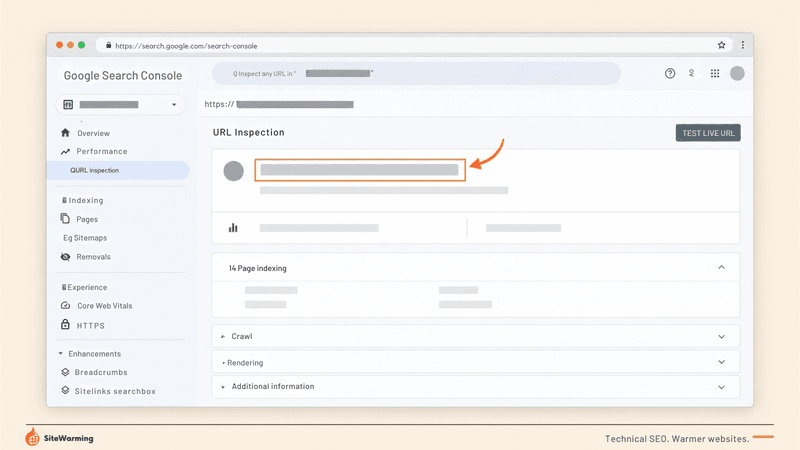
Run the URL through URL Inspection in Search Console. It'll tell you the live status: indexed, crawled but not indexed or excluded.
Open the Pages report in Search Console. If Google is classifying your domain as a soft 404, it will say so in plain language.
Check what's actually being served. If the domain has been on a parking platform at any point since 2025, load it in a private window on your phone and see where it takes you. Given what replaced the ad revenue, this is no longer a paranoid step.
Email warming vs warming a parked domain
Worth separating these, because the words collide.
Email warming means gradually increasing send volume on a new sending domain so mailbox providers learn to trust it. It's about MX records, authentication and sender reputation. If you've just set up cold outreach, that's the warming you're looking for.
Warming a parked domain means putting real, indexable content on a name so search engines and AI systems can understand what it is. It's about crawl, index and discovery.
Different systems, same underlying idea: reputation is earned through repeated, observable behaviour. Neither one accrues while you wait.
And if you're not going to build
If you're not going to build in the next six months, ask the question you've been avoiding.
Am I keeping this because it's valuable? Or because letting it go would hurt?
That's not a domain question. That's a self-honesty question.
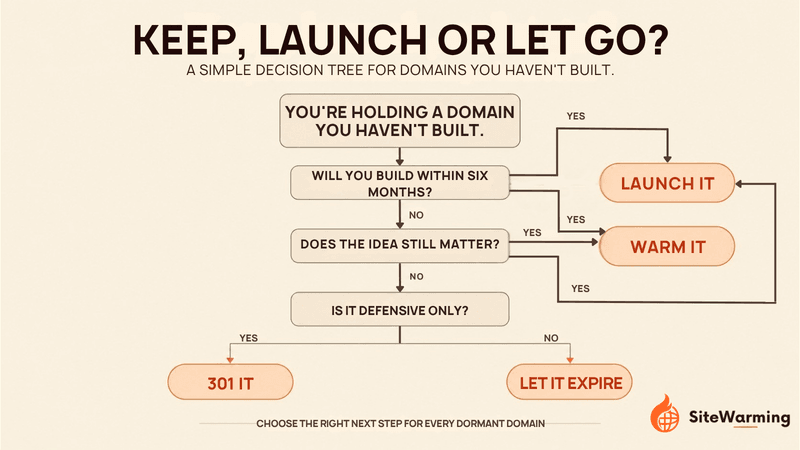
You registered that domain because you believed in something.
The domain isn't the problem. The parking is.
Registration keeps the name. It doesn't keep the visibility.
Parking feels safe because it's passive. But discovery systems are always learning, and "nothing here" is still a lesson.
So if you're going to keep the name, warm it up. Give it a pulse.
And if you're not, it might be time to stop paying for invisible hope.
Frequently asked questions
Does domain parking hurt SEO? Not as a penalty. Parking pages have no main content, so Google generally treats them as soft 404s and leaves them out of the index. Over time the domain gets crawled less often. The damage isn't a ranking drop, it's the absence of any signals at all, plus a delay when you eventually launch.
Does Google index parked domains? Usually not. Google's documentation is explicit that a page can return a 200 success code and still be classified as a soft 404 if it has no main content. Registrar placeholders, ad landers and "coming soon" shells almost always fall into that category.
Is a parked domain penalised by Google? No manual action is involved. The outcome is exclusion, not punishment. The exception is worth knowing: Google's March 2024 expired domain abuse policy targets people who buy expired domains to exploit leftover reputation, so a domain's history can carry real baggage.
How long does it take Google to re-index a previously parked domain? John Mueller of Google has said that when a domain has consistently been seen as parked, it takes time for systems to update, and crawling and indexing can lag during that window. In practice, plan for several weeks to a few months of slow discovery after you launch.
Does parking affect a domain's authority or value? There's no authority reservoir being preserved. Registration keeps the name; it doesn't keep the visibility. Historical signals fade with time and crawl decay, which is why a premium domain that's been parked for five years can start from a colder position than its owner expects.
Is domain parking still profitable in 2026? No. Google wound AdSense for Domains down through 2025 and removed parked domains as an ad surface on February 10, 2026. Portfolios that once covered their own renewals now earn effectively nothing. The passive-income argument for parking no longer exists.
Is a "coming soon" page better than a parking page? Only if it contains something real. A logo and an email field is the same soft-404 problem in nicer packaging. A page that states what the domain is, who it's for and how to make contact is genuinely different, because it has main content.
Should I just 301 redirect the domain to my main site? For defensive or misspelling domains, yes. A 301 is a clean, honest signal. But understand what it does: it consolidates value into the target and builds nothing on the redirected name. If the domain is meant to become something, redirecting delays that.
How do I check what Google currently sees on my domain? Run a site:yourdomain.com search to see whether anything is indexed, then use URL Inspection in Search Console for the live status. The Pages report will name it directly if the URL is being classified as a soft 404.
Should I let the domain expire instead? That's a legitimate answer for domains with no future. Be deliberate about it, though. Dropping a name means losing it, and reacquiring it later is expensive and carries its own history. The question to answer honestly is whether you're renewing for value or to avoid a feeling.
Sources and further reading
- APNIC and TU Munich, The prevalence of domain parking, November 2023: 58.5 million parked domains; GoDaddy free parking at 28.69 million (September 15, 2023 snapshot)
- Google, How HTTP status codes affect Google's crawlers, updated February 2026
- Google Search Console Help, Soft 404 errors
- Search Engine Journal, Google on migrating to a previously parked domain, 2020
- Search Engine Roundtable, February 2026: parked domains removed as a Search Partner Network ad surface, effective February 10, 2026
- Domain Name Wire, September and December 2025: the AdSense for Domains wind-down and its fallout
- Above.com, February 2026: parking revenue decline figures
- ICANN Security, Stability and Resiliency research, from March 2026: parked-domain redirection measurement
Image credits
- Hero, timeline, crawl-decay diagram, comparison graphic, checklist and decision tree: original SiteWarming illustrations
- Search Console screenshot: SiteWarming, captured September 2026
Share this article
Ready to Transform Your Domain Portfolio?
Start building real value with your domain investments today.