The Hidden Cost of Unused Domains (And How to Stop It)
 Bret Siers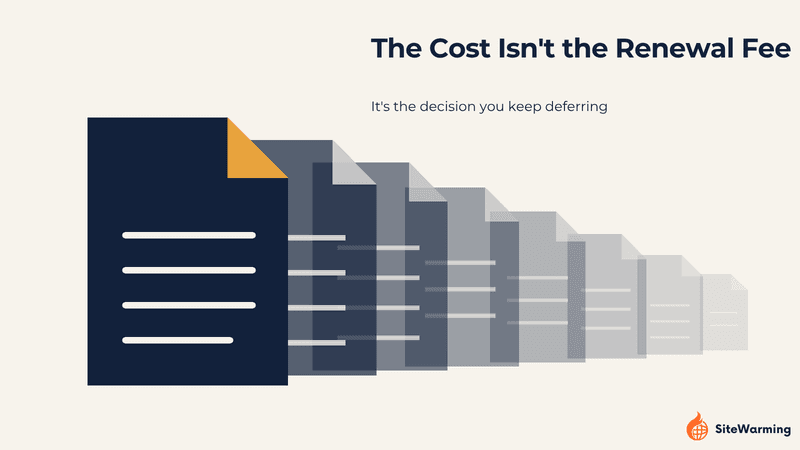
Renewing a domain you never built costs more than the renewal fee. First-year .com renewal rates sit in the mid-40% range, while domains past their first year renew in the mid-80s, and that gap is where unresolved decisions live. The real cost isn't the twelve dollars. It's the attention you spend dodging a choice you already know the answer to.
Why do renewal emails feel different than the original purchase?
The day you bought the domain felt like optimism: a name, a possibility, the start of something. The renewal notice a year later doesn't feel like that. It feels like a report card on a year you didn't get around to.
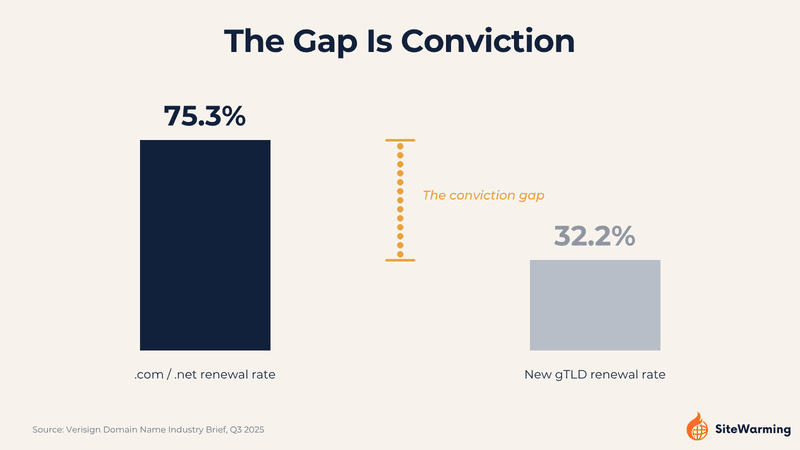
That's not just a feeling. Verisign's Domain Name Industry Brief for Q3 2025 puts the combined renewal rate for .com and .net at 75.3%, while more speculative new gTLDs sit at 32.2% (Verisign DNIB, Q3 2025). The gap between those two numbers is basically a measure of conviction; domains people feel sure about get kept; domains bought on a hunch get let go, eventually.
A renewal email doesn't ask "can you afford twelve dollars." It asks "do you still believe in this?" That's a harder question, and it's the one your inbox quietly forces on you once a year whether you're ready or not. As explored in Domain Parking Is Not Neutral, leaving a domain parked isn't a pause button; it's a public, if quiet, answer to that question.
What happens when you keep renewing without building?
Here's the uncomfortable part: most people don't actually keep renewing indefinitely. Verisign's own data, presented at Nordic Domain Days in May 2026, puts first-year renewal rates for .com in the mid-40% range, against mid-80s for domains renewing in their second year and beyond (Domain Name Wire, May 2026). So more than half of first-year domains never see a second birthday. The guilt you're feeling isn't about an infinite cycle; it's about the specific, finite window before you become part of that majority.
The same data contains the more useful finding. Domains that actually do something renew measurably more often: a web presence or email setup raises renewal likelihood by 9%, and even simple domain forwarding raises it by 13%. Doing something with a domain, anything, changes the odds you keep it.
In that window, each renewal is a deferred decision, not a neutral one. A 2024 study of digital hoarding behavior among university students found that when people face repeated choices about saving or removing digital files, they experience cognitive fatigue and default to keeping things rather than actively deciding whether they're still useful (Digital Health, 2024). Renewing a domain is the domain-specific version of that same fatigue, it's easier to pay twelve dollars than to decide the idea is dead.
That's how founders become what we call accidental aggregators: not through a deliberate portfolio strategy, but through a year of avoided decisions that quietly turned into a habit.
Before your next renewal notice arrives, answer these three questions instead of just clicking "renew":
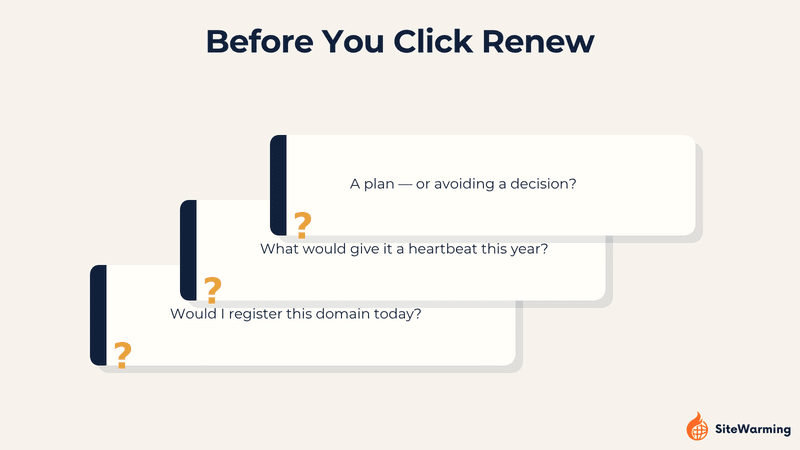
- Would I register this domain today, knowing what I know now? If the answer is no, the renewal isn't protecting an asset; it's protecting a sunk cost.
- What would it take to give this domain a heartbeat, even a small one, before the next renewal? If the honest answer is "more than I'm willing to do in a year," that's information.
- Am I renewing because I have a plan, or because deciding not to feel like admitting something? Only one of those is a reason to keep paying.
If you want that decision walked through in more depth, should you renew an unused domain? takes the same question apart from the other side.
What happens when a domain actually expires?
If you let a domain lapse instead of renewing, you don't lose it immediately. ICANN and the registries build in a long runway, and knowing the real timeline makes the decision less frightening either way.
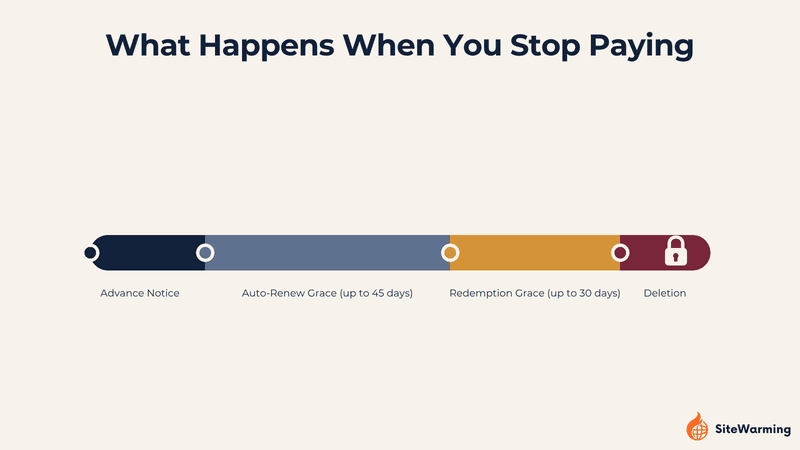
| Stage | Typical window | What happens |
|---|---|---|
| Advance notice | One month and one week before expiry, plus within five days after | ICANN requires your registrar to send two renewal reminders before expiration and one after |
| Auto-Renew Grace Period | Up to 45 days after expiration (registry/registrar dependent) | Domain typically still resolves; you can usually renew at the normal fee |
| Redemption Grace Period | 30 days | Domain is suspended but can still be redeemed or renewed, usually at a premium restore fee |
| Pending Delete | 5 days | No longer recoverable; the domain is queued for release |
| Deletion | After the above | Domain is released and becomes available to anyone |
The notification requirement, the 30-day Redemption Grace Period and the 5-day Pending Delete window are all set out in ICANN's registrant FAQs on renewals and expiration. The Auto-Renew Grace Period length is set by the registry and applied by your registrar, so confirm the exact number with yours.
Add it up and you get roughly 75 to 80 days of decision windows, which means letting a domain go isn't a snap decision either. It's just as deliberate, in its own way, as renewing it. If a domain of yours is already in that window, what to do in the 30 days after a domain expires covers the recovery steps, and what happens when a domain expires walks the full sequence.
What is the invisible cost warming exists to solve?
The actual cost of an unused domain was never the renewal fee. It's the recurring tax on your attention; a small, private moment of avoidance, twelve times a year if you hold a dozen names, that adds up to real cognitive load even though no single instance of it feels expensive.
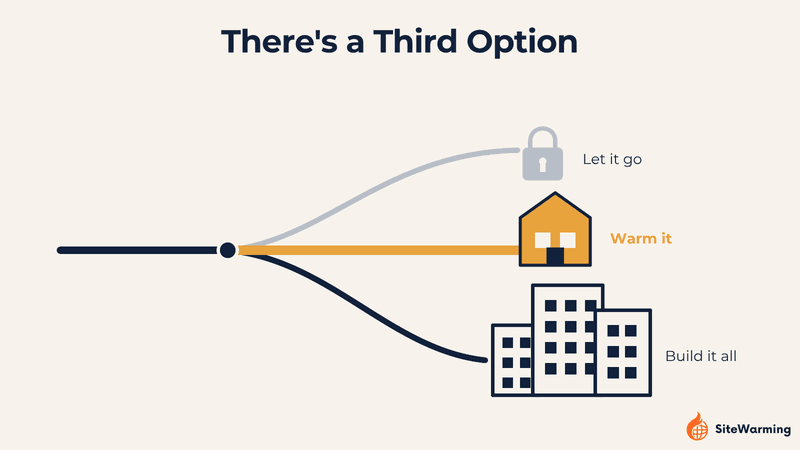
Warming exists to remove that tax without forcing the binary choice between "build the whole thing now" and "let it go." Giving a domain a heartbeat: a real, if minimal, presence, turns the renewal question from "am I lying to myself" into "this is doing something, keep going." That's also the behavior Verisign's own numbers reward: domains with a presence attached renew markedly more often than domains sitting empty.
If you haven't seen what that actually looks like, What is SiteWarming? walks through the mechanics, and The Third Option makes the case for why you don't have to choose between building and parking.
If this domain is one of several you're sitting on, the guilt compounds differently at scale, see What to Do With Too Many Domains You Never Built for what happens when this becomes a portfolio-level problem instead of a single-domain one, and From Ownership to Stewardship for the mindset shift that actually resolves it.
What is the renewal email really asking?
Strip away the invoice formatting and a renewal notice is asking one question: do you still mean it? Most people answer that question by not answering it, by renewing on autopilot and leaving the actual decision for next year.
You don't have to decide to build the whole thing today. You just have to decide honestly whether you're keeping a possibility alive or keeping a decision postponed. If you're ready to stop postponing it, see what a warmed domain looks like.
The cost is not twelve dollars. It is the attention you spend avoiding a decision you already know the answer to.
Frequently asked questions
What happens if I don't renew my domain? Your registrar must send renewal reminders one month and one week before expiration, and once within five days after. After expiry most domains enter an Auto-Renew Grace Period of up to 45 days where the domain typically still resolves and can be renewed normally, then a 30-day Redemption Grace Period where it's suspended but recoverable at a premium restore fee, then a 5-day Pending Delete window. Only after all of that is the domain released and available to anyone.
How long before an expired domain is permanently deleted? Roughly 75 to 80 days from the original expiration date, once you add the Auto-Renew Grace Period, the Redemption Grace Period and the 5-day Pending Delete window together. The redemption and pending-delete windows are set by ICANN policy; the auto-renew grace period varies by registry and registrar.
Should I renew a domain I'm not using? That depends on whether you'd register it today, knowing what you know now. If the honest answer is no, renewal is protecting a sunk cost rather than a real opportunity; letting it go, or giving it a minimal "warmed" presence, are both more honest than paying to defer the decision again.
Why do I keep renewing a domain I never built anything on? It's a well-documented pattern, not a personal failing. Research on digital hoarding shows people default to keeping things under decision fatigue rather than actively evaluating whether they're still useful. Renewing on autopilot is the path of least resistance; deciding takes more from you than the renewal fee does.
What percentage of domains get renewed after the first year? First-year renewal rates for .com sit in the mid-40% range, compared with the mid-80s for domains renewing in their second year or later, according to Verisign data presented in May 2026. Most domains that survive year one keep going; most that don't, don't.
Share this article
Ready to Transform Your Domain Portfolio?
Start building real value with your domain investments today.