What Actually Happens When Your Domain Expires (Day by Day)
 Bret Siers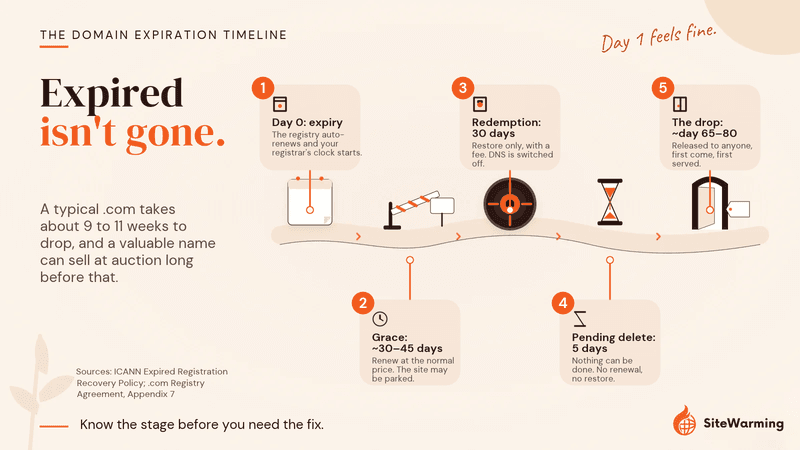
When a domain expires, it isn't released straight away. It moves through a registrar grace period (usually 30-45 days, renewable at the normal price), a 30-day Redemption Grace Period (restorable for a fee), and a 5-day pending delete. Only then does it drop and become available to anyone about 65-80 days after expiry for a typical .com.
You know the email. The one from your registrar that says your domain is expiring in 30 days. You see it. You think, "I'll handle that later." You archive it.
Here's what most people don't realize: the domain doesn't vanish overnight. The process is slower, more deliberate, and more profitable for registrars than you'd expect. Understanding it changes the way you think about what a domain actually is.
What is the domain expiration timeline, stage by stage?
Every generic domain (.com, .net, .org and the other gTLDs) follows the same skeleton. ICANN, the nonprofit that sets the rules for generic domains, fixes the minimums; your registrar, the company you pay, decides much of what happens inside them. The registry, the operator of the extension itself, such as Verisign for .com, runs the database underneath.
| Stage | Days after expiry (typical .com) | Can you renew? | What it costs | What your site and email do |
|---|---|---|---|---|
| Expiry | Day 0 | Yes | Normal renewal | Usually still working |
| Registrar grace period | Day 1 to roughly day 30-45 (registrar-dependent) | Yes | Normal renewal at most registrars | Parked, suspended or switched off at some point in this window |
| Expired-domain auction (some registrars) | Inside the grace period, e.g. from day 26 at GoDaddy | Only until someone bids | Normal renewal or redemption fee | Not working |
| Redemption Grace Period | 30 days after the registrar deletes the name | Yes, as a "restore" | Restore fee plus renewal | Not working: DNS disabled |
| Pending delete | 5 days | No | n/a | Not working |
| Drop | After pending delete ends | Anyone can register it | Standard registration price | Whatever the new owner decides |
The stage lengths come from the registry rules. For .com, the auto-renew grace period is 45 calendar days, the Redemption Grace Period is 30 days, and pending delete is five days (.com Registry Agreement, Appendix 7). Registrars must cancel an unrenewed name by the end of that auto-renew grace period, and many cancel earlier (ICANN Expired Domain Deletion Policy).
That's where "65-80 days" comes from. A registrar that deletes at day 30 puts the drop around day 65; one that holds the name to day 45 puts it around day 80. Cloudflare's own schedule, for example, ends pending delete on day 75 (Cloudflare Registrar FAQ). Call it nine to eleven weeks from "I'll handle it later" to "it belongs to someone else".
What happens on Day 1 after a domain expires?
Nothing dramatic. That's the whole trick. At many registrars your site still loads, your email still works, and anyone who types your domain into a browser sees whatever was there before.
"Many" is doing real work in that sentence, because Day 1 depends on where the name is registered:
- Namecheap switches the domain to its parking nameservers during the grace period, shows a parking page instead of your site, and email sent to the domain is lost (Namecheap).
- GoDaddy parks the domain at +5 days, and "any connected website or email will stop working" (GoDaddy).
- Porkbun usually keeps the domain working for the first 10 days (Porkbun).
- Cloudflare keeps it resolving normally for days 1-30 (Cloudflare).
Behind the scenes, the registry usually auto-renews the name at expiry and flags it autoRenewPeriod, the EPP status code that marks this grace window (ICANN EPP status codes). Crawlers and monitoring tools notice. People usually don't.
The warnings were there. ICANN requires registrars to send at least two renewal reminders, about one month and about one week before expiry and one more within five days after it (ICANN Expired Registration Recovery Policy). If you hold names at three registrars, that's three sets of reminders on three schedules, from three senders you've learned to half-ignore. Some of the emails that look like renewal notices aren't, which is why it pays to know how to spot a domain renewal email scam.
What breaks first is rarely the homepage. In July 2017, Marketo let marketo.com lapse; tracking links, images and forms in its customers' marketing emails broke, and a customer ended up renewing the domain for them (The Register, 26 July 2017). When the domain stopped resolving, everything built on it stopped with it.
Day 1 feels fine. That's precisely why it's dangerous.
Is there a grace period after a domain expires?
For generic domains, yes. The grace period is your last free window: you can renew at the normal price, with no penalty and no surcharge. It is also the stage people misjudge most, because its length is set by your registrar, not by ICANN.
What ICANN does fix is the floor. If a registrar keeps an expired name renewable for eight days or more, it must interrupt the domain's DNS for at least the last eight consecutive days of that window, and any parking page it shows must say the registration has expired and explain how to renew (ICANN ERRP). In other words, the policy guarantees you'll notice before the name is gone; if you're looking.
How long is the grace period at each registrar?
Checked on each registrar's own help pages on 28 September 2026. These apply to most gTLDs; country-code domains differ.
| Registrar | Renew at the normal price until | What your domain does meanwhile | What comes next |
|---|---|---|---|
| GoDaddy | +18 days | Parked at +5 days; website and email stop | Redemption fee from +18; Expired Domains Auction at +26; Final Closeout Auction +36 to +41; removed from your account at +72 |
| Namecheap | 30 days for most names | Parking nameservers and parking page; email lost | Redemption Grace Period with a redemption fee |
| Cloudflare | 40 days for most TLDs | Resolves normally days 1-30; suspension page days 31-40 | Redemption days 41-70; pending delete days 71-75 |
| Porkbun | Day 35-45 (typically day 37 or 38) | Works about 10 days; then an expiry notice, client hold or a parking page | May go to third-party auction from about day 21; then 30-day redemption and pending delete |
| Dynadot | 30-45 days (auto-renew grace) | Website and basic DNS still work; transfers and DNS changes restricted | Redemption (about 30 days), then 5-day pending delete |
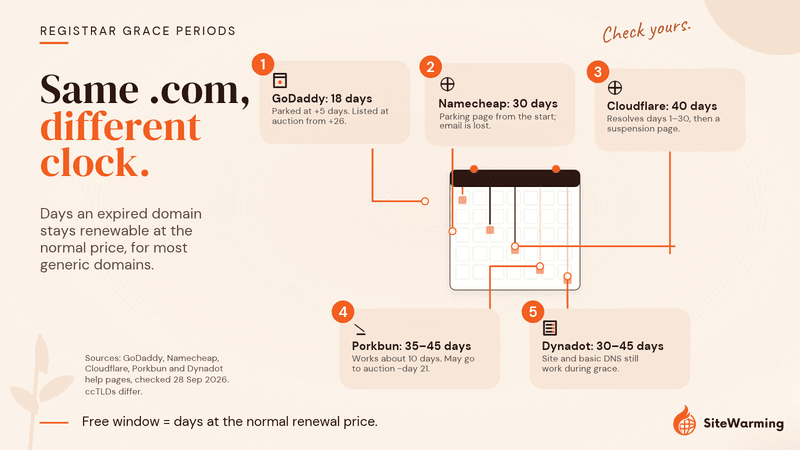
Two things stand out. The free window runs from 18 days to about 45 depending on who holds the name. And several registrars earn from your domain during that window: GoDaddy parks it, and Namecheap puts up its own parking page. Anyone who follows an old link sees an ad page, not your project. Domain parking is never neutral.
During the grace period nothing is permanently lost. But the continuity of what your domain meant is quietly eroding. A parking page is a rewrite of your domain's story, by someone else.
What is the redemption period, and what does it cost?
Miss the grace period and the registrar deletes the name. That puts it into the Redemption Grace Period (RGP): 30 days during which the registry holds it, disables its DNS, blocks transfers, and lets only you get it back through your registrar (ICANN ERRP). Every gTLD registry must offer it, sponsored gTLDs excepted.
It sounds generous. It isn't cheap. Getting a name out of redemption is called a restore, and it costs a restore fee on top of the renewal:
- Namecheap: $88.48 to redeem a .com, renewal included, as listed on 28 September 2026; .co is $175.48 and .ai is $419.96 (Namecheap redemption pricing).
- Dynadot: restore costs typically run "$250+" once the registry fee, handling fee and renewal are added up (Dynadot).
- Cloudflare: "in most cases there is a restore fee. The amount varies depending on the TLD" (Cloudflare).
- Porkbun: "the normal renewal fee plus a redemption fee which varies by the registry" (Porkbun).
- GoDaddy: its timeline says only that "a redemption fee may apply" (GoDaddy).
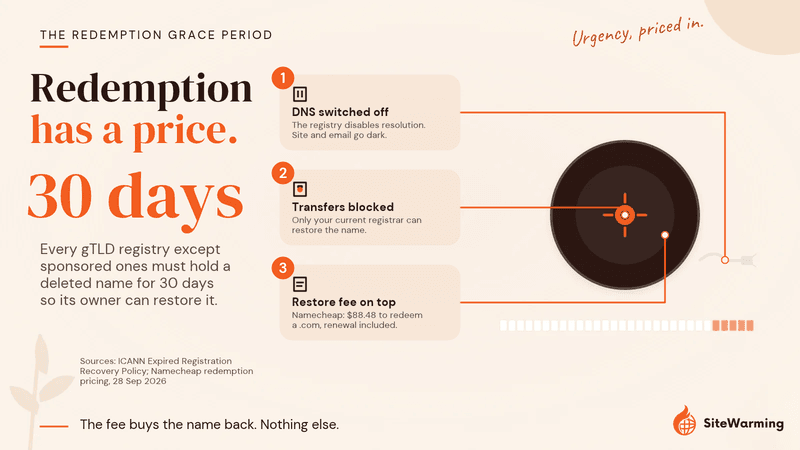
Registrars point out, fairly, that part of the fee is set upstream by the registry; Namecheap says the redemption fee "is set by our upstream Registrar and Domain Registry, that is why we cannot waive it" (Namecheap). ICANN also requires registrars to publish their renewal, post-expiry renewal and restore fees on their websites (ICANN ERRP), so the number is findable before you need it. But step back and look at the whole pipeline: it's a revenue engine, and every stage charges a bigger toll than the one before.
The fee isn't the cost of a service so much as a price on urgency. By the time you're in redemption, you've already done the emotional math, and the registrar knows you'll pay. Why renewals keep costing more is a story of its own.
Meanwhile the domain doesn't resolve. It's absent from the visible web. Anything that goes looking for it finds nothing, and that absence compounds.
Do all domain extensions follow the same expiration timeline?
No. Everything above describes generic domains, because that's what ICANN's expiry policy covers. Country-code domains (ccTLDs) such as .de, .uk or .jp follow their own registry's rules.
Some are harsher. Porkbun notes that ccTLDs such as .de, .cx and .am "do not have a grace period and may enter redemption or simply delete several days prior to expiration" (Porkbun). Namecheap lists .CH, .ES, .FR, .LI, .PE, .SG, .DE and .EU among the extensions that expire several days before their actual expiration date (Namecheap).
Some are gentler. At Cloudflare, .uk domains can't be restored the usual way but can be renewed within 90 days of expiry with no restore fee (Cloudflare). If you hold country-code names, check that registry's policy separately; don't assume the .com calendar.
Can someone buy my domain at auction before it drops?
Yes, and for any name with obvious value this is the likelier ending. Not every domain goes quietly to deletion. If a registrar thinks your domain can sell, it gets routed to an expired-domain auction while it's still in the registrar's hands.
At GoDaddy, the name is listed on Expired Domains Auction at +26 days and goes to Final Closeout Auction at +36 days; once bidding starts, you can no longer simply renew (GoDaddy). At Porkbun, expired names may be submitted to third-party auction services from about day 21 (Porkbun). A name that sells there never reaches redemption and never drops.
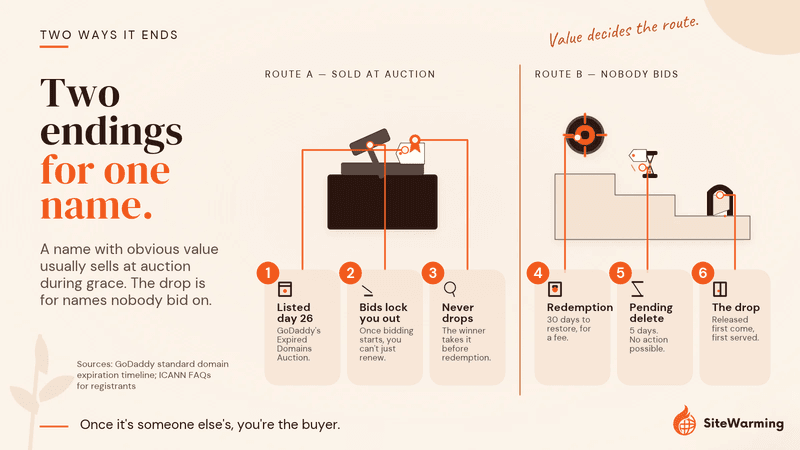
Once someone else holds it, getting it back means asking them. Most people own more domains than they realize, and every one of them runs through this same pipeline. Picture the founder who spent three years building on a name and let one renewal slip. Now they're negotiating with a stranger for the right to their own address, at whatever price the new owner sets.
At this stage the domain isn't yours in any meaningful sense. It's being valued by people who see only metrics, age and letters, not what you meant it to be. If you need to reach whoever holds it now, here's how to find out who owns a domain. And it's worth knowing what ICANN actually lets you own in the first place: you rent the right to a name, one term at a time.
What happens during pending delete?
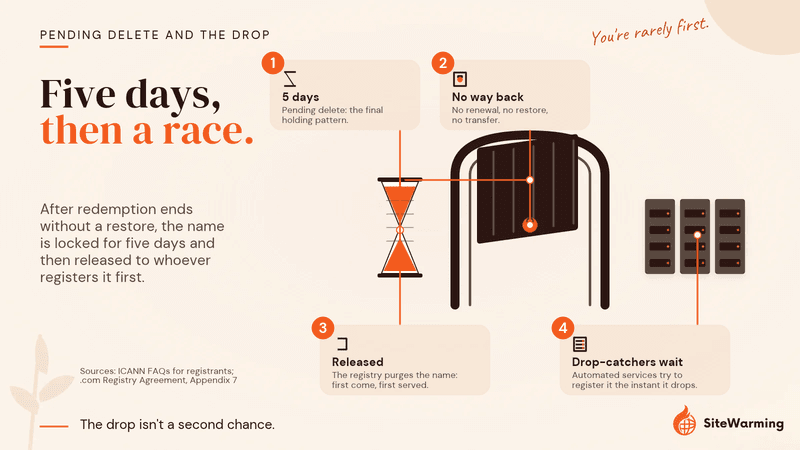
If the domain wasn't sold at auction and wasn't restored during redemption, the registry marks it pendingDelete. This is the final holding pattern, and it lasts five days (ICANN FAQs for registrants).
During pending delete nothing can be done. No renewal, no restore, no transfer, no purchase. The name sits and waits to be released.
When can someone else register my expired domain?
The moment pending delete ends. The registry purges the name and releases it for registration "on a first-come-first-served basis" (ICANN FAQs for registrants). For a typical .com, that's roughly day 65 to 80 after expiry.
First-come doesn't mean you have a fair chance. Names worth anything are usually taken by drop catching; automated services that watch deletion lists and try to register a name the instant it's released, often after selling backorders to buyers who want it (Wikipedia: Domain drop catching). The person who let it lapse is rarely first in line.
What happens to a name after someone else takes it isn't theoretical. Atre, a JR East subsidiary that runs station shopping centers in Japan, stopped using the domain atre-club.jp after 2015. A third party later registered it, and the QR codes printed on the back of membership cards issued between October 2013 and February 2016 started leading to suspicious websites; Atre warned customers on 27 June 2025 (ITmedia, 2 July 2025).
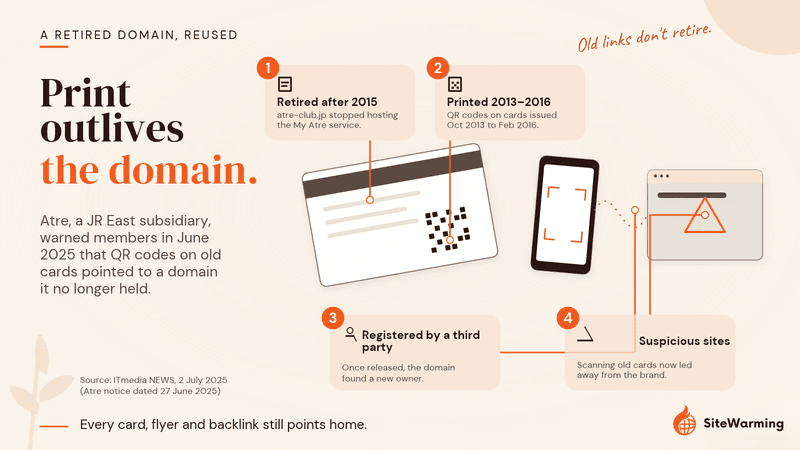
Every old card, printed flyer, email signature and backlink still pointed to that address. A domain doesn't disappear into a void. It gets reused, and you have no say in how. The ways that spreads: shared IPs, brand confusion, malicious redirects; are covered in how an expired domain can hurt your other domains and your brand.
Which lifecycle stage is my domain in right now?
Run a WHOIS or RDAP lookup on the domain and read its status codes. These are the ones that matter after expiry (ICANN EPP status codes):
| Status you see | What it means | What you can still do |
|---|---|---|
| autoRenewPeriod | The registry auto-renewed the name at expiry; you're in the grace window | Renew through your registrar, usually at the normal price |
| clientHold | Your registrar has told the registry not to put the name in DNS, so it won't resolve | Often still inside grace; ask your registrar |
| redemptionPeriod | Your registrar has asked the registry to delete the name; it's held for 30 days | Restore through your registrar, with a fee |
| pendingRestore | A restore has been requested and the registrar has a seven-day window to finish the paperwork | Wait for it to complete |
| pendingDelete | Redemption has ended without a restore | Nothing; the name will be released |
If you're past autoRenewPeriod and want the name back, the step-by-step for each stage is in what to do after a domain expires.
Why does the timeline matter more than the renewal price?
Most people treat domain expiration as a billing problem. It isn't. The real cost isn't the renewal fee or the restore fee. It's what happens to your domain's signal while it's dark.
A live domain builds presence in the systems that decide who gets found: search engines, AI models, citation databases, link graphs, people's bookmarks. When the domain goes dark, those systems update. They learn the address is unreliable and route attention elsewhere. Getting the domain back doesn't restart you where you left off; you restart with a record that says "disappeared".
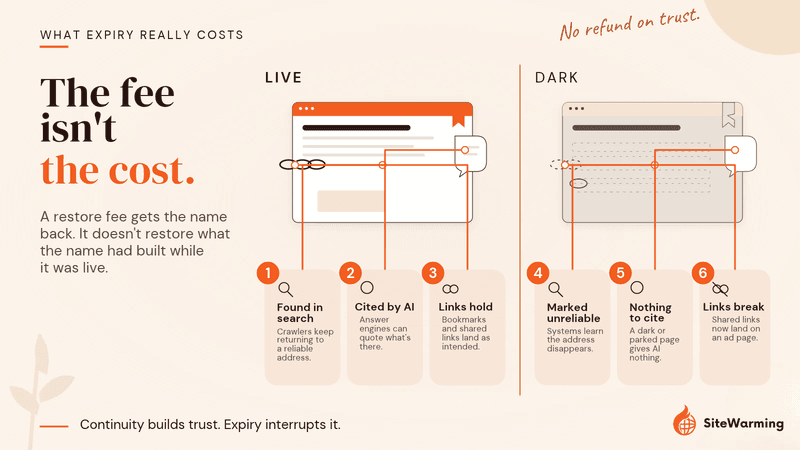
Human signals erode too. Bookmarks fail. Links people shared now land on an ad page. The people who shared them look careless, and your project looks abandoned. No restore fee reverses that.
Continuity is what builds trust, and expiration interrupts it. It's a big part of why most domains fail.
So how do you avoid expiration? The obvious answer is obvious: turn on auto-renew, keep the card on file current, put the date in a calendar, pay the renewal. A proper domain renewal management routine: review at 90 days, decide at 60, verify payment at 30; covers the mechanics.
The more useful question is why you let it get this far.
Sometimes it's an oversight: an expired card, a reminder that landed in spam, an admin inbox nobody reads. More often it's something else. The idea stalled. The project never launched. Letting the domain expire felt easier than admitting you weren't going to build it.
People who lose domains aren't usually careless. They're conflicted. And the registrar model profits from that conflict, one stage at a time.
That's why the better question isn't how to avoid expiration. It's whether you should renew a domain you haven't built yet. That's a different question, with a less obvious answer.
How does SiteWarming help you stop domains reaching redemption?
The lifecycle punishes two things: not seeing a renewal coming, and holding a name you've stopped deciding about. SiteWarming addresses each with a separate tool.
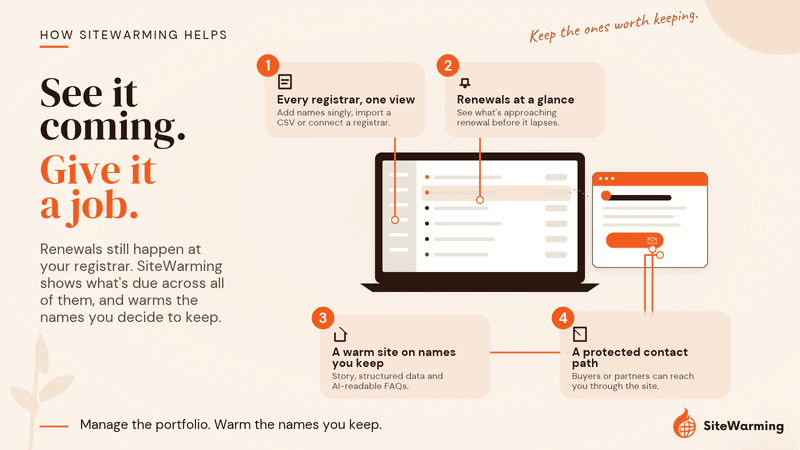
See every renewal in one place. SiteWarming's portfolio dashboard pulls your domains together from every registrar: add them one at a time, bulk-import a CSV, or connect the registrar, and shows what's live, what leads nowhere, and what's approaching renewal, at a glance. Renewals, transfers and DNS changes still happen at your registrar; the dashboard is where you see them coming, instead of relying on three inboxes. If your names are spread out, here's how to manage domains across registrars.
Give the names you keep a reason to renew. Launch & Warm puts a warm site on a dormant domain: a one-sentence story, structured data, AI-readable FAQs and a protected contact path for buyers or partners, with DNS, HTTPS, hosting and monthly content updates handled for you. Instead of a dark name drifting toward its renewal date, you have one that's building findability, and the renewal pays for something.
And if you'd rather move a name somewhere easier to manage before it lapses, you can transfer a domain without breaking anything; ideally well before the grace period, not during it.
Nobody tells you any of this when you buy a domain for $12. But now you know what happens if you let go.
Frequently asked questions
How long after a domain expires can someone else buy it?
For a typical .com, about 65 to 80 days. The name passes through your registrar's grace period (30-45 days at most registrars), a 30-day Redemption Grace Period and a 5-day pending delete before the registry releases it on a first-come, first-served basis (ICANN). A buyer can get it much sooner if your registrar auctions it during grace; GoDaddy lists expired names from day 26.
What happens to my email when my domain expires?
It stops working once your registrar parks or suspends the domain, and that can happen early. GoDaddy says connected website and email stop at +5 days; Namecheap moves the domain to parking nameservers during the grace period, and email sent to it is lost (Namecheap). Renewing restores DNS, but mail that bounced in the meantime doesn't come back.
Can I renew a domain after it expires?
Yes, during your registrar's grace period, usually at the normal renewal price. ICANN requires registrars to let the registrant renew throughout the post-expiry window in which the domain's DNS is interrupted (ICANN ERRP). After the registrar deletes the name, you can still restore it during the 30-day Redemption Grace Period, but only for a restore fee on top of the renewal.
How much does it cost to get back a domain in redemption?
It depends on the registrar and the extension. Namecheap lists $88.48 to redeem a .com, renewal included, and $419.96 for a .ai (Namecheap). Dynadot puts typical restore costs at $250+ (Dynadot). Registrars must publish their restore fees on their websites under ICANN policy, so check yours before you need it.
Can I transfer an expired domain to another registrar?
Yes, while it's still in the grace period. ICANN says a registrar can't make you pay for a renewal before you transfer an expired domain: "You have the right to transfer an expired domain" (ICANN). Once the name enters the Redemption Grace Period, the registry blocks transfers, so you'd have to restore it with your current registrar first.
Do all domain extensions follow the same expiration timeline?
No. ICANN's expiry rules cover generic domains such as .com, .net and .org. Country-code domains follow their own registry: Porkbun notes that .de, .cx and .am have no grace period and may delete before the expiry date, while Cloudflare lets .uk names be renewed within 90 days of expiry (Cloudflare). Check each ccTLD's policy separately.
How does SiteWarming help with domains that are about to expire?
SiteWarming's portfolio dashboard brings domains from every registrar into one view and shows what's approaching renewal, so a date can't hide in one registrar's inbox; renewals themselves still happen at your registrar. For names you decide to keep, Launch & Warm gives the domain a live warm site with a protected contact path, so it builds findability instead of sitting dark until the next renewal.
Share this article
Ready to Transform Your Domain Portfolio?
Start building real value with your domain investments today.