How Many Domains Does the Average Person Own?
 Bret Siers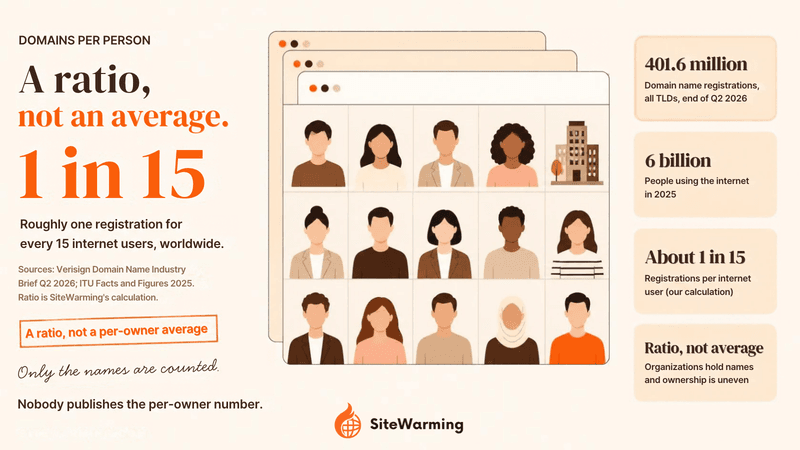
No source publishes an average number of domains per person. What the data does show: Verisign counted 401.6 million domain name registrations worldwide at the end of Q2 2026, and the ITU estimates 6 billion people are online. That works out to roughly one registration for every 15 internet users. It is a ratio, not a per-owner average.
"Over the years, I've acquired a bunch of domains. Most, because I had an idea for a project some day."
That's Dharmesh Shah, co-founder of HubSpot, on his own domains page. He wrote it casually, the way you'd mention a closet you've been meaning to clean out. People don't recognize themselves in it because it is shocking. They recognize themselves because it is familiar.
A big portfolio is one thing. But the feeling? The feeling of owning more domains than you can justify to yourself, let alone your partner or your accountant? That's not a hundreds-of-domains problem. That's a three-domain problem. Or a seven-domain problem. Or a fourteen-domain problem you haven't added up yet, because you renew them one at a time and the math stays invisible.
So how many domains does the average person actually own? Nobody publishes that number. This post shows what can be said with real data, where the honest answer stops, and how to find your own number in about an hour.
Is there an official number for how many domains the average person owns?
No. We looked for a published per-owner average and did not find one. The two most authoritative counts of domain registrations both stop at the domain name.
- Verisign's Domain Name Industry Brief counts names. Its methodology defines the .com and .net base as "the active zone, plus the domain names registered but not configured for use plus the domain names in client or server hold status." Owners do not appear in it.
- ICANN's domain name registration metrics track registration volumes, IDN share, non-resolving names and growth. None of them report domains per registrant.
Registrars know how many domains each account holds, but they do not publish it, and there is no industry standard for separating "personal" from "business" ownership. The absence of the stat is the stat. The question gets typed into search bars constantly, and the best anyone can say is that the count of owners does not exist in public.
What does exist is the count of registrations, and you can do useful arithmetic with it.
How many domain names exist, and what do they imply per person?
Verisign's Q2 2026 Domain Name Industry Brief reports 401.6 million domain name registrations across all top-level domains at the end of June 2026. That is up 9.1 million (2.3%) from the first quarter and 29.9 million (8.1%) from a year earlier. Two extension families make up most of it: .com at 166.6 million and country-code domains (ccTLDs) at 148.6 million.
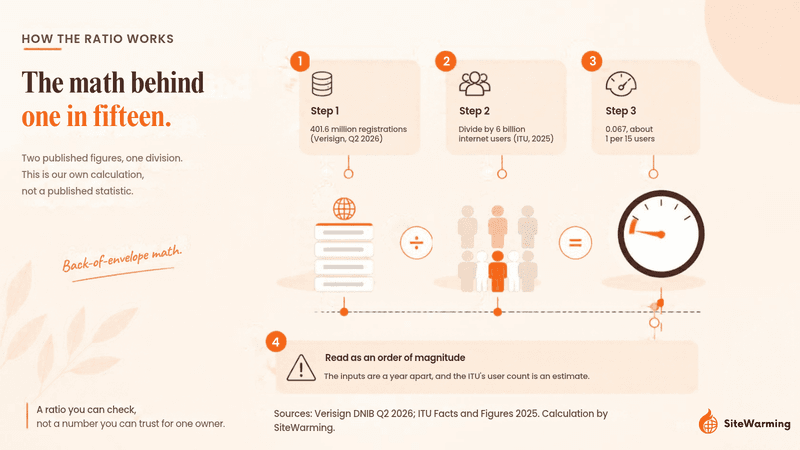
Divide that by the people who could plausibly own one, and you get a back-of-envelope ratio. This is our own calculation, not a published statistic.
| Input | Value | Source |
|---|---|---|
| Domain name registrations, all TLDs, end of Q2 2026 | 401.6 million | Verisign DNIB, Q2 2026 |
| People using the internet, 2025 | 6 billion (74% of the world's population) | ITU Facts and Figures 2025 |
| World population, 2024 | 8.2 billion | UN World Population Prospects 2024 |
| Registrations per internet user | 401.6M / 6,000M = 0.067, about 1 per 15 users | Our calculation |
| Registrations per person on Earth | 401.6M / 8,200M = 0.049, about 1 per 20 people | Our calculation |
Read that as an order of magnitude, not an average. The inputs are a year apart, the ITU's user count is an estimate, and registrations are held by companies and portfolio owners as well as individuals, so the ratio says nothing about how many domains any one person owns. What it does show is scale: the world holds far fewer registrations than it has people.
Why can't you turn that ratio into an average per owner?
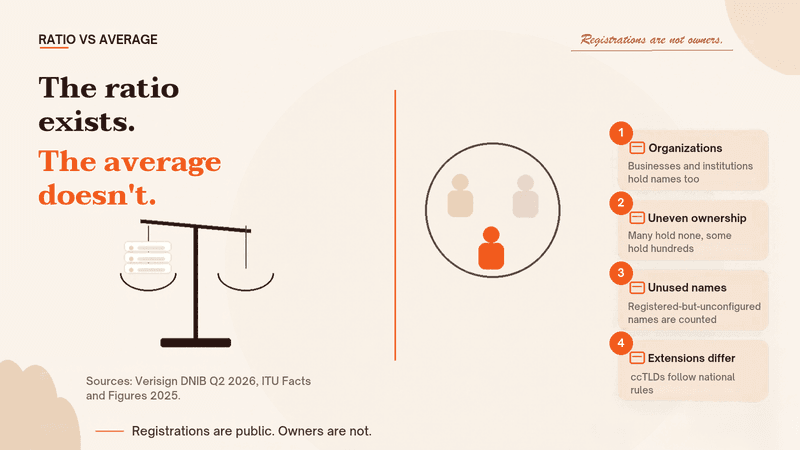
Because the ratio hides who holds the names. Four things break the jump from "registrations per person" to "domains per owner."
- Registrations include organizations. Businesses, brands, publishers and institutions hold names too, so the ratio overstates how many belong to individuals.
- Ownership is uneven. Many people hold none, and some hold hundreds. A founder with hundreds of names moves the mean without changing what is typical. The average and the typical person are different numbers.
- Some of the count is unused. Verisign's definition includes names registered but not configured for use. Separately, an APNIC study measured on September 15, 2023 found that "58.5M (17.5 %) out of 334M domains are parked."
- Extensions differ. The 148.6 million ccTLD registrations follow national rules and markets, so a single global figure blends very different ownership patterns.
The honest reading is a range with a shape, not a point estimate: most people own few or none, and a tail of founders, businesses and domainers own many.
What do registrars' own numbers say?
Registrars are the only businesses that see accounts, and one of them publishes a rough pair of figures. GoDaddy's corporate site says: "We empower over 20 million entrepreneurs" and "Our customers trust us with their over 80 million domain names." Divide the two and you get roughly four domain names per customer at the world's largest registrar.
Treat that as a signal, not an answer. A customer account is not a person, not every customer holds a domain, and large accounts would pull the ratio up. It does suggest something worth holding onto: even the average at the world's largest registrar is a handful of names, not dozens.
Why do people build trackers for their domains?
Because a collection eventually outgrows memory. Someone built an open-source project called Domain Locker, an MIT-licensed, self-hostable dashboard "for keeping track of your domain name portfolio." It fetches SSL, DNS and expiry data and sends alerts. We covered how it compares in a Domain Locker alternative.
The fact that it exists tells you something. People don't build inventory management systems for things they have one of. You build a tracker when the collection has outgrown your memory.
Why do people keep buying domains they don't build?
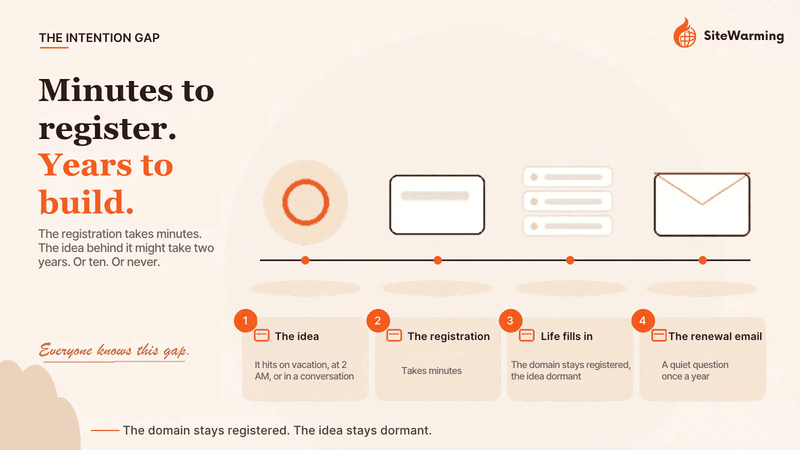
You know the moment. You're on vacation and the idea hits. Or it's 2 AM and you can't sleep and the name just clicks. Or you're in a conversation and someone describes a problem and you think, "that should be a thing," and twenty minutes later you own the .com.
The domain registration takes minutes. The idea behind it might take two years. Or ten. Or never.
The pattern shows up whenever people talk about personal domains. They split cleanly. Some have a domain running something. Others haven't touched theirs since the day they registered. There is almost no middle: hardly anyone says "I'm working on it." What we don't hear is regret about buying. The regret, when it shows up, is about doing nothing with the name afterward.
That's the pattern. The purchase feels purposeful. The domain is proof that the idea was real, that you took it seriously enough to claim it. And then time passes. Life fills in around it. The domain stays registered. The idea stays dormant. And the only sign it exists is a renewal email that arrives once a year like a quiet question you're not sure how to answer.
It's not laziness. It's the gap between intention and capacity. Everyone who's bought a domain knows this gap. Most people just don't talk about it. If you have ever wondered why founders in particular collect names, why entrepreneurs collect domains they never use makes the case that it is pattern recognition running ahead of execution.
If you've ever looked at a renewal notice and felt that specific mix of guilt and attachment, you're not unusual. You're just a person who had an idea and did the first concrete thing to make it real. What happens after that renewal is more staged than most people expect. And figuring out which domains still deserve your attention is a decision worth making deliberately, not by default.
The accumulation isn't the part that gets people. It's the silence that follows. The slow realization that you have seven tabs open in your registrar and you can't remember what three of them were for. That's where the collection trap lives.
How many domains counts as a small, medium or large portfolio?
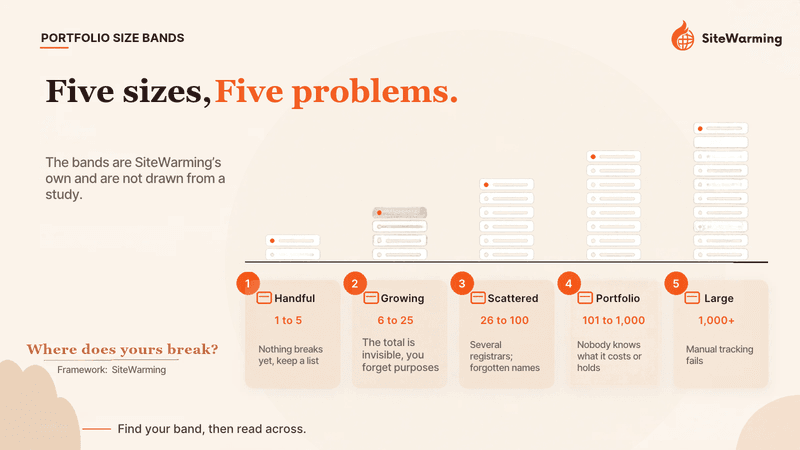
There is no published standard, so here is our working framework. Use it to see which problems tend to show up at your size. The bands are SiteWarming's own and are not drawn from a study.
| Band | Domains | What it usually looks like | What breaks first | Next step |
|---|---|---|---|---|
| Handful | 1 to 5 | You can name the purpose of each one from memory | Nothing yet | Keep a simple list with renewal dates |
| Growing | 6 to 25 | Renewals arrive one at a time; the total stays invisible | You can't recall what a few of them were for | One list: purpose, registrar, renewal date, status |
| Scattered | 26 to 100 | Several registrars and old email accounts | Forgotten names, renewal dates that cluster | A central inventory and a keep, build or release call on each |
| Portfolio | 101 to 1,000 | Names bought in batches, some for resale | Nobody can say what the portfolio costs or holds | A tool that shows status and value in one view |
| Large | 1,000+ | Managed like infrastructure | Manual tracking of any kind | Automate reminders and tier every name |
For a deeper look at what changes as the number grows, read managing 10 versus 50 domains and the domain portfolio management guide. Past the Growing band, a tool that shows every domain across every registrar in one view stops being a luxury; SiteWarming's Domain Management tool is built for that, and it is covered below.
How do you count how many domains you actually own?
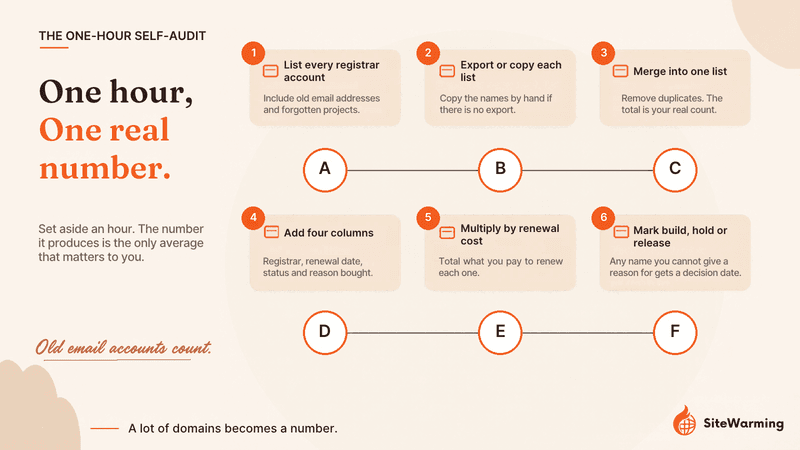
Set aside an hour. This is a self-audit, and the number it produces is the only average that matters to you.
- List every registrar account. Include the ones tied to old email addresses, a former employer's card or a project you have forgotten. This is where the domains you can't account for usually live.
- Export or copy the domain list from each. Most registrars offer an export; if not, copy the names by hand.
- Merge everything into one list. Remove duplicates. The total is your real count.
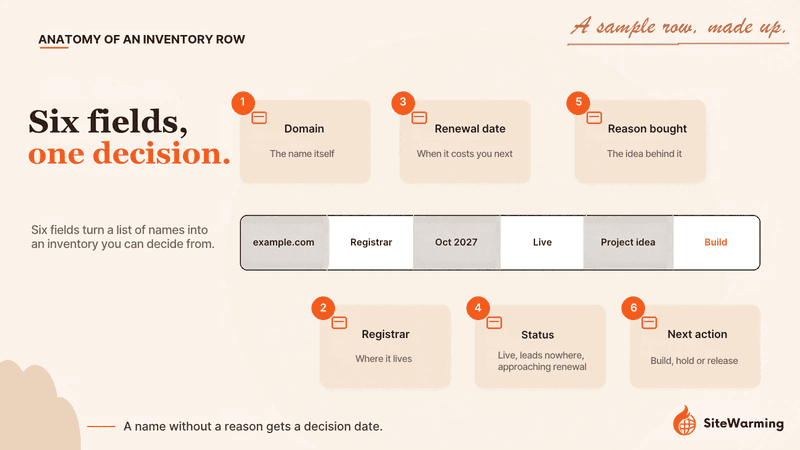
- Add four columns: registrar, renewal date, current status (live, redirecting, parked or leading nowhere) and the reason you bought it.
- Multiply your count by what you pay to renew each one. Illustration only: 14 domains at $20 each is $280 a year. Yours will differ, and the total is often larger than people expect.
- Mark each name: build, hold or release. Any name you cannot give a reason for gets a decision date.
You can do this in a spreadsheet: we published a free portfolio spreadsheet template and a walkthrough of when a spreadsheet starts to fail. Or you can manage domains across multiple registrars in one place. For a structured review of each name, use the five-part domain health check.
What should you do once you know your number?
Once the total is on the page, the question changes from "how many?" to "which of these deserve anything?" Two things help: seeing the whole portfolio in one place, and giving the names you keep a reason to be found.
How does a domain management tool help you keep the count honest?
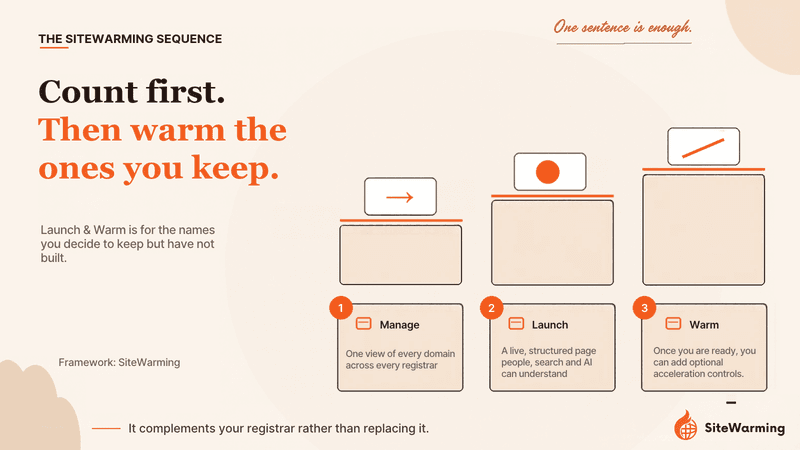
A spreadsheet goes stale and each registrar sees only its own account, so the count drifts back to a guess. SiteWarming's Domain Management tool gives you one view of every domain you own across every registrar. You can add domains one at a time, bulk-import a CSV or connect your registrar, or reach your portfolio through the SiteWarming MCP server from inside an AI assistant. It shows what's live, what leads nowhere and what's approaching renewal, and it fetches a HumbleWorth valuation for each domain. The Free plan tracks up to 1,000 domains.
It complements your registrar rather than replacing it: renewals, transfers and DNS changes stay where they are. If you'd rather start with a decision than a dashboard, the free Domain Renewal Analysis takes up to 150 domains and shows which are worth keeping, and Sale Readiness sorts up to 100 into ready to sell, hold for appreciation or needs development.
What is Launch & Warm, and when does it fit?
Launch & Warm is for the names you decide to keep but have not built. Instead of leaving a domain dark, you tell us one sentence about the idea, and SiteWarming builds a warm site: a live, structured page that people, search engines and AI can all understand. It carries a protected contact path, so if someone wants to build, partner or buy, they can reach you without exposing your details. You stay in control of what happens next. You can read more in what site warming is and why it sits between parking and building. The Free plan includes one warmed domain, and how it works walks through the templates.
That is the practical answer to the silence after accumulation. The entrepreneur's guide to domains you haven't built yet and how to launch a domain before the idea is ready go deeper.
How many domains is too many?
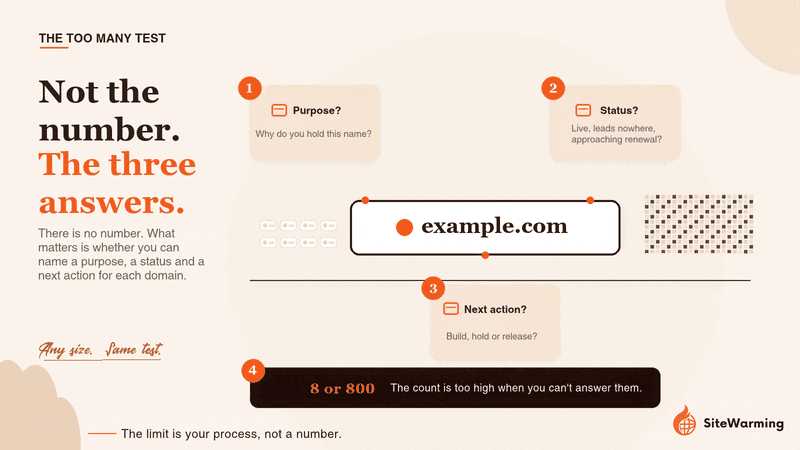
There is no number. What matters is whether you can name a purpose, a status and a next action for each domain you hold. If you cannot, the count is already too high for your current process, whether that is 8 or 800. The collection trap covers how to bucket the rest, and why domains fail to get discovered explains what quietly happens to names with no visible owner.
Frequently asked questions
How many domains does the average person own?
No source publishes a per-person average. Verisign counts 401.6 million registrations worldwide (Q2 2026) against roughly 6 billion internet users (ITU, 2025), about one registration for every 15 users. That is a ratio, not an average per owner, because organizations hold names and some people hold hundreds.
How many domain names are registered worldwide?
Verisign's Domain Name Industry Brief reported 401.6 million registrations across all top-level domains at the end of Q2 2026. Of those, 166.6 million were .com and 148.6 million were country-code domains.
Is there an official count of how many domains one person owns?
No. Verisign's methodology counts domain names, and ICANN's registration metrics do not report domains per registrant. Registrars know the counts per account but do not publish them.
How many domains does the average GoDaddy customer have?
GoDaddy does not publish a per-customer figure. Its corporate site cites over 20 million customers and over 80 million domain names, which implies roughly four per customer as a rough signal. Customer accounts are not people, so it is not a per-person average.
How do I find every domain I own?
List every registrar account you have used, including old email addresses, export the domain list from each, and merge them into one deduplicated list. Then add registrar, renewal date, status and purpose for each name. SiteWarming's Domain Management tool can import a CSV or connect your registrar to do the merge for you.
How does SiteWarming's Domain Management tool help with a large number of domains?
It gives you one view of every domain across every registrar, showing what's live, what leads nowhere and what's approaching renewal, with a valuation fetched for each name. The Free plan tracks up to 1,000 domains. Renewals, transfers and DNS changes stay at your registrar.
What is Launch & Warm?
Launch & Warm puts a live, structured warm site with a protected contact path on a domain you have not built yet, from one sentence about the idea. It makes the domain findable by people, search engines and AI, so the option to build, partner or sell can actually be exercised. See how it works and pricing.
What should I do if I own more domains than I expected?
Merge them into one list, add a purpose and a renewal date to each, then decide build, hold or release. The collection trap walks through the system, and the free Domain Renewal Analysis shows which names are worth keeping.
Share this article
Ready to Transform Your Domain Portfolio?
Start building real value with your domain investments today.