What Is Site Warming? (And Why It's Not Email Warming)
 Bret Siers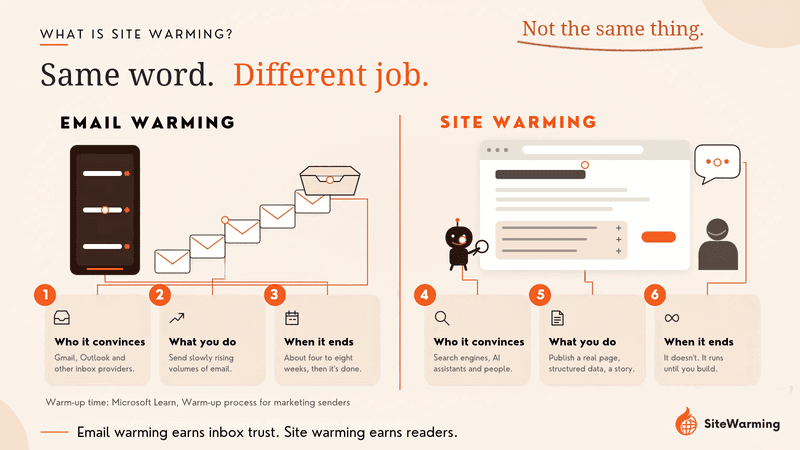
Site warming is the practice of giving a domain you own but haven't built a live, readable presence (a real page, structured data and a clear story) so search engines, AI assistants and people can find and understand it before you launch. It is not email warming, which builds sender reputation with inbox providers.
You typed "site warming" into a search engine. Maybe you heard the phrase somewhere. Maybe you were trying to understand what happens to a domain before a launch. Maybe you were wondering if there was a name for the thing you knew you should be doing but weren't.
And you got seventeen guides about email send volume ramp-up.
That's not what you were looking for. And it's not what site warming means.
"Site warming" and "email warming" share one word and almost nothing else. One is a deliverability practice for email servers. The other barely has a name yet, because the idea is new enough that most search engines don't treat it as its own concept.
This article is here to change that. This is the definition.
What is email warming (and why is it a different thing)?
If you've heard "warming" in a digital context before, it was almost certainly about email.
Email warming, sometimes called domain warming or IP warming, is a deliverability practice. When you set up a new email sending domain or IP address, inbox providers like Gmail and Outlook don't trust it yet. They've seen too many spammers do the same thing.
So you increase your send volume gradually, building a track record before you scale to full volume. Google's own sender guidance says it in five words: "Increase sending volume slowly" (Google, Email sender guidelines). Microsoft puts the time to maximum deliverability at "four to eight weeks, depending on the targeted volume and engagement" (Microsoft Learn, Warm-up process for marketing senders).
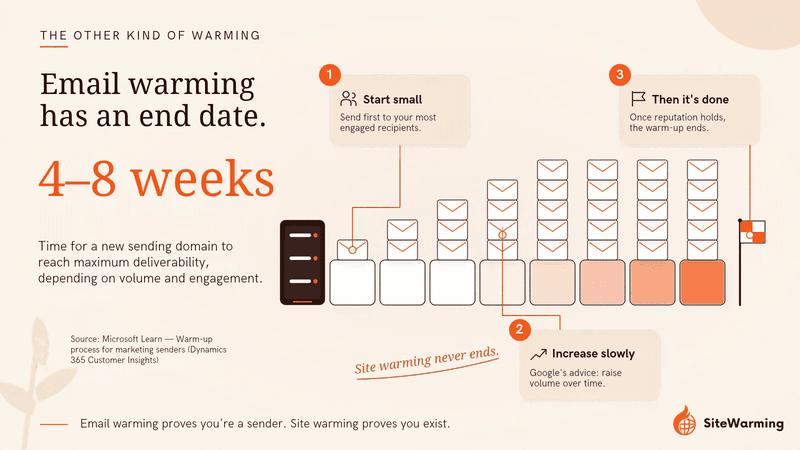
The goal is to prove to email servers that you're a legitimate sender. It's about your outgoing mail reputation, not your website. It has nothing to do with search engines, web visibility, or what AI systems see when they read the internet.
The two meet at one point. A sending domain with no website behind it has less to show a filter that's asking whether a real business exists, which is why we argue that a new domain's email deliverability starts before you hit send. That's a side effect of site warming, not its job.
If you're thinking of the email kind of warming, domain warming vs email warming covers the distinction in full. That's a different practice, for a different problem.
This article is about something else entirely.
What is site warming?
Here's the simplest version. Site warming is the practice of establishing a domain's presence, signals, and visibility before you need them.
That word "before" is doing real work in that sentence. Not before you launch a big marketing campaign. Not before you close a funding round. Before any of that. Sometimes before you even have a product.
You make sure the domain is visible, readable, and trusted by the systems that form impressions about websites. Those systems include:
- Search engines, which crawl the page, read its title, description and structured data, and decide whether to index it.
- AI assistants that cite sources when they answer questions. OpenAI's OAI-SearchBot "is used to surface websites in search results in ChatGPT's search features" (OpenAI, Overview of crawlers), and PerplexityBot "is designed to surface and link websites in search results on Perplexity" (Perplexity, Crawlers).
- The crawlers and indexing services that decide whether your domain looks like something real or something abandoned.
An active site gives all of those systems something to work with.
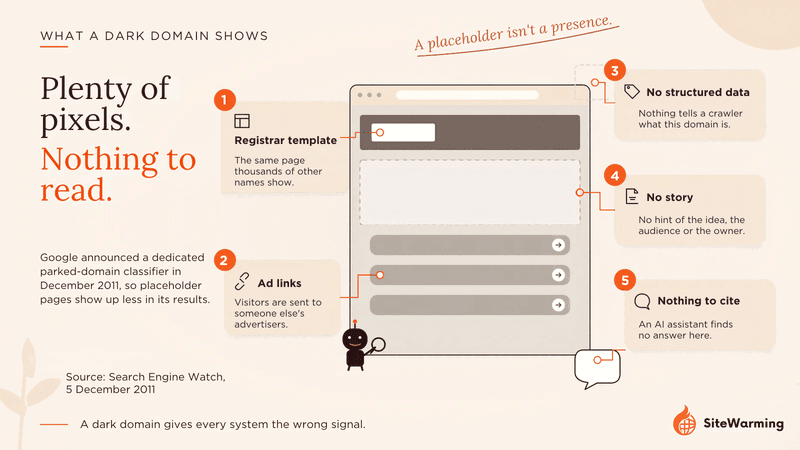
A dark domain gives them nothing. By dark I mean parked on a registrar's ad placeholder, dormant, showing a coming-soon page with no structured data, or returning a generic registrar splash. Or worse, it gives them the wrong signal entirely: Google announced a dedicated "parked domain" classifier in December 2011 so that parked pages show up less in its results (Search Engine Watch, December 2011).
So why do so many domains end up in that state?
What problem does site warming solve?
Here's what actually happens to most domains.
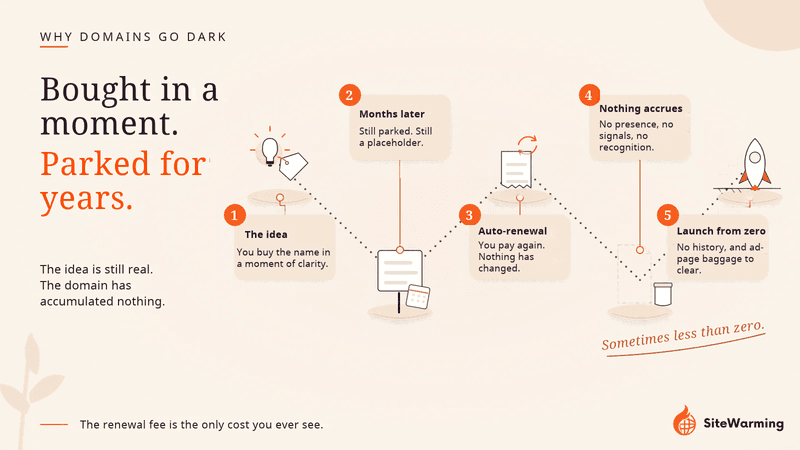
Someone has an idea. A real one. They buy the domain during a moment of clarity. Maybe on a Sunday afternoon, maybe after a conversation that made everything seem possible. The domain name is perfect. The idea is solid. They know they'll build it when the time is right.
Then life keeps moving.
Six months later, the domain is still parked. A year later, renewal is automatic and the domain is still sitting there. The idea is still real, probably still good, but the domain has accumulated nothing. No presence. No signals. No recognition from any system that could help someone find it later. That's the hidden cost of unused domains: the renewal fee is the only part you ever see.
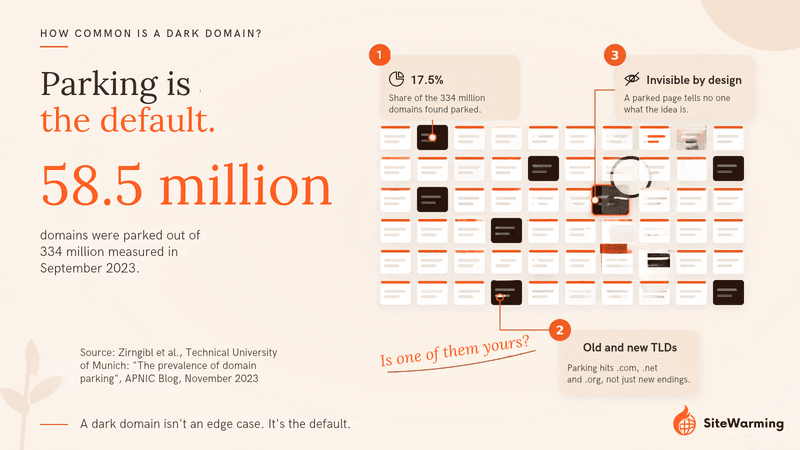
This isn't a rare situation. When researchers at the Technical University of Munich measured 334 million domains in September 2023, 58.5 million of them (17.5%) were parked (Zirngibl et al., "The prevalence of domain parking", APNIC Blog, November 2023).
When the owner finally does build something there, or decides to sell the domain, or tries to get the site indexed, they're starting from zero. Sometimes less than zero, because a parked domain that's been serving ads for two years has built up associations that take time to clear. (If that's where you are now, here's how to recover a domain Google still thinks is parked.)
That's the problem site warming solves. Not by building the full product. Not by running a campaign. By establishing presence, the minimum viable existence, while everything else is still in motion.
What does an active, warmed domain actually include?
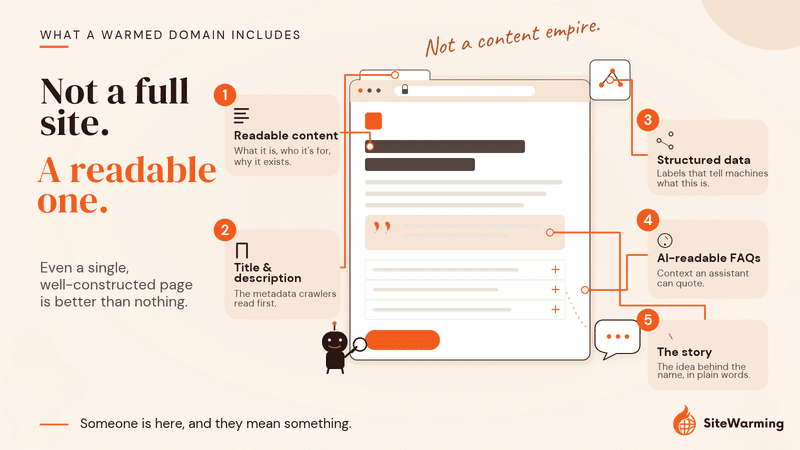
So what does a warmed domain look like? It's not a full website. It's not a content empire. It's a domain that has a few specific things a parked or dormant domain doesn't.
1. Structured content humans can read. Not a placeholder. Not a splash screen. Something that communicates what this domain is about, who it's for, and why it exists. Even a single, well-constructed page is better than nothing.
2. Signals search engines can index. A title, a description, and structured data (machine-readable labels, usually schema.org markup, that tell crawlers what kind of entity this is). Google says it uses structured data "to understand the content of the page" and "to gather information about the web and the world in general" (Google Search Central, Intro to structured data). It's the metadata that says "someone is here and they mean something," and schema markup for small websites is less work than most owners assume.
Domain age on its own does nothing for you. Asked in July 2019 whether an older domain helps in search, Google's John Mueller replied, "No, domain age helps nothing" (Search Engine Roundtable, July 2019). Domain history is different, because systems store what they see over time. The history a warmed domain builds is intentional.
3. Context AI systems can interpret. AI assistants don't just read links. They read structure. When a system like Perplexity or ChatGPT encounters a domain while building an answer, it's looking for context it can work with. An active domain provides it. A parked domain provides nothing, or worse, the context of an ad-serving placeholder. More on why AI can't read parked domains if you want the full technical picture, and on how AI crawlers decide what to index.
4. A coherent story behind the name. This is the least technical part and one of the most important. The domain name usually came from somewhere. There was an idea. An active domain tells that story, in plain language and in structured form, so that anyone who encounters it understands what it is and what it could become.
Here is the same list from the other side: what each reader gets from a warmed domain, and what it gets from a parked one.
| Element | Who reads it | What a parked domain shows instead |
|---|---|---|
| Readable content | People, then every system that quotes them | A registrar template or ad links |
| Title, description, structured data | Search engine crawlers | Generic or empty metadata |
| Clear context and FAQs | AI assistants building an answer | Nothing it can cite |
| The story behind the name | A would-be buyer, partner or collaborator | No way to know the idea exists |
What keeps a domain dark even after you "put something up"?
- A coming-soon page with a noindex tag. A
noindexrule is "used to prevent indexing content by search engines," and Google "will drop that page entirely from Google Search results" when it sees one (Google Search Central, Block indexing with noindex). - Blocking the crawlers you want to be found by. OpenAI notes that sites which opt out of OAI-SearchBot won't be shown in ChatGPT search answers (OpenAI, Overview of crawlers).
- Leaving the registrar's default parking page in place. It tells every system the name is for sale or unused, whatever your plans are.
- A logo with no story. A name and "coming soon" say nothing about who it's for or why it exists.
- Publishing once, then never again. A page that never changes stops looking like anyone is behind it; that's the argument behind how often to update your website.
Why warm a domain before you're ready to build?
I get it. If you're not ready to build, warming feels premature. Why invest time in a domain that doesn't have a product yet?
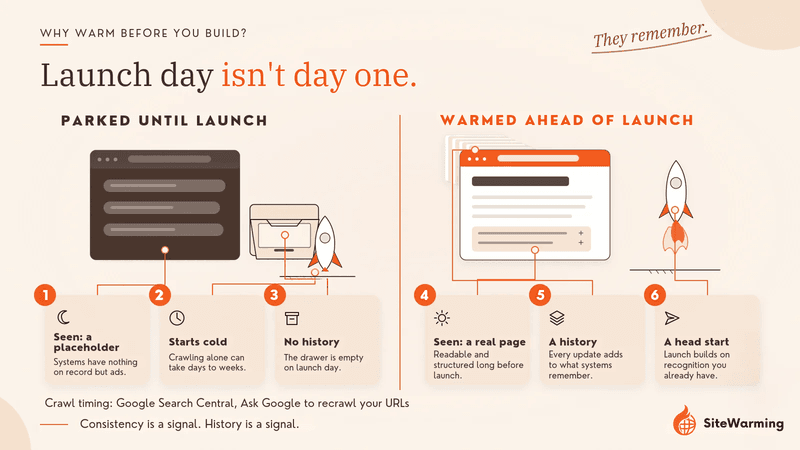
Because the systems that determine visibility don't reset when you launch. They remember.
A domain that has had consistent, structured presence for twelve months before launch walks into launch day with a history. A domain that jumps from parked to a full site overnight walks in with none, and then waits: Google says crawling alone "can take anywhere from a few days to a few weeks" (Google Search Central, Ask Google to recrawl your URLs). New domains already pay the Google sandbox effect in patience. Warming lets you pay it early, while you're not in a hurry.
Consistency is a signal. History is a signal.
Warming is what you do in the gap between "I own this domain" and "I'm ready to build." Most ideas die quietly in that gap. Warming keeps them alive. If you want the fuller case for being findable before you're finished, it's in Visibility Before Validation.
What isn't site warming?
Site warming is not a hack or a shortcut to visibility. It's not a way to trick search engines into thinking you've built something you haven't. It's not a substitute for eventually building a real product or site. It's not domain flipping or asset speculation. And it has nothing to do with email deliverability.
The tactics crowd will try to describe it as a trick. It isn't. It's the reasonable, honest practice of making a domain's existence legible: to humans, to machines, to the systems that will eventually form opinions about it.
It's treating a domain like what it is: a real asset that deserves a real presence, even before you're ready to build the full vision.
Site warming vs email warming: what's the difference?
If you only remember one thing from this page, make it this table.
| Email warming | Site warming | |
|---|---|---|
| What it builds | Sender reputation with inbox providers | Presence, history and context on the web |
| Who it's proving itself to | Gmail, Outlook and other mailbox providers | Search engines, AI assistants, and the people who find you through them |
| What you actually do | Send gradually rising volumes of email to engaged recipients | Publish a readable page, structured data and a clear story on the domain |
| How long it takes | About four to eight weeks to full deliverability (Microsoft Learn) | It doesn't end; it runs until you build, sell or let the name go |
| How you know it's working | Inbox placement and spam rate (Gmail asks bulk senders to stay below 0.30% (Google)) | The domain is indexed, understood and cited, and people can reach you through it |
| What happens without it | Mail lands in spam | The domain stays invisible, and nobody who looked for it ever tells you |
For the email-first version of this comparison, with the deliverability detail, read domain warming vs email warming.
Parked, warmed or built: which state is your domain in?
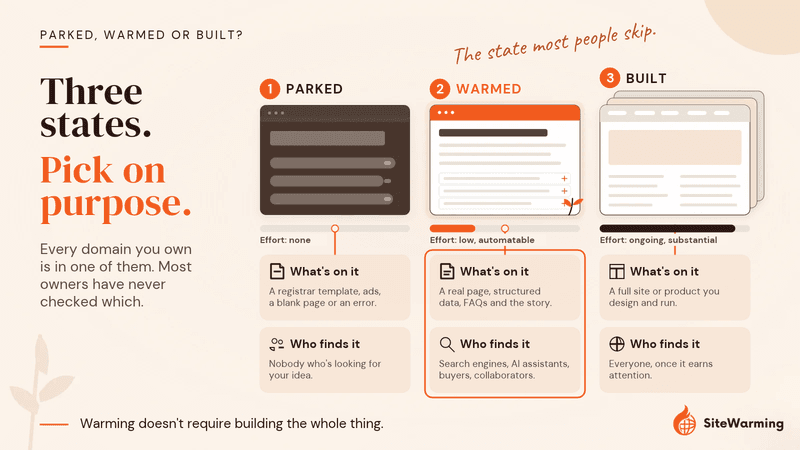
Every domain you own is in one of three states. Most owners have never checked which.
| State | What's on the domain | Effort to maintain | Who can find it |
|---|---|---|---|
| Parked (or dark) | A registrar template, ads, a blank page or an error | None | Nobody who's looking for your idea |
| Warmed | A real page, structured data, FAQs and the story behind the name, updated over time | Low, and automatable | Search engines, AI assistants, buyers and collaborators |
| Built | A full site or product you design and run | Ongoing and substantial | Everyone, once it earns attention |
The technical difference between the dark options matters too: a parking page, a 404 and a coming-soon page each send a different signal, and the companion article on what search engines actually see walks through all three. And if you've been treating the choice as build-or-park, the third option between building and parking is the one this whole page is about.
Once you know which state each name is in, the next question is whether it's healthy: renewals, DNS, ownership and access. That's the domain health check.
Who is site warming for?
Site warming is for the founder who registers domain names faster than they can build on them. You bought each one because you saw something in it, and now there are a dozen, or a hundred, sitting at the registrar with no plan behind any of them.
It fits when:
- you intend to build on a name, but not this quarter;
- you'd sell or partner on a name if the right person found it, but you don't want to list it on a marketplace (you can keep a domain open but not listed);
- you're paying renewals on names nobody can see, and you want each one to earn its place or be let go.
It isn't the right step if you're launching a full product on the domain next month. Build it. And if a name no longer means anything to you, warming it just postpones a decision you should make now.
If you want the practical sequence, start with the first steps to warming up a domain.
How does SiteWarming help you warm the domains you own?
We built SiteWarming for exactly this gap, and it does the job in two parts.
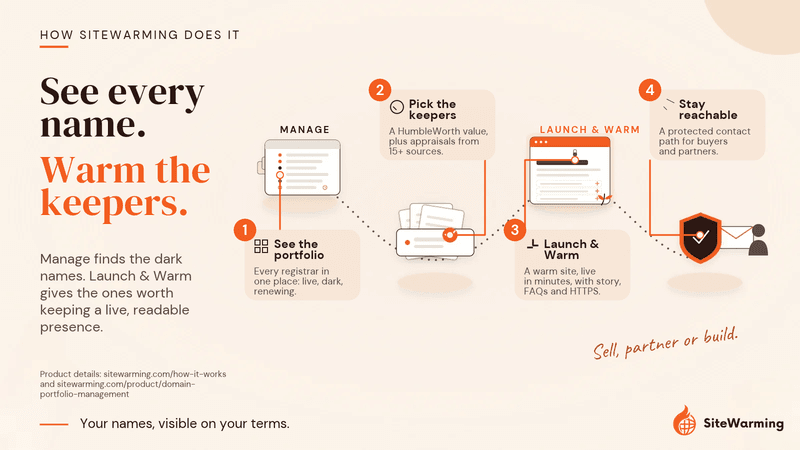
First, see the whole portfolio. The domain portfolio management tool pulls every registrar into one place, by single entry, CSV import, a registrar connection or the MCP server. It shows what's live, what leads nowhere, and what's approaching renewal, at a glance, and it auto-fetches a value for each name with HumbleWorth so you can stack appraisals from 15+ sources. That's how you find out which of your names are dark.
Then, warm the ones worth keeping. Launch & Warm puts a warm site on a dormant domain, and it goes live in minutes. You pick one of three intent templates (Future Build, Open, or Actively Selling) and give it a one-sentence story: the vision, the audience, the future path. SiteWarming handles the rest:
- structured story data and AI-readable FAQs;
- DNS configuration, HTTPS and hosting, with ongoing DNS and SSL checks;
- monthly content updates, so the domain builds history instead of standing still;
- a protected contact path, so a would-be buyer or partner can reach you without your details being public.
What happens after that is your call: sell, partner or build.
The short version
Site warming is not email warming. Not domain warming in the email deliverability sense. Not a tactic. Not a trick.
It's the practice of making a domain visible before you build. Structured presence. Coherent signals. Readable context for every system that will eventually form an opinion about that domain.
The internet doesn't have a waiting room. A domain that sits dark accumulates nothing. A domain that's active accumulates history, recognition, and a head start that compounds quietly until the day you need it.
You bought the domain because you had a vision. Warming keeps that vision legible while you figure out the rest.
Frequently asked questions
What is site warming?
Site warming is the practice of giving a domain you own but haven't built a live, readable presence (a real page, structured data and a clear story) so search engines, AI assistants and people can find and understand it before you launch. It keeps the idea discoverable while you decide whether to build, sell or partner on it.
Is site warming the same as domain warming?
No. In most search results "domain warming" means email warming: gradually increasing send volume from a new domain so Gmail and Outlook trust it. Site warming is about the web, not the inbox. It gives the domain a page and signals that search engines and AI assistants can read. The two can run side by side on the same domain.
How long does it take to warm up a domain?
It depends which kind you mean. An email warm-up takes about four to eight weeks to reach full deliverability, according to Microsoft Learn. Site warming has no finish line: the page can be live the same day, crawling can take "a few days to a few weeks" (Google), and the history it builds keeps accumulating until you launch.
Does domain age matter for SEO?
Not on its own. Google's John Mueller said in July 2019, "No, domain age helps nothing" (Search Engine Roundtable), and repeated the point in 2023. What an older domain can have is history: a record of what systems saw on it over time. A domain parked for five years has age but no useful history. Site warming builds the history.
Do I need a full website to warm a domain?
No. A single well-constructed page is enough to start, as long as it says what the domain is about, who it's for and why it exists, and carries a title, description and structured data. What matters more than size is that it's readable, indexable and kept current. You add the full site when you're ready to build.
Does site warming help email deliverability?
It isn't a substitute for an email warm-up, and it won't fix authentication. A live site does give mail filters something to find when they check whether a real entity sits behind a sending domain, which is why we treat the two as complementary. The detail is in email deliverability starts before you hit send.
What's the difference between a parked domain and a warmed domain?
A parked domain shows a registrar template or ads, gives search engines and AI assistants nothing about your idea, and costs a renewal fee every year for no return. A warmed domain shows a real page, structured data and the story behind the name, updated over time, so people and systems can find it and someone who wants it can reach you.
How does SiteWarming warm a domain?
SiteWarming's domain portfolio management tool shows every name you own across registrars, including which ones lead nowhere. Launch & Warm then puts a warm site on the names worth keeping, live in minutes: one of three intent templates, a one-sentence story, structured data, AI-readable FAQs, hosting, HTTPS, monthly content updates and a protected contact path. See how it works.
Related reading
- Domain Warming vs Email Warming: the email deliverability disambiguation
- What Is SiteWarming? The Third State Between Parked and Built: what the service does
- Why AI Can't Read Your Parked Domain: what AI systems see when they meet a dormant site
- Parked Domain vs 404 vs Coming Soon: what each technical state signals
- Visibility Before Validation: why being findable matters before being finished
- Domain Health Check: the full stewardship audit
Share this article
Ready to Transform Your Domain Portfolio?
Start building real value with your domain investments today.