Google Sandbox Effect: Why New Domains Take Months to Rank
 Bret Siers
Why starting from scratch is the most expensive mistake a founder can make.
The Google Sandbox effect is the delay new domains face before Google fully trusts them in search results, even with good content. Google has never officially confirmed it, but SEOs report it commonly lasts a few months to a year. Domain warming, building trust signals before launch, is how founders shorten that wait.
The Frozen Ground
Picture the moment you buy a domain. It's electric. You see the future. You hit "Buy."
And then? Silence.
You stare at a blank page or a generic parking page with a picture of a woman wearing a headset that has nothing to do with your vision. That moment is supposed to feel like potential.
Honestly? To me, it feels like dread.
Because in construction, you can't pour a foundation if the ground is frozen. It doesn't matter how good your blueprints are. It doesn't matter how talented your crew is. If the ground is frozen, you aren't building anything.
A new domain is frozen ground. It has no history, no trust, no connections, no context.
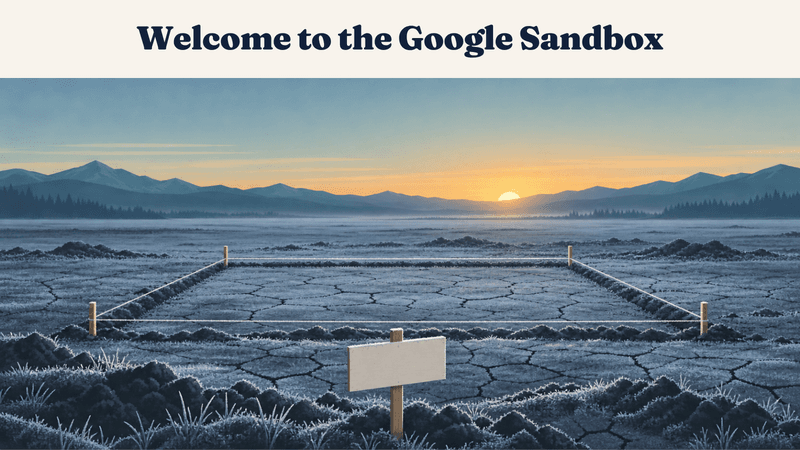
Yet we tell ourselves, "I'll build it later." We park the domain, let the ground freeze over, and walk away.
We are setting ourselves up to fail before we write the first line of code.
Hope Is Not a Strategy
I've been there. We've all been there.
You buy the domain because the idea is hot in your mind. You think, "I'm going to build this next quarter."
But "next quarter" turns into next year. And "next year" usually means never.
This is where Domain Guilt sets in.
It's that sinking feeling when the renewal email hits your inbox. You see the charge: $20, $500, maybe more, and you realize you haven't done a single thing with it.
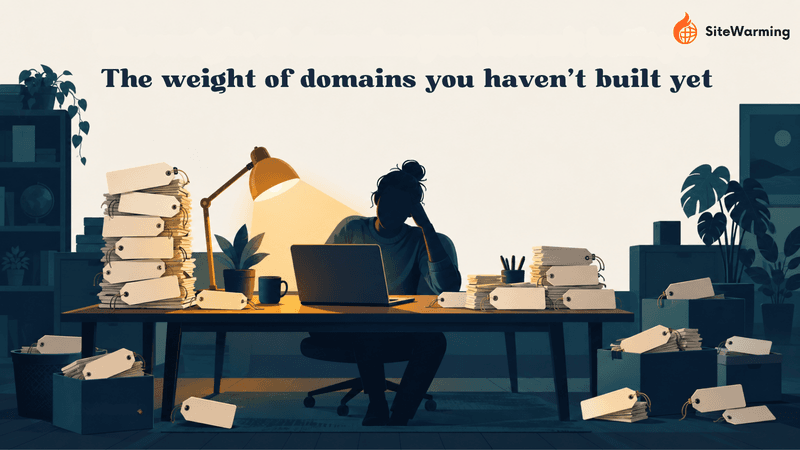
You're paying rent on an empty lot. (If you're not sure which of your domains are actually worth that rent, a free Domain Renewal Analysis will tell you in about 30 seconds.)
But here's the thing: the financial cost isn't actually the problem. $20 isn't going to break you.
The real villain is the opportunity cost. Every month that domain sits on a parking page, it is actively decaying. It's not staying fresh; it's staying invisible.
Now, let me tell you who I'm really talking to.
I'm talking to the idea-driven entrepreneur.
You aren't lazy. You're the opposite. You see possibilities everywhere. You can't help it.
A conversation sparks something. A problem you encounter becomes a product in your head. A name pops into your mind at 2am and you buy it before someone else does.
That's not a character flaw. That's how builders are wired.
But the result is predictable. You accumulate. Not because you planned to but because ideas keep coming and you keep believing in them.
You become an accidental aggregator.
And now you're sitting on 10, 20, maybe 50 domains. Each one represents an idea you genuinely believed in. Each one is frozen. Each one triggers a small pulse of guilt every time you see the renewal notice.
The villain isn't you.
The villain is the belief that starting from absolute zero is the only option.
It's not. It's just inefficient.
"Zero" Actually Costs You
Let's get specific.
There is a concept in the digital world called the "Sandbox." Search engines have never officially confirmed it exists, but most people who've launched more than one site will tell you they've felt its effects.
Here is the reality: when you launch a brand new site on a brand new domain, you are on probation.
You don't get to be found. You don't get to be seen. You don't get the benefit of the doubt.
Nobody agrees on exactly how long that probation lasts, with real sources right below, but nobody seriously argues it's zero.
Think about that timeline.
You spend months building your product. You spend money on design. You pour your soul into the copy. You finally launch.
And for however long the probation lasts:
You are invisible. Your content is unindexed. Your effort is unrewarded.
That is the "Sandbox Tax." It is the cost of starting from zero.
While your domain was parked for two years, it could have been aging. It could have been building trust with discovery systems. It could have been proving it was a real citizen of the internet.
Instead, you kept it in a coma.
Why do founders, people who obsess over efficiency, speed, and removing friction, accept a months-long lag time as "just part of the process"?
It doesn't make sense.
What Actually Causes the Google Sandbox Effect?
Nobody outside Google can say exactly what's happening inside the ranking systems. Google hasn't published a specific mechanism either; company representatives have repeatedly downplayed the idea of a deliberate "sandbox" while describing new-site evaluation as a matter of unproven trust rather than punishment (Link-Assistant, citing Google statements).
But the practical explanation SEOs converge on is trust signals, not punishment.
A brand-new domain has no backlink profile, no history of user behavior, and no track record of getting clicked on and actually read. Ranking systems built to fight spam treat that absence as a reason for caution, not confidence; the same way a bank asks a new business for financial history before extending credit. No record isn't proof of guilt, but it isn't proof of trustworthiness either.
That's a different problem from the one covered in why most domains never get discovered, which is about domains that never build an audience at all. The sandbox assumes you're discoverable; it's specifically about how long it takes Google to believe you.
It's also not only a Google problem. AI answer engines go through a similar evaluation before they'll cite or reference a domain, and a domain still sitting on a generic parking page is functionally invisible to both.
How Long Does the Google Sandbox Actually Last?
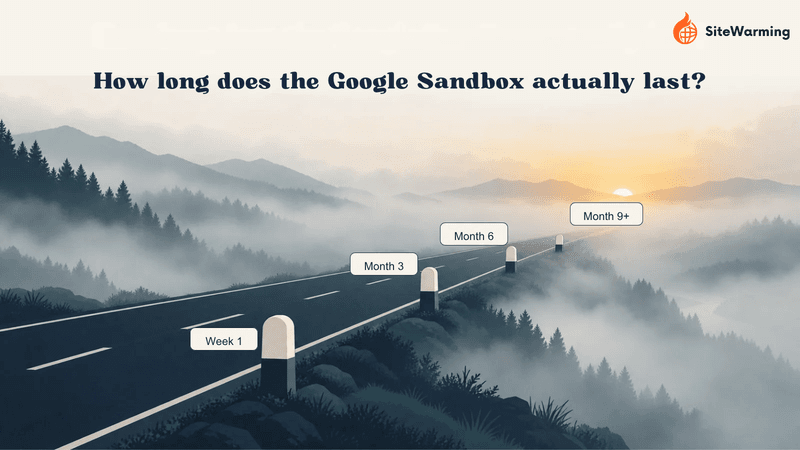
There's no confirmed number, and anyone who gives you one exact figure is rounding off a lot of nuance.
Search Logistics, which tracks SEO forum reports on this topic, found the effect commonly running from a few weeks to several months, with some site owners describing waits as long as nine months in competitive niches. Link-Assistant's review of the same debate found estimates ranging even wider, from about a month to over a year, and notes that Google representatives have repeatedly denied there's a deliberate penalty at all.
So the honest range: a few weeks at the fast end, six to twelve months at the slow end, longer in genuinely competitive categories, and no way to know in advance which one you'll get. That uncertainty is the actual problem, not any one specific number.
How Do You Know If You're Already in the Sandbox?
Three signs, in order of how easy they are to check:
- You're indexed but invisible. Search
site:yourdomain.comin Google. If your pages show up there but never show up for the keywords you're actually targeting, you're indexed and sandboxed, not unindexed. - Search Console shows impressions, not clicks. Under Performance, you'll see your pages getting served for real queries with very low or zero click-through; Google is showing you occasionally, cautiously, without ranking you where anyone will find you.
- Rankings stay flat despite real work. You've added content, built a few legitimate links, and nothing has moved for months. That's the pattern people mean when they say a site is "in the sandbox"; not that nothing is happening, but that nothing is happening fast.
The Domain Warming Advantage
Flip the frame.
Imagine you have an idea. You buy the domain today.
But instead of parking it, you "warm" it.
You haven't built the product yet. You don't hire the team. You don't write the business plan. You just turn the lights on.
Two years later, you are ready to launch.
You aren't starting from scratch. You are stepping into a house that is already warm.
Here is what a warmed domain gives you on Day 1:
- Discovery Signals. The systems that matter already know you exist. They've seen you. They trust you. You aren't a stranger; you're a known entity.
- Contextual Tags. The internet understands what your idea is about. If your startup is about "AI for Legal," the semantic connections are already established.
- Network Connections. You aren't an island. Your domain has been referenced and linked to other relevant ideas in your space.
- Visibility History. You have months, maybe years, of indexed presence. That history is currency.
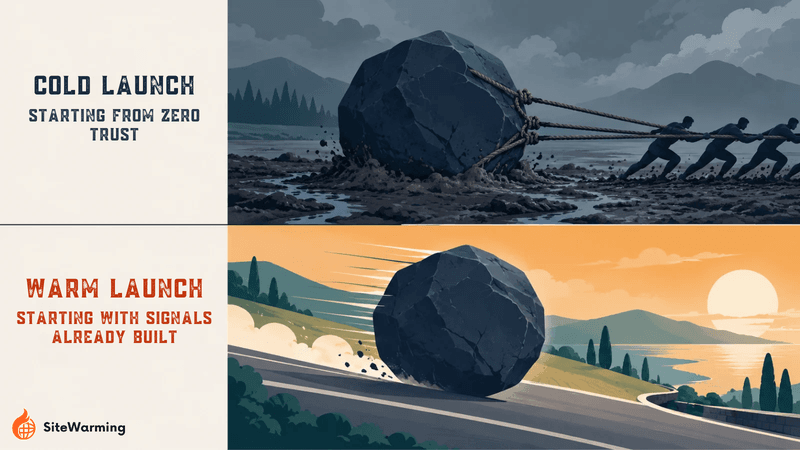
This is the difference between a Cold Launch and a Warm Launch.
A Cold Launch is pushing a boulder uphill in the mud.
A Warm Launch is releasing a boulder down a paved road.
| Cold Launch | Warm Launch | |
|---|---|---|
| Domain history on launch day | None | Months or years of indexed presence |
| Trust/discovery signals | Absent | Already established |
| Semantic context | Built from zero | Already connected to relevant topics |
| Sandbox period | Starts on launch day, in full | Was already running before you needed it to be over |
| Founder's task at launch | Fight for the right to be found | Build on ground that already holds weight |
This isn't about gaming the system. I hate that mindset.
This is about Asset Readiness.
If you believed in the idea enough to buy it, believe in it enough to prepare it.
This is exactly why we built SiteWarming for the mechanics of how it actually turns an idle domain into a warmed one.
We realized that most ideas die because the activation energy required to start them is too high. The idea-driven entrepreneur has plenty of vision. What they don't have is time to nurture every domain manually.
If we can lower that energy; if we can make the domain ready before you are, we change the odds.
The Founder's Duty
I'll be honest. This is emotional for me.
I view domains differently now. I don't see them as possessions. I see them as responsibilities.
If you believe in an idea enough to buy the URL, you owe it to the idea to keep it alive.
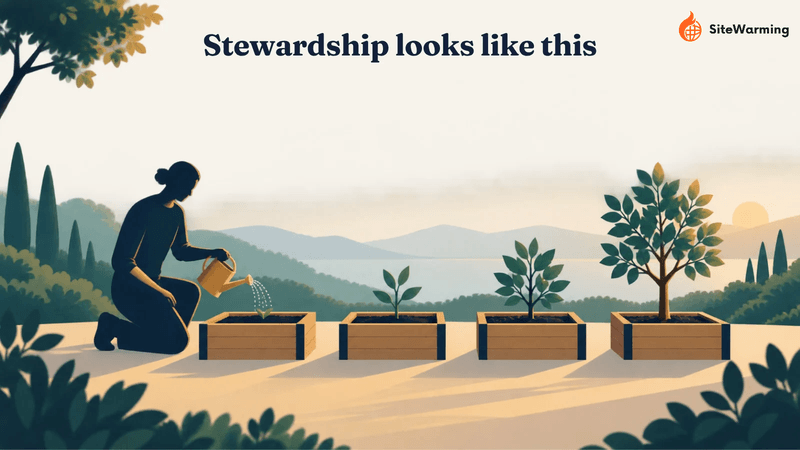
You are the steward of that vision. That's a separate argument from why you should launch before the idea is even fully validated: a related but distinct case, this one is about the ranking clock, that one is about the feedback loop.
Leaving it on a generic parking page is neglect. It's letting the vision atrophy while you tell yourself you'll get to it "someday."
But "stewardship" sounds like work, right? And you don't have time for more work. You're already building something else. You're already stretched.
That's the paradox every idea-driven entrepreneur faces. You care about the idea, but you can't invest time in it yet. Maybe not for years.
The answer isn't "do more." The answer is "automate the care."
When you warm a domain, you are preserving the vision. You are telling the market, "I haven't built this yet, but I am serious about it."
And the best part?
The guilt disappears.
You can look at your renewal notice and feel something other than shame. You know that asset is appreciating. You know that when you are ready, the ground won't be frozen.
If the guilt is the part you actually want to talk through with people who get it, there's a waitlist for that.
What Should You Do If Your Domain Is Already Sandboxed?
Warming works best before launch. But if you're reading this because your domain has already been live for months and isn't ranking, warming retroactively isn't really "warming" anymore; it's recovery. Here's the order that actually helps:
- Check what's actually indexed. Run
site:yourdomain.com. If old parking-page content or a thin placeholder is still what's indexed, that's step zero; get it deindexed and replaced with real pages before anything else matters. - Confirm you have real, unique content. Thin, templated, or heavily AI-paraphrased pages don't build trust signals any faster than a blank page does; Google's own spam policies explicitly treat mass-produced, low-value pages as working against you, AI-written or not (Google Search Central, Spam Policies for Google Web Search, "Scaled content abuse").
- Get a small number of real, relevant links. Not volume, relevance. A handful of legitimate mentions from sites in your actual space do more than dozens of generic directory links.
- Check your renewal and portfolio picture while you wait. If this domain is one of several you're carrying, run a Domain Renewal Analysis to see which of the others are worth the same effort and which aren't.
- Be patient on the timeline, not on the work. You can't buy your way out of the trust-building period, but you can make sure every month is spent accumulating real signals instead of sitting still.
Common mistakes that stretch the sandbox out longer than it needs to be: leaving old parking-page content indexed after launch, publishing thin or duplicate pages just to "have content," buying links instead of earning a handful of real ones, and giving up on updates the moment rankings don't move in month one.
Never Launch From Zero Again
I made a vow recently.
I don't start from zero anymore.
Life is too short. Business is too hard. The market is too crowded.
I refuse to spend the first 6 months of a new venture fighting for the right to exist.
If I buy a domain, I warm it immediately.
It's an efficient decision. It's a compounding decision.
For idea-driven entrepreneurs, for the builders out there holding 20, 50, or 100 domains because you couldn't stop seeing possibilities, this is how you turn guilt into leverage.
Every idea you warm today is an asset you can activate tomorrow.
So here is my challenge to you:
Go look at your domains. Look at those ideas you "shelved for later."
Stop letting them die in the dark.
Turn the lights on.
Because when you finally are ready to build? You're going to want that foundation to be solid.
Frequently Asked Questions
What is the Google Sandbox effect? The Google Sandbox effect is an observed pattern where brand-new domains struggle to rank in search results for weeks or months after launch, even with solid content, because Google hasn't yet gathered the trust and engagement signals it uses to rank established sites. Google has never officially named or confirmed a "sandbox" filter, but the pattern is widely reported across the SEO industry, and Google representatives have repeatedly said no single deliberate mechanism holds new sites back (Link-Assistant, citing Google statements).
How long does the Google Sandbox last? There's no fixed duration. SEO practitioners report delays ranging from a few weeks to well over a year, with several months being the most commonly cited range for moderately competitive niches (Search Logistics). Highly competitive categories tend to see longer delays; low-competition, well-linked niches sometimes see almost none.
Has Google confirmed the Google Sandbox exists? No. Google has not confirmed a specific sandbox filter, and Google representatives have repeatedly said there isn't one deliberate mechanism holding new sites back (Link-Assistant, citing Google statements). What is well established is that new sites lack the backlink history, engagement data, and crawl history that ranking systems use as trust signals; the practical effect looks the same either way.
How do you know if your domain is in the Google Sandbox? The clearest signs: your pages are indexed (search site:yourdomain.com and they appear) but don't rank for anything beyond your exact brand name; Search Console shows impressions with very few clicks; and rankings for target keywords stay flat for months despite adding real content and links.
Does domain warming actually prevent the Google Sandbox? Domain warming doesn't override Google's evaluation process, it front-loads the trust signals (indexed content, structured data, a visibility history) that a domain would otherwise have to build from zero after launch. In effect, warming lets a domain arrive at "real build" day already partway through the trust-building period that would otherwise start on day one.
Can a domain that was previously parked still get sandboxed once you build on it? Yes. A generic ad-parking page usually doesn't count as the kind of content or engagement history that reduces sandbox risk; search engines read placeholder parking pages very differently from genuine content. What matters is whether the domain accumulated real indexed content, links, and visibility, not just years of registration.
Share this article
Ready to Transform Your Domain Portfolio?
Start building real value with your domain investments today.