Domain Parking vs 404 Page vs Empty Site: What's the Difference?
 Bret Siers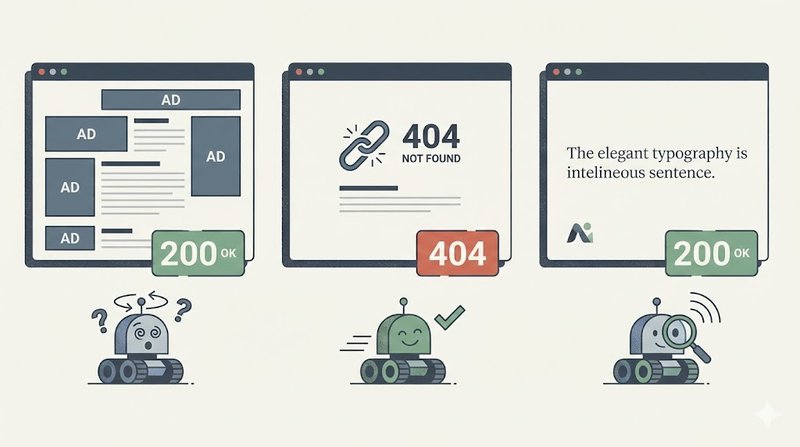
You bought the domain. You haven't built the thing yet. So your registrar helpfully parked it for you.
Problem solved, right? The domain exists. It's waiting. You're busy. You'll get to it later.
But here's the part most founders never get told: "nothing" isn't a single state.
To a human, a parked page, a 404 error, and an empty placeholder can look similar. They all translate to "no website here yet." To discovery systems, they are different objects, and they trigger different follow-on behavior.
One tells crawlers to leave. One tells them to keep checking and learn very little. One can establish that a real actor exists here.
Treating them as the same thing costs crawler attention now, and time later.
The internet doesn't see intent. It sees responses.
Three states that look the same, but aren't
Let's define the difference, because the technical distinction determines the consequence.
1) The parking page
This is the default setting for many registrars. The server returns an HTTP 200 (OK) response, which means "success." The content is usually a generic template: ads, a "buy this domain" banner, or a thin page that could belong to anyone.
2) The true 404
The server returns an HTTP 404 (Not Found) response. This is the server explicitly saying: this resource does not exist.
3) The empty but intentional placeholder
The server returns an HTTP 200 (OK) response, but the page is minimal and real. A name, a sentence about what this will be, a contact path, maybe a short paragraph that proves it isn't an ad template wearing your domain like a mask.
Visually, all three can look like "not launched." Mechanically, they are worlds apart.
What each state teaches the internet
- 404 (Not Found): nothing here. stop checking this URL.
- Parking page (200 + template): this exists, but it's interchangeable.
- Intentional placeholder (200 + meaning): this exists, and a real actor is behind it.
Parking pages are not a pause state, they're a public state. I wrote more on that pattern here: Domain Parking Is Not Neutral.
How search engines read each state
This isn't about penalties. It's about physics.
Crawlers have limited time and capacity. Google names this constraint as "crawl budget" (think: crawler attention) and explains that crawling resources are allocated based on popularity, user value, uniqueness, and serving capacity.
So what happens when your domain returns a "success" code with low-value, templated content?
Parking pages often get treated like soft 404s.
Google explicitly calls out soft 404s as wasteful: soft 404 pages "will continue to be crawled, and waste your budget."
That's the mechanical trap of the common parking setup. It returns 200 OK, which invites processing, but it doesn't provide unique value. The result is a loop: repeated crawling, repeated low signal.
Google also warns that wasting resources on unnecessary pages can reduce crawl activity for pages that matter, creating delays in discovering great new or updated content. In plain terms: you don't just fail to earn attention, you can slow down the moment you finally publish something worth noticing.
True 404s are the clean exit.
This is where most people's intuition breaks. They assume a 404 is "bad."
Google's documentation says the opposite in crawl terms: pages that serve 4xx HTTP status codes (except 429) don't waste crawl budget.
A 404 is honest. It tells crawlers to stop spending attention on that URL. That doesn't create visibility by itself, but it avoids teaching systems to revisit a low-value page forever.
Low-value inventory has spillover.
Google also warns that exposing many URLs you don't want crawled can negatively affect crawling and indexing, and they list examples like soft 404 pages and low quality or spam content.
Even if you only have one domain, that sentence is the right mental model. The internet remembers what it repeatedly observes. If what it repeatedly observes is templated and interchangeable, that becomes the default story.
The recovery cost from each state
A builder question that comes up a lot is basically: can I just switch later?
Yes. You can.
The difference is what you're asking systems to update.
Google sets expectations that indexing is not instant for most sites. Their guidance says "three days or more" is a normal baseline, and you shouldn't expect same-day indexing unless you're operating like a news site or publishing extremely time-sensitive content.
Now layer in what we already know:
- soft 404 pages keep getting crawled and waste crawler attention
- unnecessary crawling can delay discovery of great new or updated content
- crawling resources are allocated based on perceived value and uniqueness
So the recovery story becomes clearer:
- From a true 404 to a real site: you're flipping from "doesn't exist" to "exists." It's a clean change in state.
- From a parked template to a real site: you're asking systems to rewrite an older story about the domain. Not "missing," but "present and low signal."
I'm not going to invent a timeline Google doesn't publish. The honest claim is simpler: if you spend months broadcasting low-value signals, you often create more distance between launch day and discovery day than you needed to.
Renewal emails aren't reminders, they're pressure tests. This is where "later" becomes measurable. We pulled this thread harder in Why I'll Build It Later Is the Most Expensive Plan.
Why registrars don't tell you this
If a parking page is mechanically inferior to a clean 404 or a minimal placeholder, why is it the default?
Incentives.
Parking pages are often monetized. Ads, affiliate links, domain-for-sale funnels. The default creates revenue and reduces support load, and it feels like a "service."
It's not malice. It's a business model.
But the model is not designed to protect your domain's signal quality.
We've lived the loop: buy the domain in clarity, then renew it while the idea stays dark. Warming is choosing to make an idea legible before you feel ready. Quietly. On purpose. It's a way to turn ownership into presence before you have the full build, so the internet isn't forced to learn "nothing" by default. What is SiteWarming?
What this means for your domain
Technical literacy is leverage. Now you can choose deliberately instead of accepting the default.
- If you are truly doing nothing: a hard 404 is cleaner than a parking page. Google is explicit that
4xxpages don't waste crawl budget. - If you want to signal intent: publish a minimal, authentic placeholder. Not a template. Not ads. A small amount of meaning that proves a real actor exists here.
- If you're already parked: treat it as an active state, not neutral storage. Soft 404s keep getting crawled and waste crawler attention.
A browser can render a parked page, but meaning-extraction systems can't do much with it. If you want the mechanics behind that idea, here's the deeper cut: Why AI Can't Read Your Parked Domain.
Parking isn't evil. It's just misunderstood.
If you aren't ready to build, that's fine. Choose a version of "not ready" that doesn't make you pay twice when you finally are.
Share this article
Ready to Transform Your Domain Portfolio?
Start building real value with your domain investments today.