You bought the domain. You never built it. Here's what that costs.
 Bret Siers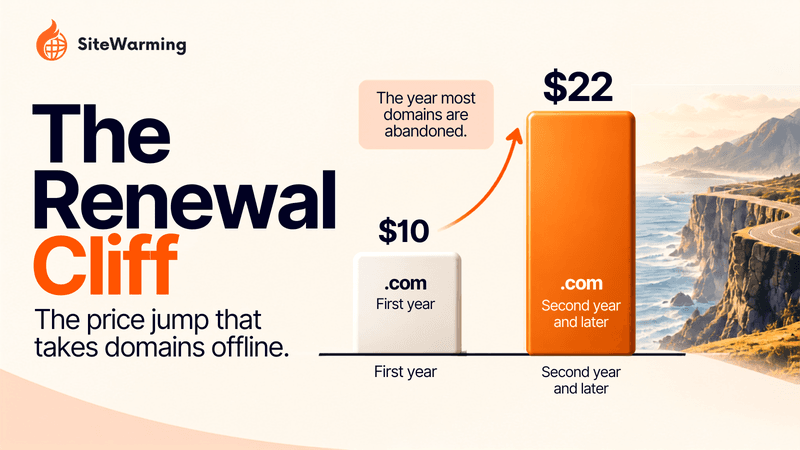
You know the folder.
Not a literal folder, exactly. More like a tab you avoid in your registrar dashboard. The list of names you bought during a clean moment. A sharp moment. The kind where the idea felt inevitable.
Each domain was supposed to be optionality. A lock on the door. A promise you could walk through later.
Then "later" arrived and it wasn't spacious. It was just a normal life.
So the domains sit there. Quiet. Unused. Waiting for a version of you that has time.
Here's the uncomfortable truth: domains are not gold bars in a safe. They're fruit. They have a shelf life.
An unused domain costs more than its renewal fee. Verisign's first-year renewal rate for .com sits in the mid-40% range, so most domains bought on an idea are abandoned within a year. Domains with even a redirect or an email record on them renew far more often. The fix is not building. It's putting something real on the name.
What does an unused domain actually cost you?
Start with the number the registry publishes about itself.
Verisign operates .com and .net. Q1 2026 investor call, the company disclosed that first-year renewal rates for .com run in the mid-40% range. Domains renewing for a second time or later renew in the mid-80s.
Read that gap slowly.
A domain that survives its first renewal is very likely to survive every renewal after it. A domain that doesn't is gone inside twelve months. The first year isn't a grace period. It's the whole test.
"Later" doesn't mean "eventually." Statistically, it leans toward "never."
Buying the name feels like starting. But leaving it dark is often just a slower form of quitting.
And the renewal fee is the smallest line in the bill. Twelve domains at $18 is $216 a year, $1,080 over five. Real money, and still not the point. The point is that five years went by and not one of those names accumulated anything. No history. No signals. No public evidence the idea ever existed. You paid the storage fee on twelve ideas and collected on none of them. There's a fuller breakdown in the four cost categories of parking a domain.
Why "I'll build it later" usually becomes "never"
Builders don't delay because they don't care.
They delay because they care too much about doing it right.
You tell yourself you're being responsible. Waiting for clarity. Waiting for the market. Waiting for the right design. Waiting until you can build it in a single, clean push.
But time does not accumulate in a jar.
It leaks.
Research on digital hoarding describes how decision fatigue pushes people to preserve rather than decide. Confronted with choices, the mind gets tired and defaults to keeping, even when keeping creates the clutter you'll have to deal with later.
A domain is a perfect container for that move. Letting one go feels like killing a future self. Building on it feels like committing to a path before you're sure. So you take the third option: keep it, do nothing, call it planning.
That's what "I'll build it later" usually is.
Not strategy. Avoidance dressed as strategy.
What happens to a domain while it sits there
A domain left dark is not in a neutral state. It's in a public one, and the internet is reading it.
Verisign's own figures put the scale of this plainly: only around 18% of first-year .com and .net domains are attached to any online presence at all. Roughly four out of five names registered last year are sitting exactly where yours is.
Three things happen while they sit.
Your presence stays unobserved. Discovery systems learn by repeated observation. Not by potential. Not by intent. Observation. A domain that stays empty doesn't send many signals, and over time it becomes legible as empty. That isn't punishment. It's how internet memory forms.
Parking is not a pause. A parking page is a published page. It loads third-party code you don't control onto a name you're responsible for, and it teaches search engines that this address serves thin content. The mechanics are in what a parking page actually does to a domain and if you've already cleaned one up, Google may still show your domain as parked for a while afterwards.
The renewal email becomes your only progress. Renewal emails have a special talent: they turn a clean idea into low-grade guilt. They don't just ask for money. They ask what changed since last year. When renewing is your only interaction with a domain, you train yourself to associate the idea with pressure instead of momentum.
Meanwhile the market keeps moving. The most expensive part of waiting is assuming your moment will still be there when you get back to it. It might be. It might not. US Bureau of Labor Statistics data on business survival is the cold version: roughly a fifth of new establishments close within their first year, and about half are gone within five. Early-stage work is time-bound. Waiting doesn't reduce the risk. It burns the runway before you've learned anything.
Why a dormant domain behaves like an expiring option
If you want a clean mental model for a dormant domain, don't ask a designer. Ask an options trader.
A domain behaves less like an asset and more like an option. You didn't buy results. You bought the right to act later.
In options trading, time decay (theta) is the reduction in an option's value as it approaches expiration, and the rate of decay accelerates as expiration gets closer.
That acceleration is the point.
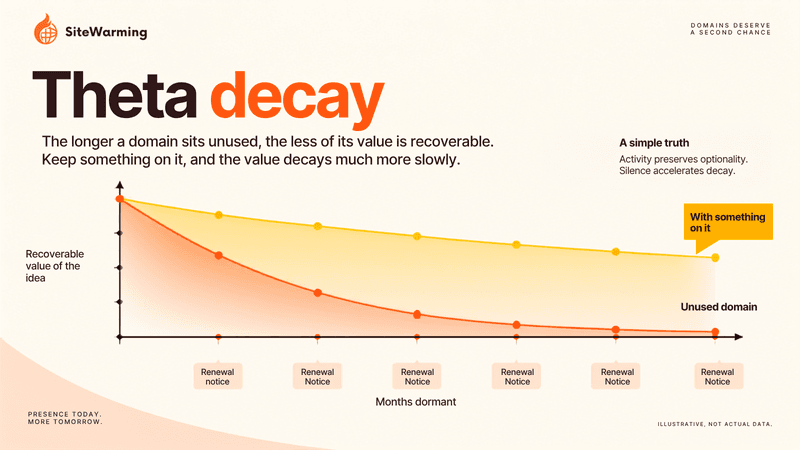
The name is the strike price. The time value is everything around it:
- the freshness of the idea in the market,
- the clarity you felt when you bought it,
- the category language people are using right now,
- the chance to be early in a space before it gets crowded,
- the compounding effect of being repeatedly seen.
A domain you've held in silence for three years still has the name. It has almost none of the rest. Theta ate it: slowly at first, then faster.
Is it too late to build on a domain I've owned for years?
Usually not, if you still believe in the idea. Age alone isn't the problem. Age without activity is just time passing. The question isn't whether the domain is old. It's whether you can make it observable again in a way that matches what you actually intend to do with it.
Does putting something on a domain actually change anything?
Yes. And there's registry data on roughly how much.
At Nordic Domain Days in Stockholm this May, Stuart Dinnes of Verisign presented first-year .com renewal rates broken down by what was actually on the domain. The baseline is worse than most owners assume: first-year renewal for .com sits in the mid-40% range, against mid-80s for domains renewing for the second time or later. Most names never make it past year one. Domain Name Wire
What's on the domain changes that. Not by a little.
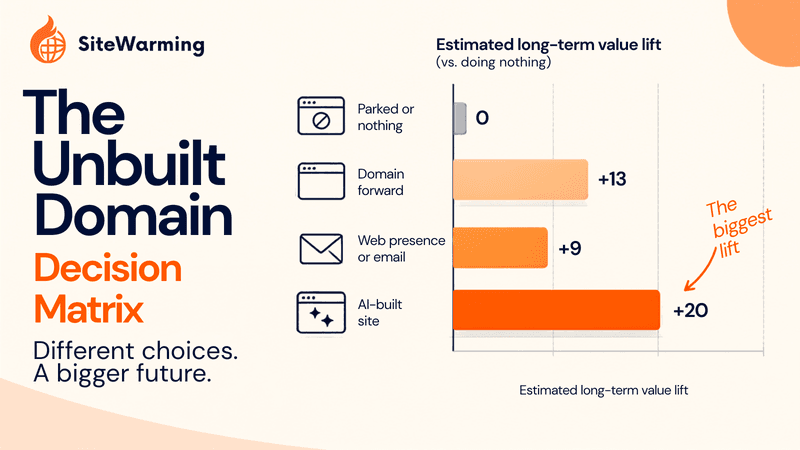
| What's on the domain | First-year renewal |
|---|---|
| Nothing, or a parking page | Baseline: mid-40% range |
| A web presence, or email set up | 9% higher |
| A simple domain forward | 13% higher |
| A site built with AI tools | 20% higher |
Source: Verisign, presented at Nordic Domain Days, Stockholm, 25 May 2026. Figures as reported from the slide; treat them as relative lift rather than precise percentage points.
One caveat worth stating out loud. The AI-tools cohort is a very small subset. A domain has to be a year old before its renewal is measurable, and most of the growth in those tools happened in the last six to twelve months. Treat the exact figure as provisional.
Also worth saying: this is observational. Owners who bothered to configure a forward were probably more invested in the name to begin with. Nobody has proved that adding something causes renewal. But the two travel together, and one of them you control.
The interesting bar is not the one you'd expect
Look at the forward.
A domain forward has no content. No indexable page, no title tag, no description, no contact route, nothing a person or a crawler can read. It fails every item on the checklist. It takes about four minutes to set up.
And it beats a working web presence with email by four points. Domain Name Wire
That ordering is the most useful thing on the slide. If the chart were measuring site quality, it would run the other way. It doesn't. So it isn't measuring site quality.
It's measuring whether the domain is still alive to the person who owns it.
A forward is the cheapest possible evidence that it is. Someone logged in, made a decision, pointed the name at something. The redirect isn't doing the work. The decision is. A domain that does something becomes a domain you think about, and a domain you think about is a domain you keep.
You cannot pivot a parked car. Bret Siers, founder, SiteWarming
That's the mechanism under all of it. You can only pivot from something that exists in the world. Even if it's small. Even if it's imperfect. Even if it's just enough to create feedback and force a decision.
The 2011 Startup Genome report found that startups pivoting once or twice outperformed both those that pivoted more often and those that never pivoted at all. Old enough now to be received wisdom, and still true in the only way that matters: you can't correct a direction you never took. steveblank
What the chart can't tell you
Renewal is a registry's metric. It records that you paid again. It doesn't record whether anyone found the name, understood the idea, or managed to reach you. Those are the things that actually matter to an owner, and they're absent from the chart because Verisign has no way to see them.
The 20-point cohort has a second limit. Those are people building one site, for one name, the one they always meant to develop. If that's your situation, go build it. The data says you'll keep it.
Nobody does that sixty times.
Which leaves the question the chart raises and can't answer. Not "should I build something." The floor turns out to be far lower than that: four minutes of DNS moves the number. The real question is what the least is that you can do across every domain you own and have it still count.
A forward counts, and it's the lowest bar there is. It also tells the world nothing. The same effort, spread across the whole portfolio, could instead produce a page that says what the idea is, who it's for, and how to reach you, and that keeps saying it next month.
Verisign now rewards registrars for registrations more likely to renew, and the share of first-year .com and .net domains it counts as attached to an online presence reached 18% last year. Which means 82% are attached to nothing at all.
That's the gap. SiteWarming exists to close it without asking you to become a website owner sixty times over.
What is domain warming?
Domain warming is the practice of putting a small, honest, public presence on a domain before you're ready to build the real thing, so the name accumulates history, context and signals while you work out the rest. It isn't a launch and it isn't a parking page. It's the option between them. More on what domain warming is.
Keep it, warm it, sell it, or let it go
"Cut the rest" is easy advice to give and hard to act on at 11pm with a renewal notice open. So here's a rule instead of a feeling.
[IMAGE 4 / replace in StoryChief: decision-flowchart-build-warm-sell-expire]
| If… | Then | Because |
|---|---|---|
| You have a real plan and a rough date | Warm it now | Signals take months to accumulate. Start before you need them, not on launch day. |
| The idea still feels alive but has no timeline | Warm it | A domain with an identity is much harder to abandon than a name in a list. |
| The name has resale value but the idea doesn't | Check sale readiness, then list it | The value is in the name, not in your plan for it. Stop paying to store it. |
| You're holding it so nobody else can have it | Let it go | Defensive registration made sense with twenty extensions. Not with hundreds. |
| You haven't thought about it in two years | Let it go | Two years of not thinking about it is the answer. You already decided. |
If a name lands in the third row, check whether it's ready to sell before you list it, readiness and price are different questions. If it lands in the last two, here's the 30-day clock after a domain expires so you let it go deliberately rather than by accident.
Most portfolios contain all of these. The exercise isn't to judge any of them. It's to stop pretending they're the same thing. Decision fatigue thrives on keeping everything. Momentum thrives on choosing. If neither building nor parking has ever felt right, that's the gap the third option sits in.
What to do with a domain you're not ready to build
"Start now" is cheap advice if it means "launch a full product." That's not what I mean.
If a domain is worth keeping, it's worth warming. Warming is small. Honest. Legible.
Put up a single page that states your intent. Not theatre. Who it's for, what problem it's about, what you're exploring. One screen. Twenty minutes.
Add one proof-of-life update each month. A short note. A simple "what I learned." Anything that builds a visible history. Twelve entries a year is a record of thinking, and twelve more signals than an empty name will ever send.
Cut the rest. Pick the one that still feels alive. Run the others through the table above and do what it tells you. If you're not sure what you're holding, run a free renewal analysis on your portfolio and look at the list properly for once.
And if you look at a domain and realise you're never going to start, that isn't failure. That's clarity. Let it expire. Save the attention for something you'll actually do.
How long does warming take to show anything?
Longer than you'd like and sooner than you'd think, depending on what you're measuring.
Indexing is quick, days to a few weeks for a single page on a domain with no history. Being understood takes longer. Discovery systems learn by repetition, so a name with one page and three months of small updates reads very differently from a name with one page and silence behind it.
The honest expectation for the first ninety days isn't traffic. It's context: a domain that something other than you can describe accurately. Traffic is a later problem, and a much easier one to have once the address means something.
The more useful signal is internal. Most people find the idea gets more concrete once it has a home, and the next step gets clearer once the first one exists.
The cost was never the renewal fee. The cost is what "later" does to your optionality.
A domain you don't use becomes an open loop. Multiply that by a dozen and you have a personal backlog of unlived identities, attention fragmented across futures you're preserving instead of choosing.
Then the concrete cost arrives: one year you simply don't renew. It expires, it disappears, or it becomes someone else's.
This is a visibility problem wearing a timing problem's clothes. Discovery systems learn from what they repeatedly see, and empty space becomes a durable signal. Warming is just the practice of turning ownership into presence early, before "later" becomes "too late." It isn't hype. It's a small, honest footprint that gives the internet something to remember. Here's here's how to build a roadmap for one domain or fifty.
Just don't pretend "later" is free.
The clock is ticking either way.
Questions people ask about unused domains
Should I keep a domain I'm not using? Only if you can name what you'd do with it. If the idea still moves you, warm it, put a single page on it and update it monthly. If you're holding it so nobody else can have it, or you haven't thought about it in two years, let it go. Renewal fees are cheap; unresolved intentions aren't.
Do unused domains lose value over time? The name doesn't. Everything around it does. A dormant domain loses the freshness of the idea, the clarity you had when you bought it, the chance to be early in a category, and any history it could have accumulated. Resale value may hold or rise, but the value of your plan for it decays.
Is it bad for SEO to leave a domain parked? It doesn't help. A parking page is a published thin-content page, often loading third-party scripts you don't control, and search engines learn the address from what they repeatedly see there. That history creates a headwind when you eventually build. It isn't permanent, but it is real and it takes time to reverse.
Is it too late to build on a domain I've owned for years? Usually not. Age alone isn't the issue, age without activity is. An eight-year-old domain with nothing on it isn't penalised for being old; it simply has no accumulated context. Start publishing and it starts accumulating. The clock that matters is the one since your last signal, not since registration.
What is domain warming? Domain warming is putting a small, honest, public presence on a domain before you're ready to build the full thing, typically one page describing the intent, plus a short update each month. It gives the name history, context and signals so it isn't starting from zero when you launch.
How many domains is too many to hold? More than you can name a next action for. There's no numeric limit, there's a clarity limit. If you can look at the list and say what each one is for and what happens next, the number is fine. If most of them produce a shrug, you're storing ideas rather than pursuing them.
What happens if I let a domain expire? It doesn't vanish immediately. After expiry most gTLDs run a grace period where you can still renew at standard price, then a redemption period with a recovery fee, then a short pending-delete window before the name returns to the open market. Once it drops, anyone can register it, and desirable names are picked up quickly.
Should I sell an unused domain instead of warming it? If the name has value independent of your plan for it, yes. Warming makes sense when you still believe in the idea; selling makes sense when you believe in the name. Be honest about which one you're holding. Check what the name would need to be sale-ready before you list it, and don't warm a domain purely to inflate its price.
Share this article
Ready to Transform Your Domain Portfolio?
Start building real value with your domain investments today.