How to Build a Domain Roadmap (For One Domain or Fifty)
 Bret Siers
There's a moment that happens to almost every domain owner eventually.
You decide to get organized. You open a spreadsheet, pull up your registrar account, and start listing your domains row by row. Name, expiration date, renewal cost, maybe a notes column. You build the thing in 20 minutes.
And then you stare at it.
Because the spreadsheet is full of intentions that never became plans. There's the domain you bought after that conference three years ago. The two you registered when a business idea felt urgent. The one you grabbed because the name was too good to let sit. And the four you're actively renewing for reasons that made sense at the time but are harder to articulate now.
You have a renewal calendar. What you don't have is a roadmap.
Those are different things. A renewal calendar tells you when to pay. A roadmap tells you what to do.
This article is about building the second one. Whether you have one domain or fifty, the framework is the same. The scale changes. The decisions don't.
Why a Renewal Calendar Isn't a Plan
A renewal calendar has one job: keep you from losing your domains by accident. It does that fine. But that's all it does.
It doesn't tell you which domains deserve another year of your money. It doesn't flag the ones that are renewing on pure momentum, names you haven't thought about since the day you bought them, quietly charging your card while you do nothing with them.
Here's how common this is: GoDaddy reported in 2023 that the average customer who owns 10 or more domains actively manages fewer than 3 of them. The rest are on autopilot. Not because the owners don't care. Because there's no system asking them to make a different decision.
You turn on auto-renewal when you register. You never turn it off. You pay $12 a year for a .com and tell yourself you'll figure out what to do with it eventually. Multiply that by fifty domains and you're spending roughly $600 a year before you've added a single line of content, configured a single DNS record, or built anything on any of them.
That's not an investment. That's a holding pattern you're paying for.
A roadmap asks a harder question than "when does this renew?" It asks: "Why does this still deserve renewal?" That's the question covered in should you renew a domain you're not using, and it's the question this framework is designed to help you answer systematically, without drama.
But here's what makes the roadmap different from just asking hard questions once a year: it doesn't just interrogate your collection. It organizes it.
What a Domain Roadmap Actually Is
A domain roadmap is a decision framework. It assigns every domain you own to a category that determines your next action. Not eventually. Now.
It doesn't require you to build anything today. It requires you to decide something today. And that decision shapes every renewal, every dollar, and every hour you put into your domains going forward.
Industry surveys from NamePros and DomainSherpa consistently show that roughly 80% of the value in any domain collection is concentrated in 20% or fewer of the domains. Most people's "best" domain is dramatically more valuable than everything else they own combined. You probably already know which one yours is. The roadmap exists to make that intuition visible, so you can stop distributing your attention and your money equally across unequal assets.
Before the categories, there's one prerequisite. You need a list. Actual names, not a vague sense of what you own. Pull every domain from every registrar into a single document. If you haven't done that yet, start there. The roadmap can't run on an incomplete inventory.
The Three-Tier Sorting Framework
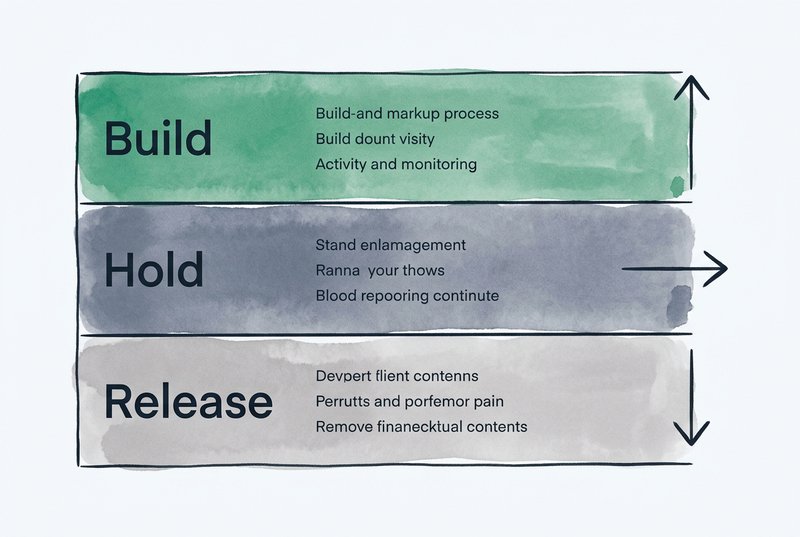
The framework has three tiers, not four categories. Here's why.
When you actually sit down to sort your domains, the honest answer for most of them isn't "develop" or "activate" or "sell." It's some version of "I'm not sure yet." That uncertainty is real. A four-bucket system forces false precision on things that genuinely need more time before you can decide. Three tiers leave room for the truth.
Tier 1: Build. These are the domains where the next action is clear and the intention is real. Build doesn't mean "launch a full website this week." It means you have a specific vision, you're willing to put time and resources into it in the next six months, and you can articulate what success looks like.
One domain at most should be in this tier for most people. Maybe two. If you have ten domains in Build, you're confusing enthusiasm with capacity. Build requires real hours, and there are only so many in a week.
Tier 2: Hold. This is where most domains live, and where the roadmap earns its keep.
Hold means you're not ready to build, but you're not ready to release either. The vision is real, the timing isn't right, and you're keeping the option open. That's legitimate. But Hold has a cost: every domain in Hold needs to be warming. Not built. Active. A domain in Hold that's completely dark is just a renewal fee with no return on that patience.
Warming is what transforms Hold from passive waiting into active stewardship. More on that shortly.
Tier 3: Release. These are the domains you're letting go. Either you let them expire at renewal, or you try to sell them first if they have genuine market value.
I get it. Release is the hardest tier to fill honestly. Putting a domain in Release feels like admitting the idea is dead. But here's the thing: most ideas don't die when you release the domain. They either weren't real ideas in the first place, or they find a better home on a domain you already own. Release isn't failure. It's clarity. And clarity frees up the attention you need for the domains that actually matter.
The sorting question for every domain is simple: "If I'm honest with myself about my time, my focus, and my actual intentions, which tier does this belong in?"
Not which tier do you wish it belonged in. Which tier does it actually belong in.
The Decision Criteria: How to Sort Every Domain
Sorting feels subjective until you give it a framework. Here are the four questions that determine which tier a domain goes into.
1. Is the vision still real?
You registered this domain because something felt true. Is that still true? Not "could I imagine a use for this someday" true. Actually true. Does this idea, this name, this niche still represent something you care about building? If you have to talk yourself into a yes, that's a no.
2. Is there a specific next action?
A Build domain has a clear next action that isn't "figure out what to do with it." A Hold domain has a specific condition you're waiting for: a life event, a funding milestone, the completion of another project. A Release domain has no next action that isn't "let it go."
3. Can you name the audience?
This is the question most domain owners skip. Who is this domain for? Not in the abstract. Specifically. If you can name the kind of person who would find this domain valuable, that's a meaningful signal. If you can't, that's a meaningful signal too. Small, focused audiences are more valuable than vague assumptions about broad interest, and knowing whether you can name yours tells you something real about where the domain belongs.
4. What's the cost of holding it for another year?
This is both financial and attentional. The financial cost is easy to calculate. The attentional cost is harder but more important. Every domain in your Hold tier is taking up some fraction of your mental space. You're aware of it. It's a low-grade obligation. The question is whether the value of the option justifies that cost, in both dimensions. If you'd feel relief rather than loss dropping this domain into Release, that's your answer.
Go through your list. Apply those four questions. Sort every domain. This takes time the first time. It gets faster every cycle.
The questions sound simple. They're not. They're designed to strip away the story you tell yourself about a domain and replace it with what's actually true. That's uncomfortable. It's also the entire point.
At SiteWarming, we care about the gap between buying a name and building the thing. That gap is where ideas become invisible. A domain in Hold that's sitting dark isn't being stewarded, it's just parked with better intentions. Warming is what gives a Hold domain a real footprint while you wait for the right moment to build. Not a full site. Just presence. What is SiteWarming?
What the Roadmap Looks Like in Practice
The framework above is the logic. But logic without scale is abstract. Here's what it actually looks like when you sit down and do it.
One domain.
This sounds simple. It's often harder than managing ten, because there's nowhere to hide. With one domain, the roadmap is really just one question: is this in Build or Release? Hold is valid, but only temporarily. You registered one domain for a reason. If that reason is still real, this is in Build and you need a specific plan for the next 90 days. If the reason has faded, Release is the honest answer and the money is better saved than renewed.
The hard part with one domain isn't the sorting. It's admitting that the idea you loved enough to name might not be the idea you're going to build.
Ten domains.
This is where most people actually live, and it's where the collection trap hits hardest. At ten domains, you should realistically have one or two in Build, four or five in Hold, and two or three in Release. If everything is in Hold, you're avoiding a decision. If everything is in Build, you're lying to yourself about your capacity. The roadmap forces an allocation that matches your actual time and attention.
Most people resist the math here. They want to believe they can build five things at once. You can't. The roadmap is the thing that makes you stop pretending you can.
Fifty domains.
At this scale, the math becomes concrete fast. Fifty .com renewals at average cost is $600 a year before anything else. Industry research consistently shows the 80/20 pattern: roughly 10 of those 50 domains account for the vast majority of the collection's total value. A roadmap at this scale is essentially active collection management. You're identifying your top tier, actively warming the Hold domains that have real potential, and releasing the rest systematically rather than letting them accumulate indefinitely. For a deeper look at what management overhead looks like at this scale, managing 10 vs 50 domains breaks down the operational difference in detail.
The difference between 1 domain and 50 isn't the framework. It's the number of honest decisions the framework requires. Same logic. More rows in the spreadsheet. More chances to avoid the truth or face it.
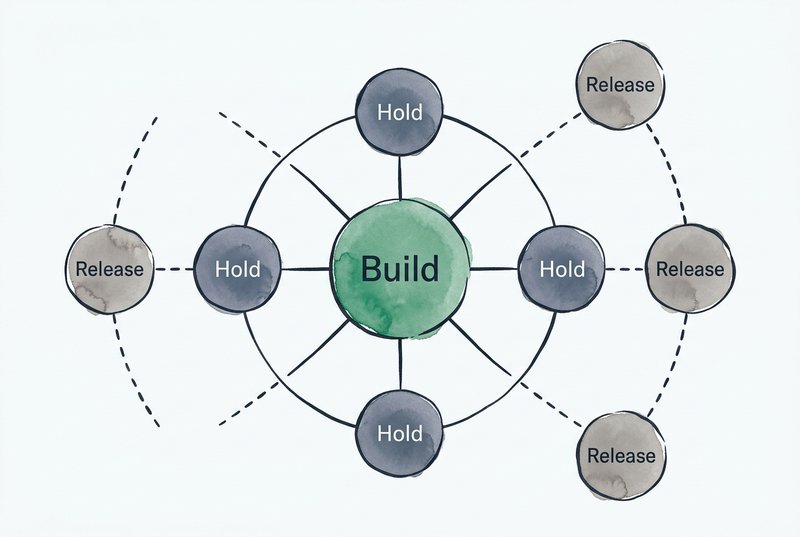
What Happens to Each Tier After You Sort
Sorting is the diagnosis. What happens next is the treatment. And this is where most roadmaps die. People sort their domains, feel good about the clarity, and then do nothing different. The sort is not the work. It tells you what the work is.
Build domains get a project brief, not a deadline.
Deadlines without resources are just guilt with a calendar. A Build domain needs a brief: what you're building, who it's for, what done looks like in six months, and what the first concrete step is this week. If you can't write that brief in 30 minutes, the domain might not be ready for Build yet. Drop it to Hold. No shame in that. There's only shame in pretending.
Hold domains get warming, not waiting.
This is where most people get the roadmap wrong. They sort their domains, put the majority in Hold, and then do nothing with them. Waiting isn't stewardship. From ownership to stewardship draws this line clearly: a domain you own but haven't done anything with is a domain you own in name only.
Warming a Hold domain means giving it a small, honest footprint. Structured content that explains what the idea is. Basic signals that tell discovery systems the domain is alive. This doesn't require building a full site. It requires making the idea legible while you wait for the right time to build it fully. If you need concrete starting points, how to monetize a domain without ads or parking pages walks through seven options you can start this weekend.
Here's the difference that matters: an active domain in Hold is an option that's growing in value. A dark domain in Hold is just a renewal fee. Same tier. Completely different trajectory.
Release domains get a sell-first check, then a clean exit.
Before you let a domain expire, spend 15 minutes on best domain registrars for long-term ownership to understand whether your registrar's marketplace is worth trying. For most domains, the answer is no: the name isn't valuable enough to attract a buyer and the listing effort isn't worth it. But for names with genuine keyword clarity, short length, or obvious brand potential, a quick listing costs nothing.
If it doesn't sell, let it go. Don't renew a domain out of sentiment. Sentiment isn't a strategy.
So now you have your tiers. You have your next actions. The question becomes: how do you keep this alive?
Maintaining the Roadmap Over Time
Here's the thing about frameworks: they're only as good as the rhythm you build around them. A roadmap you build once and never touch becomes a renewal calendar again in about 18 months. Here's the cadence that keeps it alive.
Quarterly check-in (15 minutes). Look at every Build domain and ask: am I actually making progress? Not "do I still intend to." Am I making progress? If a domain has been in Build for two quarters with no movement, it drops to Hold. No drama, just honesty. Look at every Hold domain and ask: is this still active? If it's gone dark, either recommit to warming it or release it.
Set a calendar reminder. Actually do it. The people who build real things with their domains are the ones who check in on them.
Annual re-sort (1-2 hours). Do the full sorting exercise again. Your life changes. Your ideas evolve. The domain that was genuinely exciting two years ago might honestly belong in Release now. The domain you put in Hold might finally be ready for Build. A living document, not a one-time exercise. If the annual re-sort feels uncomfortable, that's a good sign. It means you're being honest.
Trigger reviews. Some events should trigger an immediate roadmap review regardless of cycle. You start a new business. A domain you own suddenly becomes relevant to something you're already building. You receive an inbound offer on a domain. A significant renewal cost increase hits. These trigger reviews don't have to be comprehensive. They just need to address the specific domain the event touched.
The real cost of set-it-and-forget-it domain management isn't just the renewal fees. It's the compound effect of never reviewing, never releasing, and never making real decisions about what you actually intend to do. The maintenance cadence above is the antidote to that pattern.
Starting the Roadmap Today
Here's the actual starting point, because most people read a framework and then don't do anything with it.
Step one: pull your full domain list from every registrar you use. If you own domains at three different registrars, you have three lists to merge. This takes 20 minutes.
Step two: apply the four sorting questions to every domain. Don't overthink it. Your first instinct about which tier a domain belongs in is usually correct. Overriding that instinct with rationalization is how domains stay in Hold indefinitely.
Step three: for every domain in Build, write one sentence about what you're building and what the first step is. For every domain in Hold, note whether it's currently active or dark. For every domain in Release, note whether you'll try to sell first or simply not renew.
Step four: put a reminder 90 days from now to check on your Build domains. Put a reminder 12 months from now to do the full re-sort.
That's the roadmap. Clear decisions, written down, with a system for revisiting them. The domain flipping vs stewardship piece makes the case for why stewardship outperforms speculation over time. A roadmap is stewardship made concrete. It's what separates accidental aggregators who collect without a plan from intentional owners who know what they're building.
Whether this is worth it in 2026 depends entirely on which approach you're taking. Collecting without a roadmap is expensive and unfocused. Owning with a roadmap is something else entirely.
You already have the domains. You already know, somewhere, which ones matter and which ones don't.
The roadmap just makes you say it out loud.
Image Credits
Photo by Antje Winkler on Unsplash
Share this article
Ready to Transform Your Domain Portfolio?
Start building real value with your domain investments today.