Best Domain Registrars for Long-Term Ownership in 2026
 Bret Siers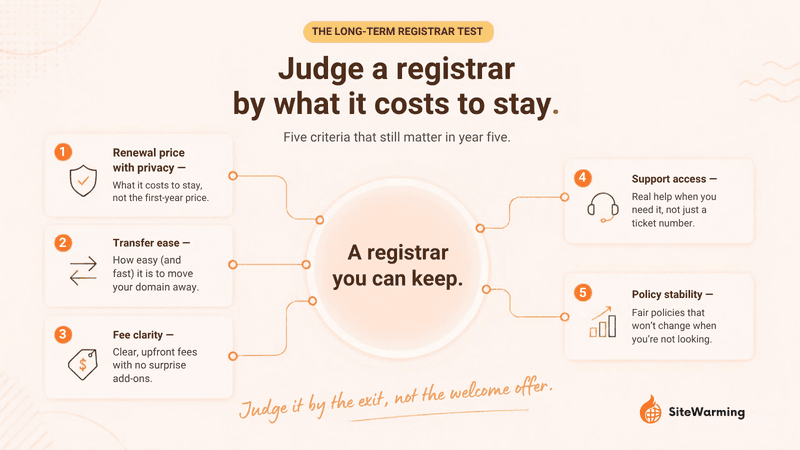
The best registrar for long-term domain ownership is the one that is cheapest to stay with, easiest to leave and least likely to change hands. Judge on renewal price, free WHOIS privacy, transfer-out terms and ownership stability, not the year-one promotion. Cloudflare, Porkbun, Dynadot and Namecheap fit that profile best; GoDaddy's renewal pricing needs scrutiny.
A note before we start: this article earns no commissions from any registrar mentioned here. No affiliate links, no sponsored placements, no partner relationships. Just the comparison someone with long-term domain stewardship in mind would actually want to read.
You've decided to move a domain. Maybe the renewal price went up again. Maybe support never answered your ticket. Maybe you just read something unsettling about your current registrar and you're done. So you log in, look for the transfer option, and discover the domain is locked. Not locked like you forgot a password. Locked like the registrar turned off the ability to leave.
The transfer that should take 20 minutes now involves an unlock request, an authorization code that may or may not arrive, and a 60-day lock because you updated your contact details six weeks ago. Three weeks. Two support tickets. One domain you can't move.
That's the moment most people realize they picked their registrar the wrong way.
Most people pick a registrar based on whatever shows up first, whatever's cheapest for year one, or whatever their hosting company nudges them toward during checkout. That's not a strategy. That's a default. And defaults in the registrar world tend to compound quietly, in ways you don't notice until you're trying to leave.
This is the comparison nobody with affiliate revenue will write. We look at registrars the way a long-term domain steward would: not by first-year promotional pricing, but by what it costs to stay, how easy it is to leave, and what happens if the company changes hands or shuts down. Because domains are infrastructure, not lottery tickets, and infrastructure deserves infrastructure-level thinking when you choose who to trust with it.
Why does your choice of registrar matter so much?
Most people treat registrar choice the way they'd treat choosing a parking spot: find the closest, cheapest option, pay, and move on. The domain is the thing that matters. The registrar is just where it lives.
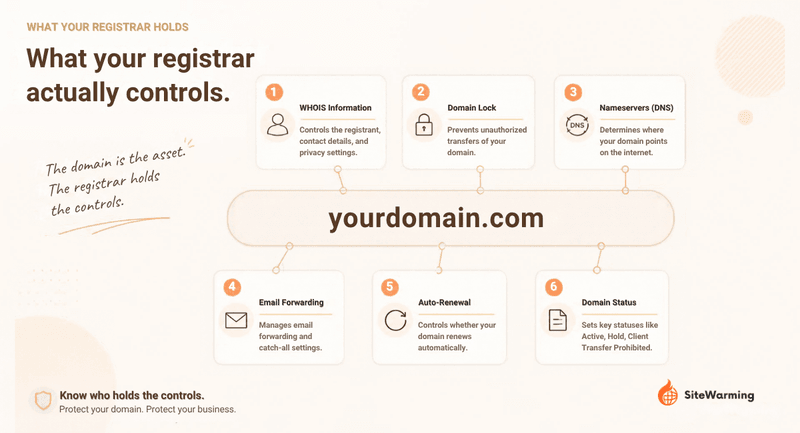
That logic breaks down the moment anything goes wrong. A registrar is the company, accredited by ICANN, that registers your domain on your behalf and holds the controls for it. Those controls include:
- Your domain's lock status and your authorization (EPP) code, which decide whether and when you can transfer.
- Your nameserver configuration, which decides where the domain points.
- Your WHOIS registration data, and whether it is public or redacted.
- Your renewal reminders and your renewal price, which can be very different from the promotional price you paid in year one.
- Your recourse if the registrar is acquired, goes bankrupt or decides your domain violates a clause in its terms of service. You are at the mercy of its process, not yours.
That is what understanding renewal cost dynamics makes clear: the price you pay in year one is rarely the price you pay in year three or five. Introductory pricing is a customer-acquisition strategy. The renewal price is the real price.
Registrar risk is also real. On September 7, 2023, Squarespace completed its acquisition of Google Domains assets, and about 10 million registered domains moved with them. The migration was finished by July 10, 2024. Most people came through without incident. The ones who had built automations around Google Domains APIs, who had specific DNS configurations, or who just didn't check their email during a busy month faced disruption they didn't choose and couldn't prevent.
Nobody registered a domain with Google expecting Google to hand it to someone else. That's the nature of registrar risk, and what happens when a registrar shuts down or changes hands is worth reading before you commit to a new one.
The registrar you choose is the first act of either stewardship or abdication. Everything else, whether you're warming the domain, building on it or holding it for the long term, depends on that foundation being solid.
What should you look for in a registrar for long-term ownership?
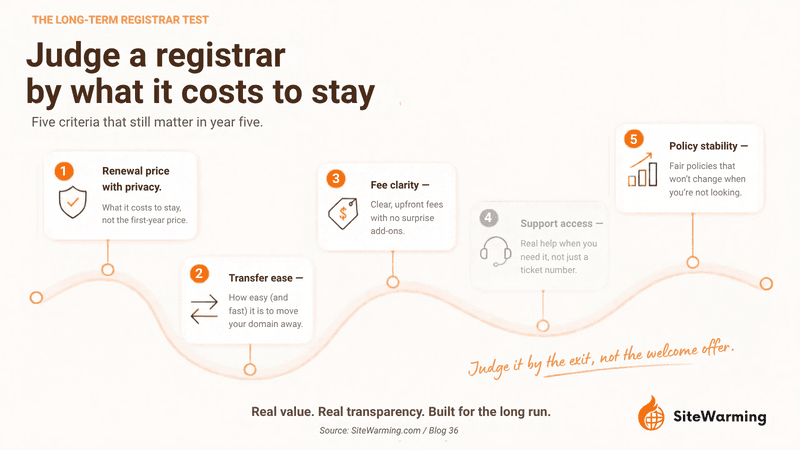
Here are the five dimensions that matter, roughly in order of importance. This is SiteWarming's own evaluation framework, not an industry standard.
How much does renewal really cost, privacy included?
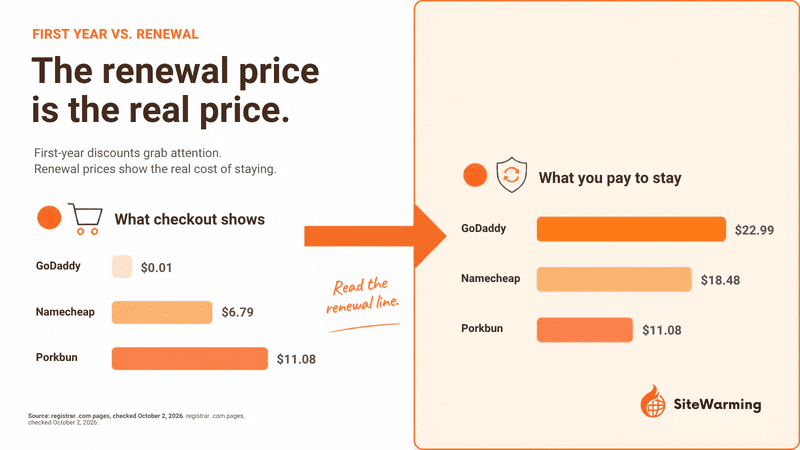
The price that counts is the renewal price, with privacy included. Wholesale sets the floor: Verisign, which runs the .com registry, charges registrars $10.26 a year today and $10.97 from November 1, 2026. Registrars add their own margin on top. Here is what three of them listed on October 2, 2026:
| Registrar | .com renewal per year | Source |
|---|---|---|
| Porkbun | $11.08 | Porkbun .com page, checked October 2, 2026 |
| Namecheap | $18.48 (an ICANN fee of $0.20 per domain may be added at checkout) | Namecheap .com page, checked October 2, 2026 |
| GoDaddy | $22.99 (first year $0.01 with a three-year purchase) | GoDaddy .com page, checked October 2, 2026 |
Introductory pricing is where the gap opens. GoDaddy's page shows $0.01 for the first year with a three-year purchase and $22.99 for each year after. Namecheap shows a $6.79 new-customer special against an $18.48 renewal. Porkbun lists $11.08 as its everyday price.
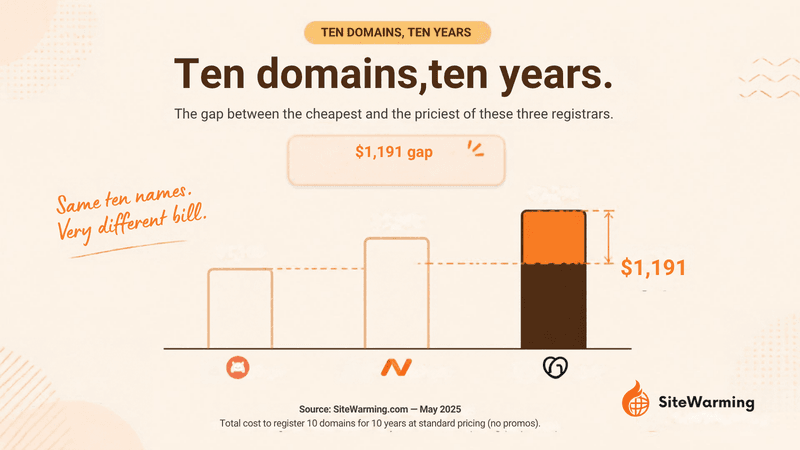
Hold today's prices constant and the gap compounds. Our arithmetic: ten .com names for ten years cost $1,108 at $11.08 a year, $1,848 at $18.48 and $2,299 at $22.99. That is a $1,191 difference for the same ten domains. Prices change, so treat these as a snapshot.
Privacy belongs in the same calculation. WHOIS privacy should be free. Cloudflare, Porkbun, Namecheap and Dynadot each say on their own sites that it is included at no charge, and a registrar that bills extra for it is adding margin to a basic protection, not selling a privacy product. The registrars that include it free are telling you something about their business model.
How easy is it to transfer out when something goes wrong?
The test of a registrar is the exit. ICANN's Transfer Policy governs how transfers work, and it sets a few rules that every accredited registrar has to follow:
- A registrar must provide the authorization code within five calendar days of the registrant's request.
- A registrar may deny a transfer only for reasons the policy lists, such as evidence of fraud, a dispute over the registrant's identity, nonpayment under specific conditions, an express objection from the registrant, or one of the 60-day restrictions.
- The 60-day restrictions follow a new registration, a completed transfer and a change of registrant.
- A completed transfer adds one year to the registration.
Those are the rules, and the ICANN Transfer Policy is public. Compliance varies in practice, and the policy does not address what a registrar may charge for transfer-related services. The signal isn't whether transfers are possible. It's how many support tickets they require. If you want the full mechanics, see our guide to transferring a domain without breaking anything.
Has the registrar changed hands, or is it likely to?
Is the registrar independently owned? Has it changed hands recently? Is it backed by a private equity firm that cuts costs after an acquisition? Registrar acquisitions are common, and our view is that when one happens, pricing tends to rise and support tends to slip. Look at ownership structure before you commit. As one example, Network Solutions and Register.com belong to Newfold Digital, a company formed in 2021 when Endurance and Web.com merged, and which is private-equity owned through a joint venture between Clearlake and Siris. Ownership isn't a fault. It's a reason to read the terms before you move more names in.
Is the registrar ICANN-accredited, and how do you check?
Every legitimate registrar is ICANN-accredited, and you can confirm it in ICANN's searchable list of accredited registrars. The list shows a registrar's contact details, IANA number and website. It does not show compliance records, so accreditation tells you the company is real, not that it behaves well. Behavior is what separates registrars with a good compliance posture. They don't suspend domains without warning, they honor the transfer process, and they don't use administrative holds as leverage. If a registrar ever does hold a domain, here is what you can do about it.
How responsive is support?
This one is hard to judge in advance, but you can triangulate. Read recent threads in public forums such as r/Domains and in the registrar's own community. Look for how long tickets stay open and whether the same complaint repeats. A registrar with an active public community tends to get feedback faster, and feedback is what you are relying on when something breaks at 2 a.m.
Which registrars are worth considering for long-term ownership?
These aren't ranked by price. They're ranked by how well they hold up when things get complicated. The table shows what we could confirm on October 2, 2026.
| Registrar | .com renewal | WHOIS privacy | Worth knowing |
|---|---|---|---|
| Cloudflare | Registry and ICANN price, no markup | Free WHOIS redaction | Supports new registrations and transfers; 390+ extensions |
| Porkbun | $11.08 | Free | Everyday price listed on its .com page |
| Namecheap | $18.48 | Free ("free for life" on its page) | ICANN fee of $0.20 may be added at checkout |
| Dynadot | Compare at checkout | Free | Publishes a domain portfolio management guide |
| Hover | Compare at checkout | Compare at checkout | A Tucows service that began in July 2008 |
| GoDaddy | $22.99 | Not stated on its .com page | $0.01 first year with a three-year purchase |
Is Cloudflare Registrar worth using?
For many owners, yes. Cloudflare says it does not mark up registry and ICANN prices, so you pay what the registry and ICANN charge for registration and renewal, and it includes free WHOIS redaction. That is as close to a pure-cost model as the market offers. Because wholesale .com is $10.26 today and rising to $10.97 on November 1, 2026, any older figure for Cloudflare's .com price below that line is out of date.
The limitation is coverage, not access. Cloudflare says it supports new registrations as well as transfers, but it lists "over 390" extensions, which is not every extension, so confirm that yours is supported. It is a good fit for domains you want managed with minimal overhead and maximum control, particularly if you already use Cloudflare for other services.
Is Porkbun a good choice?
Porkbun lists .com at $11.08 a year with free WHOIS privacy, which puts it close to the wholesale floor and well below the two largest retail names on the table above. That is the case for it. For any domain where continuity matters above all else, run the stability test from the previous section on Porkbun as you would on any registrar before you move your most valuable names.
Is Namecheap a good default?
Namecheap is one of the most commonly used independent registrars, and it shows $18.48 for .com renewals with domain privacy "free for life". That is $7.40 a year above Porkbun, or $740 over ten years on ten names. The trade is a familiar interface and documented transfers. We treat it as a solid default rather than a long-term price winner.
Is Dynadot worth considering for multiple domains?
Dynadot states that all domains include free privacy, and it publishes a domain portfolio management guide that lists bulk renewals, transfers and updates among the features to look for. That tells you who it builds for. If you own five or more domains, compare its dashboard with your own list, and check its current .com renewal at checkout.
Is Hover worth the premium?
Hover is a simple domain registration service run by Tucows that began in July 2008. It is built for people who want domain management without the add-on clutter. Compare its current .com renewal and privacy terms at checkout. If simplicity is worth a possible premium to you, it belongs on the shortlist.
Which registrars should you look at closely before you commit?
This section is not a condemnation. It's context. Some large registrars have structural incentives that don't align with long-term domain stewardship, and it's worth understanding why before you decide.
What should you know about GoDaddy?
GoDaddy is one of the best-known registrars in the world. Its .com page shows $0.01 for the first year with a three-year purchase and $22.99 for each additional year, more than double Porkbun's $11.08. Its .com page does not say that domain privacy is included. GoDaddy is not a scam and plenty of people run domains there for years without trouble. But the model is built around promotional pricing that converts to higher renewals, and around bundling products you didn't ask for. That is a known pattern. Go in with your eyes open.
What should you know about Network Solutions and Register.com?
Both sit under the Newfold Digital umbrella. If your domain is currently at either one and you're not having problems, you don't need to move immediately. If you are registering new domains, apply the ownership test above and the exit test below: read the transfer terms, and check what it costs to stay in year three.
Is it safe to buy a domain through your hosting company?
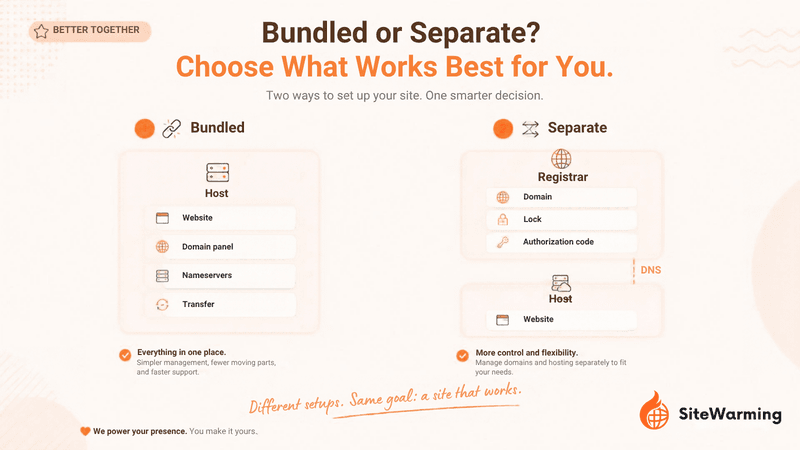
When a hosting company prompts you to "add a domain" during its checkout flow, you're usually registering through a reseller or a bundled service. That means the hosting company can control your domain management interface, your transfer process and sometimes your nameserver configuration. Separating your registrar from your host is a basic practice for anyone serious about long-term control. The difference between a registrar and a host matters more than most people realize until they're trying to move one without the other.
What should you check before you transfer to a new registrar?
If you're already using a registrar from the caution list and want to move, confirm three things before you start. The full process is in our transfer guide.
- Check whether the domain has a 60-day lock. ICANN's policy applies 60-day locks after a new registration, a completed transfer and a change of registrant. Renewing does not appear on that list. If you updated your registrant details recently, you may be waiting before you can start.
- Check that the registrant email is one you can open. Registrars use it for lock, change-of-registrant and renewal notices. If it's an old address, update it first, and expect that the change may itself start a 60-day lock unless your registrar offers an opt-out.
- Request the authorization code early. The registrar has five calendar days to provide it. Ask for it before your current term is close to ending, so a delay doesn't turn into an expiry.
Should you keep every domain at one registrar?
Not necessarily. One registrar means one login and one invoice, and it also means one point of failure. Several registrars spread the risk and multiply the places a renewal can hide. Neither choice is wrong. What matters is that you can see everything in one place.
That is the problem domain management at SiteWarming solves. It shows every domain across every registrar in one view. You can add domains one at a time, bulk-import a CSV, connect a registrar or use the MCP server, and it shows what is live, what leads nowhere and what is approaching renewal. It also fetches a HumbleWorth valuation automatically and lets you stack appraisals from 15+ sources. The Free plan tracks up to 1,000 domains; see pricing. If you own more than a handful of names, managing 10 vs. 50 domains covers how to sort them.
Wherever a domain lives, one you aren't using still needs a decision. Should you renew a domain you're not using? walks through it, and SiteWarming's Launch & Warm keeps a name findable while you decide.
Which registrar should you choose?
Most registrar decisions aren't made with long-term thinking. They're made at checkout, under time pressure, with promotional pricing doing the work. That's how the industry is designed.
But people asking "which registrar should I use for the long term?" are asking a different question. They're asking who they can trust with something that represents real plans, real intentions, real infrastructure. And trust is a system, not a feeling. It's built from transfer policies you've read, renewal pricing you've compared, and stability histories you've checked.
The short version:
- Cloudflare: minimum cost and maximum control, especially if you're already in its ecosystem.
- Porkbun: the lowest listed retail renewal of the registrars we could confirm, with free privacy.
- Dynadot: a candidate for multi-domain management.
- Hover: worth considering if simplicity matters more than price.
- Namecheap: a solid default.
- Any domain you are building toward: keep it away from bundled registrar-and-host checkout flows.
That's the comparison someone thinking about stewardship, not just ownership, would actually want.
Related reading
- How to transfer a domain without breaking everything
- Do you actually own your domain? What ICANN says
- What happens when a registrar shuts down
- Can your registrar hold your domain hostage?
- Domain registrar vs. domain host: the difference that costs you
- WHOIS privacy and domain protection: what's free, what's a scam
Frequently asked questions
What is the best domain registrar for long-term ownership?
There is no single winner, but the best choice is cheap to stay with, easy to leave and stable. Cloudflare, Porkbun, Dynadot and Namecheap fit that profile best in our review. Compare renewal price, free WHOIS privacy, transfer-out terms and ownership history, not the year-one promotion.
Is Cloudflare a good domain registrar?
For many owners, yes. Cloudflare says it does not mark up registry and ICANN prices, includes free WHOIS redaction, and supports registering new domains as well as transfers. It covers more than 390 extensions, not all of them, so confirm that yours is supported before you plan around it.
How much does a .com renewal cost at different registrars?
On October 2, 2026, Porkbun listed $11.08, Namecheap $18.48 and GoDaddy $22.99 a year, against a $10.26 wholesale price that rises to $10.97 on November 1, 2026. Cloudflare passes registry and ICANN prices through with no markup. Prices change, so confirm at checkout.
Should WHOIS privacy be free?
Yes, in our view. Cloudflare, Porkbun, Namecheap and Dynadot each state on their sites that privacy or redaction is included at no charge. A registrar that bills extra for it is adding margin to a basic protection. Check the privacy line on every renewal quote before you commit.
How long does a registrar have to give me my transfer code?
ICANN's Transfer Policy says a registrar must provide the authorization code within five calendar days of your request. The policy also lists the reasons a registrar may deny a transfer, such as fraud or the 60-day locks that follow a new registration, a completed transfer or a change of registrant.
Does renewing my domain lock it for 60 days?
No. ICANN's Transfer Policy ties the 60-day locks to a new registration, a completed transfer and a change of registrant. It does not say renewal triggers a lock. If a registrar tells you renewal blocks a transfer, ask which rule it is applying, because it is not in ICANN's policy.
Should I buy a domain through my hosting company?
It is safer to keep them separate. When a host registers the domain for you, its control panel can decide how transfers and nameserver changes work. A standalone registrar keeps the domain independent of the site, so you can change hosts without touching ownership. Check which company is listed as registrar.
What happens to my domain if my registrar shuts down?
It depends on how the exit is handled. When Google left the business, about 10 million Google Domains registrations were sold to Squarespace, and the migration finished by July 10, 2024. Expect emails and deadlines. Keep your contact email current and your DNS records exported so a forced move cannot break anything.
How can I see all my domains across registrars in one place?
SiteWarming's domain management shows every domain across every registrar in one view. You can add domains one at a time, bulk-import a CSV, connect a registrar or use the MCP server. It shows what is live and what is approaching renewal, and it fetches a HumbleWorth valuation. The Free plan tracks up to 1,000 domains.
Share this article
Ready to Transform Your Domain Portfolio?
Start building real value with your domain investments today.