Managing 10 vs. 50 Domains
 Bret Siers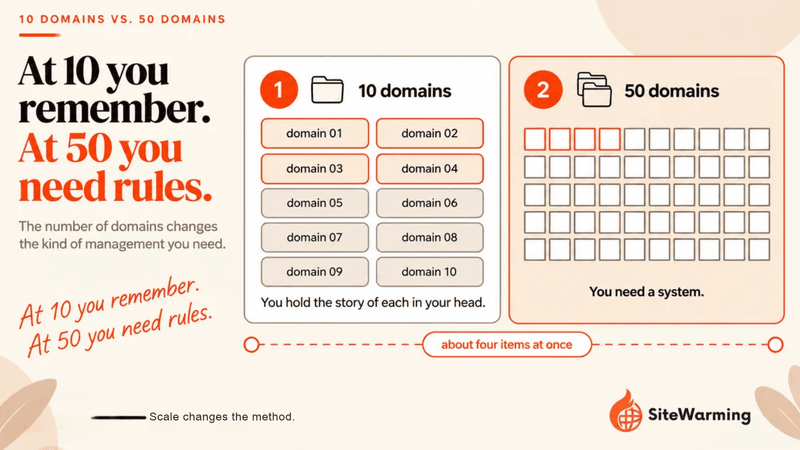
Managing 50 domains takes a different method from managing 10, because past a handful of names you cannot hold each one's purpose and renewal date in your head. Stop tracking and start triaging: sort every domain into activate, keep or release tiers by rule, then review on a schedule instead of waiting for each renewal email.
Somewhere between your 10th domain and your 50th, a renewal email showed up for a name you forgot you owned.
You looked at it. You could almost remember buying it. The flash of an idea at 2 a.m., the certainty that this could be something. Now it's a line item. One of many.
That moment, the gap between "I have a vision for this" and "I don't even remember what this was for," is where the spreadsheet stops working.
This isn't disorganization. It's math. Cognitive science revised the old "7 plus or minus 2" rule downward: Nelson Cowan's 2001 review put the central capacity limit at about four chunks, with a range of three to five. For complex, meaningful relationships, like the kind you have with a domain (its purpose, its renewal date, its audience, its potential), that is a useful rough guide to what you can hold at once. A 50-domain collection is more than ten times that threshold.
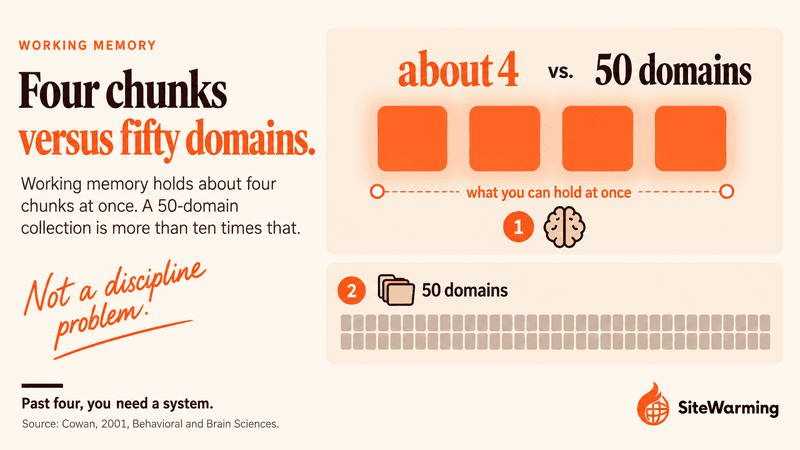
You didn't get worse at managing domains. You crossed a biological line.
We talked about moving from ownership to stewardship. Here's where that shift stops being philosophy and starts being operations.
Why does a spreadsheet stop working when you own 50 domains?
The first instinct at scale is always the same. Build a better spreadsheet. Add columns. Color-code the rows. Maybe set up a reminder system.
Spreadsheets are inventories. They show you what you have. They don't tell you what to do about it.
An outdated spreadsheet is worse than no spreadsheet. It creates false confidence. You look at 50 rows and feel organized. But the notes are three months old. The status column hasn't been touched since you added it. Two domains renewed while you weren't looking. Three others expired because the reminder went to an email address you stopped checking.
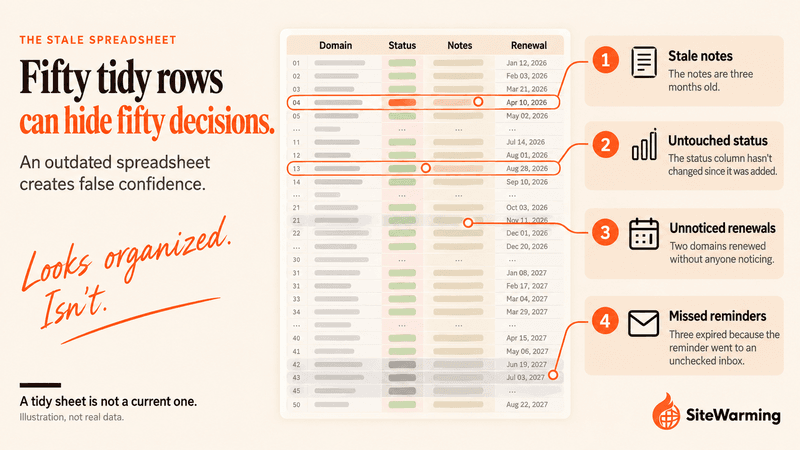
Here's the thing. The problem isn't organization. It's that you're making the same types of decisions, renew or release, develop or defer, activate or let sit, hundreds of times without any framework to reduce them. Every domain in that spreadsheet is a pending decision. And pending decisions stack. They don't wait quietly. They compound into a low-grade anxiety that makes you avoid the spreadsheet entirely, which is how you end up with renewal surprises in the first place.
A prettier spreadsheet doesn't change that. Organization is passive. Systems are active. One shows you the chaos. The other reduces it.
What actually changes between 10 domains and 50?
At 10 domains, each one has a story. You remember the purchase, the idea, the audience you imagined. You can hold all of it in your head.
At 50, you can't. And the reason isn't laziness. It's that you've gone well past your brain's capacity for complex relationships.
Then decision fatigue kicks in. A study of 26,501 credit loan applications by Tobias Baer and Simone Schnall found that approvals dropped at midday compared with early or later in the workday, and the authors modeled that the bank would have earned $509,023 more in revenue over one month without that effect. You don't feel dumber. You just default to the easiest choice available.
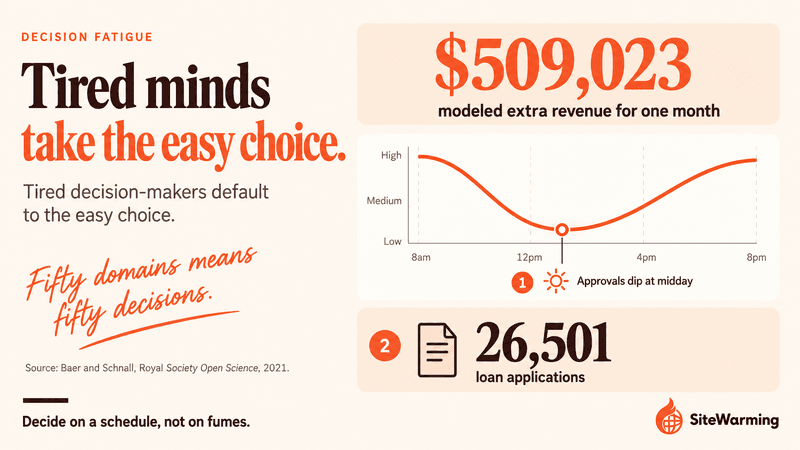
In domain management, the easiest choice is always one of two things: renew everything automatically, or ignore everything until the deadline. Neither is stewardship.
The shift isn't about the domains. It's about the decision architecture. At 10, attention is abundant. At 50, attention becomes the scarce resource. And what's scarce needs a system.
| At 10 domains | At 50 domains | |
|---|---|---|
| What you remember | The story behind each name | A few names and a feeling |
| How you decide | One at a time, on the merits | In bulk, usually at deadline |
| What works | Memory and a simple list | Rules, tiers and review dates |
| Typical failure | A missed renewal | Thirty names with no decision at all |
| What is scarce | Time | Attention |
This comparison is SiteWarming's framework, not a published benchmark.
So if the biology won't change, the architecture has to. And that starts with the hardest conversation most domain holders avoid.
What is domain triage, and how does it work?
Here's the question everyone avoids: you can't activate all 50 domains. You shouldn't try.
This is where managing domains stops being a task and starts being a framework. The real skill at scale isn't management. It's domain triage: deciding which domains get active stewardship, which get maintained at minimum presence, and which get intentionally released. Not abandonment by default, but allocation by design.
The shift from management to triage changes everything about how you interact with your domains:
- Categories become criteria. Rules, not folders.
- Monitoring becomes signal-based. Automated, not manual.
- Assessment becomes framework-driven. Criteria, not gut.
Think of it this way. At 10 domains, you can evaluate each renewal on its own merits. You know the story behind the name. You remember what it was supposed to become. At 50, that kind of individual evaluation is impossible. You need a system that sorts domains into tiers before you ever look at any of them individually. The sorting is the skill.
Dynadot's portfolio guide points the same way. It says a focused portfolio of 10 to 30 premium domains typically outperforms a scattered collection of hundreds of mediocre names, and it recommends an allocation of 40% premium established domains, 40% niche TLDs and 20% emerging opportunities. That guide is written for investors, so take the lesson and not the percentages: at scale, you stop thinking about individual domains and start thinking in tiers.
What does the cost of getting triage wrong look like?
The cost isn't abstract. On December 16, 2025, Infoblox reported that in its large-scale experiments, visitors to a parked domain were directed to illegal content, scams, scareware or malware more than 90% of the time, where a decade-old study had estimated under 5%. A forgotten domain on a parking page leaves what appears under your name to an ad network. We cover what parking pages do to a domain in why AI can't read a parked domain and parked domain vs. 404 vs. coming soon.
Neglect is also the default across the internet. APNIC's scan of 334 million domain names found at least 58.5 million, or 17.5%, parked, and it describes that as a lower bound. Legacy extensions such as .com, .net and .org showed higher rates, up to 30%. Without triage, your collection joins that pattern. The default state isn't neutral. It's entropy.
What does triage look like with 47 real domains?
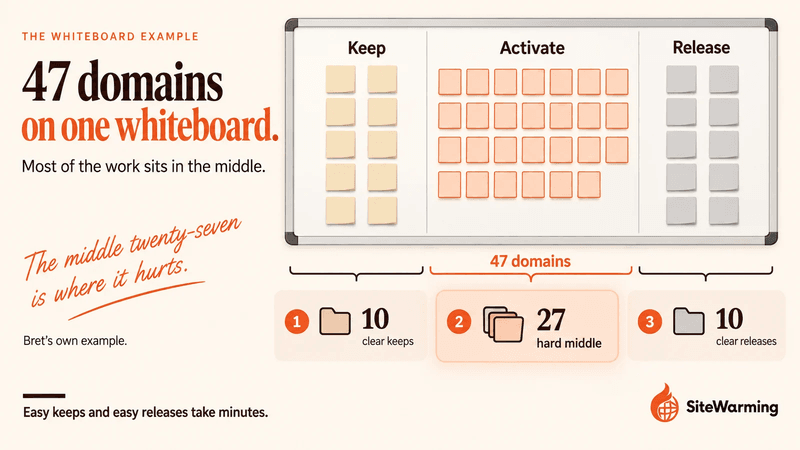
I sat down with my own domains last year and forced myself through this. Forty-seven names. I printed the list and drew three columns on a whiteboard: Keep, Activate, Release. The first ten were easy. Domains with active content, real audiences, clear purpose. The last ten were easy too. Impulse buys, name variants I'd never use, ideas that had moved on without me.
It was the middle twenty-seven that hurt. Each one carried a memory of the night I registered it, the project I imagined, the version of me that thought this would be the one. Letting go of a domain isn't letting go of $12. It's letting go of a possibility you once believed in. But holding all twenty-seven wasn't stewardship. It was hoarding dressed up as hope.
The whiteboard forced the hard conversation. Some of those names belonged in the Activate column because the idea was still alive and the timing was better now. Others belonged in Release because I could finally admit the window had closed. But the hardest ones were the five or six where the idea was good, the name was good, and I still couldn't justify the attention they'd need. Those went into Keep, which really meant "maintain at minimum presence and revisit in six months." That middle tier is where most domain holders get stuck. It feels like limbo, but it's actually the most honest category.
What rules sort a domain into a tier?
Our three tiers map to the whiteboard columns. Domains that already have active content simply stay where they are.
| Tier | Put a domain here when | What happens | Review |
|---|---|---|---|
| Activated | The idea is alive and the timing is better now, or the name already has content, an audience and a purpose | Keep building, or put a warm site on it | Check its signals each quarter |
| Keep (minimum presence) | The idea and the name are good, but you can't justify the attention it needs yet | Hold it at minimum presence, ideally with a warm site and a contact path | Revisit in six months |
| Release | The window has closed, or it was an impulse buy or a variant you will never use | Turn off auto-renew, check what depends on it, let it expire | One last look before the renewal date |
This table is SiteWarming's framework. For the middle names, the five-question test in should you renew a domain you're not using gives you a rule to apply to each one.
Deliberate neglect, choosing which domains not to activate, is part of stewardship. It sounds contradictory. But stewardship includes the decision to let go, not just the decision to hold. Not every domain needs to be an active site. But the ones you choose to activate need systems behind them.
This is why the collection trap is real. The cognitive load of holding everything makes it harder to invest in anything. And it's why the myth of "set and forget" is so dangerous at this scale. The domains you park and forget don't stay neutral. They decay. Triage isn't a one-time exercise. It's a recurring practice.
When does stewardship become infrastructure?
At 10 domains, stewardship is a mindset. You think about each one. You remember why it matters.
At 50, stewardship is infrastructure.
The question shifts. Not "Am I organized?" but "What decisions have I automated?" Every decision you make repeatedly is a candidate for a system:
- Renew or release becomes criteria-based rules.
- Develop or defer becomes priority tiers.
- Activate, maintain or park becomes signal-based allocation.
Here's what that looks like in practice. Instead of opening your registrar dashboard and making 50 individual decisions every quarter, you define the criteria once. Domains with active content and growing signals stay in the top tier. Domains in the middle tier get a six-month checkpoint. Domains in the release tier get one last look before the renewal date. The system makes the decision architecture visible so you're not reconstructing it from memory every time.
Without infrastructure, the pattern is predictable. You go three months without looking at your domains. Then a renewal notice triggers a panic review. You spend an entire afternoon scanning the list, trying to remember context, Googling your own domain names to see what's happening on them. You make a few decisions, get emotionally tired, and close the spreadsheet with half the list untouched. Next quarter, same cycle. The domains that needed attention three months ago still need it, plus they've accumulated more neglect. That's not a productivity problem. That's an architecture problem.
Systems don't save you time. They give you back the time you were already losing to the cognitive load of keeping everything in your head. And they protect against the worst failure mode at scale, which isn't making a bad decision about one domain. It's making no decisions about thirty of them because you're overwhelmed by the full list.
And here's what took me a while to accept: you're not uniquely bad at this. Verisign reports 401.6 million domain name registrations across all top-level domains at the end of Q2 2026, and, as the APNIC figure above shows, a large share of them sit parked. The entire ecosystem defaults to neglect. Your idle domains are a microcosm of it.
Systems are how you resist that gravity. Not by working harder. By designing around the biology that makes neglect the default.
This is the patience premium. Six years of consistent presence on a domain builds something that six months of effort never will. But you can't sustain six years of presence across 50 domains on willpower alone. Infrastructure makes consistency possible at scale. It's the difference between intentions and outcomes.
And that consistency, showing up, signaling, staying present on the domains that matter, is what builds the trust that static pages never will.
How do you run a domain triage in one afternoon?
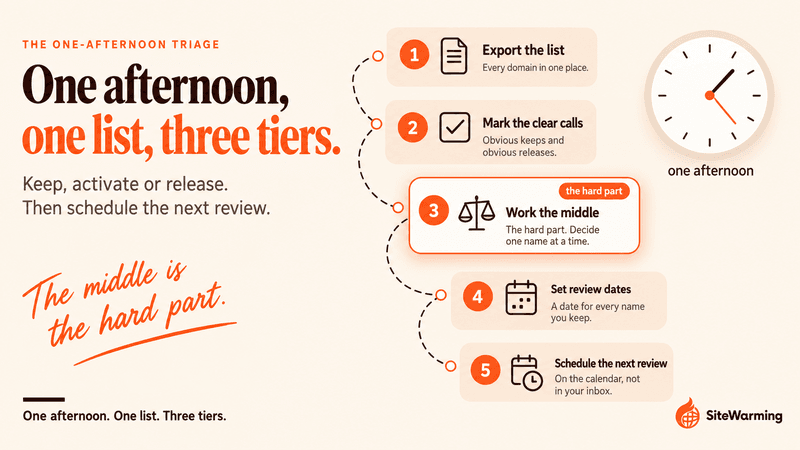
The whiteboard took one afternoon. You can run the same exercise on any list:
- Export every domain you own, with its registrar and renewal date, into one list.
- Mark the clear keeps, the names with active content and a clear purpose, and the clear releases, the impulse buys and variants you'll never use. In our 47-name example, about a fifth each.
- Sit with the middle. Run the five questions on each name and assign a tier.
- For every name in Keep, set a six-month review date. For every name in Release, check what depends on it, then turn off auto-renew.
- Put the dates in your calendar, so the next review is scheduled and not triggered by a renewal email.
How does SiteWarming help you manage a growing list of domains?
The SiteWarming perspective: warming is systematic, not heroic. An active domain isn't one you think about constantly. It's one where the system quietly moves the story forward while you focus elsewhere. The question isn't whether you have time for 50 domains. It's whether your domains have a system that doesn't need you to remember them. If you're new to the term, what is SiteWarming? explains it.
Two tools line up with the two halves of triage. Domain management shows every domain across every registrar in one view. You can add domains one at a time, bulk-import a CSV, connect a registrar or use the MCP server, and it shows what is live, what leads nowhere and what is approaching renewal. It also fetches a HumbleWorth valuation automatically and lets you stack appraisals from 15+ sources. The Free plan tracks up to 1,000 domains; see pricing. If you only want a quick sort, the free Domain Renewal Analysis takes up to 150 domains from a pasted list or a CSV.
Launch & Warm covers the names you decide to keep. You tell the domain's story, choose an intent template (Future Build, Open or Actively Selling), launch the warm site and add structured context such as FAQs, so a name at minimum presence is still findable and has a contact path. The Free plan includes one warmed domain.
Is managing 50 domains just managing 10 five times over?
Managing 10 domains is execution. You hold it in your head. You remember the ideas. You track the renewals.
Managing 50 is different. Not harder in a "work more hours" way. Different in a "you need a new way of thinking" way.
The founders who scale their domain sets without losing their minds aren't the ones with more discipline. They're the ones who stopped relying on discipline at all. They built systems that reduce decisions instead of adding them. They accept that triage isn't giving up on ideas. It's being honest about which ones they can actually steward.
You can't organize your way past biology. But you can design around it.
The spreadsheet stopped working a while ago. That's not a personal failing. It's the threshold. Recognizing it is where the real stewardship starts.
Related reading
- From ownership to stewardship
- The collection trap
- The myth of "set and forget" digital assets
- How many domains does the average person own?
- Should you renew a domain you're not using?
- Why 6 years of content beats 6 months of marketing
- Continuity builds trust
Frequently asked questions
How many domains can one person manage?
There is no fixed number, but memory research puts working capacity near four items, and each domain carries a purpose, a renewal date, an audience and a potential. In our experience, past roughly ten domains a system works better than memory. Below that, you can still hold the story of each name in your head.
Why does a spreadsheet stop working for domains?
A spreadsheet is an inventory: it shows what you own, not what to do about it. Notes go stale, status columns go untouched, and reminders land in inboxes you stop checking. The deeper failure is that you make the same renew-or-release decision again and again without a rule to reduce them.
What is domain triage?
Domain triage is sorting every domain you own into tiers by rule: activate, keep at minimum presence, or release. It replaces deciding each renewal from memory with criteria applied to the whole list at once. SiteWarming uses three tiers, with a six-month review for the middle one.
How do I decide which domains to keep and which to release?
Ask five questions of each name: does the idea still matter, will you act on it within a year, could someone else want it, does anything depend on it, and would you register it again today. Clear yeses and clear nos sort quickly. The names in the middle need a tier and a review date.
How many domains should I keep?
There is no universal number. Dynadot's guide says a focused set of 10 to 30 premium domains typically outperforms hundreds of mediocre names, but that advice is aimed at investors. For founders, the more useful rule is to keep only the names you can give a tier and a review date.
Is it bad to let some domains expire?
No. Deliberate neglect, choosing which domains not to activate, is part of stewardship, and releasing a name you have moved past is a clean decision. What hurts is releasing a name without checking what depends on it, or never deciding at all and letting renewals decide for you.
What happens to a forgotten domain on a parking page?
Infoblox reported in December 2025 that, in its large-scale tests, visitors to a parked domain were directed to illegal content, scams, scareware or malware more than 90% of the time. A forgotten domain on a parking page leaves that outcome to an ad network instead of to you.
How often should I review my domains?
Review on a schedule, not when a renewal email arrives. We suggest a six-month checkpoint for the middle tier and a last look before each renewal date for the release tier. Put both dates in a calendar when you assign the tier, so the decision never depends on memory.
How can I track every domain in one place?
SiteWarming's domain management shows every domain across every registrar in one view. You can add domains one at a time, bulk-import a CSV, connect a registrar or use the MCP server. It shows what is live and what is approaching renewal, and it fetches a HumbleWorth valuation. The Free plan tracks up to 1,000 domains.
Share this article
Ready to Transform Your Domain Portfolio?
Start building real value with your domain investments today.