The Myth of "Set and Forget": What Happens to a Website Nobody Maintains
 Bret Siers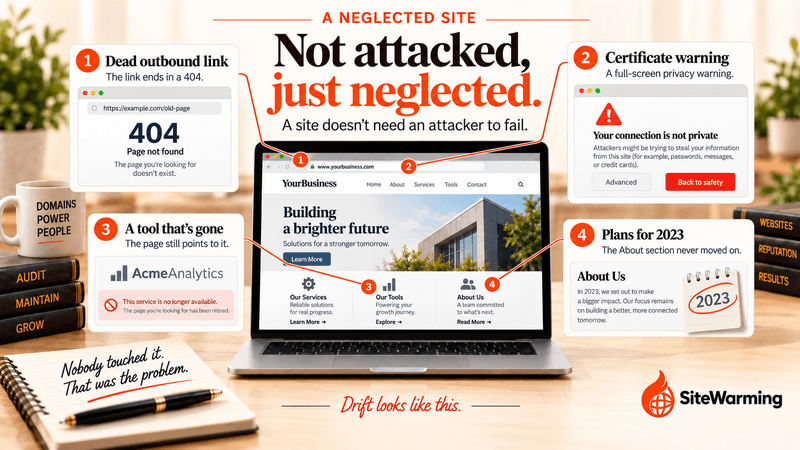
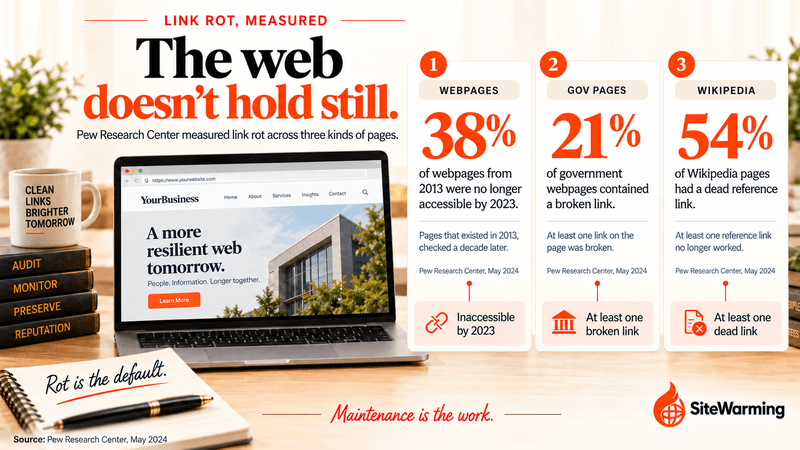
A website you stop maintaining doesn't stay frozen. It decays. Links break, certificates expire, content goes out of date, and the pages that once linked to you disappear. Pew found that 38% of webpages that existed in 2013 were no longer accessible by 2023. Maintenance is small and periodic. Neglect compounds.
I checked on a domain I hadn't touched in two years last month. I remembered the night I bought it. Sitting in my home office, the idea so clear I could already see the landing page. I registered it, set up DNS, built a quick site, wrote a few pages, and told myself I'd come back to it when things slowed down.
Things never slowed down.
When I finally pulled it up, the SSL certificate had expired. The browser threw up a full-screen warning, "Your connection is not private," like the site was dangerous. One of the pages referenced a tool that no longer exists. Two of the outbound links pointed to 404s. The "About" section mentioned plans for 2023.
Nothing had been vandalized. Nobody attacked it. The domain just sat there while everything around it moved. And now it looked abandoned. Not because I made a decision to walk away, but because I made no decisions at all.
Here's the thing about digital assets: they don't hold still. We treat them like we treat a safe deposit box. Lock something valuable inside, come back later, find it exactly where we left it. But that's not how any of this works.
Nobody says "set it and forget it" about a house. Not about a car, not about a garden. We understand that physical things require maintenance. But somehow, we convinced ourselves that domains are different. That domain depreciation isn't real. That a website, once built, holds its value like a rock on a shelf.
It doesn't. It decays like everything else. Quietly, steadily, and with interest that compounds.
Why does "set and forget" fail for websites and domains?
The misconception isn't stupidity. It's understandable.
Physical assets depreciate in ways you can see. Paint peels. Engines seize. Roofs leak. Digital assets depreciate invisibly. Links break at 3 AM. Certificates expire without a sound. Content drifts from relevance while nobody's watching. The founder believes nothing changed because nothing visible changed. But discovery systems don't care about what's visible to you. They care about what's visible to them.
Digital asset maintenance sounds like something only large companies need to worry about. It sounds like overhead. The truth is simpler and harder: every domain you own is either being maintained or it's losing ground. There is no neutral.
And domain registrars won't tell you that. "Renew your domain" implies you're protecting value. You're not. Renewal without maintenance is paying property tax on an abandoned building. The registrar profits whether or not the domain does anything useful. For the specific fees and lapses that come with passive management, see the real cost of "set it and forget it" domain management.
How common is technical neglect?
Common enough that it takes down organizations with full IT teams. In a September 2026 survey of 1,001 IT and security decision-makers in the US, UK and Australia, DigiCert reported that 33% had a service outage from an expired certificate in the past year, and 73% of those reported at least five hours of downtime. DigiCert sells certificates, so read it as a vendor survey. It makes the point anyway.
The named cases are worse. Microsoft Teams went down on February 3, 2020, because of an expired authentication certificate. In its 2018 report on the Equifax breach, the US House Oversight Committee wrote: "Failure to renew an expired digital certificate for 19 months left Equifax without visibility on the exfiltration of data during the time of the cyberattack."
If resourced organizations can't keep their certificates current, what chance does a solo founder with ten domains have?
What happens when a website's SSL certificate expires?
Browsers put a full-screen warning in front of the page. I saw it on my own site: "Your connection is not private," as though the site were dangerous. The percentages you'll find quoted for how many visitors leave at that point trace back to an unsourced vendor blog post, so I'm not repeating them. The warning is enough. A visitor who sees it has to decide whether you can be trusted, and you aren't there to explain.
Why are certificates getting riskier to forget?
Because they're living shorter lives. In April 2025 the CA/Browser Forum passed ballot SC-081, which cuts the maximum validity of public TLS certificates in steps. The dates below come from the Baseline Requirements.
| Certificates issued | Maximum validity |
|---|---|
| Until March 14, 2026 | 398 days |
| From March 15, 2026 (in force now) | 200 days |
| From March 15, 2027 | 100 days |
| From March 15, 2029 | 47 days |
Free certificates already run on short cycles. Let's Encrypt certificates are valid for 90 days, and it recommends renewing every 60. Since June 4, 2025, Let's Encrypt no longer sends expiration reminder emails. A certificate that renews itself is fine right up until the renewal fails and nobody is told.

What does neglect actually cost a website?
Here's where it gets concrete.
Content decay isn't a dramatic event. It's not a server crash or a hack. It's a slow accumulation of small failures that add up to a system-level problem. Links break one at a time. A source you cited shuts down. A statistic you quoted gets updated, and now your page has the old number. A tool you recommended gets acquired and the URL redirects to a marketing page. Each of these is trivial by itself. Together, they're systemic.
How much of the web disappears or breaks?
A lot. Pew Research Center's May 2024 study, When Online Content Disappears, sampled just under 1 million webpages from Common Crawl archives and re-checked them. Pew's wording is exact, so here it is by content type.
| Content type | Pew's finding | Sample |
|---|---|---|
| All webpages that existed in 2013 | 38% were not available at the time of Pew's 2023 re-check | Pages that existed in 2013 |
| All webpages that existed at some point from 2013 to 2023 | A quarter were no longer accessible | Pages from the full decade |
| Government webpages | 21% contained at least one broken link | About 500,000 pages and 42 million links |
| News webpages | 23% contained at least one broken link | 500,000 pages from 2,063 news sites |
| Wikipedia pages | 54% had at least one reference link pointing to a page that no longer exists | 50,000 English-language pages |
| Tweets | 18% were no longer publicly visible, within a few months | About 5 million tweets |
Read the unit carefully. "21%" means pages containing at least one broken link, not 21% of links, and not 21% of sites. It's still the point: government sites have dedicated teams and public mandates. If those institutions can't keep their links working, the rest of us need to be honest about what happens when we look away.
Do broken links hurt your rankings?
Probably not directly, and it's worth being precise. Google's Search Console Help says 404 responses "are not necessarily a problem" if the page was removed without a replacement, and that a moved page should get a 301 redirect. In 2021, Google's John Mueller told a Search Console user that Google wouldn't see a large share of 404 URLs as a quality signal. That was about 404 pages on your own site, not broken outbound links. We found no Google source saying that broken outbound links lower rankings.
The damage is to the reader. A page that cites a tool that no longer exists, links to a dead source, and talks about "plans for 2023" tells everyone who lands on it that nobody is paying attention. That's a trust problem before it's a ranking one.
What else decays?
Content drifts. A page written in 2022 that references "current trends" or "this year's data" isn't wrong in the way that a factual error is wrong. It's wrong in the way that a faded storefront sign is wrong. It tells everyone who sees it that nobody is paying attention anymore.
The patience premium, the advantage that compounds when content has years to accumulate trust, requires that the content still exists to compound. Six years of content beats six months of marketing only if the six years are still standing. Content decay kills compounding. You can't earn compound value from something that's quietly falling apart.
And the damage doesn't stay local. Whether it travels upward into the systems that decide who gets seen depends on how those systems work, and that's worth looking at closely.
Do search engines and AI systems penalize a site you stop updating?
Sometimes I hear people frame stagnation as "my site just stays where it is." As if not updating means your position is frozen. That's the comfortable version. The accurate version is more specific, and it's worth separating what's documented from what's repeated.
A domain that stops publishing doesn't go invisible. It stops giving discovery systems new reasons to send people your way, while everything around it keeps moving. How much that costs depends on the query.
| Common claim | What the record shows |
|---|---|
| Google rewards freshness on every search | No. Google's ranking systems guide describes "query deserves freshness" systems designed to show fresher content for queries where it would be expected. Movie reviews and earthquakes are its examples |
| Google penalizes pages nobody has touched | We found no Google document describing a penalty for unchanged pages |
| Freshness is a fixed share of the ranking algorithm | One agency's estimate. First Page Sage puts freshness at 6% in its Q3 2026 report. Google publishes no factor weights, and First Page Sage doesn't explain how it derives its own |
| Updating the date on a page counts as an update | Google's helpful content guidance lists "changing the date of pages to make them seem fresh when the content has not substantially changed" as a question to ask yourself, which is a warning sign, not a tactic |
First Page Sage also says that pages its team updated at least once in the past year continued to outrank comparable pages that had gone untouched. That's an agency's own client data, so treat it as a signal worth testing, not a rule.
The practical read: freshness matters most where the topic changes, and honest maintenance matters everywhere. Google's guidance doesn't reward frequency for its own sake. It asks whether the content actually changed. For how freshness plays out in Google and in AI answers, and how often to update, see Static Pages Don't Build Trust. Continuity Does.
What if your content is evergreen?
"But my content is evergreen," you might say. "It shouldn't need updates."
Here's the honest answer. The content might be evergreen. The links it contains are not. The data it references is not. The competitive environment around it is not. And the people and systems evaluating it can only see observable signals. A page that hasn't been touched in three years looks the same whether the content is timeless or time-sensitive: nobody is home.
Static pages don't build trust. Continuity does. And continuity is the opposite of set-and-forget. Continuity is the quiet signal that someone is paying attention.
How fast does neglect compound?
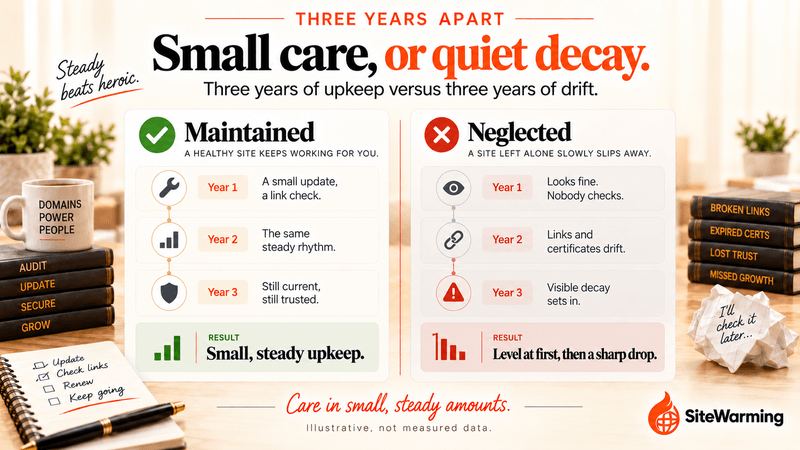
This is the part that catches people off guard. Just as stewardship compounds positively, neglect compounds negatively.
| Year of neglect | What happens | What you notice |
|---|---|---|
| Year 1 | A few broken links. A certificate that renewed only because you set it to | Almost nothing. The domain looks the same |
| Year 2 | Content starts drifting. Competitors in your space update their pages | Nothing, unless you compare. Your page didn't get worse. The world moved and your page didn't |
| Year 3 | Structural damage: the links that once pointed at you start to die | A shrinking network and a site that reads as abandoned |
How many links to your site die over time?
More than most owners assume. Ahrefs' link rot study reported that "since January 2013, 66.5% of the links pointing to the 2,062,173 websites we sampled have rotted." The unit matters: these are backlinks pointing at the sampled sites, as recorded in Ahrefs' index. It isn't a measure of every link on the web. But it's the right warning for a domain owner. If you earned links when you launched, some of them are probably gone now, and if you haven't been earning new ones, the network your domain relies on for visibility is shrinking while you assume it's stable.
Archives help only so much. The Internet Archive says that using the Wayback Machine cuts the share of inaccessible URLs from one in every four to one in every ten. One in ten is still gone.
Is maintenance cheaper than recovery?
As we see it, yes, and by a wide margin. Maintenance costs are small and linear: a few hours a quarter. Recovery costs are larger and less predictable: weeks of finding what broke, rebuilding links, and re-earning the trust of people and systems that have already learned to look elsewhere. You're not starting fresh. You're correcting a record.
Ownership without stewardship equals decay. That's not a slogan. It's a structural fact.
Scale makes this visible faster. At 50 domains, you can't afford set-and-forget. Managing 10 domains versus 50 is a different job, and the math is the same at one domain. It just takes longer to hurt.
The SiteWarming perspective: This is a maintenance problem disguised as an ownership problem. The web's discovery systems learn from what they repeatedly see, and empty space becomes a durable signal. Warming provides the consistent care your domains need, moving the story forward on your behalf while you focus elsewhere. Not elaborate maintenance on your part. Just consistent presence that keeps a domain legible over time. What is SiteWarming?
What does website maintenance actually look like?
The word "maintenance" triggers the same resistance as "exercise." It sounds like ongoing work, and founders already have too much to do.
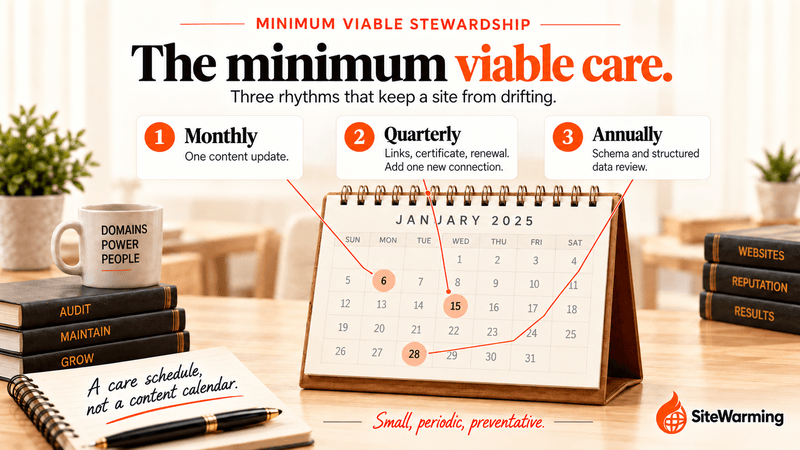
But here's what I've learned: the reality of minimum viable stewardship is far smaller than what people imagine. It's not rebuilding. It's not daily attention. It's the digital equivalent of changing the oil. Small, periodic, preventative.
| Task | How often | How to do it | Tools |
|---|---|---|---|
| Update one page with current reality, even 300 words | Monthly | Revise a date-sensitive claim, a statistic or a recommendation, and say what changed | None needed |
| Check outbound and internal links | Quarterly | Fix or remove dead links; redirect moved pages | Search Console's page indexing report lists 404s Google found |
| Confirm certificate renewal works and is monitored | Quarterly, and after any hosting change | Test the live certificate; make sure someone is notified if renewal fails | Qualys SSL Labs server test, Certbot for free Let's Encrypt certificates with automatic renewal, UptimeRobot (its free plan lists an SSL and domain expiry monitor; confirm the scope before relying on it) |
| Verify schema and structured data | Annually | Check that it still describes the page accurately | Your validator of choice |
| Add one new connection to a relevant page | Quarterly | A link, a mention or a reference that points to your domain | None needed |
That's it. This isn't a content calendar. It's a care schedule. And the distinction matters: a content calendar is about output. A care schedule is about keeping what you already built from falling apart.
There's one more nuance. Even genuinely evergreen content sits inside a technical container that does need attention: links, certificates, schema, structured data. Even if the words don't change, the infrastructure around them has to be verified. And changing a date on a page without changing the substance doesn't count as maintenance. Real digital asset maintenance means substantive attention. Not frequent. Just honest.
Revenue compounds on trust, and trust requires that your domain stays legible. When someone lands on it, the infrastructure works, the content is current, and the signals are clear. None of that happens automatically after the initial build.
What if you own more domains than you can maintain?
Then decide, domain by domain, instead of letting the calendar decide for you. Every domain falls into one of three groups.

| Where the domain stands | The decision | Why |
|---|---|---|
| Live, with content or an audience | Maintain it on the care schedule above | It already has something to lose |
| Parked, with an idea worth keeping | Warm it. Launch & Warm gives it content and a contact path, so it can be found and its option exercised: sell it, partner on it or build on it | Silence is the failure mode, and a parked name has nothing for anyone to read |
| No idea, no audience | Release it on purpose. Run the pre-lapse checklist in Can an expired domain hurt your other domains or brand? first, and use the renew-or-release framework to decide | A deliberate release is cheaper than a lapse you didn't see coming |
The hard part for a founder with a scattered portfolio is seeing which group each domain is in. The Domain Management Tool puts every domain across every registrar in one view, so you can see what's live, what leads nowhere and what's approaching renewal.
I keep coming back to the domain I checked on last month. The one with the expired certificate and the broken links and the plans for 2023.
It wasn't a bad domain. It wasn't a bad idea. I just stopped paying attention. And in the time I looked away, everything around it kept moving. Links died, competitors updated, and my domain quietly slipped from "active" to "abandoned" in the eyes of everyone who came across it.
Nobody told me it was happening. That's the thing about domain depreciation. It doesn't send a notification. There's no red banner that says "your domain is losing value." It just happens, the same way a garden grows over when you stop tending it. Not all at once. Slowly enough that you don't notice until you come back and realize the path is gone.
The domain you registered during a real moment of inspiration still matters to you. The question is whether it still looks like it matters.
Content that stops being maintained stops being memory. The story behind the idea, the vision that made you buy the name in the first place, quietly disappears. Not dramatically. Not all at once. Just gradually, as the links break, and the certificates lapse, and the freshness signals fade, and the people and systems that route attention toward ideas learn to route it somewhere else.
The cost of care is small. The cost of neglect is everything you built, quietly becoming nothing, while you assumed it was fine. And the question that follows, what happens to domain identity over the next decade, depends entirely on whether someone is still paying attention.
FAQ
What happens to a website you stop maintaining?
It decays in four ways: links break, certificates expire, content goes out of date, and the pages that linked to you disappear. Pew found that 38% of webpages that existed in 2013 were no longer accessible by 2023. Nothing dramatic happens on any one day, which is why most owners notice only when they come back.
Does a website lose value if you stop updating it?
It can. Google's freshness systems matter mainly for queries where fresher content is expected, and Google publishes no ranking weights for freshness. What erodes more reliably is trust and links: dead outbound links, outdated claims and an expired certificate tell visitors nobody is paying attention, and Ahrefs found that 66.5% of sampled backlinks since 2013 have rotted.
What happens when a website's SSL certificate expires?
Browsers show a full-screen warning such as "Your connection is not private" before the page loads. Certificates now last at most 200 days, falling to 100 days from March 15, 2027 and 47 days from March 15, 2029, so unmonitored renewals fail more often. Set up monitoring so you're told if a renewal fails.
Do broken links hurt SEO?
Not directly, as far as Google documents. Search Console Help says 404 responses are not necessarily a problem, and we found no Google source saying broken outbound links lower rankings. The cost is trust: readers who hit dead links or outdated claims leave with a worse impression of your site.
How often should you maintain a website?
A minimum viable schedule is one content update a month, a link and certificate check each quarter, one new connection to a relevant page each quarter, and a schema review once a year. It's a care schedule, not a content calendar, and it keeps what you already built from falling apart.
Does evergreen content need updates?
Evergreen content still needs its container maintained: links, certificates, schema and structured data. The words may stay the same, but the infrastructure around them has to be verified. Changing the date without changing the substance doesn't count, and Google's helpful content guidance flags it as a warning sign.
Is it better to release an unused domain than to neglect it?
If a domain has no idea and no audience, releasing it deliberately is cheaper than a lapse you didn't see coming. Remove the DNS records and logins tied to it first. If the idea is worth keeping, maintain it or warm it so it stays findable instead of drifting into silence.
Does changing a page's date help it rank?
No evidence says it does. Google's helpful content guidance asks whether you're changing the date of pages to make them seem fresh when the content has not substantially changed, which it treats as a warning sign. Update the substance first, then update the date.
Related reading
- Static pages don't build trust. Continuity does.: how freshness works in Google and AI answers, and how often to update
- The real cost of "set it and forget it" domain management: the fees and gaps that come with passive domain management
- Why 6 years of content beats 6 months of marketing: why content that stays standing compounds
- Managing 10 domains versus 50: what changes as a portfolio grows
- Can an expired domain hurt your other domains or brand?: what to do before you let a domain lapse
- Should you renew an unused domain?: the decision framework for domains you're not developing
Share this article
Ready to Transform Your Domain Portfolio?
Start building real value with your domain investments today.