The Real Cost of "Set It and Forget It" Domain Management
 Bret Siers
It started with a renewal invoice that was $40 more than last year.
That's what got Sarah's attention. Not a warning email. Not a notification from her registrar. Just a charge on her credit card that was bigger than the one before it, and a vague memory of the price being lower when she first registered the domain.
She logged in to check. And then, because she was already logged in, she checked the SSL certificate on the domain she'd been meaning to build something on. Expired. Six weeks ago. Then she searched for the DMARC record she thought she'd configured when she set up the custom email address. It wasn't there. She'd never actually set it up.
Three problems in one afternoon. None of them urgent in isolation. All of them accumulating quietly while auto-renew ticked along and she assumed that meant everything was handled.
This is what "set it and forget it" domain management actually looks like. Not negligence. Not carelessness. Just the reasonable assumption that because the domain is renewing, everything is fine.
It isn't.
What auto-renew actually covers (and what it doesn't)
Auto-renew covers one thing: the domain name registration itself. The registrar charges your card annually, the domain stays in your name, and the registration doesn't lapse.
That's it. One thing. Everything else is on you.
Auto-renew does not cover:
- SSL certificates (renew separately, often annually, from your hosting provider or a certificate authority)
- DMARC, DKIM, and SPF records (configured once, but need to be verified they're still in place)
- WHOIS contact information (required to be accurate under ICANN rules, but nobody alerts you when it goes stale)
- Domain reputation monitoring (no automatic alerts if your domain appears on spam lists)
- DNS record accuracy (records configured years ago may point to servers you no longer use)
Most domain owners, especially those who haven't built anything on the domain yet, set up auto-renew and move on. The domain is paid for. Done.
But "paid for" and "taken care of" are not the same thing. What they've actually done is guarantee that the domain name is theirs for another year. They've done nothing to guarantee that the domain is healthy, trusted, or functional. And the gap between those two things is where the real costs hide.
The six hidden costs of passive domain management
1. Renewal price escalation
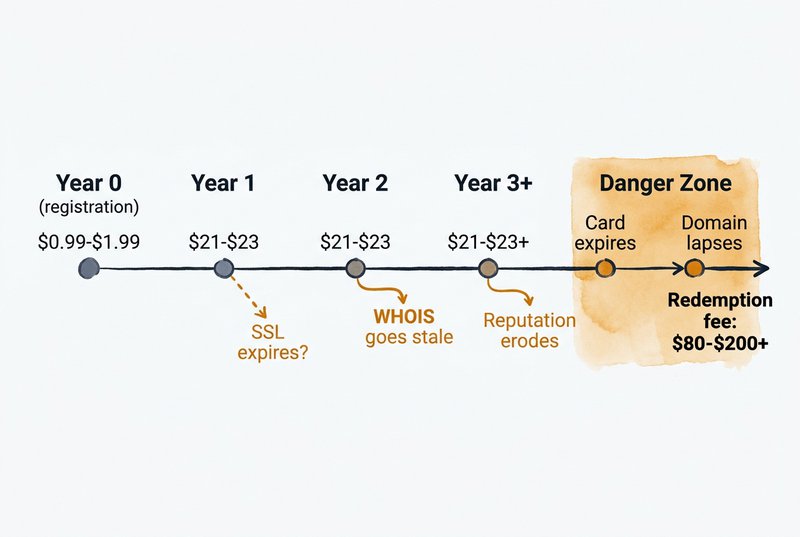
Introductory pricing is one of the oldest tricks in domain registration. GoDaddy's documented pricing shows first-year registrations frequently priced at $0.99 to $1.99 for popular extensions. Renewal pricing for the same domain runs $21 to $23 per year. That's a documented 10x to 20x increase from the registration price to the ongoing cost.
This isn't a warning about future increases. This is the structure that already exists. If you registered a domain on an introductory promotion and set auto-renew, you may already be paying the full renewal rate without having noticed the jump.
The qualitative reality is consistent across registrars: renewal prices exceed registration prices, often significantly, and they're subject to change with limited notice. The collection trap becomes financially significant when you're holding 20 domains and the renewal prices are all higher than what you initially budgeted.
2. SSL certificate expiration
An expired SSL certificate means visitors get a browser warning before they can see your site. The warning says something like "Your connection is not private." Most visitors leave immediately. They don't investigate. They don't give you the benefit of the doubt. They leave.
For a domain that's actively built, this is a critical issue you'd catch fast. For a parked or dormant domain, it's invisible. Nobody's visiting and nobody's reporting the warning to you. The certificate expires quietly, and the domain's security posture degrades without anyone noticing.
Here's the part that bites later: if you ever decide to turn on a landing page, start a newsletter, or forward the domain to a real destination, an expired SSL means that destination looks broken from day one. You're starting with a trust deficit. That's the opposite of what you want.
3. DMARC misconfiguration (and what it costs you)
DMARC, DKIM, and SPF are email authentication protocols. They tell receiving mail servers that emails from your domain are legitimate. Without them configured correctly, email from your custom domain addresses goes to spam or gets rejected outright.
Here's what makes this one particularly frustrating. If you have a custom email at your domain (yourname@yourdomain.com) and DMARC isn't properly configured, you may be sending emails that look like spam to the recipient's provider. They never arrive. You never know. You just wonder why nobody responds.
It gets worse. Misconfigured email authentication also opens your domain to being spoofed. Someone can send emails that appear to come from your domain, because there's no authentication record telling mail servers that yours are the only legitimate ones.
This isn't theoretical. It's a documented failure mode for domains with partial or missing email configuration, which describes a significant portion of dormant and semi-active domains. And if a spoofed domain gets flagged, the reputation damage spreads. An expired domain can hurt your other domains and your brand through exactly this kind of cascading trust failure. Your other domains pay for the neglect of the one you forgot about.
4. Stale WHOIS records
ICANN requires accurate WHOIS contact information. For most domain owners, this is never checked after initial registration. You moved? Your WHOIS still says the old address. Changed your email? WHOIS still has the one from 2019. None of those updates happen automatically.
Stale WHOIS has practical consequences. Domain transfer requests may fail. Registrar communications may go to an email address that no longer exists. ICANN compliance flags can be triggered, which in serious cases can result in a domain being put on hold.
The more consequential issue is reputational. AI systems and verification services read WHOIS records as part of assessing domain trustworthiness. A domain with an old email address and an address from three residences ago sends a weak trust signal, even if the domain itself is otherwise clean.
Nobody thinks about this until it causes a problem. And by the time it causes a problem, you've been sending a weak signal for years without knowing it.
5. The lapsed domain: redemption fees
This is the most expensive failure mode. And the one that generates the most genuine surprise, because people assume auto-renew prevents it.
If a domain lapses past the grace period after expiration, it enters a redemption period. During redemption, the domain is still technically available to its original owner. But recovering it costs significantly more than a standard renewal. Redemption fees typically run $80 to $200 depending on the registrar, on top of the renewal fee.
The math hurts: a $12/year domain that you let lapse and then try to recover costs you $92 to $212 to get back. If multiple domains lapse in the same quarter, the costs compound quickly.
Auto-renew does prevent this. If the payment method is current. But payment methods expire. Cards get cancelled and replaced. If your auto-renew is attached to a card you replaced six months ago and haven't updated in your registrar account, you're one failed charge away from a lapsed domain. The registrar sends a notice to the email on file. Which, if cost number four applies to you, might be an email you don't check anymore.

6. Reputation degradation from inactivity
This is the most diffuse cost. The hardest to see. And over time, the most expensive.
Domain reputation is built through consistent, legible activity. Fresh content. Valid SSL. Accurate contact information. Email authentication records. Return visitors. These signals accumulate and tell the systems reading the web that this domain is real, maintained, and trustworthy.
A dormant domain, especially one with a parking page, sends no positive signals and several negative ones. No fresh content. No return visitors. No engagement. Domain age accumulates, which is good. Everything else stays flat or erodes.
This is why most domains fail. Not from a single catastrophe but from the slow accumulation of neglect. It's like leaving a house empty. The roof doesn't collapse on day one. But after three years of no maintenance, you don't have the same house anymore. And the larger your collection, the faster it compounds. At scale, managing 10 vs 50 domains becomes a fundamentally different operational challenge.
The myth of set and forget digital assets is that holding is neutral. It isn't. The domain either builds reputation or loses ground. Auto-renew only covers the single thing that would make you lose the domain entirely. It doesn't cover the slow, quiet erosion of everything else.
Six costs. None of them catastrophic by themselves. All of them preventable. The question is what prevention actually looks like, because it's simpler than you think.
What active domain management actually looks like
Here's the good news: active management is not complicated. It's not a second job. It's about knowing what needs attention and putting a rhythm around checking it.
Here's what it actually involves:
Annual (when renewing):
- Verify the renewal price hasn't jumped significantly
- Update WHOIS contact information if anything has changed
- Check that DNS records are pointing to the right places
- Confirm SSL certificate status and renewal date
Every 6 months:
- Check email authentication records (DMARC, DKIM, SPF) if you have a custom email address
- Review any forwarding or redirect settings
- Verify payment method on file is current
When you notice something:
- Browser security warnings
- Email delivery failures or unusual bounce rates
- Unexpected ICANN communications
That's it. For most domain owners with fewer than 10 domains, this is a 30-minute annual review and a calendar reminder every six months to check the email authentication. The time investment is minimal. The cost of not doing it compounds.
A monthly domain health checklist
If you want a simple framework for the domains you're actively holding, here's a one-page check:
- Domain registered and auto-renew active with a current payment method?
- SSL certificate valid and expiration date noted?
- WHOIS contact information current?
- DNS records pointing to intended destinations?
- Email authentication records (DMARC/DKIM/SPF) in place if using custom email?
- Any unusual communications from registrar or ICANN?
- Renewal price verified against last year?
For dormant domains, the checklist is shorter but still matters. A domain you're warehousing is still an asset with a cost and a reputation. The checklist keeps it healthy until you need it.
The should you renew an unused domain question is related. Sometimes the answer is no. But that's a decision made with clear eyes, not the default outcome of forgetting to update a payment method.
SiteWarming builds monitoring and signal cadence into the warming process. A warm domain isn't just one that has content and structure. It's one that's actively maintained. Valid SSL. Current records. Clean reputation signals. If you're holding multiple domains, the domain roadmap is the right framework for deciding which ones get development attention, which ones stay warm, and which ones get released.
Sarah eventually got her SSL renewed, her DMARC configured, and her renewal prices audited. It took about three hours total. Three hours to undo years of quiet neglect. But she got there because a $40 discrepancy on a credit card statement caught her eye.
Most domain owners don't get that alert. They get a domain in redemption. Or an email address that silently stops working. Or a domain with six years of passive erosion they didn't notice until they tried to do something with it and realized the foundation had rotted.
The cost of "set it and forget it" is rarely catastrophic in any single instance. It's the accumulation of small invisible debts, compounding quietly, until the bill comes due in a way that's harder to ignore.
Three hours of annual review prevents most of it. Three hours. That's the difference between owning domains and just paying for them.
SiteWarming is a vision preservation system for domain owners. If you're ready to make your domains active assets instead of passive liabilities, start with what sitewarming means.
Image Credits
- Hero: Photo by Andrei Slobtsov on Unsplash
- Section (Lapsed Domain): Photo by Kelly Sikkema on Unsplash
Share this article
Ready to Transform Your Domain Portfolio?
Start building real value with your domain investments today.