Too Many Domains? How to Stop Collecting and Start Building
 Bret Siers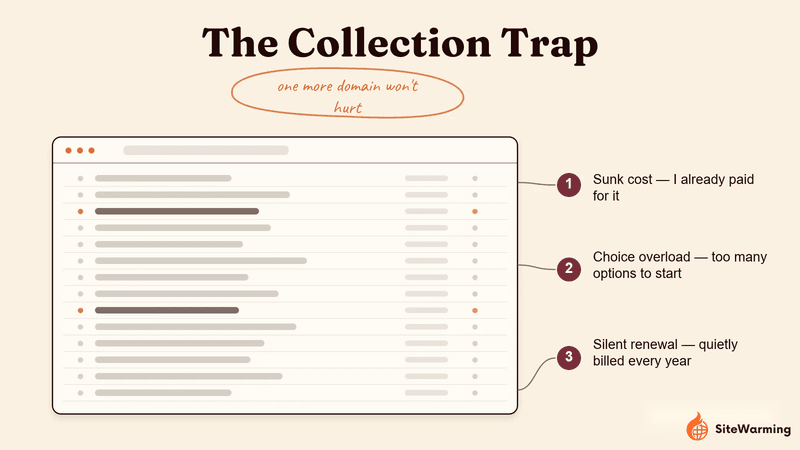
The domain collection trap is what happens when founders register names faster than they build them, mistaking accumulation for progress. Psychology research shows more options reduce the odds you'll act on any single one. The fix isn't buying less, it's picking a system: declare a few active domains, bucket the rest honestly and give each one a minimum real footprint.
You registered another one last week.
The idea was clear. The name was perfect. You could see the landing page in your head. You told yourself you'd build it soon. Next weekend. Next month. When things calm down.
Now it sits with the others.
12. 24. 47 However many you have.
Each registration felt like a smart move at the time. You were preserving opportunity. You were buying "optionality" for $12 a year. A small price to keep a door unlocked.
But be honest: when you look at that list of names now, do you feel opportunity?
Or do you feel a low-level hum of anxiety?
This isn't a character flaw. It's a psychological trap with a name. And the more "smart" purchases you make, the tighter the trap gets.
Mihir Desai said it plainly: "acquiring options becomes habitual, and the longer you spend acquiring options, the harder it is to stop. These safety nets don't enable risk-taking. People become habitual acquirers of safety nets."
That's the pattern domain collectors live inside. The collection isn't neutral. It has gravity.
Why more options create less action
We tell ourselves a clean story: more domains means more chances to win. If I have 50 ideas parked, surely one of them will hit.
But the evidence says the opposite happens.
In the famous "jam study" by Sheena Iyengar and Mark Lepper, researchers set up a tasting display in a grocery store. In one condition, they offered 6 options. In the other, 24.
More people stopped at the large display. But fewer people bought from it.
When the options were limited, people were 10x more likely to take action (30% vs 3%). When the options were abundant, purchase rates collapsed. Even satisfaction with the choice was higher when the choice set was smaller.
That's not about jam. It's about cognitive load.
This is what happens inside a registrar account.
When you have three domains, you feel an urgency to build one. When you have 50, the cost isn't money. It's choosing. The selection pressure becomes so heavy that your brain reaches for relief.
And the fastest relief is "none."
A big domain list looks like freedom until you try to choose from it.
How many domains is too many to manage?
There's no official cutoff, but here's a rough, honest way to think about where you sit:
| Portfolio size | What it usually means | Recommended move |
|---|---|---|
| 1–5 domains | Manageable by memory alone | Pick your top 1–2 and build now |
| 6–15 domains | Stewardship still works, but drift is starting | Run the Active Three system below |
| 16–50 domains | You're managing competing futures, not domains | Active Three + explicit buckets, non-negotiable |
| 50+ domains | Scale has changed how you think: this is portfolio management now | Active Three + buckets + a tool that tracks renewal dates and value automatically |
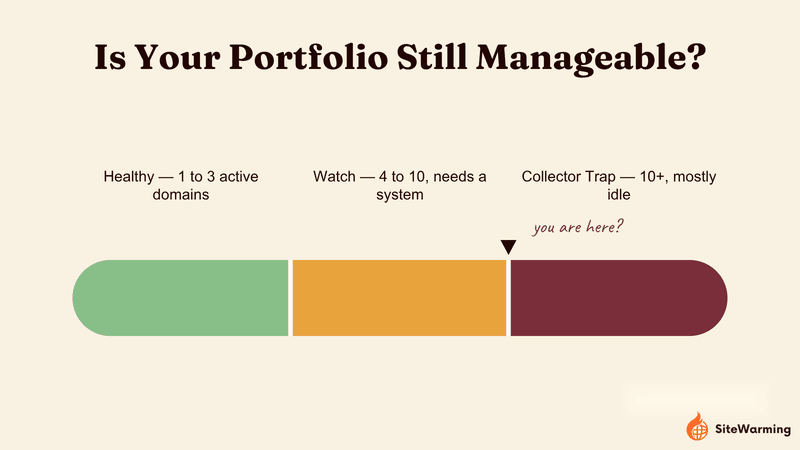
There's a related scale effect here too. Managing 10 domains is usually stewardship. Managing 50 starts changing how you think, because now you're carrying competing futures.
When the list gets big, you're not managing domains. You're managing competing futures.
I wrote more on that scale shift here: Managing 10 Domains Is Easy. Managing 50 Changes How You Think.
How the trap forms
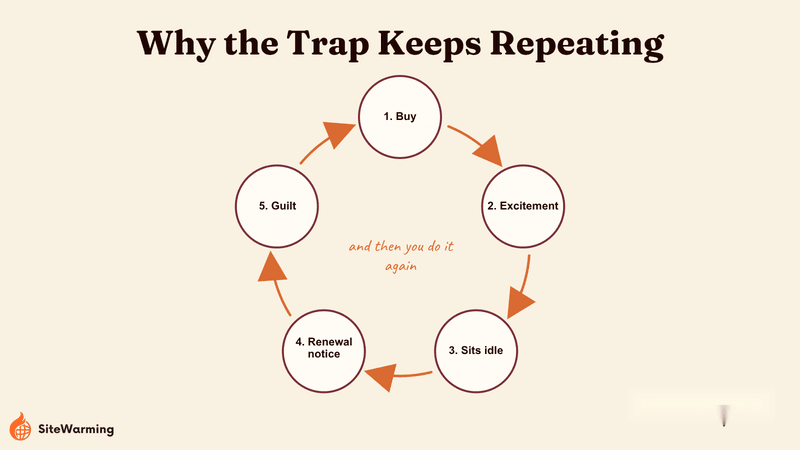
Nobody wakes up and decides to build a cage of 50 undeveloped projects. You don't set out to create overwhelm.
The trap forms the way most founder traps form: through small, rational decisions that feel harmless on their own.
Farnam Street describes "the tyranny of small decisions" like this: "few people deliberately lock themselves into an undesirable situation. Yet we make small rational choices that remove options over time."
Day to day, it's hard to see the path forming. Then one day you look up and don't like where you're going, and by then it feels late.
That is domain collecting in its most honest form.
- "It's only $12."
- "If I don't buy it now, it'll be gone."
- "I might want to build this later."
- "This one could be valuable."
Each decision is defensible. That's why it's dangerous. It doesn't feel like self-sabotage. It feels like being alert.
But fifty small "yes" decisions can create a massive "no."
Not because the names are bad. Because the system is missing.
The thing nobody says out loud is that you don't just buy a domain. You buy a tiny obligation. You buy a future you now have to either honor or consciously release.
And if you never choose, the obligation doesn't disappear. It just turns into background noise.
The silent erosion
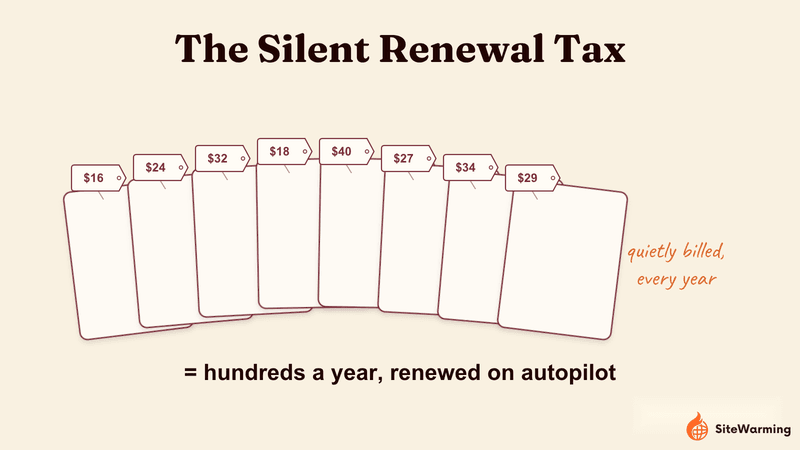
Choice overload rarely shows up as panic. It shows up as drift. It's a silent erosion of momentum.
The Decision Lab describes choice overload as "overwhelm from too many options," and notes what people do to reduce the anxiety: they settle for the default choice, or make no decision at all.
In the domain world, the default choice is renewal.
Renewal is psychologically clean. It's easier to pay $12 than it is to do either of the two hard moves:
- Admit you aren't going to build it and let it drop.
- Actually do the work to give it a real footprint.
So you renew. You kick the can. You keep the door "open."
And slowly, the portfolio stops feeling like possibility and starts feeling like unfinished business. If you want the deeper psychology of why that renewal button is so hard to resist, even for a single domain, I go further into it here: The Hidden Cost of Unused Domains.
Barry Schwartz's paradox of choice comes at the cost: "learning to choose well in a world of unlimited possibilities is harder still, perhaps too hard."
This is also why most domains never get the chance to prove themselves. Most domains don't fail dramatically. They fail quietly by staying invisible. They drown in a sea of competing priorities. We pulled this thread harder in The Domain Discovery Problem: Why Most Domains Never Get Found.
The uncomfortable truth about "optionality"
Here's the part that stings, because it's not about domains. It's about what domains protect you from.
We love the word "optionality." It sounds strategic. It sounds like something a disciplined person does.
But Desai argues that for many people, optionality becomes a habit, not a strategy. He goes further: sometimes optionality was always the end, not the means.
That's the collector's reality when it's stripped down to behavior.
The act of buying the domain feels like work. It releases a small dopamine hit. "I did something for my business today."
But often, the purchase is where the story ends.
"I'll develop it someday" becomes the cover story. Accumulation becomes the actual behavior.
This isn't judgment. It's recognition. Because once you can name it, you can stop feeding it.
We've lived the loop: buy the domain in clarity, then renew it while the idea stays dark. Warming is choosing to make an idea legible before you feel ready. Quietly. On purpose. Not hype. Just presence. Structure doesn't limit optionality. It's the only thing that makes optionality usable. If you're wondering what that actually looks like in practice: What is SiteWarming?
From collector to builder
So what do you do? Delete them all?
No. You probably have real gems in there. Most collectors do.
The move isn't scorched earth. It's stewardship: turning a pile of options into a system you can actually operate. If the ownership-versus-stewardship distinction is new to you, it's worth reading in full: How to Manage a Domain Portfolio Without Building Every Site.
Here's a simple operator approach that respects reality. You will still see new names. You will still feel the pull. The goal isn't purity. It's clarity.
If you're sitting on a handful of names, this is a five-minute exercise. If you're managing dozens, you'll want something that tracks renewal dates and estimated value automatically so your buckets don't silently rot back into one undifferentiated pile.
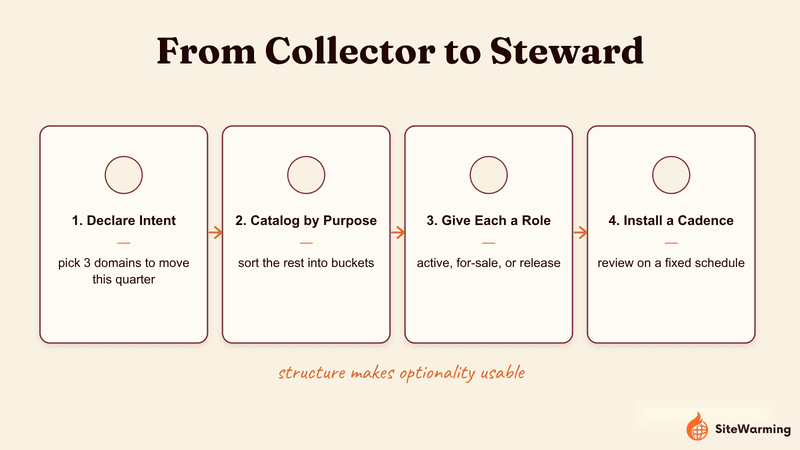
1) Declare your Active Three
Pick three domains that are allowed to receive your attention for the next 30 days.
Not forever. Not as a life sentence. Long enough to restore movement.
If you can't pick three, that's the jam study showing up in your own life. The option set is already too large for clean choosing. A constraint isn't a limitation. It's a decision scaffold.
2) Catalog the rest into explicit buckets
The brain hates ambiguous ownership. That's where the guilt comes from. Give everything else a label so you stop re-deciding every morning:
- Parked with intent: Still meaningful, not active this month.
- Release candidates: You're allowed to let these go without self-betrayal.
- Unknown: You don't have clarity yet, so you stop pretending you do.
This sounds small, but it changes the emotional texture.
A catalog turns shame into inventory.
3) Give each Active Three a minimum honest footprint
This is where stewardship becomes real.
The smallest meaningful move is rarely a full build. It's legibility.
A single page that says what the idea is, who it's for, and what problem it's trying to solve. Something a stranger can understand. Something the internet can observe.
Here's what that looks like in practice: say you're sitting on a domain for a bookkeeping tool idea. The minimum honest footprint isn't a built product: it's one page that states what the tool will do, who it's for and a single way to reach you. That's it. That's the whole minimum.
Because a domain that stays hidden in a registrar account doesn't accumulate signal. It accumulates pressure.
Discovery systems learn from repeated observation. Dark space teaches them nothing.
If you want the mechanics behind that idea, here's the deeper cut: Visibility Before Validation: Why Proof Comes First Now.
4) Install one rule for future purchases
Collectors don't stop because someone told them to stop. They stop because a rule makes it easier to act than to keep accumulating.
One rule is enough. Pick one:
- "I can buy a new domain only after I publish a real page on one I already own."
- "I can buy a new domain only if it replaces another one I release."
- "I can buy a new domain, but it must enter an explicit bucket the same day."
The point isn't to punish yourself. It's to keep optionality from becoming a cage.
I'll be honest: I still buy domains. I still see ideas and want to grab them.
But I know now the purchase isn't the win. The win is what happens after.
Frequently asked questions
How many domains are too many to own? There's no universal number, but the pattern is consistent: once you can no longer name every domain and its purpose from memory (usually somewhere past 10–15), you've crossed from stewardship into portfolio management, and you need an explicit system rather than intuition.
What should I do with domains I never built anything on? Sort them honestly into three buckets: parked with intent, release candidates and unknown, then give your active picks a minimum honest footprint (one page stating what the idea is, who it's for and how to reach you) instead of either a full build or continued silence.
Should I let unused domains expire, or keep renewing them? If a domain has been sitting in your "release candidates" bucket for more than one renewal cycle with no plan to give it a footprint, letting it expire is usually the more honest choice than paying to keep deferring the decision.
Is it bad to buy a domain and never use it? Not on its own, registering an idea early is reasonable. It becomes a problem when accumulation itself becomes the activity, and the purchase, rather than the build, is where the sense of progress comes from.
How do I decide which domain to build first? Pick the three domains that matter most right now, ignore the rest for 30 days, and start with whichever one needs the smallest possible footprint (a single clear page) to stop being invisible; momentum comes from shipping something small, not from picking the "best" idea.
The question isn't how many domains you own.
It's how many you're actually building.
Share this article
Ready to Transform Your Domain Portfolio?
Start building real value with your domain investments today.