How to Manage a Domain Portfolio Without Building Every Site
 Bret Siers
Domain portfolio stewardship means actively managing every domain you own, tracking renewals, documenting ownership, and giving each one a visible, minimal presence, instead of passively holding names and hoping their value appears on its own. It replaces ownership's question, "what can this do for me?" with stewardship's question: "what am I responsible for here?"
There's a question owners ask: "What can this domain do for me?" And there's a different question stewards ask: "What am I responsible for here?"
Ownership feels like the highest form of control. You bought the name, you hold the registration, you can do whatever you want with it, including nothing. But nothing is not a neutral choice. A parked domain, one that's registered but shows no real content, still renewed, still shows up in a WHOIS lookup, still sits in a registrar dashboard collecting dust and fees. Ownership is control without responsibility. Stewardship is control with a duty.
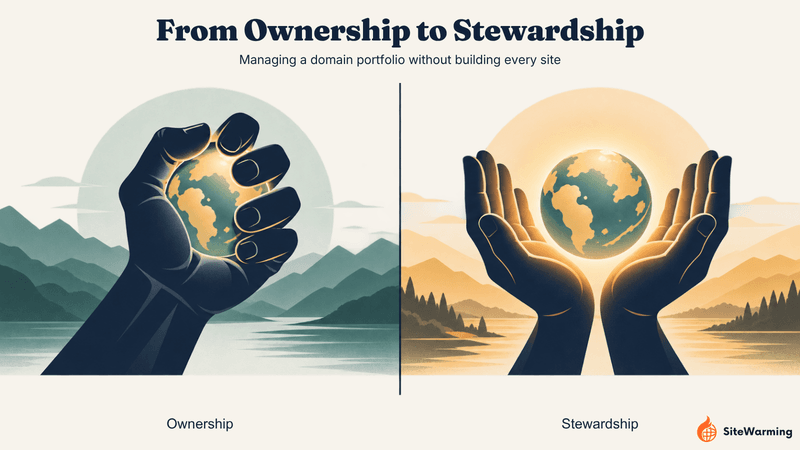
The difference one word makes: ownership vs. stewardship
Ownership feels like the highest form of control. It frames an asset as something to exploit at will, use it, ignore it, sell it, none of that changes what you're allowed to do. Stewardship frames the same asset as a responsibility that requires care. Infrastructure doesn't improve by being held. It improves by being maintained.
A domain portfolio, the full set of domains you hold across every registrar, works the same way a stock portfolio does when you take it seriously: it gets reviewed, rebalanced, and adjusted on purpose, rather than left to sit. Here's the contrast this whole article works through, laid out directly:
Owner vs. steward, at a glance
| Dimension | Owner mindset | Steward mindset |
|---|---|---|
| Development | Parks the domain and waits | Builds a minimal, visible presence |
| Signals | Waits for luck or a buyer to find it | Builds signals that compound over time |
| Continuity | Creates dead ends; no documentation | Prepares for succession and transfer |
| Measurement | Measures possession ("I own X domains") | Measures responsibility ("I can actively manage X domains") |
| Time horizon | Thinks in transactions | Thinks in decades |
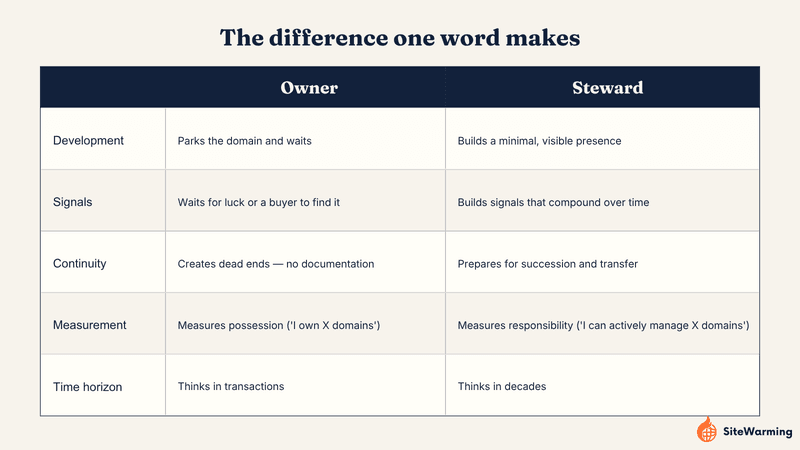
This is the same distinction we draw between treating domains as infrastructure and treating them as lottery tickets; stewardship is what infrastructure thinking looks like in practice, domain by domain.
Why stewards build and owners wait
The posture dictates the behavior. Stewards treat maintenance as essential work; they build visible signals of care because an asset that shows no sign of active management looks abandoned, whether or not it technically is. Owners minimize effort and wait for external validation: a buyer, an idea that finally feels ready, some future version of themselves with more time.
The steward prepares the asset for its future state. The owner defends the current state, whatever that state happens to be, including doing nothing. Small decisions reveal this divide: a steward updates a parked page for clarity the moment it's confusing; an owner defers the decision because nothing is technically broken yet.
This avoidance is exactly the psychological trap of collecting domains you'll never build; the more names pile up, the harder any single one becomes to act on, because acting on one means admitting the other nineteen are also waiting.
The survival evidence: do steward-owned companies actually last longer?
Stewardship can sound like philosophy until you look at what it does over long horizons. According to a Purpose Foundation study of Danish companies, foundation-owned (steward-owned) firms have a 60% probability of surviving 40 years in business, compared with 10% for conventionally investor-owned companies, six times the survival rate over the same period (Purpose Foundation, "Effects of Steward-Ownership as a Corporate Ownership Structure: Evidence from Denmark," 2022).
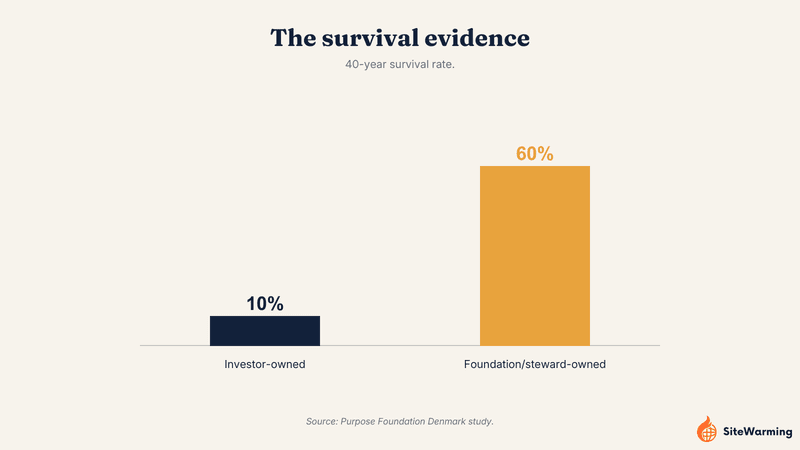
Domains aren't companies, but the mechanism is the same one this whole article is about: the asset treated as infrastructure to be maintained outlives the asset treated as a possession to be held. Part of what makes a domain's presence genuinely "visible" today is that it needs to be legible to two different audiences, search engines and AI systems alike; not just a single crawler checking whether a page exists.
The succession problem ownership creates
Ownership has a hidden failure mode: it has no plan for what happens when the owner stops being the one paying attention. Family-business research bears this out; only 30% of family businesses survive to the second generation, 12% make it to the third, and just 3% reach the fourth (Business Initiative, "Family Owned Business Statistics").
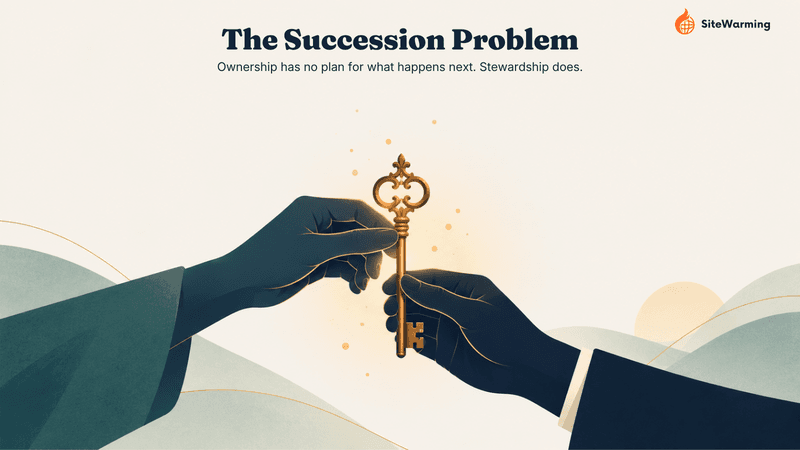
Domains held as personal knowledge, the login only you remember, the renewal date only you track, become exactly this kind of liability. Nobody else can act on an asset they don't know exists or don't know how to access. This is where renewal tracking stops being a nice-to-have and becomes the mechanism that prevents succession failure, a single dashboard that tracks every renewal date and valuation across every registrar you use, rather than a fact only you carry in your head.
What stewardship looks like for domains (5 rules)
What does stewardship actually look like day to day for a domain owner? If you want to move from owner to steward, here are the rules:
- Stewards develop, owners park. Active maintenance beats abandonment: the internet recognizes no neutral state; a parked domain is read as inactive, not as "waiting."
- Stewards build signals, owners wait for luck. A visible presence and legible signals compound value over time; a domain sitting silent compounds nothing.
- Stewards prepare for succession, owners create dead ends. Documentation and transfer-readiness ensure continuity if you're not the one managing the portfolio next year.
- Stewards measure responsibility, owners measure possession. At scale, capacity constraints matter; systems replace intuition once you're past a handful of names.
- Stewards think in decades, owners think in transactions. Long-term coherence builds compound trust and discoverability that a one-off transaction never does.
How many domains is too many to manage without a system?
The five rules above hold whether you own three domains or three hundred, but the mechanics change with scale. Somewhere around ten to twenty domains, tracking renewal dates and valuations in your head or in a spreadsheet starts to fail quietly, a lapsed renewal doesn't announce itself, it just happens. We've written a longer breakdown of exactly where that shift happens and what changes at each threshold: how managing ten domains differs from managing fifty. The short version for this article: stewardship at any scale requires the same three things, a single place to see every domain and its renewal date, a minimal presence for each one, and a plan for what happens to each name if you stop being the one managing it.
What SiteWarming does with this in practice
Stewardship is a mindset, but it still needs a mechanism. In practice, that mechanism is two things: knowing what you have, and giving each domain a minimal, visible presence without building a full site for every name. The Domain Management Tool consolidates domains held across multiple registrars into one dashboard, tracking renewal dates and providing valuation from one source automatically, so the "domain held as personal knowledge" problem described above stops being personal knowledge. You can add additional valuation sources if you want deeper coverage. Launch & Warm handles the other half: it takes a short story you write about the domain and deploys DNS, SSL, structured data, and FAQs automatically into one of three templates (Future Build, Open, or Actively Selling), so a name that would otherwise sit parked gets a visible signal without you building a site by hand. If you're new to what SiteWarming does at a foundational level, start with What Is SiteWarming?
Common mistakes stewards make anyway
- Treating stewardship as a one-time cleanup. Renewal tracking and minimal presence need to be maintained, not set up once and forgotten; that's the whole distinction between owning and stewarding.
- Documenting nothing. If you're the only person who knows which registrar a domain lives in, you haven't solved the succession problem, you've just delayed it.
- Confusing "doing something" with the right thing. Building a full site for a domain you're not ready to commit to isn't stewardship any more than parking it is; a minimal, honest presence beats an abandoned half-built one.
- Waiting for validation before giving a domain any visibility. As we've argued elsewhere, visibility should come before the idea is fully validated, not after; a domain with no visible presence can't collect the signals that would validate the idea in the first place.
See what a stewardship-first plan costs.
Frequently asked questions
What does it mean to be a steward of a domain instead of an owner? Being an owner means you hold the legal right to a domain and can do anything with it, including nothing. Being a steward means treating that domain as a responsibility: tracking its renewal, giving it a minimal visible presence, and keeping records so it doesn't become a dead end if you stop managing it.
How many domains can one person actively manage? There's no fixed number, but most people's ability to track renewals and status by memory or spreadsheet starts breaking down somewhere between ten and twenty domains. Past that point, a centralized tracking system, not a bigger spreadsheet, is what makes stewardship possible. See how managing ten domains differs from managing fifty for a fuller breakdown.
Do steward-owned companies really last longer than traditional ones? Yes, according to available research on business ownership structures. A Purpose Foundation study of Danish companies found foundation-owned (steward-owned) firms have a 60% chance of surviving 40 years, versus 10% for conventionally owned firms (Purpose Foundation, "Effects of Steward-Ownership as a Corporate Ownership Structure: Evidence from Denmark," 2022). This article applies that logic to domains as an analogy, not as a domain-specific study; no equivalent long-term survival data exists yet for domain portfolios themselves.
What's the difference between parking a domain and being a steward of it? A parked domain is registered but shows no real content, it's the passive default. Stewardship means giving that domain some minimal, honest presence (even a single page explaining what it's for) and keeping its renewal and ownership details actively tracked, rather than leaving it invisible until it lapses or gets challenged.
How do I start managing a large domain portfolio without building every site? Start with visibility, not construction: get every domain you own into one place with its renewal date and current valuation, then give each one a minimal presence appropriate to its stage, a placeholder, a one-page story, or an active build rather than trying to fully build every name at once. The Domain Management Tool and Launch & Warm are built specifically to do this without requiring a full site build per domain.
Share this article
Ready to Transform Your Domain Portfolio?
Start building real value with your domain investments today.