Why Your Domain Is Infrastructure, Not a Lottery Ticket
 Bret Siers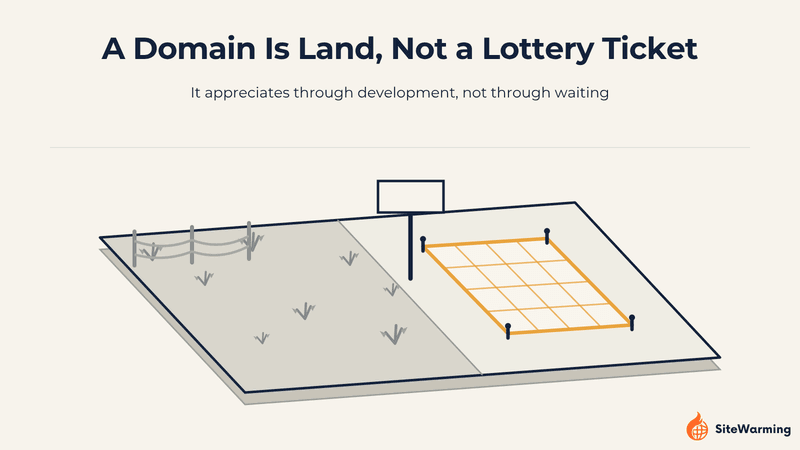
A domain is infrastructure, not a lottery ticket: its value comes from active stewardship, not from waiting for a buyer. Research measuring 334 million domains found 17.5% of them parked, and a parking page is a public state, not a pause. Treating a domain as infrastructure means managing it, not just holding it.
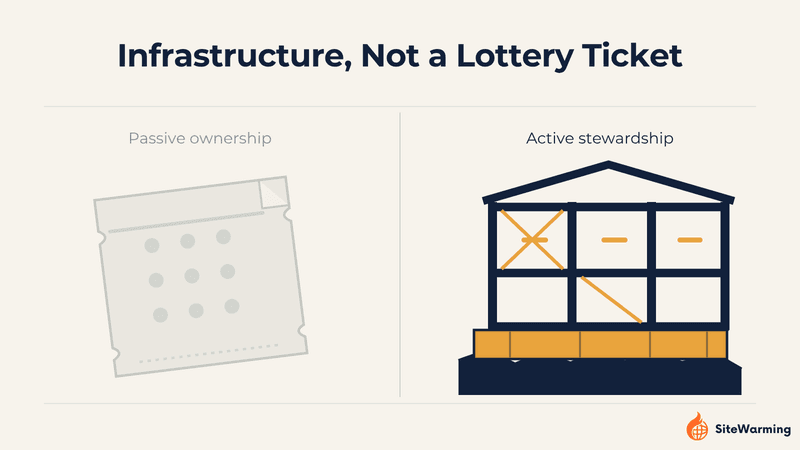
What does lottery-ticket thinking look like?
Imagine buying a neglected commercial lot and expecting developer interest to show up on its own, without you ever fixing the fence, mowing the lot, or putting up a sign saying what's for sale. That's how most people treat domains: buy them, park them and wait for appreciation to happen by itself. Digital real estate works the same way physical real estate does: both require ongoing stewardship, not just a purchase.
Domain parking is common enough that it's worth naming as a pattern rather than a personal failing. A DNS scan of more than 334 million domains, run in September 2023, identified 58.5 million of them, 17.5%, as parked, and the researchers describe that as a lower bound, since smaller parking services and redirect-based parking weren't counted (APNIC, "The prevalence of domain parking," 2023).
But common doesn't mean neutral. Parking pages aren't a pause state, they're a public state. Anyone, human or machine, who looks at that domain sees exactly what you've chosen to show them: nothing.
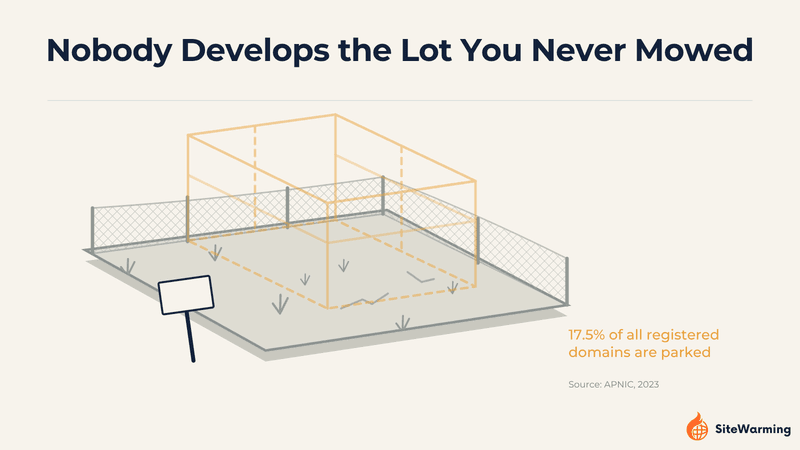
Lottery-ticket thinking treats ownership as a single transaction rather than an ongoing responsibility:
- Annual renewal payments continue, regardless of activity.
- The mental burden of remembering why you bought it in the first place accumulates.
- The domain exists publicly but communicates nothing.
We confuse registration with presence. Parking doesn't compound, it just persists. See White Space Isn't Luck, It's Pattern Recognition for what actually does compound, in contrast, and domain speculation vs. stewardship for the same split framed as two strategies.
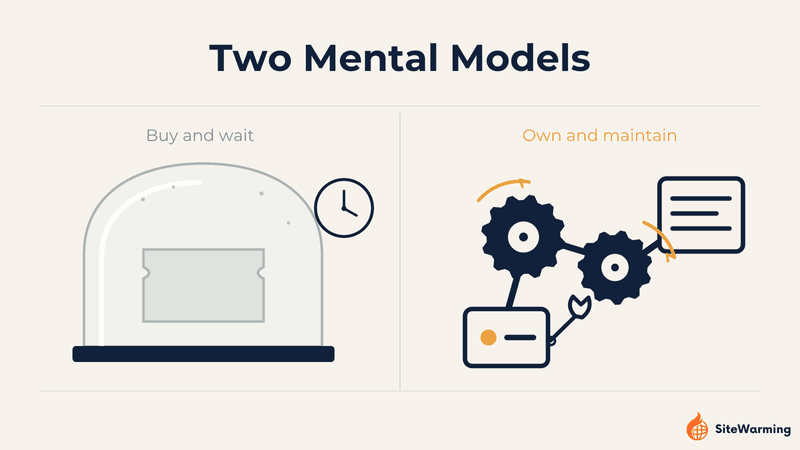
Lottery-ticket thinking vs. infrastructure thinking
| Lottery-ticket thinking | Infrastructure thinking | |
|---|---|---|
| Mental model | A single purchase, then you wait | An ongoing responsibility |
| What happens over time | Renewal payments continue with nothing to show for them | Deliberate maintenance builds value |
| Public signal | A parked page: a public state, not a pause | A minimal, legible footprint |
| Risk profile | Expires harmlessly, eventually | Lapses catastrophically when neglected |
| What creates value | Hoping the market notices | Observable signals accumulated over time |
What does infrastructure thinking actually require?
Five things, in practice.
1. Ownership clarity
Domain registration should sit under company entity control, not a founder's personal account, so continuity survives if a team member leaves. WHOIS and registrar records should reflect who's actually responsible.
2. Renewal discipline
Auto-renew provides a baseline, but it's not a substitute for actually knowing your renewal dates and payment methods, recorded somewhere that survives organizational change; not just in one person's inbox.
3. DNS hygiene
Old DNS records accumulate quietly. A periodic review prevents experimental settings from an old project becoming permanent by accident, and catches records pointing at services you no longer use. A domain health check is the systematic version of this.
4. Security posture
Domain locks, multi-factor authentication on the registrar account, and limiting administrative access to a small, known group all reduce the chance of losing a domain to something other than neglect.
5. Minimal presence
A simple page that clarifies purpose, audience and future direction demonstrates active stewardship rather than vacancy, it's the visible proof that principles 1 through 4 are actually happening. See how to increase a domain's value before listing it for how a minimal presence pays off even if selling isn't your near-term plan.
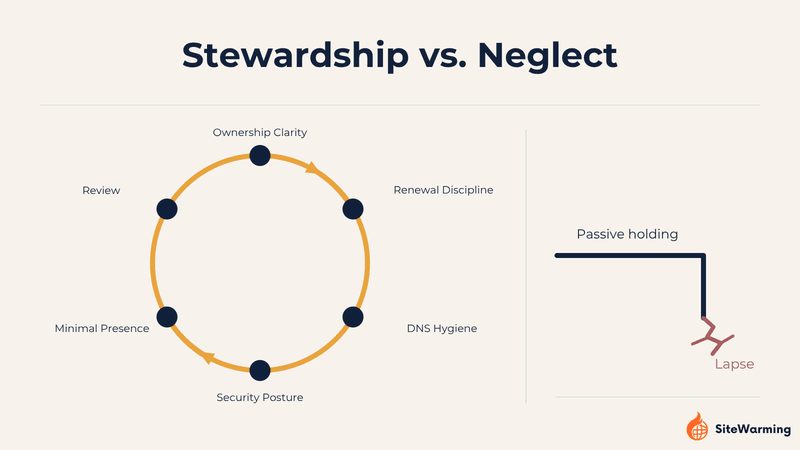
Use this as a quick self-check: if you can't confidently answer all five for a given domain, it's being held with lottery-ticket thinking, whatever your intentions were when you bought it. The myth of set-and-forget digital assets makes the same case from the opposite direction.
Why does scale force infrastructure thinking?
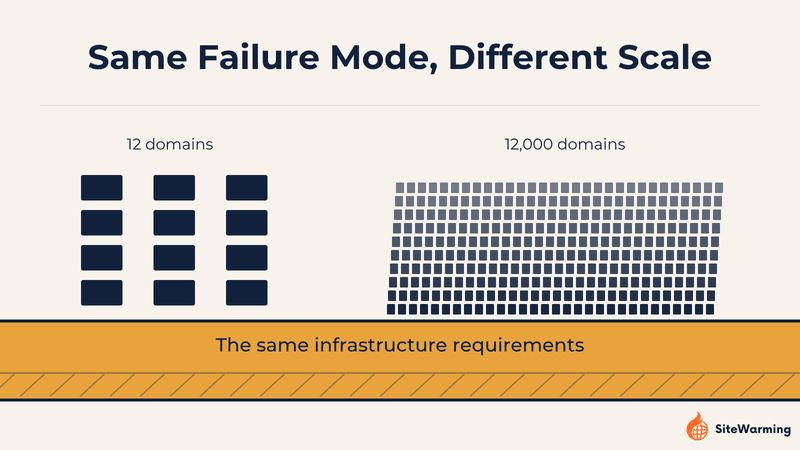
Infrastructure discipline isn't just a large-company problem, but scale does make it unavoidable. In GoDaddy Corporate Domains' sixth annual corporate domain management survey, 56% of respondents came from companies owning more than 3,000 domain names and 29% from companies with more than 10,000 (GoDaddy Corporate Domains). At that scale, domains become operational infrastructure through sheer necessity: centralized administration, renewal processes, security controls, monitoring.
If you're holding a handful of domains rather than thousands, the lesson still transfers; it's complexity, not raw quantity, that demands a systematic approach. Managing 10 domains vs. 50 is where that shift usually starts to bite. The founder with twelve undeveloped domains and the enterprise with twelve thousand are both exposed to the same failure mode: infrastructure problems don't punish you daily, they punish you catastrophically, on the one day it actually matters.
What actually drives domain value?
Domain appreciation doesn't come from time alone. It comes from:
- Natural memorability and typing behavior
- Categorical demand
- Observable signals suggesting usability and trust
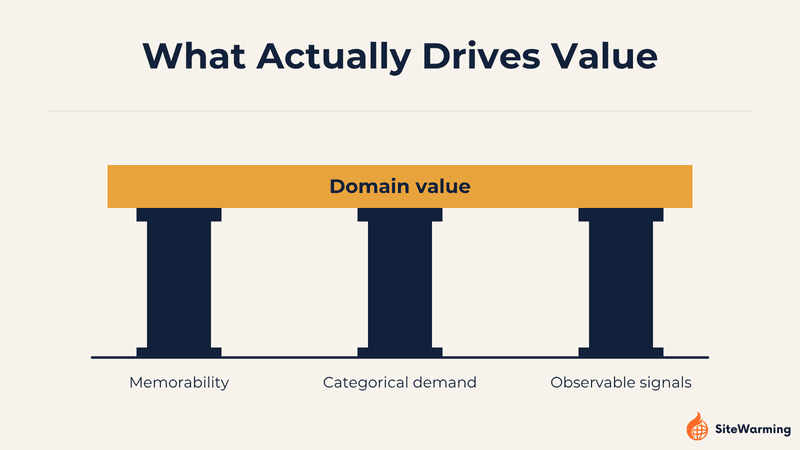
Insurance.com is a useful, if extreme, example: it changed hands as part of a $35.6 million acquisition in 2010 (Domain Name Wire). Worth noting, and the source says so directly: that figure was for a full acquisition, not confirmed to be the bare domain name alone changing hands. But the underlying lesson holds either way. Premium valuations attach to names that reduce friction and carry observable demand, not to names that have merely existed for a long time. Value comes from signals accumulated over time, not time alone, which is the question do domains appreciate as a scarce asset? takes apart in full.
See What is SiteWarming? for how a small, honest footprint gives discovery systems something to repeatedly observe; exactly the kind of signal accumulation this section describes.
What happens when domain infrastructure lapses?
A lapsed domain doesn't just quietly disappear. It becomes available to someone else, and that someone is often not a neutral party. CSC's corporate domain security research puts it starkly: almost 13% of all corporate domain name lapses are picked up by a third party (CSC, "Expired Domain Names: Risks and Protection Strategies").
Three consequences follow, and they compound:
- Loss of control. An expired domain can be registered by competitors or bad actors and used for phishing, malware distribution, or impersonation. Worse, it keeps receiving email sent to the old address; invoices, statements, privileged correspondence; now delivered to whoever holds it.
- Service disruption. A misconfigured or expired domain breaks email, web access, and APIs, often all at once. Anything quietly depending on that domain fails with it.
- Reputation damage. Whoever acquires the domain inherits its established search authority and any residual trust attached to the name, and can point both at content you'd never have published.
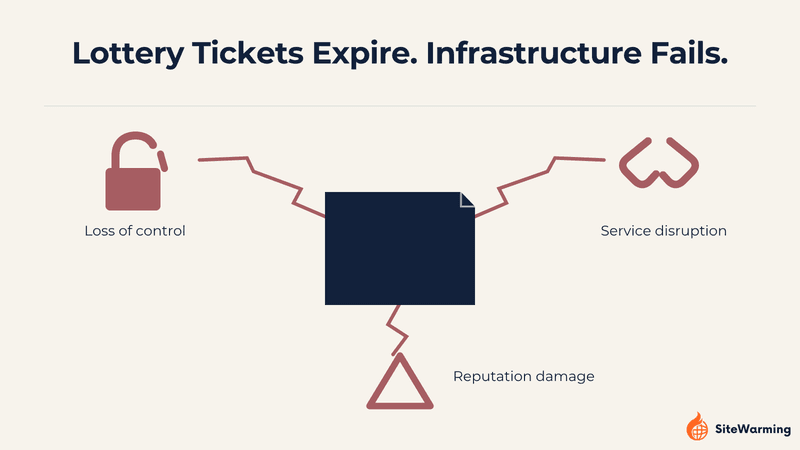
The distinction that matters: lottery tickets expire harmlessly. Infrastructure lapses create operational vulnerabilities. The fix is the same five things above: defensive registrations, monitoring for lookalikes, centralized ownership, and clear renewal discipline. Can an expired domain hurt your brand? covers the reputational side specifically, and the real cost of set-and-forget domain management prices out the whole failure mode.
See From Ownership to Stewardship for the broader mindset shift this all sits inside, and Why Most Domains Never Get Discovered if the domain in question isn't at risk of lapsing so much as it is simply invisible.
The choice
A domain is land you own. It appreciates through development and maintenance and it decays through neglect, there's no third option where it simply holds still. The honest question isn't whether you own the domain. It's whether you're currently managing it like infrastructure or hoping it pays off like a lottery ticket.
If you'd rather not track renewal dates, DNS records and security posture across a portfolio by hand, that's what SiteWarming's domain portfolio management is for.
Frequently asked questions
What happens when a domain expires accidentally? Most registrars build in an advance notice period, then an Auto-Renew Grace Period (typically up to 45 days) where the domain still resolves and can be renewed normally, then a 30-day Redemption Grace Period where it's suspended but recoverable at a premium fee, then a 5-day Pending Delete window. After that, the domain is released and becomes available to anyone; including competitors or bad actors.
How do I protect my domain from being stolen? Enable a domain lock through your registrar, turn on multi-factor authentication for the registrar account and limit administrative access to a small, known group. Keeping WHOIS and ownership records under company, not personal, control also prevents continuity problems if someone with access leaves.
What is DNS hygiene? DNS hygiene means periodically reviewing your domain's DNS records to remove old or experimental entries that have quietly become permanent, and confirming that every active record still points to a service you actually use. Neglected DNS records are a common, invisible source of both security risk and broken functionality.
Should I treat my domain as an investment? Only if you're actively managing it: reviewing renewal dates, securing the account and maintaining at least a minimal presence. A domain that's purely held and hoped about is closer to a lottery ticket than an investment; the difference is whether you're doing anything to influence the outcome.
How many domains are parked? A September 2023 DNS scan of more than 334 million domains found 58.5 million of them, 17.5%, were parked, and the researchers treat that as a lower bound because smaller parking services and redirect-based parking weren't counted.
Share this article
Ready to Transform Your Domain Portfolio?
Start building real value with your domain investments today.