Do Domains Appreciate? The Scarce, Appreciating Asset
 Bret Siers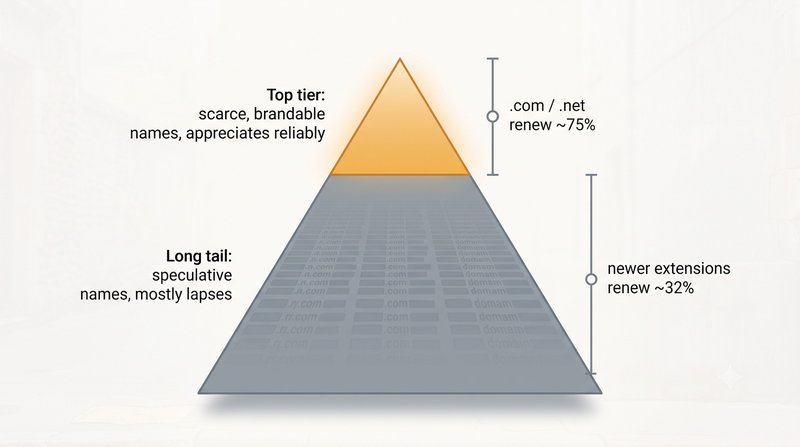
Photo by Micheile Henderson on Unsplash
Do Domains Appreciate? The Scarce, Appreciating Asset
You still own it. The name you registered back when the idea felt close enough to touch. The renewal notice landed again last month, you paid it again, and somewhere in the back of your mind a small question keeps circling. Is this thing actually worth keeping? Or am I paying twelve dollars a year to feel like I haven't given up?
That question rarely gets a straight answer. People either tell you domains are gold, or they tell you you're holding a digital Beanie Baby. Neither one helps. So here is the direct version, the one that respects both the name you believe in and your time.
The answer is yes, with a condition that changes everything. A thin top tier of domains appreciates reliably, sometimes dramatically. Most domains do not. The long tail loses money at a rate the aftermarket's optimists rarely volunteer. Which half applies to you is the whole question, and it leads somewhere more useful than a price target.
The Honest Counter-Evidence
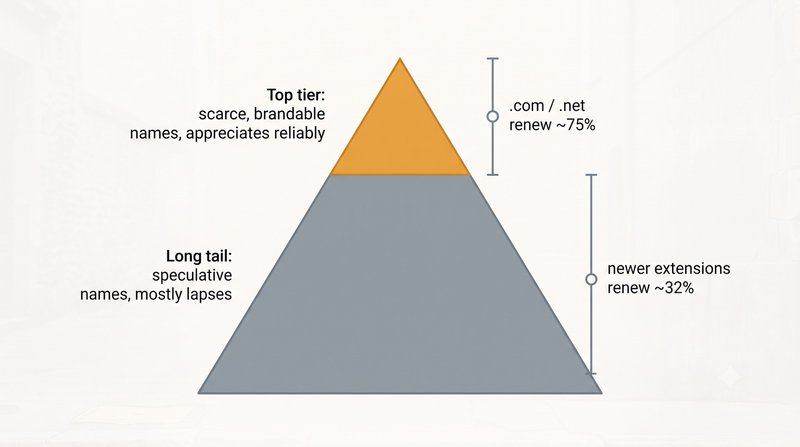
There is a part most articles skip, because it doesn't sell. Most domains do not appreciate. The long tail of speculative names churns and quietly lapses, costing more in renewals than it ever returns. The clearest signal is renewal behavior.
Legacy .com and .net names renew at roughly 75% (DNIB, Q3 2025). Three out of four owners decide, every year, that the name is still worth keeping. The newer generic extensions, the ngTLDs, renew at only 32.2% (DNIB, Q3 2025). Read that again. Almost seven in ten of those names are not renewed inside a year. People register them hoping for a quick trade, the trade never comes, and the carrying cost stops feeling worth it.
That gap, 75 versus 32, is the most useful number in this whole piece. It tells you appreciation is not a property of domains as a category. It is a property of a specific kind of name held for a specific reason. The names that hold value are the ones owners actually want to keep. The names that vanish are the ones someone was only ever trying to trade.
Which is a strangely reassuring thing to learn. If you have been holding a name because the idea still means something to you, you are at least asking a better question than the quick-trade crowd.
Scarce and Appreciating Is Not a Trade
Both halves are true at once, and holding them together is what actually helps. A domain is genuinely scarce. There is exactly one of any given name, and nobody is making more. When the meaning behind it is real, that scarcity is the engine underneath any appreciation. That is the grain of truth in every domains-are-assets claim, and it's worth taking seriously.
But scarce and appreciating is not the same as a quick trade. An asset that grows quietly over a long horizon and an asset you churn for a fast gain are two different relationships with the same domain. The first is patient. The second is the gamble that produces the 32% renewal number and the field of dead names behind it. The trade is the trap. A domain is closer to infrastructure than a lottery ticket, and the people who get burned are almost always the ones who confused the two.
Think about how value actually accumulates on a name. Not by sitting dark on a parking page, waiting for a buyer who can't find it. It builds the way value builds anywhere on the internet, through presence and time. A name that has stayed visible and consistently itself for years carries more weight than one that went silent the day it was registered. It is the same logic as why six years of content beats six months of marketing. Appreciation rewards the names that stayed alive, not the ones that sat in the dark hoping.
The SiteWarming perspective
The appreciation question and the trading question pull in opposite directions. Trading asks what you can get for the name today. Appreciation asks what it becomes if you keep it alive and let it grow. An asset only appreciates if it stays an asset. A name that goes dark has fewer ways to accumulate anything, it just renews and erodes quietly toward the day you decide it isn't worth twelve dollars anymore. SiteWarming is built for the other direction. It keeps a domain present and discoverable so value can accumulate while you decide nothing, instead of eroding on a parking page. What is SiteWarming?
Yes, But Only at the Top
At the level of the whole market, the picture is calm. The domain aftermarket, the space where names change hands after their first registration, behaves like a slow, modestly appreciating asset class. It is forecast to move from about $0.72 billion in 2026 to $1.31 billion by 2035, a 6.1% annual rate (Business Research Insights), a little ahead of long-run inflation. Real appreciation, if an unspectacular kind, and boring is exactly the point.
Above that average sits a thin top tier that appreciates reliably, sometimes dramatically. Those are the scarce, category-defining names held for decades by people who do this for a living. They are the reason the word appreciation belongs in this conversation at all. They are not a promise about the name sitting in your account, and anyone who uses them as one is selling you something.
If you want a grounded read on what your specific name might be worth today, that's a different and more useful question. How much is your domain worth walks through honest appraisal, and domain valuation tools compared shows what the estimators actually measure.
The Asset Is the Idea
So back to the small question that has been circling. Is it worth keeping?
The market value of any single name is mostly out of your hands and mostly unknowable until the day someone shows up wanting it. Chasing that number is how people end up trading, and trading is how people end up in the 32%. That is the loop to stay out of.
But there is a different kind of worth, the one you actually control. The name still means something to you. That conviction, the reason you registered it in the first place, is the real scarce thing here. Not a resale figure. The idea. A name kept open keeps that idea alive and within reach, so that if the right moment ever arrives, by your own choosing, you still have every option in front of you. Build it later. Partner on it. Let the right person find their way to it. Or just keep believing in it quietly. Each of those stays possible only while the name is yours and alive.
Going dark forfeits all of it. Dumping it on a marketplace forfeits it too, just faster. The third way is to keep it Open, Not Listed. Present and reachable, without becoming a seller. That is how a scarce asset appreciates in the only way that matters to you, by staying yours long enough for the idea to still be there when you're ready.
So, do domains appreciate? Some do. Most don't. But the name you believe in was never really a bet on a price. It was a preserved idea and a preserved choice, a door you left yourself. And the smartest thing to do with a door worth keeping is not to sell it. It is to make sure it still opens.
Share this article
Ready to Transform Your Domain Portfolio?
Start building real value with your domain investments today.