Domain Valuation Tools Compared: GoDaddy, EstiBot, Atom, HumbleWorth (And How Accurate They Are)
 Bret Siers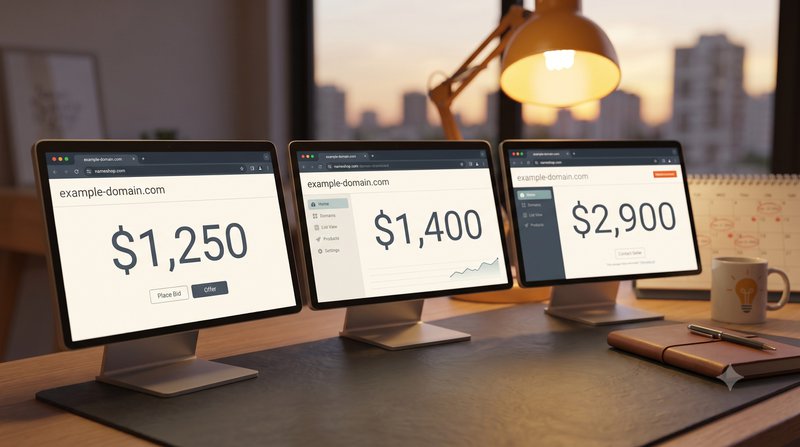
Photo by Slava Keyzman on Unsplash
Domain Valuation Tools Compared: GoDaddy, EstiBot, Atom, HumbleWorth (And How Accurate They Are)
The companion piece explains why appraisals disagree. This one is more practical: what each tool is useful for, where it breaks, and how to use them together without over-trusting any single number.
Most owners are not appraising a domain because they have a buyer. They are appraising it because renewal is coming and they want to know if the name still deserves a place in the drawer. The name was not random when you bought it. And you don't need five tools to validate the idea. You need enough information to make a calm decision about whether to keep holding it.
You have three browser tabs open. Same domain, three tools, three completely different numbers. One says $500. One says $12,000. One says $0.
None of them deserves full trust alone. But each one is telling you something real. The problem isn't the tools. It's using any single one as the final word.
Five different questions. Five different answers. Here's what each one is actually good for.
GoDaddy: The Conservative Comparable-Sales Baseline
GoDaddy runs a machine learning model trained on twenty-plus years of its own auction sales. Word tokenization, extension weighting, sales comps. For common English .com names, it produces a grounded, conservative number. You get something back fast, and it feels solid.
Where it's useful. Your starting point. If GoDaddy says $500, you have a floor. It's probably a low floor, especially for anything brandable. But it gives you something to build from. For standard .com names with clear keyword meaning, GoDaddy's number is usually in the right neighborhood.
Where it breaks. GoDaddy's model has no visibility into private sales, broker transactions, or marketplace data beyond its own platform. If your domain is a coined brand or carries meaning that doesn't map to keyword patterns, GoDaddy will undervalue it. As the accuracy analysis shows, the appraised number is more often an upper bound on common names than a realistic floor on premium ones.
What to do with it. Note the number. If it's close to what other tools return, the name is probably priced predictably. If other tools say ten or twenty times more, the gap itself is telling you something about what kind of name you have.
EstiBot: Keyword Math and Hard Zeros
EstiBot evaluates over 100 attributes per domain, with heavy weighting on character count, keyword search volume, extension, and linguistic patterns. It's fast and it covers a wide range of domains.
Where it's useful. Dictionary-word .com names where keyword math is the primary driver. When EstiBot returns a real number, you have a keyword-weighted data point that's worth comparing against the rest.
Where it breaks. EstiBot penalizes length hard. In one NamePros portfolio review, EstiBot assigned a $0 value to 94 of 134 domains tested. Not low values. Zero. One of those $0 domains, FabVoila.com, was later appraised at $400 by a human appraiser on Afternic. EstiBot treats anything over 15 characters with deep suspicion, and anything outside keyword patterns gets wiped to zero rather than estimated low.
What to do with it. If EstiBot gives you a number, you have a keyword-weighted floor. If it says $0, don't panic. That tells you the value, if it exists, is brand-driven. A $0 from EstiBot isn't a verdict about your domain. It's a limitation of the model.
Atom: The Brandable Ceiling
Atom uses an AI model benchmarked against its own marketplace of curated, brand-ready domains, analyzing what Atom's documentation variously describes as "over 50 data points" and "hundreds of data points." If you have a short, coined, pronounceable domain that could work as a startup name, Atom is the most relevant comparison.
Where it's useful. Brandable names where the value is about sound, memorability, and category fit. Atom is calibrated to what buyers in the premium brandable space actually pay. When you see Atom's number, it tends to feel like possibility. That's the point.
Where it breaks. Atom's own marketplace is the training data. That biases the model toward brandable names and biases it high. A geo domain, a long descriptive domain, or an exact-match keyword domain isn't what Atom's buyers want, and the model reflects that.
What to do with it. Treat Atom as your aspirational ceiling. If Atom says $12,000 and GoDaddy says $500, the realistic number for a brandable domain is somewhere between those, closer to Atom for the right buyer and closer to GoDaddy without one.
HumbleWorth: Range and Confidence Instead of One Number
The most useful difference is that HumbleWorth gives a range instead of asking you to believe one number. It uses a language model combined with three million-plus domain auction records and returns three numbers: low, mid, and high, each with its own confidence level. Every other tool gives you a point estimate and acts like it's settled. HumbleWorth admits the uncertainty is real.
Where it's useful. Defining the zone your domain likely sits in. When HumbleWorth's high-confidence estimate aligns with what GoDaddy says, you have a fairly reliable data point. When the range is wide, that's honest too. It means the name depends more on who finds it than on what the letters spell.
Where it breaks. The range can be wide enough to feel unclear. A spread from $200 to $8,000 doesn't give you a price. It gives you a zone. That requires interpretation. HumbleWorth is also newer and has a smaller base than GoDaddy, which means confidence can be lower on less common patterns.
What to do with it. Use HumbleWorth to define the bracket, then see where GoDaddy's floor and Atom's ceiling fall within that bracket.
Sedo: A Human Check When a Transaction Is Real
Sedo is the only paid option here ($99 as of 2026) and the only one with a human appraiser. According to Sedo's appraisal documentation, it evaluates domains against a ten-factor rubric: TLD match, length and memorability, language complexity, typo susceptibility, international usability, search-engine suitability, advertising potential, sales opportunities, business potential, and experience combined with the world's largest comparable-sales database.
Where it's useful. When money is actually changing hands. A human appraiser won't predict what one motivated buyer will pay either, but the evaluation is more defensible than any algorithm alone. There's something grounding about knowing a person actually looked at your name.
Where it breaks. At $99, you're not running this on thirty domains. You're running it on the one domain you're already close to making a decision about.
What to do with it. Save Sedo for when the stakes justify it. For the rest of your names, the free tools are your starting layer.
How to Use These Tools Together
Not everyone needs the full set. Here's what makes sense depending on what you're doing.
For a casual look across your names: Run two or three of the free tools. GoDaddy for the floor, HumbleWorth for the range, and optionally Atom if the name is brandable. That gives you enough to know whether you're holding something interesting or something quiet. Most renewal decisions don't need more than this.
For names you might hold long-term or sell someday: Run all four free tools. Compare the spread. If three tools cluster around a similar number and one outlier disagrees, you've learned something. The cluster is probably closer to where things sit. The outlier is telling you about a feature the others can't see. Write the range down. Come back in six months and run them again.
For active negotiations or real transactions: Add a Sedo appraisal ($99). A human analyst's evaluation against a ten-factor rubric is the strongest single data point you can get. Use it when the decision is big enough to justify the cost.
Why the Disagreement Is the Point
GoDaddy asks: "What have similar domains sold for on my platform?" EstiBot asks: "What do the measurable attributes of this string suggest?" Atom asks: "What have similar-quality names sold for in my marketplace?" HumbleWorth asks: "Given three million auction records, what is the probability distribution?" Sedo asks: "What would a human expert conclude?"
Those are five different questions about the same name. And no single tool can give you the whole picture.
The domains that get the most consistent valuations across tools are short, common English .com names with clear keyword meaning. The further your domain moves from that center, the more the estimates diverge. A creative brandable. A .ai extension. A three-word phrase that matches a growing industry. These are the domains where the tools disagree by orders of magnitude, and exactly the domains where the value might be highest.
The name was not random when you bought it. The fact that tools can't agree on what it's worth doesn't mean it's worthless. It means the value is harder to see from the outside. That's true of most interesting things.
A single appraisal from a single tool is a guess. Multiple valuations, tracked across time in one place, are a signal. The gap between managing domains and understanding what you actually have is the gap between a list and a watched asset. That's what turns a name you're paying to renew into something you're choosing to hold. What is SiteWarming?
What You're Really After
Do this once and you have a snapshot. Do it repeatedly and you start to understand the asset.
The domains you've been renewing for years, the ones you registered because the idea felt right, the ones sitting in dashboards you haven't opened in months. They're worth understanding. Not because you're trying to sell. Because the decision to keep holding something is clearer when you know what you're holding.
That kind of tracking is part of managing domains across multiple registrars. And once you understand the range, make sure you're not at risk of losing what you have, because the only thing more avoidable than a bad appraisal is losing a good domain to an expired card.
See also: why 6 years of consistent presence beats 6 months of marketing
Share this article
Ready to Transform Your Domain Portfolio?
Start building real value with your domain investments today.