Domain Speculation vs Domain Stewardship: Why the Difference Matters
 Bret Siers
Domain speculation is buying a name to resell it, so your return depends on a buyer arriving. Domain stewardship is holding a name you believe in and building context around it, so a buyer, a partner or you can act on it. Speculation bets on someone else's decision. Stewardship builds on yours.
He had bought the domain three years earlier. A clean name. Good category. The kind of name that felt like it had obvious value the moment he typed it.
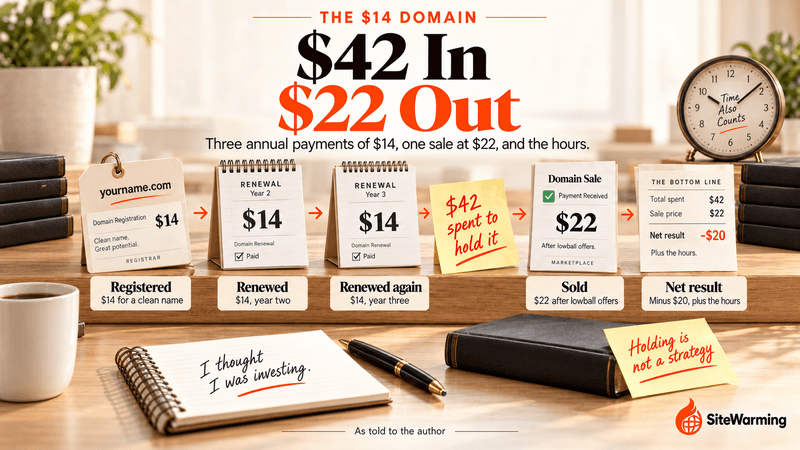
He paid $14 to register it. He renewed it twice. And last year, he finally sold it. For $22.
Three annual payments of $14, the registration and two renewals, came to $42 to hold it. He sold it for $22. The net was negative $20, plus the hours he'd spent listing it, fielding lowball offers and updating the for-sale page.
"I thought I understood this," he told me. "I thought I was investing."
Here's what he was actually doing. He was holding. And holding is not a strategy. It's a posture.
He wasn't careless. He was waiting for someone else to confirm that the name had value. The rest of this piece is about the difference between waiting and building, and how to tell which one you're doing with each domain you own.
What is domain speculation, and what does it require?
Let's be clear about what we mean, because "buying to resell" gets described loosely in ways that confuse people.
Buying a domain to resell it for a profit is a specific activity with a specific success condition: the price someone pays you has to exceed what you paid to acquire the name, plus the cost of holding it until they show up. That sounds simple. The execution is not.
How often does a domain bought for resale actually sell?
Rarely, and the best public estimate is older than most owners would like. In a November 21, 2019 analysis on NamePros, domain analyst Bob Hawkes divided the roughly 106,900 sales NameBio had reported over the prior year by the roughly 22.4 million names listed for sale on Dofo on November 18, 2019. That gave an apparent sell-through rate of 0.476% a year. NameBio captures only part of all sales, so he also estimated the real rate.
| Measure | Rate per year | How Hawkes got it |
|---|---|---|
| Apparent, all extensions | 0.476% | About 106,900 NameBio sales divided by about 22.4 million listed names |
| Adjusted estimate, all extensions | About 2.4% | Assumes NameBio holds perhaps 20% of sales of $100 or more |
| Adjusted estimate, .com | About 3.0% | Same method |
That is roughly two to three listed names in a hundred selling in a year. Two years at the adjusted rate adds up to about 4.8%, which is where our rule of thumb comes from: fewer than one in twenty. That figure is our extrapolation, not one Hawkes published. Treat all of this as an order of magnitude. It's seven years old, it covers sales of $100 and above, it measures names that are listed for sale rather than every name bought to resell, and we found no newer published estimate. The names that don't sell stay in holding, still generating renewal invoices, still waiting for a buyer who hasn't arrived.
Which domains do sell, and who is the model for?
In our experience, the domains that sell tend to share a few characteristics. They're either truly exceptional names (short, memorable, clear, with an obvious commercial use) or they were acquired below market from someone who didn't know what they had. Both conditions take skill, patience and either money or luck.
The model works for experienced domain investors with the right acquisition channels and enough volume to absorb the names that don't move. Scale is the point. Rick Schwartz, one of the best-known veteran investors, told TheDomains in September 2025 that his annual renewal bill is about $75,000 and that he is still holding names worth hundreds of millions more. We read that as a portfolio built to carry a large holding cost. It's not a template for a small one.
It does not work well for the person with ten domains they bought because the names felt good. That's not a judgment. It's the math, and we run it below. A related question changes the calculation for anyone treating names as tradeable assets: do you actually own your domain? For the wider question of whether the aftermarket still pays, is domain investing still worth it in 2026 takes it on directly.
What is domain stewardship?
Stewardship starts from a different place. Not "who will buy this name?" but "what can I build here?"
That sounds like a small distinction. It changes everything.
A domain steward buys with intention. They know, at least roughly, what story the domain could tell. They don't buy names because they're cheap or because a keyword trend looks promising. They buy names that could become real things. The full philosophical frame lives in from ownership to stewardship, but here's the practical version.
A steward builds value into the domain over time. Not necessarily a full website, not a business launch, but something. Content that establishes context. A presence that tells human and machine readers what the idea behind the name actually is. Signals that accumulate. Even a single landing page that says "this is what this domain is about" puts the steward ahead of everyone holding a parking page.
And a steward measures success differently. Not just "did it sell" but "what did I build here?" In our view, a stewarded domain that sells has more to show a buyer: a context, a history, a start. The buyer isn't just getting a name. They're getting a head start.
A note on the term. "Domain stewardship" isn't an established industry category, and other writers may use it differently. We use it here to mean one specific thing: holding a name you believe in and putting real context on it. That's the definition the rest of this article tests.
What does a domain steward actually do?
The work is small and repeatable. None of it requires a full website or a business launch.
- State the idea. Write one sentence on why you bought the name and who it's for.
- Choose an intent. Decide whether the domain is something you may build later, something you'd leave open to the right builder, buyer or partner, or something you're actively selling.
- Put a page on it. One page that says what the domain is about is enough. Launch & Warm launches that page for you, with DNS, HTTPS, hosting, structured story data and AI-readable FAQs, according to the How It Works page.
- Add a contact path. If someone finds the name and can't reach you, they move on and you never learn what it cost you. A contact path keeps your option to sell, partner or build open.
- Keep it current. Fresh updates and answers to the questions a visitor would ask. A page that keeps moving tells a reader and a crawler that someone is still there, which is the point of why continuity builds trust.
- Decide per domain. When interest arrives, you choose: sell, partner or build.
How do domain speculation and domain stewardship differ in practice?
This is where the two approaches diverge in ways you can feel, not just understand.
| Domain speculation | Domain stewardship | |
|---|---|---|
| Question asked | Who will pay for this name, and how much? | What can I build here, and what does that make the name? |
| Who decides the outcome | A buyer, on their timing and budget | You |
| Time horizon | Until a buyer arrives, which may be never | The next page, the next update; value builds as you work |
| What you do while you wait | List it, price it, answer offers | Publish context, add a contact path, keep it current |
| What you pay | Renewals every year, plus your time | Renewals every year, plus your time and the work |
| What success looks like | A sale price above your total cost | A name with something attached, and the choice to sell, partner or build |
| Typical failure mode | Renewals outrun sales | The collection trap: believing in every idea and building none |
The person trying to buy and sell thinks about the domain's value to someone else. They're constantly asking: who would pay for this, and what would they pay? That's a reasonable question. But it makes the domain's value entirely dependent on an external party showing up with the right timing and budget. You're betting on someone else's decision.
The steward thinks about what the domain is worth to them right now, and what it could be worth in a year if they do something with it. They're asking: what can I build here, and how does that increase what this domain represents? You're building on your own decision.
Different questions. Different actions. Different outcomes.

What is the uncomfortable middle?
Here's the part that might sting a little. In our experience, many people who describe themselves as domain investors are trying to buy and sell but behaving like stewards without realizing it. They hold the domain for years. They renew it because they believe in the name. They're emotionally attached to the idea behind it. But they haven't done anything with it.
They're in the uncomfortable middle, paying the cost of holding while waiting for a speculative return. And sometimes that waiting turns into premature monetization: parking ads, for-sale pages, anything to make the renewal fee feel justified. That's a pattern worth understanding, and why monetization too early poisons domains explains the damage it does.
That middle is expensive. And it's where, in our experience, most domain collections live. If you're there right now, you're not alone. But the longer you stay, the more it costs.
What does it cost to hold domains while you wait?
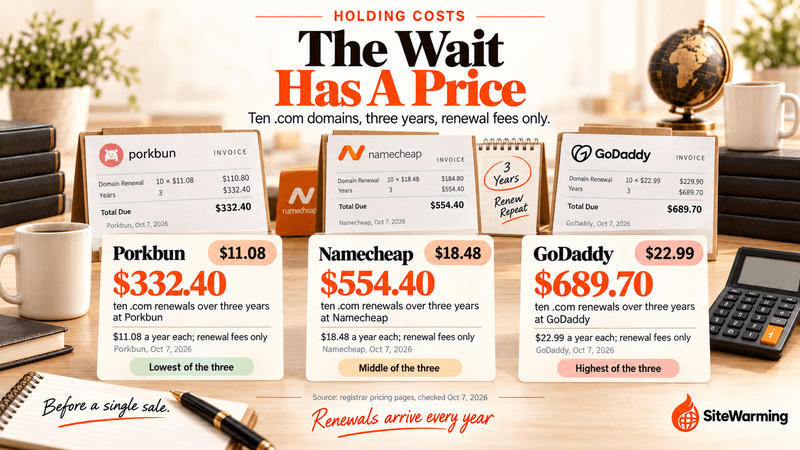
A renewal of $11 to $23 per domain per year sounds small. Here is the math for ten .com domains held for three years, using renewal prices we checked on October 7, 2026. It counts renewals only. It leaves out registration fees, marketplace commissions and your time.
| Registrar | .com renewal, per year | Ten domains, one year | Ten domains, three years |
|---|---|---|---|
| Porkbun | $11.08 | $110.80 | $332.40 |
| Namecheap | $18.48 | $184.80 | $554.40 |
| GoDaddy | $22.99 | $229.90 | $689.70 |
Porkbun's page says its price includes ICANN and other fees. Namecheap's page says ICANN charges a mandatory $0.20 a year per domain, which it adds to the listed price for some domains. Your registrar's price may differ, so check it before you decide anything.
Those prices sit on top of a registry fee that is rising. In its filing for the quarter ended June 30, 2026, Verisign said it raised the wholesale fee for each new and renewal .com registration from $9.59 to $10.26 on September 1, 2024, and announced on April 23, 2026 a rise from $10.26 to $10.97 effective November 1, 2026 (Verisign Form 10-Q). The same filing says the .com Registry Agreement lets Verisign raise the price by up to 7% in each of the final four years of each six-year period. Registrars pay that fee before they add their own margin, so the floor under every .com renewal is moving up.
What do those costs mean against the odds of a sale?
Now add the odds. If ten listed names each sold at Hawkes's adjusted rate of about 2.4% a year, you would expect about 0.24 sales a year, or roughly 0.7 over three years. At an average sale of $200, that's about $144 of expected revenue against $332.40 to $689.70 in renewals. If all ten sold at $200, you'd have $2,000 minus the renewals. That's the best case, not the plan.
This is illustrative arithmetic, not a forecast. It uses a 2019 estimate of sell-through for listed names and a sale price we chose for the example. Change the inputs and the answer changes. What doesn't change is the shape of the problem: the cost is certain and arrives every year, and the sale is neither.
The math is harder than it looks. And the emotional math is harder still, because admitting a domain won't sell means admitting the purchase was a mistake. Most people would rather keep paying renewal fees than face that.
Why would the internet reward stewarded domains?
This is an argument about structure, not philosophy. It is also our view, not a documented ranking rule, so here is what is known and what isn't. None of the major search or AI systems publishes a score for how a domain is stewarded; we cover what each one does document in how AI search engines decide which domains to trust.
What we can say plainly is this. A crawler can only read what is on the page. A parked page gives it a placeholder. A page that says what the domain is about, who it's for and how to reach the owner gives it something to read, attribute and cite. Our reading is that the systems deciding what gets found, cited and trusted look for context, coherence and continuity, and that a stewarded domain supplies all three where a parked one supplies none. Why AI can't read a parked domain sets out the mechanics.
Do veteran investors agree?
Not as a group, and we won't claim they do. As the Schwartz account above shows, some veterans hold names passively and profitably at scale. Our claim is narrower. For an owner without that scale, holding alone leaves a domain's value static until a buyer appears. A stewarded domain's value can grow because something real is attached to it. Signals accumulate. Discovery paths widen. The story behind the name becomes more coherent. The steward doesn't just wait. They build, and what they build becomes part of the asset. For the longer version of this argument, see domains are infrastructure, not lottery tickets.
In our experience, many stewards started out as accidental collectors who made a deliberate decision. The piece on accidental aggregators is worth reading if that sounds familiar. You didn't plan to own this many domains. But now that you do, the question is what you do next.
How do you know which path fits which domain?
The useful question isn't "am I a speculator or a steward?" You can probably feel the difference already, and most people are both, depending on which domain you're looking at.
Can you be a speculator and a steward at the same time?
Yes, per domain and not per person. Sort each name into one of three categories.
| Category | How to recognize it | What to do |
|---|---|---|
| Pure speculation | You bought the name because it seemed valuable. You have no attachment to the idea. You'd sell for the right number today. | Hold it if the cost is manageable. List it aggressively, accept that most won't sell and move on. Sale Readiness sorts up to 100 domains into sell, hold or develop first. |
| Stewardship candidate | You bought it because you had a real idea and the domain felt like the right name. You still believe in the idea, even though you haven't built it. | Give it something beyond a parking page, even if that something is only enough context to tell the world what the idea is. |
| Collection trap | Every domain feels like a stewardship candidate and none of them has been stewarded. | Be honest. Release or sell the ones you won't tend, and pick the few you will. |
The collection trap is the hard one. You believe in every idea but haven't built anything for any of them. That's not stewardship. That's hope wearing a steward's costume.

How do you sort your domains into these categories?
The way out is honest categorization. Not every domain deserves stewardship. Some should be released. Some should be sold. The ones that remain, the ones you actually believe in, are the ones worth building a launch strategy around.
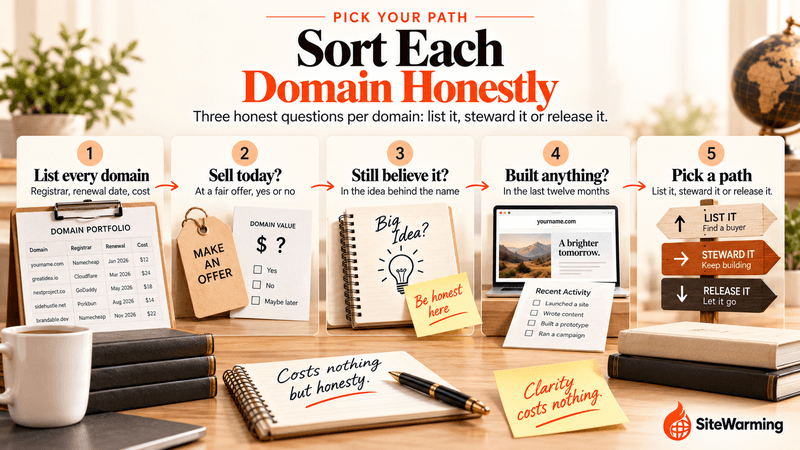
- Put every domain in one list. Registrar, renewal date and annual cost for each. Domain Renewal Analysis takes your domains one per line or as a CSV and analyzes up to 150 for free.
- Ask three questions of each name. Would I sell today for a fair offer? Do I still believe in the idea behind the name? Have I done anything with it in the last twelve months?
- Sort the answers. Would sell and no attachment: speculation, so list it. Still believe and ready to act: stewardship candidate. Believe in everything and have done nothing for any of it: that's the collection trap, so choose.
- Start small with the ones you keep. One page and a contact path per domain is a real start. How Launch & Warm works shows the steps.
- Revisit at every renewal. Renewal is the moment each domain has to earn another year.
For the full method across a portfolio of one name or fifty, see how to build a domain roadmap. That clarity costs nothing but honesty. And it changes everything.
When should a steward sell?
Stewardship isn't a vow never to sell. It's a way to be ready when someone asks. If you saw value in a name, someone else likely did too. The question is whether they can find you and reach you. A domain with a page and a contact path can receive an inquiry. A parked one can't.
When interest arrives, you decide: sell it, partner on it or build it. The sell, hold or build answer explains why SiteWarming says to gather evidence about a domain before you choose, rather than guess.
What is SiteWarming's stake in this conversation?
We have a point of view here. We'll name it directly.
SiteWarming was built for domain stewards. Not buyers and sellers. Not speculators. People who have domains tied to real ideas and want those ideas to be visible, growing and worth more over time, even if they're not ready to build the full thing yet.
Launch & Warm is the operational expression of stewardship. It's what building value into a domain looks like before you're ready to build the domain out fully. Content that establishes context. Signals that accumulate. A story that makes the idea legible to the systems that matter. A contact path means the option you bought the name for, to sell it, partner on it or build it, can actually be exercised when someone shows up.
We're not against anyone who wants to buy and sell. The domain aftermarket is real and it serves a real purpose. But our frame is stewardship, and we think the internet is moving in a direction that rewards it more, not less.
The SiteWarming perspective. SiteWarming is what stewardship looks like in practice. It's the month-to-month work of making a domain visible, coherent and growing, without requiring you to launch a full business first. An active domain accumulates the signals that make it worth more to the right person, and more discoverable to the systems they use to find things. That's stewardship in operation. What is SiteWarming?
Ready to see where your domains stand? Start free, or learn how Launch & Warm works.
Frequently asked questions about domain speculation and stewardship
What is the difference between domain speculation and domain stewardship?
Speculation buys a domain to resell it, so the outcome depends on a buyer arriving on their own timing and budget. Stewardship holds a domain tied to a real idea and builds context around it, so the owner decides whether to build, partner or sell. Speculation waits. Stewardship works on the name.
What is domain stewardship?
Domain stewardship means holding a domain you believe in and putting real context on it: a page that says what the idea is, a way for interested people to reach you, and regular updates. It isn't an established industry term, so we define it that way here. It doesn't require a full website.
What is domain speculation?
Domain speculation is buying a domain name mainly to resell it for more than you paid. The return is the sale price minus the acquisition cost, the renewals and your time. It works best for experienced investors with strong acquisition channels and enough volume to absorb the names that never sell.
How likely is a domain bought for resale to sell?
Unlikely in any given year. The most careful public estimate we found, from analyst Bob Hawkes in 2019, put the apparent yearly rate for listed names at 0.476% and his adjusted estimate at about 2.4%. It's seven years old and covers listed names only, so treat it as an order of magnitude.
How much does it cost to hold ten .com domains for three years?
At prices we checked on October 7, 2026, renewals for ten .com domains over three years total $332.40 at Porkbun, $554.40 at Namecheap and $689.70 at GoDaddy. That excludes registration fees and your time. The registry fee behind those prices rises on November 1, 2026.
Can you be both a domain speculator and a steward?
Yes, but per domain, not per person. Names you bought for apparent value and would sell today are speculation. Names tied to an idea you still believe in are stewardship candidates. The trap is treating every name as the second kind without doing any work on it.
Does domain stewardship mean building a full website?
No. Stewardship needs enough to tell people and machines what the domain is about: a single landing page, a clear statement of the idea and a way to contact you. A full site or business launch is optional. The test is whether someone who finds the name can understand it and reach you.
When should a domain steward sell?
Sell when a fair offer beats what you expect to build, or when you no longer believe in the idea. Stewardship doesn't rule out selling. A domain with a page and a contact path can actually receive an offer, so you choose whether to sell, partner or build.
Related reading
Share this article
Ready to Transform Your Domain Portfolio?
Start building real value with your domain investments today.