Is Domain Investing Still Worth It in 2026?
 Bret Siers
Someone asked me this last week. Not in a forum. At dinner. They'd bought six domains during the pandemic. The ideas had all felt urgent at the time, the way ideas do at 11pm when nobody's awake to talk you out of it. None of the domains had moved. All of them were up for renewal.
"Is this still a thing?" they asked. "Like, is anyone actually making money doing this?"
I didn't answer right away. Because the honest answer isn't yes or no. It's: it depends entirely on what you mean by "this."
What the 2026 Aftermarket Actually Looks Like
The headlines love the big sales. "ai.com" went for $11 million in 2023. Premium one-word domains still command prices that seem impossible. And yes, those sales are real. Verisign's data puts global registered domain names at around 362 million as of Q3 2025. The aftermarket is enormous.
But the headlines are telling you about the exceptions, not the rule. More than 90% of domain transactions involve names that sell for under $500. Not $5,000. Under $500. The median sale time for a non-premium domain, according to NameBio's historical data, runs somewhere between two and seven years. That's two to seven years of annual renewal fees before you see a dollar.
Think about that for a second. You pay $12 a year to hold a domain. You wait four years. You sell it for $300. You've spent $48 in renewals and however many hours listing it and fielding lowball offers. Your actual return is $252 over four years. That's not investing. That's a side project with a bad hourly rate.
The aftermarket also contracted. Sales volume is down roughly 18% from the 2021 peak, which was itself inflated by pandemic-era speculation. People at home, flush with stimulus, buying domains the way they were buying crypto and collectibles. That wave crested. It receded.
So is domain investing dead? No. Is the easy money from 2015-2021 gone? Almost certainly.
What's left is a more functional, more demanding market. The domains that sell are the ones that actually mean something to someone willing to pay for them. Which raises a question the speculation crowd doesn't want to hear: what makes a domain mean something?
Where the Speculation Model Failed
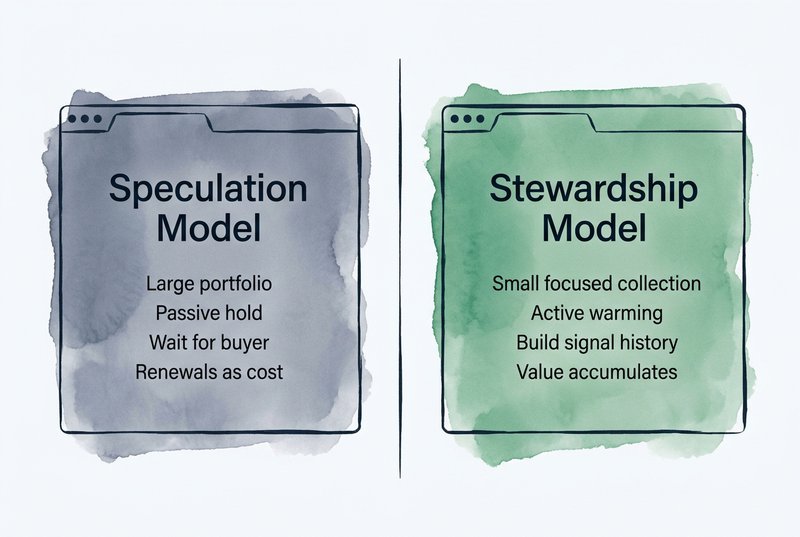
Here's the thing about the speculation model: it was always a numbers game. Buy 300 domains. Hope 10 sell. Absorb the renewal cost on the other 290 as a cost of doing business.
That math worked when domain registration fees were cheap, buyer demand was rising, and the universe of "good" domain names felt inexhaustible. It doesn't work the same way anymore. And the reasons it broke aren't temporary. They're structural.
The premium namespace got claimed. The clean, memorable, single-word .com names worth serious money were registered years or decades ago. What's left in the primary market is either long, hyphenated, or in a new extension that buyers aren't convinced about yet. If you're shopping for domain names to speculate on today, you're picking through what the professionals left behind. That's not a position of strength.
New extensions didn't behave the way speculators hoped. .io, .ai, .co, and dozens of others promised a new frontier. Some delivered. Most became confusion rather than opportunity. Buyers who need a domain for a real business usually still want .com, or they'll use whatever makes sense for their specific audience. The extension gold rush created more inventory, not more demand.
And the speculation model created its own problem: a supply glut. There are millions of domains sitting in speculative hands that will never sell because they're not actually useful to anyone. The buyers who do show up are increasingly sophisticated. They know what they want, they know what it's worth, and they're not paying speculative premiums for domains that don't solve a specific problem.
I get it. If you're sitting on a collection right now, this reads like bad news. But it's only bad news if you're still playing the old game. Buying based on keyword trends. Stacking extensions. Waiting for a buyer who shares your enthusiasm for a name you thought was clever. Many people in that position became accidental aggregators, collecting without a plan and now paying renewal fees on names they can't sell. And the worst instinct, monetizing too early with parking pages and ads, actually damages the domain's long-term value.
The speculation model isn't dead everywhere. But the version of it that worked for amateurs with good taste and a little luck? That version is mostly gone. The question is what replaced it.
Where the Stewardship Model Is Winning
There's a different kind of domain holder operating in 2026. You probably haven't heard of most of them, because they're not in domain forums talking about sales. They're building.
They don't have 300 names. They have five to fifteen. And every one of them is attached to something real, or at least something that could become real. They're not waiting for a buyer. They're building value into the domain itself. Content that establishes context. Signals that tell systems, human and machine, what the domain is about. A story behind the name that makes it more valuable to the right buyer than to any speculator.
Rick Schwartz, who built one of the most successful domain investing careers in the industry's history, has been saying it plainly since 2024: the era of passive domain holding is over. The value has moved from the name to what gets built on the name. Not the hold. Not the wait. The build.
When someone who made his fortune on name value alone tells you the game has changed, it's worth listening.
A stewarded domain accumulates something over time. Discovery paths. Reputation signals. A connection between the name and a real idea. It becomes worth more than its renewal fee in a way that a parked domain never can. A parked domain is only worth what someone else decides to pay for it. A stewarded domain is worth what you've built into it, plus what someone else is willing to pay.
The ceiling is higher. The floor is more stable. And the time you spend isn't dead weight. It's building something.
What Makes a Domain Valuable in 2026
This is actually the more useful question. And the answer has shifted in a way that matters if you're deciding what to do with your domains right now.
Three years ago, domain value was mostly about the name. Short. Memorable. Exact-match for a keyword. One word if possible. That still matters. But two new factors have emerged that matter just as much, maybe more.
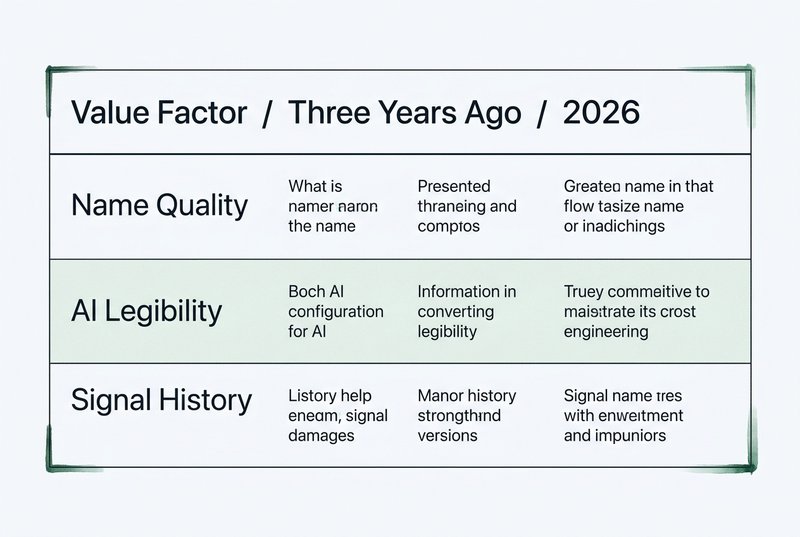
The first is AI legibility. When an AI system indexes the internet, it's not just reading page text. It's evaluating whether a domain makes sense, whether it's associated with coherent ideas, whether there's a real entity behind it. A domain with context, connected to actual content, summarizable in one sentence, is more legible to these systems than a parked page with a "for sale" sign.
Most domain holders haven't caught up with this yet. They're still optimizing for name quality alone. But a domain with a slightly less perfect name that's been developed thoughtfully may be more valuable, and more discoverable, than a clean name sitting empty. That's a different game. And it rewards different behavior.
The second factor follows from the first: signal history. How long has the domain existed? Does it have a consistent story? Has it accumulated any reputation with the systems that track these things? A domain that's been active and coherent for two years is in a different category than one that's been in holding for two years. Even if the name is identical.
Here's why this matters to you specifically. If you're holding a domain and doing nothing with it, the name isn't gaining value. It's just aging. Age without activity is a number on a registration record, not a signal anyone cares about. Activity without a good name still builds something. The name gets you in the room. What you've built on it determines whether you stay.
What This Means If You're Holding Domains Today
Let's be direct about this, because I think this is what most people reading this article actually want to know. Not the market trends. Not the history. What do I do with the domains I have right now?
If you're sitting on a collection you bought speculatively and nothing has moved in three years, you have a decision to make. Not a comfortable one. A real one.
Some domains are worth developing. Warming. Building into something, even something small, even just enough to establish that there's a real idea behind the name. You know which ones these are. They're the ones where you look at the name and can immediately picture what it could become. Those domains deserve your attention.
Some domains should be listed for sale. Not with a price that assumes the 2021 market still exists, but with a realistic number that reflects what the name is actually worth to someone who needs it. If you'd feel relieved to sell it for $300 and get the renewal cost off your plate, that's probably the right price. Relief is a good signal. Listen to it.
And some domains should be let go. This is the uncomfortable one. Not every domain that seemed like a good idea in 2020 is still a good idea in 2026. Letting a domain expire isn't failure. It's honest accounting. The speculation model taught people to hold everything, because selling felt like admitting defeat and expiring felt like leaving money on the table. But the math on most speculative domains is bad. Two years of renewals on a domain that sells for less than the holding cost is not investing. It's delayed disposal with extra steps.
The stewardship model starts from a different place entirely. A smaller, more intentional collection. A willingness to ask what you can actually do with each one. For more on how to think through this, the companion piece on domain flipping vs stewardship gets into the practical differences in behavior and decision-making between those two approaches.
The Honest Verdict
Is domain investing still worth it in 2026?
Yes. But not the way most people are doing it.
The people making it work have smaller, more focused collections. They treat each domain as an asset that needs active attention, not a lottery ticket that needs patience. They're building value into names rather than waiting for buyers to appear. They're thinking in terms of what they can create with a domain, not just what someone else might someday pay.
The people still struggling are waiting for a market that isn't coming back. The one where you could buy anything that sounded good and sell it two years later at a profit. That market existed. It was real. It's mostly gone now.
The shift isn't complicated. It's just uncomfortable. Because it asks you to do more than speculate. It asks you to steward. And stewarding, honestly, is harder than waiting. But it's the only thing that compounds.
Domain stewardship is an orientation, not a product. But when you've decided a domain deserves to be built before it's built, warming is how you start that process. A warm domain accumulates signals, discovery paths, and context, all of which increase its value to the right person, and its legibility to the systems that matter. The stewardship model starts the moment you decide a domain deserves more than a parking page. What is SiteWarming?
Related Reading:
- Domain flipping vs stewardship: the two camps, defined clearly
- From ownership to stewardship: how the philosophy shifts
- Domains are infrastructure, not lottery tickets: the foundational frame
- The myth of set and forget digital assets: what passive ownership actually costs
- How to build a domain roadmap: what to do next, practically
Image Credits
Share this article
Ready to Transform Your Domain Portfolio?
Start building real value with your domain investments today.