Why Founders Buy Domains They Never Use
 Bret Siers
Key takeaways
- There are 401.6 million registered domains worldwide, and at least 17.5% of scanned domains sit parked. Waiting is a normal state on the internet.
- Founders buy names they never use because ideas arrive in bursts and execution is linear. The domain is a capture mechanism, not a failure.
- The cost is not the renewal fee. It is the number of names you have not made a decision about.
- One question sorts a portfolio on renewal day: do I still believe in this pattern?
- The names you keep need proof of life, not a full build. One page saying what the idea is, who it serves, and what you are trying to learn.
You have forty-seven domains in your registrar account.
You haven't told your spouse about twenty of them.
You know the moment. It's late. You notice a gap. A phrase clicks into place. You check availability and it's open. You buy it for the price of a small impulse, and for a few minutes it feels like you just made the future more certain.
Then a year passes.
The renewal email arrives and the math changes. Twelve dollars becomes hundreds, not because any one name is expensive, but because your collection is larger than the story you've told yourself about it.
That's when the shame shows up. Not when you buy. When you renew.
You start using a word you hate, usually in your own head: hoarder.
Here's the problem with that frame. It treats your behavior like a character flaw, when it's mostly a structural mismatch. And the broader internet looks a lot like your registrar account.
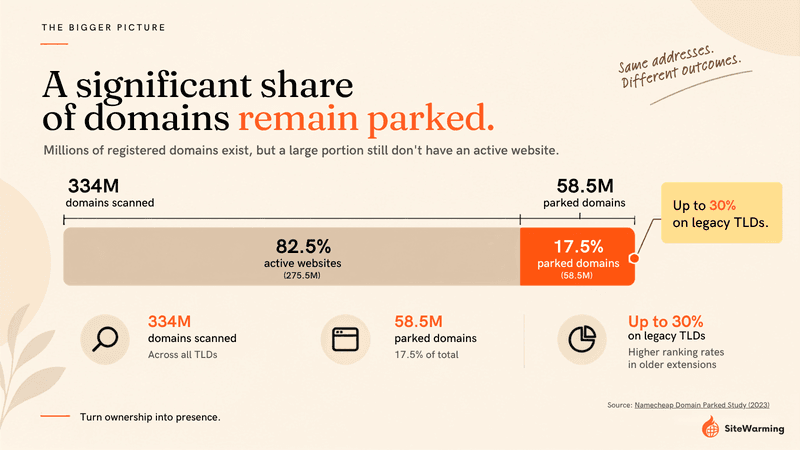
A 2023 measurement study that scanned 334 million domains found 58.5 million of them, or 17.5%, were parked. The authors are explicit that this is a lower bound, because parking can be implemented in ways their method misses. On legacy extensions, the internet's oldest top-level domains like .com, .net and .org, the share reached up to 30% depending on the source.
So before we call this a personal failure, we should admit what's true. Waiting is a normal state on the internet.
The question is not whether you have too many domains. The question is whether you have a relationship with your portfolio that creates guilt by default.
You're not a hoarder. You're an accidental aggregator.
Founders accumulate unused domains for a reason that has nothing to do with clutter.
"Hoarder" is a judgment. It implies you're keeping trash because you can't let go. That's not what most founders are doing.
Founders are pattern-recognition machines. That is the job description. We notice friction, we notice language, we notice neglected edges of the market, and we want to capture the shape of the thing before the moment passes.
Domains are the simplest capture mechanism we have. They turn a passing pattern into an object. A name. An address. A place you can return to later.
What is an accidental aggregator?
An accidental aggregator is a founder who registers domain names faster than they can build on them, accumulating a portfolio of undeveloped names without a deliberate portfolio strategy. The behaviour is a capture reflex rather than a compulsion: each name records a pattern the founder noticed before they had time to act on it.
It's not a flattering term. It's an accurate one.
You're collecting because you see faster than you can build.
Why pattern recognition outruns execution
The psychology here is not mysterious. It's documented.
A paper in the Journal of Consumer Research by C Clark Cao argues that collecting is often driven by a fundamental desire for control, and that people seek structure by turning separate items into a coherent whole.
That maps cleanly onto founder behavior. When the world is noisy, organizing possibilities feels like progress. Even when nothing is launched. Even when all you did was buy a name.
And it creates a predictable mismatch:
Ideas arrive in bursts. Execution is linear.
How common are unused domains?
Unused domains are not an edge case. They are a structural feature of the internet.
There were 401.6 million registered domain names across all top-level domains at the end of the second quarter of 2026, the Domain Name Industry Brief. That is up 8.1% year on year. The .com and .net extensions account for 179.1 million of that total on their own.
What the parking data actually measures
A parked domain is one that resolves to a placeholder instead of a real page. Sometimes that is a registrar default page. Sometimes it is an ad page. Sometimes it is a "coming soon" template that has been coming soon since 2019.
The 17.5% figure counts only the parking patterns a scanner could reliably detect. Anything hosted in a less standard way falls outside the count, which is why the researchers flagged their own number as conservative. The real share of domains showing nothing meaningful is higher.
Why two renewal statistics disagree
A commissioned study of one million domains across eight TLDs found only 29.79% were re-registered for more than a year. That leaves 70.21% not renewed. Meanwhile, Verisign reports a combined .com and .net renewal rate of 75.2% for the second quarter of 2026.
Those two numbers look like they contradict each other. They don't, because they measure different populations.
Verisign's figure covers the entire .com and .net base, which is dominated by names that have already survived several renewal cycles. The one-million-domain sample tracks fresh registrations through their first renewal, where abandonment is far higher. Both are true at once. Established domains renew reliably, and speculative first-year registrations mostly do not.
Your portfolio is full of names that crossed from the second group into the first. That is exactly why they feel heavy.
So if you're renewing into year two or three, you're not behaving like the average first-time registrant. You're not uniquely broken. You're unusually committed.
Commitment is where the emotional weight starts, because commitment demands decisions. And most founders don't have a decision system for their portfolio. They have a purchase system.
The dormancy gap: where domain guilt comes from
The dormancy gap is the period between capturing a name and making the idea legible. It is the single place where domain guilt is manufactured.
The purchase moment feels clean. The gap after it does not. In that gap, your portfolio stops feeling like possibility and starts feeling like a list of promises.
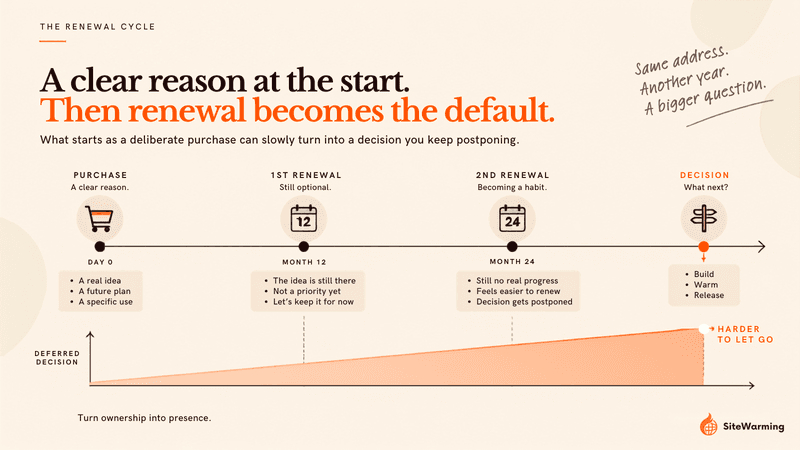
The guilt is not proof that you're irresponsible. It's proof that you're carrying too many undecided futures.
It is also where visibility starts to matter, not in the marketing sense but in the internet-memory sense. Parking a domain is a public state. It signals nothing about what the idea is, who it's for, or whether it is alive. Silence has a way of becoming a durable signal.
Two threads we've pulled harder elsewhere: what parking a domain actually costs beyond the renewal fee, and why AI systems can't read a parked domain at all.
Hoarding vs stewardship: the one difference that matters
There is a line between the two. Not a moral line. A functional one.
Hoarding is accumulation without intention. You keep names because releasing them would force you to admit the idea has changed.
Stewardship is curation with explicit intent. You keep names because they still map to futures you actually believe in.
Here is what the difference looks like in practice.
| Hoarding | Stewardship | |
|---|---|---|
| Why you keep it | Releasing it would mean admitting the idea changed | It still maps to a future you believe in |
| What's on the domain | A parking page, or nothing | One page stating intent |
| Renewal day | Autopay, no review | A scheduled decision |
| Record of intent | In your head | Written down and dated |
| Portfolio size | Unbounded | Bounded by attention |
| What it signals | Nothing | Live, early, deliberate |
This is where the "how many domains" conversation gets unhelpful. Count is not the core problem. Undecided count is.
Collections aren't the problem. Invisibility is. A portfolio you've made legible is a form of stewardship. A portfolio you hide from is just deferred decision-making.
The same idea shows up in a different form in Domains Are Infrastructure.
How to decide what to do with each unused domain
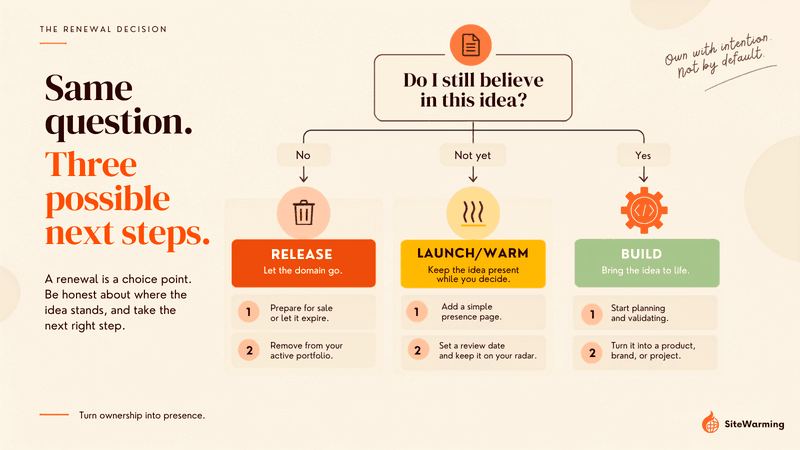
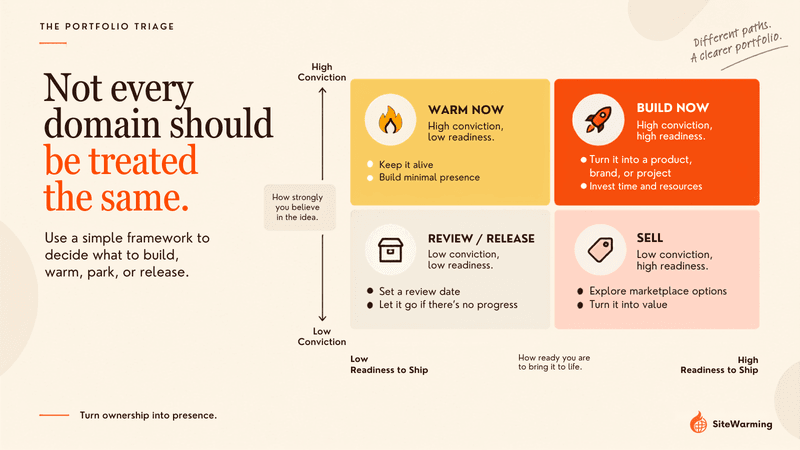
Here is the system. It takes one sitting, it works on a portfolio of any size, and it produces three piles: release, warm, build.
Step 1: Sort by conviction, not by renewal price
Open your registrar account and export the list. Most founders sort by cost, because cost is the thing that triggered the review. Sort by conviction instead.
Next to each name, write one sentence describing what the idea is and who it's for. If you can't write the sentence, that tells you more than the renewal price does.
Names with no sentences are not expensive. They are undecided, which costs more.
If exporting and annotating the list sounds like a Saturday you'd rather not spend, paste your domains into the renewal analysis. It returns what each name is costing you, which ones have never shown a signal, and which are worth warming first. It takes about two minutes.
Step 2: Ask the renewal-day question
The next time the renewal email hits, don't treat it like a fine. Treat it like a forcing function.
Ask one question: do I still believe in this pattern?
If the answer is no, release it. Not as a confession. As a clean edit.
If the answer is yes, ask the second question: can I ship a real page for this in the next three months? If yes, build it. If no, warm it. Choosing between those two is the whole subject of the third option between building and parking.
Step 3: Give the keepers proof of life
Every name you keep gets moved from parked to present. Not with a full build. With proof of life.
A single page that says what the idea is, who it serves, and what you intend to learn next. That is the minimum a discovery system needs in order to register that something exists here. It is also the minimum a human needs in order to stop feeling like the name is a debt.
If a domain has been parked for years, the switch isn't instant on the search side. Getting Google to stop treating a domain as parked takes a few deliberate steps.
Step 4: Release the rest on purpose
Releasing is not failure. It is the edit that makes the rest of the portfolio mean something.
Do it deliberately rather than by accident. Expiry runs on a fixed ICANN schedule with grace periods, redemption windows and recovery fees attached, and drifting into it by ignoring an email is the expensive way to let a name go. Here is what happens in the 30 days after a domain expires.
And if a name you're releasing has genuine market value, check whether it's ready to sell before you let it drop. Some of what you're carrying is inventory, not guilt.
What a proof-of-life page needs
A proof-of-life page is the smallest thing that makes a domain legible. Six elements, and nothing else is required.
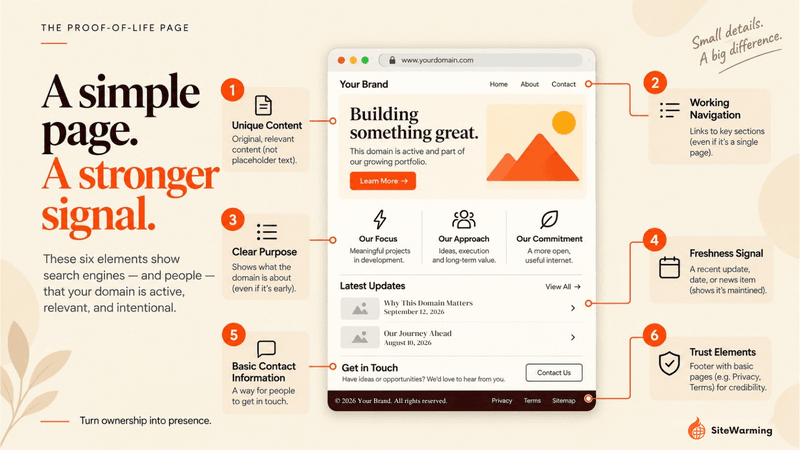
- A plain sentence naming what the idea is. Not a tagline. A sentence.
- Who it's for, specifically enough that the wrong reader leaves.
- What you're trying to learn next, with a date on it.
- One way to reach you.
- A visible last-updated date, so the page reads as tended rather than abandoned.
- Enough real text that a crawler and a language model can tell what the page is about without guessing.
That's it. You are not launching. You are refusing to be silent.
How many domains should you keep?
There is no universal number, and anyone who gives you one is selling something. Three limits actually bind, and you keep the smallest of them.
- The renewal you would pay without flinching. Not the amount you can afford. The amount that doesn't make you avoid the email.
- The number of names you can review in one sitting. If the list outlasts your attention, you're not curating. You're deferring.
- The number of ideas you can give proof of life to in a year. For most founders running one main business, that's somewhere between three and six.
Most founders find the third number is far smaller than the first. That gap is the portfolio.
From guilt to systems
We've lived the loop: buy the domain in clarity, then renew it while the idea stays dark.
Warming is choosing to make an idea legible before you feel ready. Quietly. On purpose. Discovery systems learn from repeated observation, and empty space becomes a durable signal. That's the whole idea behind what we mean by warming a domain, and it's the shift from ownership to stewardship. Owners accumulate. Stewards decide.
The best part is the emotional side effect.
Guilt dissolves when intention becomes visible.
You aren't a domain hoarder.
You're a builder who sees patterns faster than you can build.
Decide which ideas deserve your attention. Make those legible. Release the rest with honesty.
Before the next renewal email arrives, put your list somewhere you can see it. Run the renewal analysis and you'll get back what each name is costing you, which ones have never shown a signal, and which are worth warming first. If you want to see how that compares to leaving them where they are, here's parking next to warming.
Frequently asked questions
Why do entrepreneurs buy domains they never use? Founders buy domains they never use because registering a name is the fastest way to capture an idea. Pattern recognition takes seconds; building takes months. The domain turns a passing observation into an object you can return to. Ideas arrive in bursts, execution is linear, and the gap between them fills with unused names.
Is it bad to own domains you don't use? Owning unused domains is not a problem on its own. At least 17.5% of scanned domains sit parked, so waiting is a normal state on the internet. The cost appears when names are undecided rather than merely unused: you renew every year without ever establishing whether you still believe in the idea.
How many domains is too many? There is no universal limit. The practical ceiling is the number of names you can make a clear keep-or-release decision on in a single sitting. If your renewal list contains names whose purpose you can't state in one sentence, the portfolio has outgrown the attention you give it.
What should I do with domains I'm not using? Sort every name into three actions. Release the ones you no longer believe in. Build the ones you can genuinely ship this quarter. For everything in between, publish a proof-of-life page: one page stating what the idea is, who it serves, and what you intend to learn next.
Should I let an unused domain expire? Let it go when you can't say what the idea is or who it serves, when the name no longer matches where the business is heading, or when you wouldn't buy it again today at renewal price. Release it deliberately rather than by accident, because expiry runs on a fixed schedule with recovery fees attached.
Do parked domains have any SEO or brand value? A parking page tells discovery systems nothing about the idea, so the domain accumulates no topical signal and no trust. Search engines and AI systems learn from repeated observation of real content. An empty page is not neutral; over time, it becomes a durable signal that nothing is there.
Share this article
Ready to Transform Your Domain Portfolio?
Start building real value with your domain investments today.