Why Monetizing a Domain Too Early Hurts It
 Bret Siers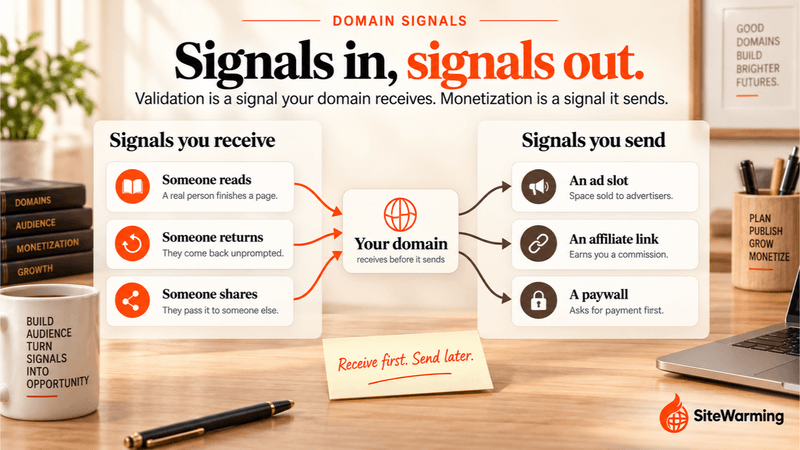
Monetizing a domain too early hurts it when the monetization is thin: affiliate links or ads on a few pages with nothing original to offer. Google's spam policies target thin affiliate content, and visitors dislike intrusive ads. Monetization itself is not penalized. Start once readers return on their own and the offer extends the site.
Someone in a founder Slack told me earlier this year that I was leaving money on the table.
I'd mentioned a domain I've been accelerating for about a year. No ads. No affiliate links. Just content. Just presence. And this person, trying to help, said: "Why not throw some affiliate links on there? At least cover your renewal costs."
Twelve dollars a year. That's what they wanted me to optimize for. A .com costs a registrar $10.26 a year at wholesale until November 1, 2026, and $10.97 after that, according to Domain Name Wire. Call it twelve dollars at retail: a dollar a month.
I didn't push back in the moment. But something about it sat wrong. Not the advice itself. It was logical, tidy, responsible-sounding. What bothered me was the assumption underneath it: that a domain's first job is to pay for itself. That if it isn't generating revenue, it isn't doing anything.
Here's the thing. Monetizing early and validating early aren't the same thing. One is a signal you receive: people care, something resonates, there's demand. The other is a signal you send, and what you send to search engines and visitors in the early months matters more than most founders realize.
The pressure to monetize is real, and the risk is narrower than "any monetization poisons a domain." Thin, low-value pages and intrusive ads on a brand-new domain with no established signals rarely earn much, and they can make everything you publish afterward harder to get noticed. This post separates what Google's own documents say from what I think, and it labels which is which.
What does "validate early" mean, and how is it different from monetizing?
The startup world loves the phrase "validate fast." It's good advice, mostly. Test your assumptions. See if anyone cares. Don't build for two years in silence.
But somewhere between lean startup theory and domain management, "validate" got translated into "monetize." And that translation error is where the damage starts.
Validation means testing whether your idea connects with real people. Does anyone read this? Does anyone come back? Does anyone share it? Those are signals you receive: proof of resonance. Monetization means extracting value: ads, affiliate links, paywalls. Those are signals you send, and they tell both people and machines what this domain is for.
| Validation | Monetization | |
|---|---|---|
| Direction of the signal | Received | Sent |
| Examples | Readers return, share, reply | Ads, affiliate links, paywalls |
| What it tells people and systems | Something here is wanted | What this domain is for |
| When it fits | From day one | After readers return on their own |
Put affiliate links on a three-month-old domain with eight pages of content and you haven't validated anything. In my read, you've told everyone looking, human or machine, that this domain exists to extract, not to contribute.
Google's Search Quality Evaluator Guidelines point the same way. They are the document that trains the people who rate Google's results, and their lowest rating covers pages "created to benefit the owner of the website (e.g. to make money) with very little or no attempt to benefit website visitors." One caveat: Google says a rater's score "does not directly impact how this page or site ranks in Search", because the ratings measure how well its systems perform. So read the guidelines as a statement of what Google is trying to reward, not as a penalty list.
A domain with real content that serves visitors is building a foundation. A domain with affiliate links before it has built any trust is announcing its intentions before it has earned the right to have them. Domains inadvertently become something they weren't meant to be when the earliest signals point the wrong way.
Infrastructure means building before extracting. Monetization without trust isn't validation. It's extraction wearing a responsible-sounding name.
Does monetizing a new domain hurt SEO?
Not by itself. Google's published policies don't penalize earning money from a site. They penalize low-value pages, and a brand-new domain with eight pages and a handful of affiliate links is where low-value pages are easiest to produce.
What do Google's spam policies say about thin affiliate pages?
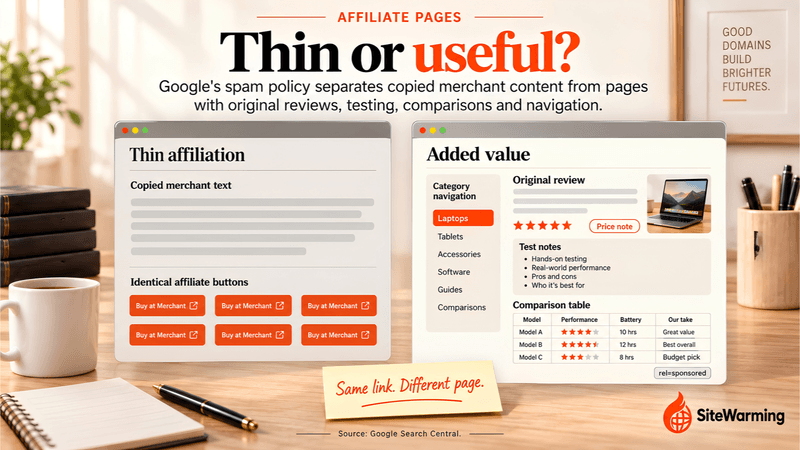
Google's spam policies define thin affiliation as "the practice of publishing content with product affiliate links where the product descriptions and reviews are copied directly from the original merchant without any original content or added value." They also say what a good affiliate page does instead: original product reviews, rigorous testing and ratings, navigation of products or categories, product comparisons and additional information about price.
The consequence is narrower than "removal from the index." The same policies state that sites that violate them "may rank lower in results or not appear in results at all." If a person at Google reviews the site and finds a violation, it appears in Search Console's manual actions report as "thin content with little or no added value," a category that covers thin affiliate pages, scraped content and doorway pages. To clear it, Google asks you to fix all affected pages and then request a review.
Affiliate links themselves are not the violation. Google's guidance on qualifying outbound links asks you to mark advertisements and paid placements with the sponsored value. Tag affiliate links the same way.
What did Google's March 2024 update change?
In March 2024 Google announced a core update and three new spam policies: scaled content abuse, site reputation abuse and expired domain abuse. On April 26, 2024 it reported that the rollout had finished on April 19 and that people would see "45% less low-quality, unoriginal content in search results versus the 40% improvement we expected across this work," in Google's own announcement. That figure covers the update together with Google's earlier efforts, not one change on its own.
Only some of the new rules can touch a young domain. Here is how each one reads against a fresh registration with a few honest pages.
| Policy | What Google says it covers | Does it describe a new domain with a few honest pages? |
|---|---|---|
| Thin affiliation | Affiliate links with product descriptions and reviews copied from the merchant, with no original value | Only if the pages are copied or add nothing |
| Scaled content abuse | "Many pages are generated for the primary purpose of manipulating search rankings and not helping users" | Only if you publish pages in bulk for rankings |
| Expired domain abuse | "An expired domain name is purchased and repurposed primarily to manipulate search rankings by hosting content that provides little to no value to users" | No, unless you bought an expired name |
| Site reputation abuse | Third-party content published on a host site mainly because of that host's already-established ranking signals | No, it needs an established site |
That means expired domain abuse is about expired names bought for the signals they already carry. It is not a rule against filling a new registration with ads. If your domains are fresh registrations, the policies that apply are thin affiliation and scaled content, and both ask the same question: did you add anything?
Does the Google sandbox explain why new domains are slow?
SEO folklore says new domains sit in a "sandbox." Google has never confirmed one. John Mueller said in 2018, "We don't really have this traditional sandbox...we have a number of algorithms that might look similar," as quoted by Ahrefs. This argument doesn't need a sandbox. It rests on what Google publishes about thin content and on what visitors do.
What do visitors do when a new site leads with ads?
The machine side is only half of it. The research I can verify says visitors overlook what looks like an ad and think less of sites that interrupt them. Two of the three studies are old, so read them as direction, not measurement.
| Study | Date | What it measured | What it found |
|---|---|---|---|
| Web credibility study hosted by Consumer Reports (Stanford Web Credibility Project) | October 29, 2002 | Comments from 2,684 people evaluating the credibility of two live websites | The "design look" of the site was mentioned most often, in 46.1 percent of the comments |
| Banner blindness: old and new findings, Nielsen Norman Group | April 22, 2018 | Eyetracking with 26 participants completing tasks on web pages | People tended to ignore page elements they perceived, correctly or not, to be ads |
| Most hated advertising techniques, Nielsen Norman Group | December 5, 2004 | A survey of 18,808 users on how a pop-up ad affected their opinion | More than 50% said it affected their opinion of the advertiser very negatively, and nearly 40% said the same of the website |
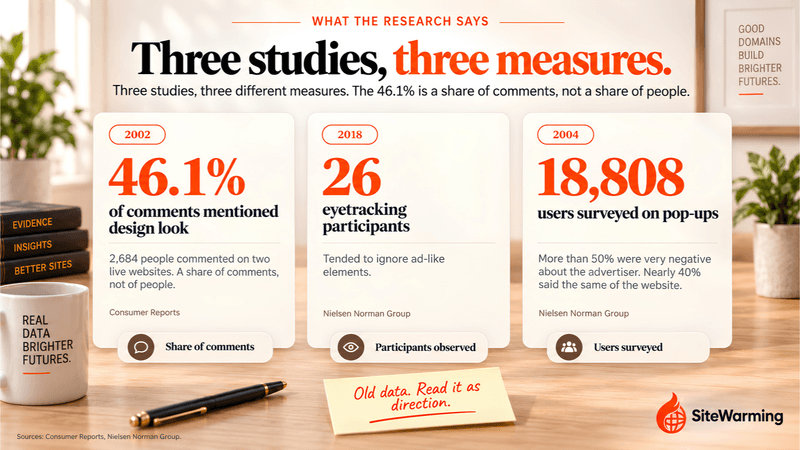
The credibility figure is easy to misread. The 46.1 percent is the share of comments that mentioned design look, not the share of people who judge a site on looks alone. It still says something useful: appearance is the first thing many people comment on. A new domain that leads with a banner grid asks for trust before it has given them anything to trust.
When a visitor lands on a new domain and sees ads, affiliate banners or a monetization-forward layout before any real substance, many will leave. Whether those bounces feed back into how search systems judge the site is a separate question. I haven't found Google confirming it, so that part is my inference, not a documented mechanism. What the pop-up survey does support is that visitors hold the website responsible for what it shows them, not only the advertiser. My read is that it compounds: a first impression people don't return from also leaves you with no returning readers, the one signal that would justify monetizing later.
Can a domain recover from a thin, monetized start?
Yes, but slowly, and that slowness is the cost. Sometimes I hear "early monetization is risky" interpreted as "you'll miss some revenue." That's not the risk. The risk is spending your first months building a record that makes real money harder to earn later.
Google has been drawing this line for a long time. On February 24, 2011 it announced a change that "noticeably impacts 11.8% of our queries," aimed at "low-quality sites" it described as "sites which are low-value add for users, copy content from other websites or sites that are just not very useful," in the post that introduced what became known as Panda. The target was low value, not revenue.
What does Google say about recovery today? Its guide to core updates says: "Some changes can take effect in a few days, but it could take several months for our systems to learn and confirm that the site as a whole is now producing helpful, reliable, people-first content in the long term." It also says deleting unhelpful content can help the good content on a site perform better.
There is a site-wide element too, with limits. Google's ranking systems guide says site-wide signals and classifiers "contribute to our understanding of pages," and adds that good or poor site-wide signals don't mean every page from a site ranks one way.
So here is the compounding problem, stated with what the sources allow. A thin, monetized start rarely earns meaningful revenue. It also hands you months of rebuilding before your real work is judged on its own merits, because Google confirms improvement slowly. Future content may have to work against the site's own record. That is slower and more expensive than never building the record.
The quiet part is the worst part. A manual action is reported in Search Console. A slow ranking problem usually doesn't announce itself. As far as I can tell, nothing tells you the site has been judged low-value. You notice that nothing seems to work: content doesn't get discovered, visitors don't return, and you can't work out why.
Stewardship means not extracting prematurely. The domain doesn't know about your cash flow concerns or your renewal anxiety. It only knows what you showed it. The dormancy of a quiet domain that's building a story is less damaging than the active harm of a domain broadcasting the wrong identity.
The irony is sharp. Twelve dollars a year in affiliate commissions can cost you far more in lost trust, the kind that would have enabled real revenue down the line. That last point is my opinion. The numbers I can source stop at the months Google says it takes to confirm a change.
Why does patience give a domain a structural advantage?
I get it. The word "patience" sounds passive. It sounds like something people say when they don't have a better plan. "Just be patient." Nobody wants to hear that.
But this isn't that kind of patience. It's a sequence, and it's my rule of thumb, not a Google rule: value first, trust second, revenue third. Invert that order and you pay for it, not once, but continuously, as the early record shapes everything that follows.
Think about the two paths. The figures below are an illustration, not measured data.
| Path A: monetize at six months | Path B: publish first, monetize later | |
|---|---|---|
| What goes on the site | Affiliate links, display ads, maybe product reviews sourced from merchant descriptions | Original content, no ads, no links that exist to earn commissions |
| Revenue (illustrative) | A few dollars a month | Zero |
| How Google's policies would read it | Thin affiliation, if the reviews are copied from merchants | Nothing to flag |
| What visitors likely do | Bounce | Stay longer, some return |
| When monetization arrives | Already behind: future content works against the record | Aligned with the content and the same audience, so it works because trust was the foundation |
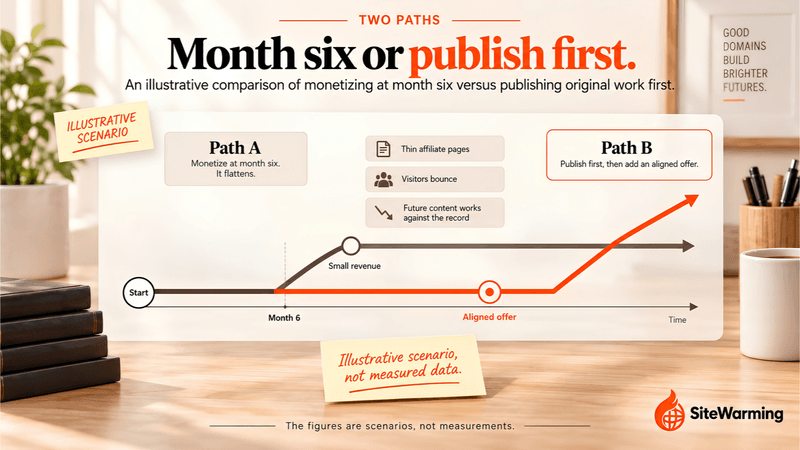
Patience isn't passive. It's the most structurally aggressive thing you can do with a new domain. While you're building presence and earning trust, the early monetizer is teaching visitors and search systems to expect very little from the site.
Options theory applies here in a real way. A domain that hasn't been judged yet still has every option open: a publication, a product, a community, a partner vehicle, a sale. A domain that started as a monetization platform has fewer paths, and some get harder to reach because the site's record points the other way. If you're weighing those options across a portfolio, the sell, hold or build decision is worth making before anyone puts an ad on the page.
Value appreciation happens when you invest in the domain before you ask it to invest in you.
Will an ad network even approve a brand-new site?
Not if it is thin. Ad networks enforce the same instinct. In Google's guidance on insufficient content for AdSense, published March 1, 2017, a site with insufficient content "may not have enough text, and/or the site was deemed to be 'under construction.'" Google adds that sites consisting only of a template and very little content may not be approved. The AdSense requirements page also tells publishers not to put ad code on auto-generated pages or pages with little to no original content.
So a domain with eight pages and a banner slot is not just risky for search. It may not clear the network's own review.
When is a domain ready to monetize?
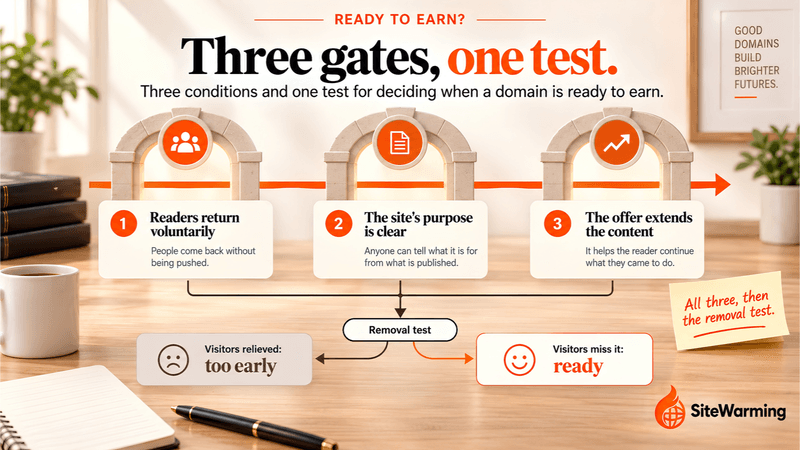
I want to be clear. This isn't an anti-monetization argument. Monetization is fine. Monetization is good. Revenue is how ideas sustain themselves. This is a timing argument, and no source gives a fixed number of months, so I use conditions instead. A domain is ready when all three are true:
- The audience returns voluntarily. People come back because the content served them, not because you captured their email or ran retargeting ads. They chose to return. That's a trust signal no affiliate link can manufacture.
- The site's purpose is established. Enough consistent, valuable content exists that anyone, or any system, can tell what the site is for. It reflects what you actually built, not what you hoped to extract.
- The monetization feels like extension, not pivot. The audience expects it because it aligns with the value already provided. A recommendation from a trusted source feels different from a banner ad on a thin page. Same mechanism, someone clicks and you earn a commission, but the context changes everything.
What is the removal test for early monetization?
Here's the simplest test I know. If removing the monetization would make visitors feel relieved, it's too early. If removing it would make them feel like something useful is missing, like a tool or resource they relied on disappeared, then it's time.
Google's guidance on helpful content asks a version of the same question about purpose: whether content is "created primarily to help people" or primarily to attract search visits. Early monetization answers that question the wrong way. Patient monetization answers it the right way. And when the foundation is there, long-tail audiences become revenue infrastructure rather than an afterthought.
How do you monetize a young domain without hurting it?
- Publish original pages first. Give people a reason to return before you ask for anything. Copied merchant text is the exact pattern Google's spam policies name.
- Add value to every affiliate page. Google's list is original reviews, testing and ratings, product comparisons, price information and navigation. If a page has none of those, don't put a commission link on it.
- Tag paid links. Use
rel="sponsored"for advertisements and paid placements, as Google's guidance on outbound links asks, and say plainly when a link earns you money. - Keep the offer off the first screen. Nielsen Norman Group's 2004 survey found pop-ups reflected badly on the website that showed them.
- Add one placement and watch. If returning readers hold steady, add another. If they drop, take it out.
Is a parked page with ads the same risk?
It is the extreme case of thin monetization: no original content at all, with the revenue coming from ads. A 2014 USENIX Security study by Sumayah Alrwais and colleagues examined 24 million monetization chains over 5.5 months and found illicit monetization revenue approached 40% of the total for some parking services. That is one study, from 2014, of parking services, not of every parked page. It is still a fair reason to look hard at what a parking page actually shows your visitors. The parking question has its own posts: why parking is not neutral and how to monetize a domain without ads or parking pages. If your site already has an audience, monetizing a niche website without ads covers the models that fit.
How do you decide which domains in a portfolio are ready to earn?
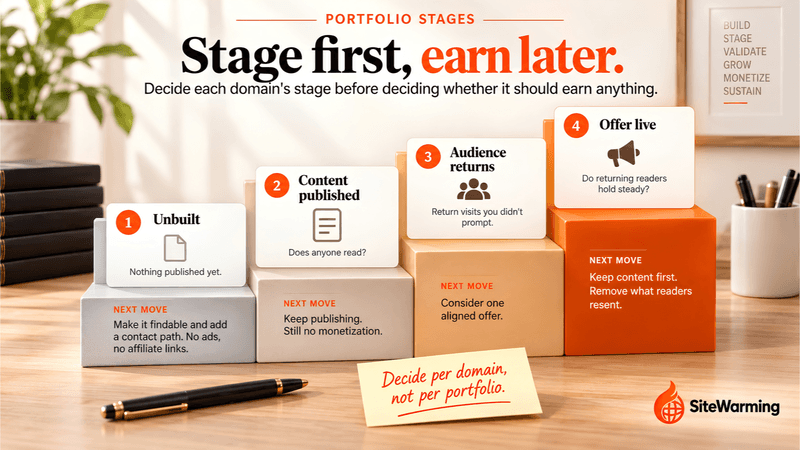
If you hold more than a handful of names, the mistake is deciding for the portfolio instead of for each domain. Put each name at a stage, and let the stage decide whether it earns anything. The order I argue for is visibility before validation, then monetization.
| Stage | What exists | What to look for | Next move |
|---|---|---|---|
| 1. Unbuilt | A registered name, nothing published | Nothing yet | Make it findable and give it a contact path. No ads, no affiliate links |
| 2. Content published | Original pages, no audience yet | Does anyone read? | Keep publishing. Still no monetization |
| 3. Audience returns | Readers come back on their own | Return visits you didn't prompt | Consider one offer that extends the content |
| 4. Offer live | An aligned offer on the site | Do returning readers hold steady? | Keep content first and remove what readers resent |
The SiteWarming perspective: warming protects the foundation. Launch & Warm puts content on an unbuilt domain so it can be found, and gives the name a contact path, so the owner can hear from people who want to buy, partner or build without the page carrying an ad. An active domain builds presence, trust and visibility before anyone asks "but how does it make money?" How it works walks through the process, and What is SiteWarming? is the longer explanation.
The other half is knowing where each name stands. The domain management tool shows every domain across every registrar in one view. Add domains singly, import a CSV or connect a registrar, and it shows what's live, what leads nowhere and what's approaching renewal, with a HumbleWorth valuation and more than 15 appraisal sources. The free plan, on the pricing page, tracks up to 1,000 domains, and the guide to managing domains across multiple registrars explains how to get that view without moving anything.
What should you do when someone tells you to cover your renewal costs?
The pressure to monetize is real. The advice comes from good places. Someone tells you to "at least cover your renewal costs" and it sounds reasonable. Responsible, even.
But here's what I keep coming back to. The domain doesn't know about your runway. It doesn't know about your anxiety or your renewal date or the Slack channel where someone told you to throw up some affiliate links. It only knows what you showed it first. I expect AI shopping agents to weigh a domain's record the same way, a case I make in When Agents Do the Shopping. That is my expectation, not a documented behavior.
And what you showed it first shapes what it becomes. Sometimes the most responsible thing you can do with a domain isn't to make it pay for itself immediately. It's to let it become something worth paying for.
If you're sitting on a domain right now, resisting the pressure to monetize before it's ready, you're not wasting time. You're not leaving money on the table. You're building something early monetizers skipped.
That's not procrastination. That's stewardship.
Frequently asked questions
Does monetizing a new domain hurt SEO?
Not by itself. Google's spam policies target thin affiliation, meaning affiliate links with merchant-copied descriptions and no original value, and violating sites may rank lower or not appear at all. A young site with original pages and tagged affiliate links is not breaking a rule. The risk is thin pages, not the presence of a link.
Can affiliate links get a new website penalized?
Affiliate links are allowed, but Google's manual actions report lists thin affiliate pages under thin content with little or no added value. Google says good affiliate pages offer original reviews, rigorous testing, ratings, product navigation or comparisons. Tag paid links with rel="sponsored" and publish original pages before adding any.
How long should I wait before monetizing a new domain?
No source gives a fixed number of months, so wait for conditions instead. Monetize when visitors return without prompting, when enough consistent original content shows what the site is for, and when the offer extends what you already publish. Google says it can take several months for its systems to confirm a site is helpful.
Does Google have a sandbox for new websites?
Google has not confirmed one. In 2018 John Mueller said, "We don't really have this traditional sandbox...we have a number of algorithms that might look similar." The argument for waiting does not depend on a sandbox. It rests on Google's published policies on thin content and on how visitors react to ads.
Can a domain recover from thin affiliate content?
Yes, though not quickly. Google says it could take several months for its systems to confirm that a site now produces helpful, people-first content, and that deleting unhelpful content can help the good content perform better. For a manual action, fix every affected page, then request a review in Search Console.
Is it okay to put ads on a brand-new website?
Ad networks may refuse a thin site. Google says an AdSense site deemed under construction or with too little text may not be approved, and its requirements warn against placing ad code on pages with little original content. A 2004 Nielsen Norman Group survey found pop-ups reflected badly on the website too.
What is a thin affiliate page?
Google calls it thin affiliation: publishing content with product affiliate links where the product descriptions and reviews are copied directly from the original merchant without any original content or added value. A page with original testing, comparisons, price information or product navigation is a different thing, and Google names those as the fix.
Should I park a domain with ads to cover the renewal fee?
Probably not. Wholesale .com costs $10.26 a year until November 1, 2026 and $10.97 after, about a dollar a month, which a parked page rarely justifies. A 2014 study of 24 million parking monetization chains found illicit revenue approached 40 percent for some parking services. A simple page with a contact path carries less risk.
How do I know my domain is ready to monetize?
Check three conditions. Visitors come back without being prompted, enough consistent original content exists to show the site's purpose, and the offer extends what you already provide. Then apply the removal test: if taking the monetization away would leave visitors relieved, it is too early. If they would miss it, it is time.
Related reading
- How to Monetize a Domain Without Ads or Parking Pages: seven options for making a domain useful before you build the full site.
- How to Monetize a Niche Website Without Ads: the models that fit once a niche audience exists.
- Domain Parking Is Not Neutral: what a parked page tells search systems and visitors.
- Why You Should Launch Your Domain Before the Idea Is Ready: why visibility comes before proof.
- Domains Are Infrastructure, Not Lottery Tickets: why building comes before extracting.
- Accidental Aggregators: how a domain becomes something it was never meant to be.
Share this article
Ready to Transform Your Domain Portfolio?
Start building real value with your domain investments today.