How to Monetize a Domain Without Ads or Parking Pages
 Bret Siers
You registered the domain. The idea felt real. It still does.
But that was eight months ago, and the site you were going to build is still sitting at "when I have time." The renewal invoice just arrived. You've been paying to hold a name that's doing nothing except costing you $12 a year and a small steady guilt.
Here's what most domain owners do at this point: park it. Enable ads. Let the registrar fill the page with links that have nothing to do with the original idea, collect a few cents in parking revenue, and call it managed.
I want to show you a different set of options. Specifically, I want to show you what's possible this weekend. Not "build the whole site." Not "launch the full product." Just: make the domain start doing something useful while you figure out the rest.
This article is for pre-website, pre-audience domain owners. If you already have a site with content and visitors, this isn't your entry point. But if your domain is parked or dark and you're wondering whether there's a middle path between "build everything" and "do nothing," keep reading.
Why parking and ads aren't neutral options anymore
First, the honest case against parking. Not "parking is lazy." That's a moral argument and it's not useful. This is the practical one.
Parking pages send specific signals to search engines and AI systems. Those signals are: this domain has no content, no identity, no consistent purpose. When either humans or machines visit a parked domain looking for something to index, cite, or trust, they find noise. Not silence. Noise. There's a difference.
In 2010, ad parking generated meaningful revenue because display advertising paid well and domain visitors were counted on volume. In 2026, the math is broken. Ad parking revenue for most domains is measured in cents per month. The reputation damage is measured in months of trust signals erased.
I've talked to domain owners who were genuinely surprised by this. They assumed parking was neutral, just sitting there, doing nothing. "I'm not hurting anything," they'd say. But they were. Parking a domain isn't neutral storage. It's active erosion. Domain parking is not neutral, and every month of parking is a month where the domain's reputation stays flat or declines, while a domain with even minimal content and structure is accumulating something.
The real cost of parking a domain goes beyond the revenue shortfall. It's the opportunity cost of all the signal-building that didn't happen. Time you can't get back.
The good news is that "something" doesn't have to be complicated. Here are seven options, ordered from "you could do this today" to "this takes a few weeks."
Option 1: Forward the domain to a lead capture page
This is the fastest thing you can do. Today, if you want.
Domain forwarding means pointing your domain to a URL you control. That URL doesn't have to be a full website. It can be a single landing page built with Carrd, a Linktree, a ConvertKit landing page, or any simple page tool. These take an afternoon to set up, many have free tiers, and none require code.
What goes on the page? Your name. What the domain is eventually going to be about. One sentence that says: "This is coming. Leave your email if you want to know when it's ready."
That's it. You now have a domain that when someone types it into a browser, they see something human instead of ad noise. They see an idea with a name behind it. Some percentage of them will leave their email.
Those emails are your early audience. They're people who found the idea before the thing existed and decided it was worth knowing about. That's valuable. It costs you nothing to collect.
The domain has gone from dark to active in an afternoon. No website, no product, no code. Just a name that now points to something human.
That might be enough for some domains. For others, you'll want to go further. You won't just want to capture interest. You'll want to build a relationship with it.

Option 2: Start a newsletter tied to the domain
A newsletter-first strategy means you're building the audience before you build the site. The domain becomes the brand. The newsletter is the product, for now.
Substack and Beehiiv both support custom domains. Connect your domain to a newsletter so that when someone visits, they see your publication. Publish whenever you have something worth saying, even once a month. You're building a subscriber list. You're accumulating a reputation for this topic.
Here's what this does that parking never can: it starts the trust-building process immediately. Every issue is a signal. Every subscriber who opens it is engagement. Every reply is relationship. Those three things compound. Parking generates none of them.
You don't need an audience to start. You need a perspective and the willingness to share it at a pace you can sustain. The why small focused audiences are more valuable argument matters here. You're not trying to reach everyone. You're trying to find the 200 people who care specifically about this topic. Those 200 people are worth more than 20,000 passive visitors who found you accidentally and left.
By the time you're ready to build the full site, you won't be launching into silence. You'll be launching to a list. That list is the beginning of what long-tail audiences that become real revenue infrastructure look like.
Option 3: Use the domain to signal consulting or service availability
This one requires the least infrastructure of anything on this list. And it works immediately if you have expertise in the domain's topic area.
You don't need a built website. You need two things: a professional email address at the domain, and one public piece of content that connects you to it.
A custom email address at your domain is free through Cloudflare Email Routing. It takes about 20 minutes to set up. You now have yourname@yourdomain.com instead of yourname@gmail.com. Every email you send from it references the domain. Every signature includes it. It starts to appear in inboxes associated with a real professional identity.
Pair that with a LinkedIn article or post that mentions the domain, describes what you're building, and invites inquiries. The domain starts appearing in search results as associated with your name. AI systems reading the web begin to understand what this domain is about.
You haven't built a website. You've created a consulting signal. The right people find it, they reach out, and the domain starts generating value through the opportunities it creates. I've seen domain owners land their first consulting client within weeks of doing nothing more than this. The domain did the selling. They just had to show up.
The first three options all require you to do something with the domain. The next two work even if you're not going to touch it yourself.
Option 4: Domain leasing
Leasing means allowing a business or operator to use your domain in exchange for a monthly fee, while you retain ownership.
This model has grown significantly as more businesses understand the value of aged, specific domains. If your domain is a strong match for a real business category, there are operators who'd pay to use it rather than build on a weaker domain.
Lease-to-own arrangements are increasingly common. You set a monthly fee and a buyout price. The business uses the domain, builds on it, and at the end of the agreed period they can purchase it outright.
This is a longer-range play. Finding the right tenant takes time. But for domains with clear business relevance, it's real revenue that doesn't require you to build anything. You're still the owner. Someone else does the work. The domain stays active.
Option 5: License content or a small tool from the domain
If the domain's concept lends itself to a specific piece of content or a simple tool, you can build and license that without building a full website.
A single-page calculator. A reference guide in PDF form. A template set. A small data tool. These are things that can live on a minimal site, be offered for a small fee, and generate recurring downloads without requiring ongoing content production.
The threshold for "minimal viable tool" is lower than most people assume. A well-designed, genuinely useful template that solves one specific problem can generate $500 to $5,000 in revenue with no audience, no advertising, and no ongoing maintenance. The domain is the container. The tool is the value.

Option 6: Service landing page with a specific offer
This is the practical extension of Option 3. You're not just signaling availability. You're describing a specific service with a specific scope and a specific price.
A single-page service landing page on a domain can generate client inquiries without a full site. The page includes: what you do, who it's for, what it costs, and how to get started. That's the whole page. No blog, no portfolio section, no about page (yet).
The visibility before validation argument applies here. The most common mistake is waiting until the whole site is built before anyone can find you. A single service page is visible. It signals that the domain is live, the offer is real, and you're ready to work.
This is particularly effective when the domain name is descriptive. A domain like chicagoroofingquotes.com with a service page is immediately clear to anyone who finds it. The domain does part of the selling before the page even loads.
Option 7: Strategic referral partnership
The last option, and the one most overlooked, is building a single referral relationship through the domain.
If your domain represents a topic that has established players, those players may pay referral fees for warm introductions. A domain about a specific professional services category, pointed at a simple landing page that captures contact information, can route qualified inquiries to a service provider in exchange for a commission.
This requires one conversation with one business in the relevant space. You explain that your domain receives inquiries in their category and that you'd like to route them to the business in exchange for a referral fee. Many established businesses have these arrangements already and are open to adding them.
The domain goes from dormant to a quiet, consistent source of referred business. No content required. No product. No audience. Just a well-named domain pointed at a capture page, with an agreement in place for where the inquiries go.
How to choose the right option for your domain
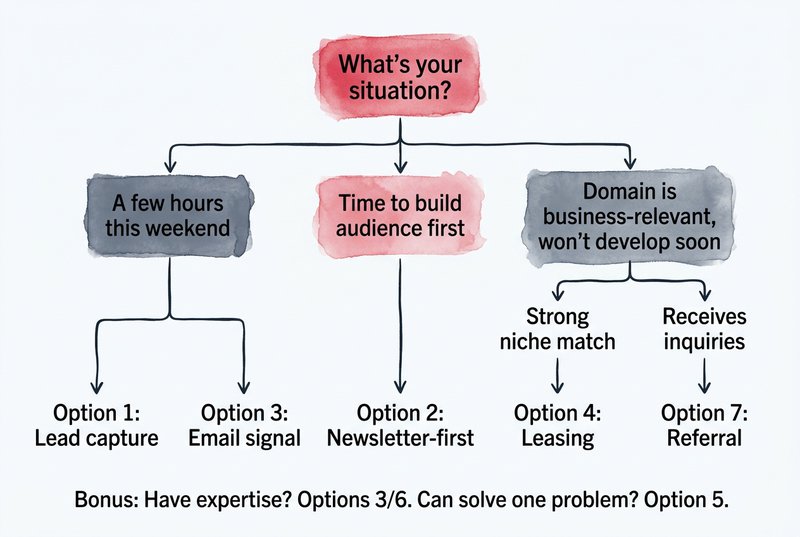
Seven options is a lot. Here's how to narrow it down. The right path depends on two things: how close the domain is to the original idea you registered it for, and how much time you realistically have right now.
If you have a few hours this weekend: Options 1 and 3. A forwarding page and a custom email address. That's two hours of work and you've turned a dormant domain into an active signal. Not a finished product. A signal. That's enough to start.
If you have time to build a small audience before you build the site: Option 2 is the most valuable long-term play. A newsletter-first strategy means you arrive at launch day with subscribers already waiting. That changes everything about how the launch feels.
If the domain is clearly relevant to a business category and you're not going to develop it anytime soon: Option 4 (leasing) or Option 7 (referral) convert the domain's inherent value into actual revenue without requiring you to build anything.
The one option that's not on this list: parking it and hoping the ad revenue covers renewal. You already know that doesn't work.
The what is sitewarming framework is built around exactly this problem. The gap between "I bought this domain" and "I built this thing" is where most ideas die. But the gap doesn't have to be empty. It can be active, growing, accumulating.
If you want a plan for all your domains, not just one, how to build a domain roadmap is the right next step.
The domain you're sitting on isn't a burden. It's an idea that hasn't found its first foothold yet. Every option above is a foothold. Pick one. Start this weekend. The idea has waited long enough.
SiteWarming exists for the gap between "I registered this domain" and "I built this thing." That gap doesn't have to be empty. The options above are what a warming strategy looks like in practice. Not building everything. Just making the domain start doing something real while you figure out the rest. What is SiteWarming?
Image Credits
- Hero: Photo by Pramod Tiwari on Unsplash
- Section (Option 1): Photo by Chanhee Lee on Unsplash
- Section (Option 5): Photo by Darius Cotoi on Unsplash
Share this article
Ready to Transform Your Domain Portfolio?
Start building real value with your domain investments today.