Long-Tail Audiences as Revenue Infrastructure
 Bret Siers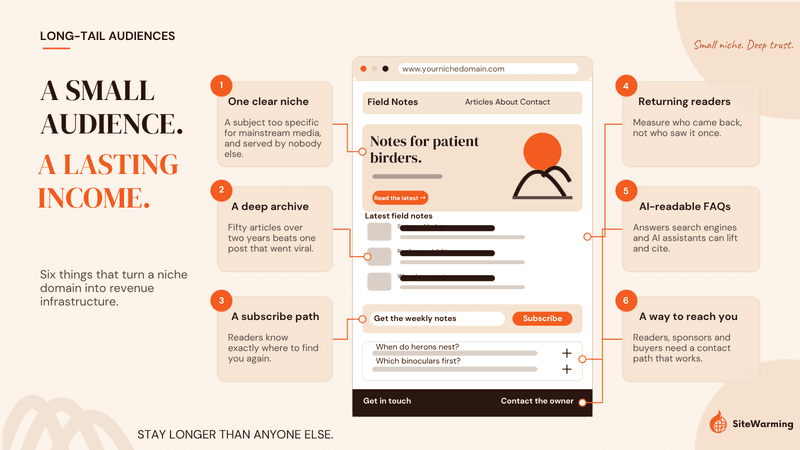
A long-tail audience is a small, specific group of people that mainstream publishers and brands don't bother to serve. It converts better than a broad audience because trust is concentrated, competition is absent and intent is coherent. Served consistently, it becomes revenue infrastructure: income that recurs from the same people instead of restarting with every launch.
AG1 was reported in 2024 to spend about $2.2 million a month on podcast ads, according to OptiMonk's breakdown of the brand's marketing. It can buy a slot on basically any show that exists: fitness, biohacking, health and wellness, whatever it wants.
One of the audiences that surprised its partnerships team was bird watchers.
What did AG1 learn from bird watchers?
Not fitness enthusiasts. Not biohackers. Not the health-conscious mainstream that looks like the obvious customer. At a SXSW 2025 panel, Margaux Natiello, AG1's Senior Partnerships Manager, said that alongside the big-name shows, the brand looks for smaller niche communities, and that podcasts about bird watching do "surprisingly well" because listeners really trust what the host recommends (Quill's write-up of the panel).
That lines up with the wider data. In Acast's 2024 study with Edison Research, US listeners said they were 63% less likely to skip ads on niche podcasts than on mainstream ones. The trust behind that is still rising: in Acast's Podcast Pulse 2026, a survey of 4,300 people across 13 markets, 42% of podcast fans said they trust brand and product recommendations from podcasters, up nine points from 2025. The audience is smaller. The attention is deeper. And deeper attention converts in ways that raw scale doesn't.
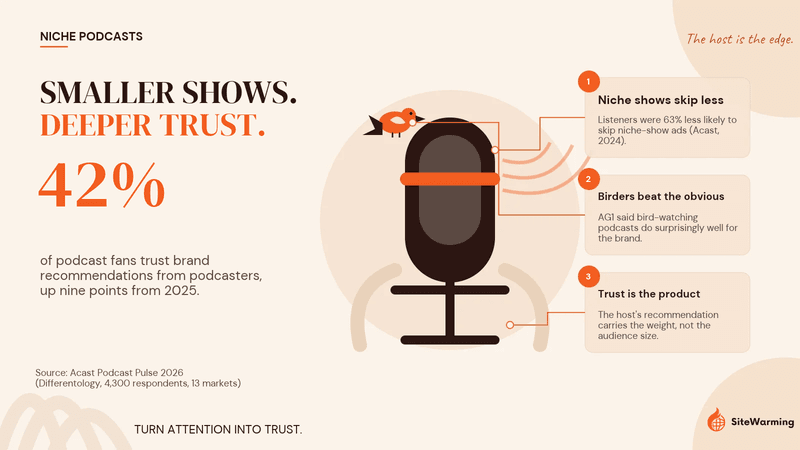
A supplement company spending millions a month found that an audience nobody fights over was one that actually paid.
This isn't about podcast ads. It's about how markets work. The audiences nobody fights over are where trust lives. And trust is where revenue starts.
What is a long-tail audience?
A long-tail audience is the group of people at the thin end of a demand curve: too specific for mainstream media, too small for venture-backed companies, and usually served by nobody. The term comes from Chris Anderson, then editor of Wired, who described the long tail in an October 2004 article and a 2006 book of the same name. His argument: once shelf space stops being scarce, the many small niches add up to a market as real as the hits.
Amazon was his proof, and the numbers are worth getting right. Anderson's 2004 article claimed that "more than half of Amazon's book sales come from outside its top 130,000 titles." That figure rested on a flawed study, and by the 2006 book he had revised it to about a quarter of sales from outside the top 100,000 (Rough Type's account of the correction). The stronger evidence came later. Erik Brynjolfsson, Yu Jeffrey Hu and Michael D. Smith compared Amazon's sales curve in 2000 and 2008 and found the tail had grown longer, with niche books accounting for 36.7% of Amazon's sales by 2008.
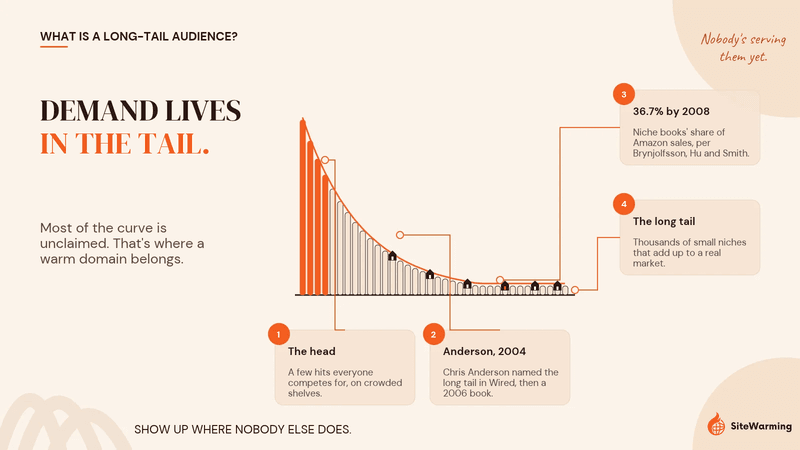
So demand exists in the niches. The question for anyone holding a domain is what happens when you're the only one who shows up for it. I've written before about the patience premium in third-tier markets: the spaces too small for venture capital and too niche for media companies. In those markets, a warm domain doesn't compete for attention. It inherits it. The audience is unclaimed not because it's worthless, but because nobody took the trouble to recognise the white space.
That's not a consolation prize. That's unclaimed infrastructure.
Why do niche audiences convert better?
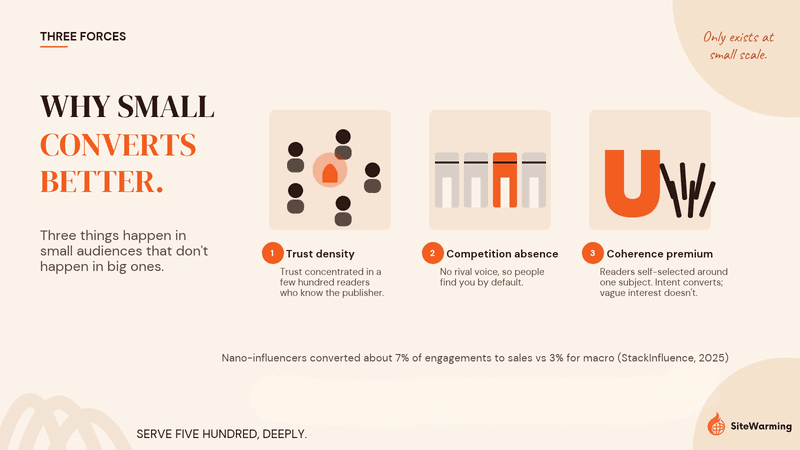
This isn't abstract. You can measure it. Three things happen in small audiences that don't happen in big ones, and they explain why small keeps winning. I call them trust density, competition absence and the coherence premium.
1. Trust density
In a small community, the publisher has a direct relationship with a higher percentage of the audience. Trust isn't spread across millions. It's concentrated.
The influencer market shows the same pattern. A June 2025 StackInfluence analysis reports that nano-influencers (under 10,000 followers) saw roughly 7% of their engagements convert to a sale, more than double the 3% for macro-influencers. The same roundup cites HubSpot data that 56% of marketers report better ROI with micro- and nano-influencers than with larger ones. Budgets are following: in Influencer Marketing Hub's 2026 benchmark report, a survey of more than 600 respondents, about 51% planned to expand their work with nano creators and about 53% with micro creators.
Five hundred people who deeply care will outperform fifty thousand who vaguely notice.
2. Competition absence
Nobody else is serving this audience. There's no alternative voice. The warm domain isn't competing for position; it occupies the position. That's the first-mover logic behind building authority in a market nobody is covering. When you're the only one there, the cost of being found organically drops close to nothing, because people find you by default.
3. The coherence premium
A small audience that self-selects around a specific interest has far higher intent than a broad audience with vague overlap. Someone who subscribes to a newsletter about vintage mechanical pencils cares about mechanical pencils in a way a general stationery audience never will. Intent converts. Vague interest doesn't.
| Broad audience | Long-tail audience | |
|---|---|---|
| Trust | Spread thin across millions | Concentrated; the publisher knows a large share of readers |
| Competition | Many publishers chasing the same readers | Often no one else serving them |
| Intent | Vague overlap with the topic | Self-selected around one subject |
| Cost to be found | Paid reach, constant replacement | Close to zero once you're the default voice |
| Where it wins | Ad inventory at volume | Premium products, services, direct sponsorship |
Is a small audience worth more per person?
Yes, but not where most people look. The economics show up in newsletter sponsorship pricing: beehiiv's November 2025 pricing guide reports that B2B newsletters in specialised industries often command CPMs of $50 to $100 or more, while broader consumer newsletters sit closer to $15 to $35. CPM is the price an advertiser pays per thousand readers reached.
Here's the math, run honestly.
| 500-subscriber niche newsletter | 50,000-subscriber broad newsletter | |
|---|---|---|
| Sponsorship CPM | $75 | $20 |
| Revenue per sponsored send | $37.50 | $1,000 |
| Revenue per subscriber per send | 7.5 cents | 2 cents |
On pure ad inventory, the big list wins on total dollars. The small list wins per person, nearly four times over, and that's only the ad line. The real edge is what trust lets the small publisher sell. If 20 of those 500 readers pay $1,500 for a course, a consulting engagement or a tool, that's $30,000. A year of weekly sponsorships at $37.50 is $1,950. Trust enables premium pricing, and premium pricing is where a small audience pays. If you want the full per-subscriber breakdown, I've laid out the ARPU math behind small, focused audiences and three business models with real numbers separately.
That's what the economics actually look like. Not a consolation prize. An edge nobody else has.
One warning. If you monetise before trust has formed, you kill the thing that was going to pay you. That's premature extraction, and it's how most people blow it.
Isn't the long tail a myth?
It's a fair challenge, and the research is mixed. Serguei Netessine and Lorin Hitt of Wharton, with Tom Tan of SMU, studied movie-rental data from 2001 to 2005 and found the opposite of Anderson's prediction. "If anything, you see more and more concentration of demand at the top," Netessine said (Wharton Mack Institute). Harvard Business School's Anita Elberse found both effects at once in 2006: the number of titles selling only a few copies a week doubled, but the number that sold nothing at all was four times as high as in 2000 (HBS Working Knowledge).
Read those findings closely and they support the argument here rather than kill it. Netessine blamed the concentration on search: when people face more choice, they gravitate to what's easy to find. Elberse's point was that a bigger catalogue doesn't help any single producer much.
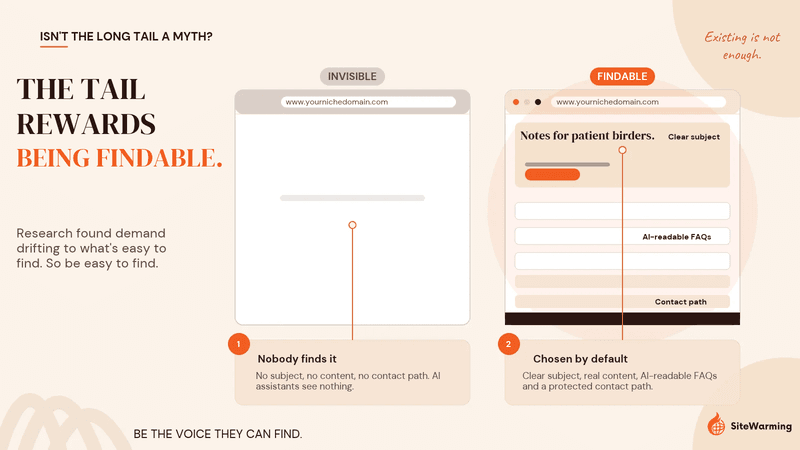
So the long tail doesn't reward stocking more niches. It rewards being the one findable, consistent voice for one niche. A domain that shows nothing to search engines or AI assistants is part of the tail nobody finds. A domain with real content, a clear subject and a way to reach its owner is the part of the tail that gets chosen. That's the gap Launch & Warm closes on a domain you haven't built yet: a live site with the domain's story, AI-readable FAQs and a protected way for readers, partners or buyers to reach you.
What is revenue infrastructure?
There's a difference between building something that keeps paying and chasing the next launch. Most people can't tell which one they're doing.
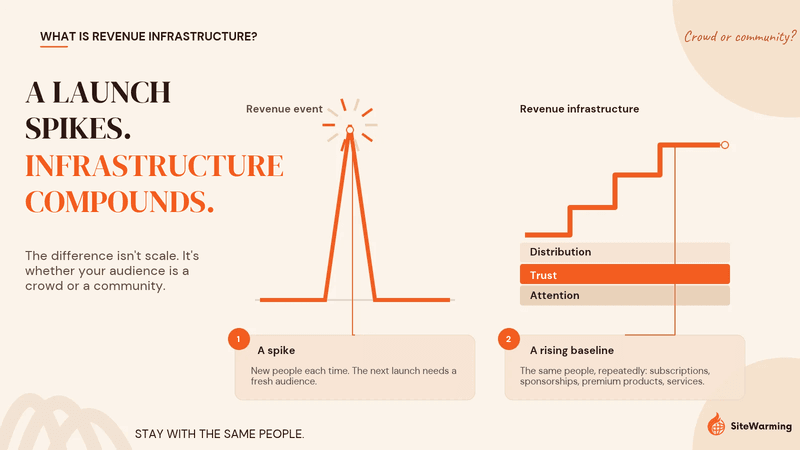
A product launch generates a spike. A subscription generates a baseline. One requires a new audience for each event. The other serves the same audience repeatedly. One extracts value and moves on. The other accumulates value and compounds.
| Revenue event | Revenue infrastructure | |
|---|---|---|
| Shape | A spike | A rising baseline |
| Audience | New people each time | The same people, repeatedly |
| Examples | A launch, a product drop, a one-off promotion | Subscriptions, recurring sponsorships, premium products, services |
| What it needs next time | A fresh audience | More of the same trust |
Kevin Kelly made the case in March 2008 with 1,000 True Fans: a true fan is "a fan that will buy anything you produce," and if you keep the full $100 a year from each of 1,000 of them, that's $100,000 a year. The math was elegant, and almost twenty years later it keeps being right. I've written a full breakdown of how the 1,000 True Fans model applies to a domain you own.
The arithmetic at small scale isn't exotic. Fifty students at $2,000 is $100,000. That's not a massive audience. It's a small group of people who trust the person teaching them enough to pay a premium. Not launch events. Not product drops. Revenue infrastructure: the kind that compounds instead of requiring you to start over every time.
A warm domain in a niche market builds three layers of it over time.
Attention infrastructure
The audience knows where to find you. You don't pay to reach them. They come back.
Trust infrastructure
The audience believes what you publish. Recommendations convert. Sponsorships perform. Products sell at premium prices.
Distribution infrastructure
The audience shares your work within the niche. Word of mouth in a small community is proportionally more powerful than in a large one because density is higher. When everyone knows everyone, a recommendation travels fast.
Revenue events require you to find new people. Revenue infrastructure means the people are already there. The difference isn't scale. It's whether your audience is a crowd or a community.
How does the compounding loop work?
Content produces trust. Trust produces audience. Audience produces revenue. Revenue produces more content. The loop repeats, and each time it gets a little stronger.
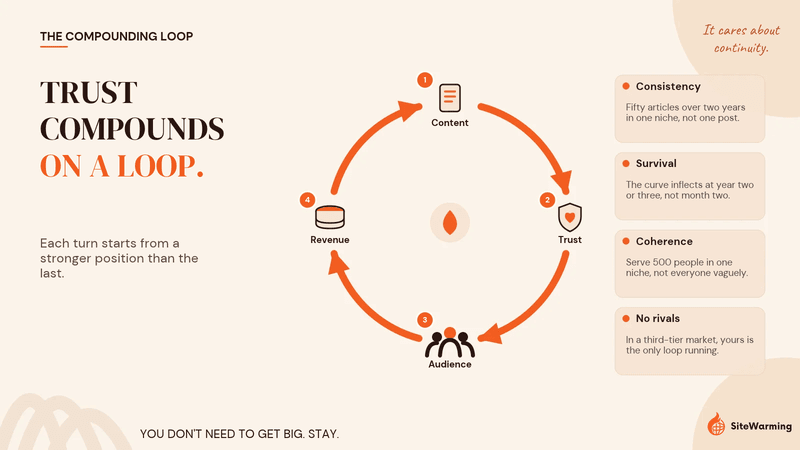
But the loop has four requirements, and most of them are about time.
- Trust requires consistency. You can't build trust with one article. You build it with fifty articles over two years in the same niche. That means showing up when nobody's watching and publishing when the metrics show nothing. Being willing to stay is the advantage most people can't replicate.
- Compounding requires survival. The loop doesn't produce visible returns in month three or month six. The curve inflects at year two or three, not month two or three. Most people quit before the loop starts paying. The ones who don't become the default voice in their niche.
- Small scale enables coherence. A domain trying to serve everyone can't build trust with anyone. A domain serving 500 people in one niche builds trust with all of them. Coherence is the prerequisite for the loop to function.
- Competition absence sustains the loop. In a third-tier market, nobody else is running this loop. The warm domain isn't competing for attention inside it. It's the only loop running.
Stratechery shows what this looks like over more than a decade. Ben Thompson started it as a blog while still working at Microsoft, and in April 2014 went full-time on a paid subscription model; by April 2015 he had more than 2,000 paying subscribers (Wikipedia). By early 2015 the site was reported to be doing about $200,000 a year in revenue (Nieman Lab). Stratechery doesn't publish its numbers; the most recent outside estimate I could verify, from 2020, put it at roughly 26,000 paying subscribers and about $3.3 million in annual revenue (Andreas Stegmann's estimate). In 2026 it is still Thompson's full-time job, with free weekly articles and three subscriber-only Daily Updates a week (Stratechery's About page). A niche technology-strategy publication no mainstream publisher would have greenlit. The loop didn't spike. It compounded: the audience grew because the content grew because the trust grew because the audience grew.
The loop doesn't care about speed. It cares about continuity.
How long does it take for a niche audience to pay?
In my experience, there's a period, often twelve to twenty-four months, where the content exists and the trust is forming, but the revenue hasn't arrived. This isn't failure. It's the pre-infrastructure phase. Every warm domain in a niche market passes through it. The ones that survive it become the default.
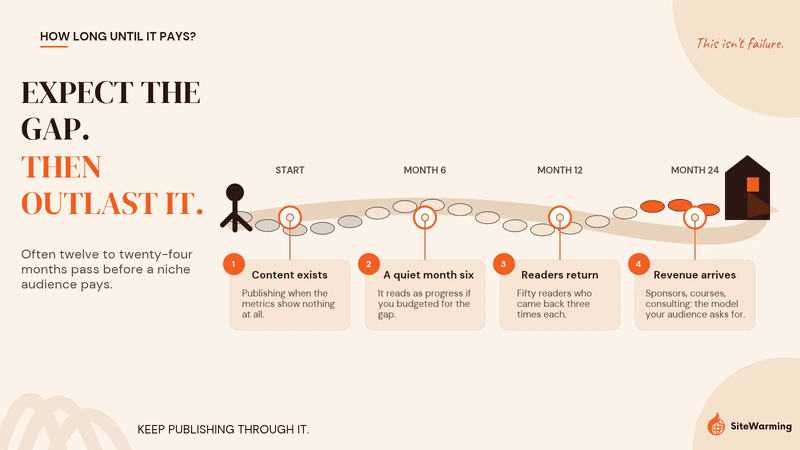
The gap isn't understanding. It's execution: sitting with a small number and not reading it as failure. Fifty readers in month eight looks like nothing on a dashboard built for reach. Fifty readers who came back three times each is the start of the trust layer.
How do you build a long-tail audience on a domain you already own?
Here's what it looks like in practice.
1. Choose the depth, not the breadth
The topic is already set by the domain's subject, its reason for existing. The decision is how deep to go. The long-tail audience nobody else bothers with is where a warm domain has a structural advantage. Not because it's easy. Because it's unclaimed. If you own more names than you can build on, the first decision is which domain. Seeing every name in one place, with its status, renewal date and value, makes that a deliberate choice rather than whichever idea feels freshest; that's what our domain portfolio management tool is for.
2. Publish for the audience that exists, not the audience you wish existed
In a third-tier market, fifty people reading your content isn't failure. It's the beginning of the compounding loop. Those fifty people, served consistently, become the trust infrastructure.
3. Measure trust, not reach
The wrong metric is "how many people saw this." The right metric is "how many people came back." Watch return visitors, subscribers who stay past their third issue, replies, and direct inquiries through the domain. These are trust signals. They predict revenue infrastructure. Reach predicts nothing.
4. Expect the gap
Plan for twelve to twenty-four months before revenue. If you budget for the gap up front, a quiet month six reads as progress rather than a reason to quit.
5. Let the audience define the product
In a small, coherent niche, the audience will tell you what it needs. Sponsorships, courses, consulting, tools, premium content: the revenue model emerges from the relationship. I've covered the revenue models that work for niche sites without ads in detail. Revenue infrastructure isn't planned from a spreadsheet. It's cultivated from the conversation.
What mistakes kill a long-tail audience?
- Chasing reach metrics. Judging a niche domain by page views pushes you toward broader topics and dilutes the coherence that made it valuable.
- Monetising in month two. Ads and aggressive affiliate links before trust exists tell readers the domain is there to extract, not to serve.
- Broadening to grow. Adding adjacent topics to reach more people trades a community for a crowd.
- Going quiet. A niche audience forgives a small voice. It doesn't forgive an absent one. There's no such thing as a set-and-forget digital asset.
- Being unreachable. If a reader, sponsor or buyer can't find a way to contact you, the trust you built has nowhere to go.
Why "too small" is venture-capital math
"Too small" is a judgment based on venture-capital math. Venture capital needs massive markets because it needs massive returns on a short timeline. That's its math, not yours. A warm domain operates on the stewardship timeline, where small audiences served consistently become the most valuable asset the domain owns.
The smallest market you can find isn't a limitation. It's the foundation. It's the tier where trust forms fastest, competition is absent, and the compounding loop runs uncontested. This is what continuous care produces: not a set-and-forget outcome, a compounding one.
Revenue infrastructure isn't built by reaching more people. It's built by staying with the same people longer than anyone else will.
The audience nobody else wanted, the bird watchers, the fifty-student course, the 500-subscriber newsletter in a market that barely shows up in any analyst's report: those are the audiences that pay. Not because they're large. Because they're yours.
You don't need to get big. You need to stay.
How do you apply this across every domain you own?
Everything above works one domain at a time, but most people reading this don't own one domain. Founders who buy names faster than they build end up with a drawer of ideas nobody can find: when someone goes looking for that niche, or wants the name itself, there's nothing there and no way to reach the owner, and the renewal bill arrives anyway. If you saw value in the name, someone else probably did too. Domainers have the same problem at scale: hundreds of names across several registrars, renewal dates they can't afford to miss, and no clear view of which names to keep.
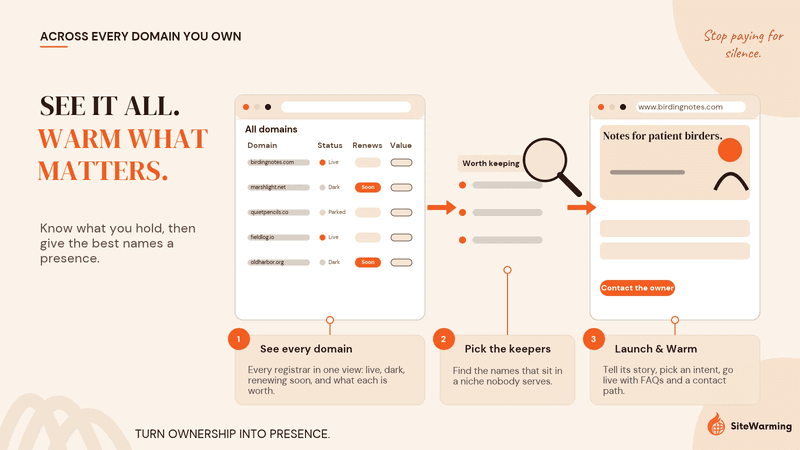
So the first job is to see the whole portfolio. Our domain portfolio management tool puts every domain from every registrar in one view, whether you add names one at a time, bulk-import a CSV, connect a registrar or use the MCP server. It shows what's live, what leads nowhere and what's approaching renewal, and it attaches a HumbleWorth valuation with appraisals stacked from 15+ sources. That's how you find the handful of names that sit in a long-tail niche worth serving, and the ones to let go.
The second job is to act on those. Launch & Warm puts a warm site on the domain: you tell its story in one sentence, choose an intent (Future Build, Open or Actively Selling), and it goes live with domain analysis, AI-readable FAQs, structured story data and a protected, anonymous inquiry path for buyers or partners. DNS, HTTPS, hosting and ongoing DNS and SSL checks are handled. The domain starts earning the trust this post is about, and when the right reader, sponsor or buyer turns up, they can reach you. That's what SiteWarming is for.
Frequently asked questions
What is a long-tail audience? A long-tail audience is a small group of people with a specific, shared interest that mainstream publishers and brands consider too small to serve. The term borrows from Chris Anderson's long tail theory. Because nobody else serves them, whoever shows up consistently earns concentrated trust, faces little competition and reaches readers whose intent is unusually clear.
Why do niche audiences convert better than large ones? Three forces work in a niche that fade at scale. Trust is concentrated because the publisher knows a larger share of readers. Competition is absent, so there is no alternative voice to lose them to. And intent is coherent, because readers self-selected around one subject. In a 2024 Acast and Edison Research study, US listeners were 63% less likely to skip ads on niche podcasts.
Is the long tail theory still true? Partly. Amazon's niche book sales grew to 36.7% of its sales by 2008, according to Brynjolfsson, Hu and Smith. But Wharton researchers found movie-rental demand concentrating on hits, which they blamed on how hard niche titles are to find. The tail exists; it pays the publishers who are findable and consistent, not every catalogue that simply stocks more.
How long does it take for a niche audience to generate revenue? In my experience, usually twelve to twenty-four months. The content exists and trust is forming, but the returning readers, replies and inquiries that become revenue take time to accumulate. Most people quit inside that gap. The ones who keep publishing through it tend to become the default voice in their niche, which is where the compounding starts.
What is the difference between a revenue event and revenue infrastructure? A revenue event, such as a product launch, produces a spike and then requires a new audience for the next one. Revenue infrastructure serves the same audience repeatedly through subscriptions, sponsorships, premium products or services. It is built from three layers: attention (readers know where to find you), trust (they believe you) and distribution (they share you within the niche).
Can a parked domain build an audience? Not while it stays parked. A parking page or a blank domain gives searchers, AI assistants and would-be buyers nothing to find, trust or contact. The audience starts forming once a focused page goes live with the domain's subject, a few genuine answers and a way to reach the owner. From there it grows with every piece of consistent content you add in that niche.
Share this article
Ready to Transform Your Domain Portfolio?
Start building real value with your domain investments today.