Why Small, Focused Audiences Are More Valuable Than Traffic
 Bret Siers
A small, focused audience is worth more than a large, indifferent one because value is revenue per person, not people counted. In our worked example, 500 subscribers converting at 2% to a $50 monthly offer earn $500 a month, which 50,000 passing visitors who buy nothing do not. Traffic measures reach. An audience measures commitment.
I watched someone celebrate hitting 50,000 monthly visitors last year. They posted the screenshot everywhere. The number looked incredible.
Two months later they shut the site down. Fifty thousand people showed up every month and nobody bought anything. Nobody subscribed. Nobody came back. The visitors were a weather pattern, not an audience.
That's the volume trap. If you own a domain you're trying to build into something real, it's worth understanding why the small, focused audience beats the large, diffuse one almost every time.
Two terms, so we mean the same thing. Website visits are the number of visits to your domain, counted whether or not anyone comes back. A focused audience is a small group of people who share one specific problem, chose to hear from you and respond when you speak.
Why does website traffic make a poor measure of success?
"We hit 100K monthly visitors" sounds good at a dinner party. "We have 200 subscribers who pay $50 a month" sounds smaller. But 200 × $50 is $10,000 a month. One of those is a real business and one is a vanity number.
The platforms taught us to think this way. Ad-funded platforms earn more when more people watch, because more viewers means more ad inventory. So the metrics they surfaced were reach metrics: follower counts, page view numbers, monthly visitor dashboards. Easy to measure. Easy to optimize for.
Here's the thing: domain owners and builders aren't platforms. They're not selling ad inventory. They're building something specific for someone specific. And for that purpose, a small, engaged, paying audience beats a large, indifferent one.
What did Kevin Kelly's 1,000 True Fans argue?
Kevin Kelly published the essay on March 4, 2008. His argument: a creator needs only about 1,000 true fans, people who will buy anything you produce, each worth about $100 in profit a year. At that rate, 1,000 fans is $100,000 a year, "a living for most folks." He was clear that the number is a rough order of magnitude, not a rule. We cover the model itself in our guide to the 1,000 true fans model. Here we use the idea to ask a narrower question: what is each person in your audience worth to you?
In our view, the math works even better now, because the tools to find and serve a small audience are cheaper and easier to use than they were in 2008. Knowing that in theory is different from feeling it in the numbers, so look at what it costs to chase volume versus depth.
What is ARPU, and why does it expose the volume trap?
ARPU stands for average revenue per user. Xero defines it as how much revenue, on average, each customer generates over a set period such as a month or a year, and gives the formula as total revenue divided by the number of users. It's the lens that makes the volume trap visible, because it measures what each person in your audience is actually worth to you.
Take two domains. The numbers are illustrative. They're ours, not measured data.
Domain A gets 50,000 visitors a month. They land, they browse, they leave. The domain has a contact form and a vague mission statement. Almost nobody subscribes. Nobody buys. ARPU is near zero.
Domain B has 500 email subscribers. They signed up deliberately. 2% of them convert to a $50/month offer. That's 10 people paying $50, which is $500/month from 500 people.
| Measure | Domain A | Domain B |
|---|---|---|
| Audience | 50,000 monthly visitors | 500 email subscribers |
| How they arrived | Landed, browsed, left | Signed up deliberately |
| Conversion to a paid offer | Almost none (assumed) | 2% |
| Paying customers | Near zero | 10 (500 × 2%) |
| Monthly revenue | Near zero | $500 (10 × $50) |
| ARPU per month | Near $0 | $1.00 ($500 ÷ 500) |
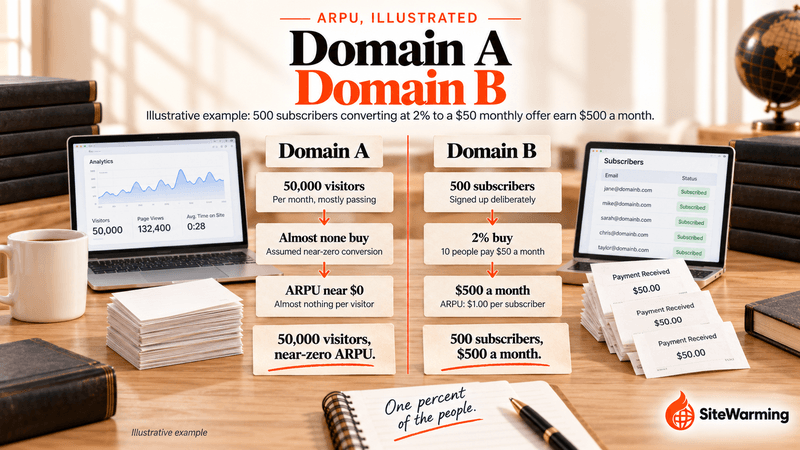
Domain B earns more, with one percent of the people. To match it, Domain A would have to earn one cent from every visitor every month: $500 ÷ 50,000 is $0.01.
Sit with that for a second. Domain A needs to find 50,000 visitors every month just to stand still. Domain B needs to keep 500 subscribers happy and convert a few more each month. One is a treadmill. The other is a foundation. And the person running Domain B sleeps better at night, because their business isn't one algorithm change away from zero.
How much real newsletters earn varies widely, and we found no public dataset we could verify, so we don't quote one. The arithmetic in the next section shows what each size can earn. In our view, what the ones that do well share is specificity: they serve a reader who knows exactly what they're there for.
The question isn't "how do I get more people?" It's "how do I become more useful to the people who already showed up?" That question changes everything about how you build.
How big does an audience need to be for each business model?
What "valuable" means changes with what you're building, and so does the minimum viable audience. Here's what the math looks like in three common models. The prices and conversion rates are assumptions. Replace them with your own.
| Model | Audience you need | The math (assumed prices) | What matters most |
|---|---|---|---|
| Paid newsletter or subscription community | About 100 paying subscribers to start | 100 × $10 = $1,000/month ($12,000/year). 500 × $10 = $5,000/month ($60,000/year). 1,000 × $15 = $15,000/month ($180,000/year) | Whether people pay and keep reading |
| Consulting or services | Five to ten clients who trust you | 1 client at $3,000/month = $36,000/year. 3 clients = $108,000/year. 5 clients = $180,000/year | Credibility when the right people arrive |
| Digital products (courses, templates, tools) | A list that shares one specific, recurring problem | 300 people × 5% buying a $99 product = 15 sales = $1,485 (illustrative) | Alignment with the problem, not list size |

What does a paid newsletter or subscription community need?
You need roughly 100 paying subscribers at $10/month to generate $1,000/month. That's a starting point, not a ceiling. The economics scale cleanly: 500 subscribers at $10/month is $5,000/month. 1,000 at $15/month is $15,000/month. All of it is before platform and payment fees.
The key word is "paying." A free list of 10,000 people who barely open your emails is not the same asset as a paid list of 100 who read every issue and forward it to colleagues. Those 100 people chose to pay for what you write. That's a relationship. The 10,000 who signed up and forgot is just a number.
How many clients does a consulting or services business need?
You need zero audience in the traditional sense. You need five to ten clients who trust you. A single client at $3,000/month is $36,000/year. Three clients at that rate is $108,000, a six-figure business.
I get it. It feels counterintuitive. You'd think a consulting business needs a big audience. It doesn't. It needs the right five people to find you and trust what they see when they arrive. The domain's job here isn't to drive volume. It's to signal credibility. A focused, well-developed domain in a specific niche tells the right people you know what you're talking about. In our view, that signal is worth more than a domain with 100K passive visitors and no identity.
What does a digital product business need?
You need an audience that has a specific, recurring problem you've already solved. Size matters less than alignment. For a product built around one workflow challenge, a list of 300 product managers who all struggle with it is more useful than a list of 10,000 generalists. At an assumed 5% conversion on a $99 template, those 300 people produce 15 sales and $1,485. Small, but real, and it comes from people who already told you what they need.
What do sponsors pay to reach a niche audience?
Sponsorship is a fourth route, and the published data is messier than any single range suggests. CPM is what an advertiser pays per 1,000 impressions: at a $50 CPM, a sponsor reaching 5,000 readers pays $250. Beehiiv, a newsletter platform, said in November 2025 that B2B newsletters in specialized industries often command CPMs of $50 to $100 or more, while broader consumer newsletters sit closer to $15 to $35. Dupple's April 2026 benchmarks run lower: $5 to $12 for generalist B2B and up to $25 to $60 in cybersecurity. Two vendors, two ranges.
They agree on the direction. A specific audience commands a higher rate than a general one. Beehiiv also makes the point this post makes: "A newsletter with 5,000 highly engaged subscribers who click on every recommendation can be worth more than one with 50,000 passive readers who barely open emails."
Every model points the same way: focused beats broad. For a domain owner there is a second question. Does audience size change how search engines and AI systems treat the domain?
Does audience size change how search engines and AI systems see a domain?
For domain owners it's not only about revenue. It's also about whether the systems that decide who gets found can tell what your domain is for. Be careful here, because most claims about this are guesses. We separate what is documented from what is our view.
What does Google document?
Google doesn't document visitor counts, subscriber counts or return visits as ranking inputs. Its guidance on creating helpful, reliable, people-first content asks for content created primarily for people, and poses questions such as whether the content provides original information, reporting, research or analysis, and whether it provides substantial value compared with other pages in search results. The page was last updated October 5, 2026, so re-check the wording before you quote it. We found no statement about engagement signals on it.
Here is our view, and it is a view, not a documented mechanism. A domain that serves a small, specific audience tends to publish the kind of content those questions describe: specific, original and useful to a defined reader. A domain chasing 50,000 accidental visitors tends to publish for no one in particular. We can't show that a subscriber list changes rankings. We can say that the work needed to build the list is the work Google's guidance asks for.
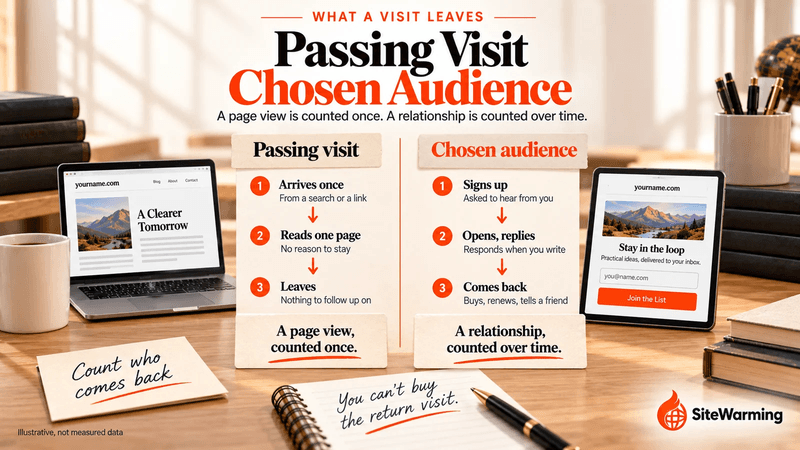
You can buy visitors. You can inflate numbers. You can't buy people choosing to come back. In our view, that pattern is what separates a domain that matters from one that is only visible. We make the longer case in why trust, not volume, is what a domain is building.
What about AI search engines?
Each AI search engine uses its own crawler and index, so one answer doesn't cover all of them. We set out what Google, ChatGPT search, Bing and Copilot, and Perplexity each document in how AI search engines decide which domains to trust. We found no engine that names subscriber count as a trust input. What those documents describe is access for the bot, readable pages, clear attribution and specific content.
What does this mean if you're warming a domain?
If you're warming a domain, the goal isn't to reach the most people. It's to become the most useful thing for the right people. That's a different build. And honestly, it's a more achievable one. You don't need to outcompete established giants for broad audiences. You need to be the clearest, most useful voice for a specific group of people with a specific problem.
That's a smaller target. But it's one you can actually hit. Finding that specific group is pattern recognition, not luck. The white space where focused audiences live is visible if you know how to look.
So the question becomes practical: how do you build this kind of audience instead of the other kind?
How do you build a focused audience instead of a large one?
You don't just decide to have a focused audience. You build toward one. And the building looks different from what most people expect. There are four steps.
Why start with a problem, not a topic?
A domain about "finance" has a topic. A domain about "how freelancers handle quarterly taxes without an accountant" has a problem. The second one finds its audience faster because the audience can self-identify immediately. They read the headline and think: that's me. That recognition is everything. Don't mistake interest for proof, either. Real validation is someone paying before you've built the thing.
Why use email, not just discovery?
Visitors are moments. Subscribers are relationships. Every piece of content, every page on an active domain, should have one job: invite the right people to stay in touch. A small email list is a durable asset. A visitor count is a snapshot that disappears the moment you stop looking at it.
Why let the niche get smaller before it gets bigger?
This is the one that scares people. Most people try to appeal to the broadest possible audience from day one because it feels safer. But breadth at the start creates noise. In our experience, the domains that build genuine audiences start narrow and expand from a position of trust, not a position of hope. You earn the right to go wider by being indispensable to a few people first.
Which metrics show a focused audience is working?
Open rates, reply rates, conversion rates, repeat purchase rates. These are engagement measures. They tell you whether the people who found you are actually there for what you're offering.
| Metric | What it shows | Example from this post |
|---|---|---|
| Open rate | Whether subscribers read what you send | The "100 who read every issue" in the paid newsletter |
| Reply rate | Whether people respond to you, not just receive you | The right five people who trust you in consulting |
| Conversion rate | The share of your audience who pay | 2% of Domain B's 500 subscribers buying a $50/month offer |
| Repeat purchase rate | Whether buyers come back | The 200 subscribers who "bought something" and stayed |
Visitor counts tell you almost nothing about any of this. If you're checking your analytics dashboard and feeling good about page views, you're looking at the wrong number.

The long-tail audiences that become real revenue infrastructure follow this path. They don't start large. They start specific and stay consistent until the audience finds them.
None of this happens fast. That's where the real test lives.
What does a focused audience mean for a domain you haven't built on yet?
If you register domains faster than you build on them, you can't build ten audiences at once. Pick the one name where you can answer "who is this for?" in a sentence, and start there. If you're deciding which name earns that focus first, a domain roadmap is the place to start.
Launch & Warm is built for the stage before the full build. Per its how-it-works page, you tell your story in one sentence: the vision behind the purchase, who it's for and whether you'll build it, keep it open or sell it. You pick an intent template (Future Build, Open or Actively Selling), the domain stays current with fresh updates, and interest arrives through a protected inquiry path where you decide when and how to respond. A concept page shows the idea without a full website. The Free plan on the pricing page covers one warmed domain, so you can test your focus on the name you know best before you spend on the rest.
It won't hand you an audience. It keeps the domain readable and reachable while you find out who it's for.
Why do people still chase traffic? The impatience trap
The reason most people chase volume instead of focus is impatience. Volume is visible immediately. Focus takes time to show its value. And we're all wired to want proof that what we're doing is working.
A domain with 50,000 visitors looks like it's working. A domain with 200 subscribers doesn't look like much. Until you realize those 200 people came back, bought something, told a friend, and are still there six months later. The 50,000 visitors are gone. The 200 subscribers are a business.
The risk of monetizing too early is related to this. When you optimize for volume too fast, you make decisions that sacrifice the long-term audience relationship for short-term numbers. Ads that interrupt. Content that gets broad instead of deep. A domain identity that starts to blur because you're chasing everyone instead of serving someone. Every one of those compromises feels small in the moment. Together, they hollow out the thing you were building.
How long does the focused path take?
The focused audience path requires patience. Real patience, not "I'll try this for two months" patience. Kevin Kelly put the timeline in years: adding one new true fan a day, he wrote, would "only take a few years to gain a thousand." In our view, six years of consistent writing beats six months of marketing. That's our opinion, and that post sets out our evidence.
Here is what slow looks like as arithmetic. Start with a 200-person email list that grows by 20 people a month, where 3% of the list buys a $50/month offer. These are assumptions, not a forecast, and they ignore churn.
| Point in time | List size | Paying subscribers (3%) | Monthly revenue at $50 |
|---|---|---|---|
| Today | 200 | 6 | $300 |
| Month 12 | 440 | 13.2 | $660 |
| Month 24 | 680 | 20.4 | $1,020 |
The decimals are deliberate: the point is the slope, not the headcount. If the assumptions hold, that is a small business that grows in a straight line, and you can see it coming.

That's what learning to monetize a domain without relying on ads or parking pages is really about. It's not just about avoiding bad options. It's about building the kind of asset that doesn't depend on volume to create value.
So who is this domain actually for?
When a domain warms, the goal isn't volume. It's fit. SiteWarming is built around this difference. In our view, a domain with structured content, a consistent identity and a growing record is easier for the right visitors to recognize as being for them. That helps with the right kind of discovery, not just more of it.
A domain with a small enough audience to build a real business is not a consolation prize. It's the outcome worth building toward.
Here's the question worth sitting with: who is this domain actually for?
If you can answer that specifically, the size of the audience matters a lot less than you think.
Frequently asked questions about small audiences and website traffic
Is a small, engaged audience worth more than high website traffic?
Usually, when you measure revenue per person. In our worked example, 500 subscribers converting at 2% to a $50 monthly offer earn $500 a month, while 50,000 visitors who buy nothing earn nothing. Traffic measures reach, not commitment. The example is illustrative, not measured data, so test it against your own numbers.
What is ARPU, and how do you calculate it?
ARPU stands for average revenue per user. Xero's glossary gives the formula as total revenue divided by the number of users, over a set period such as a month or a year. If 500 subscribers generate $500 in a month, ARPU is $1.00 per subscriber for that month.
How many paying subscribers does a newsletter need to earn $1,000 a month?
At $10 a month, 100 paying subscribers produce $1,000 a month, or $12,000 a year, before platform and payment fees. At $15 a month you need about 67. Those figures are arithmetic, not forecasts. They assume subscribers stay, so retention matters as much as the headline number.
How many clients does a consultant need for a six-figure year?
At $3,000 a month per client, one client is $36,000 a year and three clients are $108,000. The rate is an assumption; change it to match your own pricing. A consulting business needs a few clients who trust you, not a large audience, so the domain's job is credibility.
Do niche audiences earn higher sponsorship rates?
Sources disagree on how much. Beehiiv says specialized B2B newsletters often command CPMs of $50 to $100 or more, against $15 to $35 for broader consumer newsletters. Dupple's April 2026 benchmarks put generalist B2B at $5 to $12 and niche verticals up to $60. Niche pays more, by an uncertain margin.
Does a bigger audience help a domain rank higher in Google?
Google doesn't document visitor counts or subscriber counts as ranking inputs. Its helpful content guidance asks whether content is created primarily for people and provides original information and substantial value. We found no statement about engagement metrics on that page, so treat audience size as an outcome of good content, not a ranking lever.
What should you measure instead of page views?
Measure whether people who found you act on it: open rate, reply rate, conversion rate and repeat purchase rate. Each shows commitment that a visitor count can't. Start with the one closest to revenue. If you sell something, track how many subscribers buy it and how many buy again.
How long does it take to build a focused audience?
There's no fixed timeline. Kevin Kelly wrote in 2008 that adding one new true fan a day would take only a few years to reach 1,000. In our illustrative example, a list growing by 20 people a month reaches 440 in a year. Expect years of consistent work, not weeks.
Related reading
- The 1,000 true fans model: why small audiences build bigger businesses
- A small enough audience to build a real business
- Domain authority vs domain quantity: what actually matters
- Long-tail audiences that become real revenue infrastructure
- How to validate a niche idea before building anything
- Why 6 years of content beats 6 months of marketing
Share this article
Ready to Transform Your Domain Portfolio?
Start building real value with your domain investments today.