White Space Isn't Luck, It's Pattern Recognition
 Bret Siers
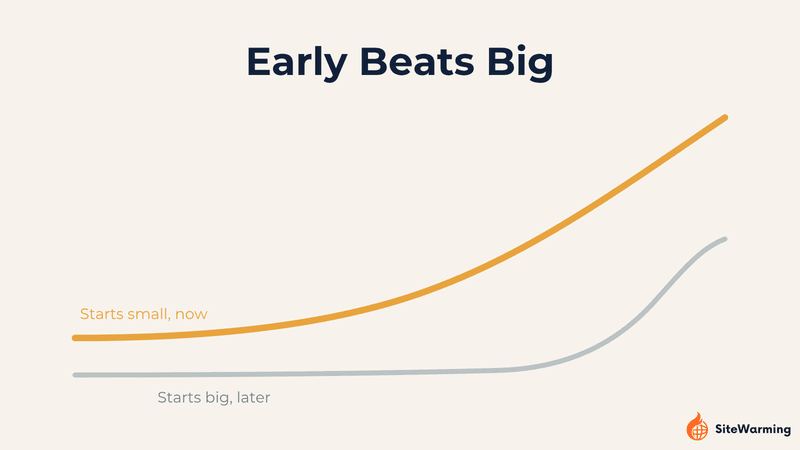
White space, the advantage early movers seem to have, isn't luck. It's pattern recognition: discovery systems reward domains that send small, consistent signals over time, not ones that wait for a single big launch. Early, small efforts compound; late, large efforts rarely catch up, because systems learn from repetition, not from size.
Why do small actions feel pointless until they compound?
Founders love big moments because big moments are legible. A launch, a press hit, a spike in traffic; these are the things you can point to and say "that happened." The internet's signal layer doesn't work that way. It rewards repeated patterns, not single events.
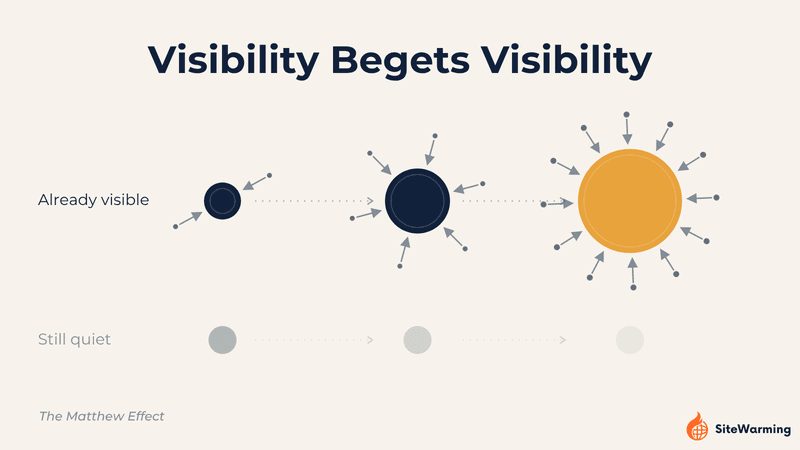
This is the Matthew Effect, named and formalized by sociologist Robert K. Merton in 1968: those who already have recognition tend to accumulate more of it, while equivalent work from the unrecognised goes unnoticed (Merton, "The Matthew Effect in Science," Science, 1968). Once someone has a bit of visibility, the system tends to deliver more credit, more attention, and more opportunity to them, which then creates even more visibility.
It compounds in the other direction too, that's Double Jeopardy: larger, more visible domains have both more buyers and more loyalty, so smaller, quieter domains suffer twice over, not once.
That's why "white space," the advantage early movers seem to have, looks like luck from the outside. It isn't. Early signals are deposits, not immediate payoffs. Nobody notices the first small update. The tenth one, six months later, is what a discovery system has actually been tracking the whole time. See Signals Are the Asset for what those deposits are made of.
How do discovery systems reward pattern recognition?
Discovery systems infer through proxies, not direct understanding. They're effectively asking:
- Is this place active or abandoned?
- Does it change in a way that suggests real stewardship?
- Is it connected to other places?
- Do people engage with it usefully?
None of those questions get answered by a single event. Google's 2011 freshness update was explicitly designed to surface more recent results for time-sensitive queries (Google Search Central, 2011) and the lesson that's held up since is that it isn't one update that matters, it's a pattern of updates over time.
Big means slow. Big means perfect. Big means you wait. But systems don't need your biggest artifact. They need consistent signals that teach them what you are. See Why AI Can't Read Your Parked Domain for what happens when a domain sends no signals at all, and Trust Is a System for how those repeated signals eventually add up to something a system is willing to call trust.
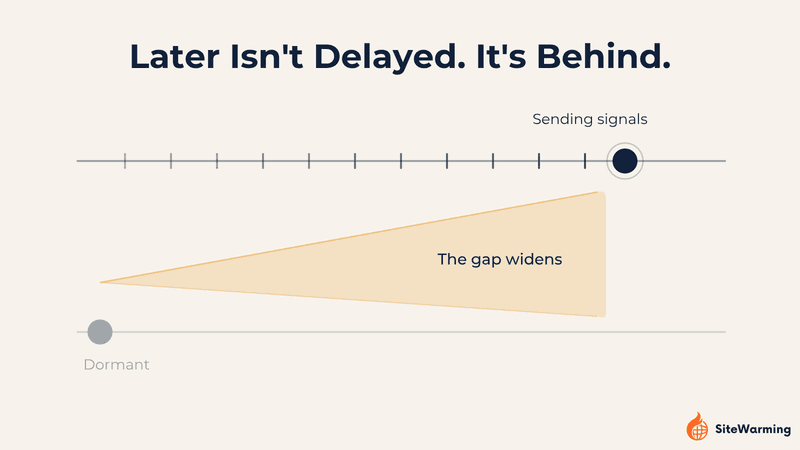
Why do dormant domains fall behind exponentially?
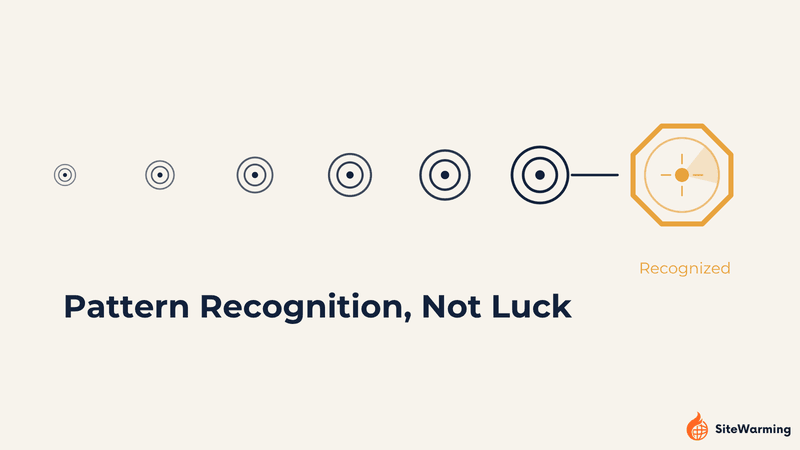
A dormant domain doesn't just pause. It broadcasts absence.
A 2025 paper in the European Sociological Review studied cumulative advantage in media visibility and found that once someone crosses a threshold of mentions, future mentions become self-reinforcing (European Sociological Review, 2025). The paper is about professors' media coverage, not domains, but the underlying mechanism is the same one at work here: visibility begets visibility, and its absence compounds in the same direction, just downward.
Later isn't delayed effort. It's effort spent while competitors' patterns are already compounding. The Sandbox Tax covers what that delay actually costs a new domain.
What does "sending signals" actually look like?
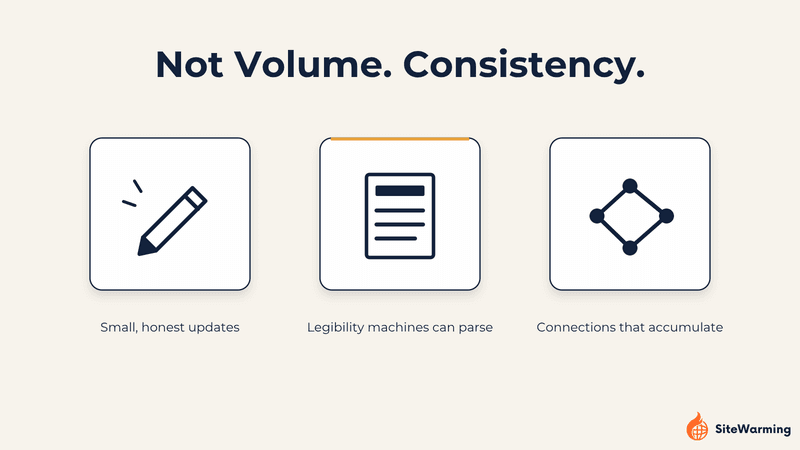
Not volume. Consistency and legibility.
Small, honest updates
Add one paragraph clarifying the current meaning. Fix something broken and explain the change. Expand a section readers keep misunderstanding. Add a "last updated" note when the substance actually changes. Why six years of content beats six months of marketing is the long-run version of this argument.
Legibility that machines can parse
Clear titles. Clear page intent. Consistent language across the domain. Structured data where it helps a system confirm what it's looking at.
Connections that accumulate
Useful, small artifacts earn connections over time: a mention here, a reference there. That increases discoverability without buying impressions, and it compounds the same way everything else in this article does. Content Is Memory makes the case for why those artifacts keep paying out long after you publish them.
This is what warming does: it starts the pattern. Not with a launch or a campaign, but with small, consistent signals that compound before anyone notices. See What is SiteWarming? for what that actually looks like in practice, and Visibility Before Validation for why the order matters.
Early vs. late: what the math actually looks like
| Starts small, now | Starts big, later | |
|---|---|---|
| Month 1 | One paragraph, one heading fix | Nothing published yet, still planning the "real" launch |
| Month 3 | A handful of small, consistent updates; early pattern established | Still building; zero signals sent |
| Month 6 | Discovery systems have observed a repeated pattern | Launches with a large, polished site all at once |
| Month 9 | Compounding continues; each new signal reinforces an established pattern | Starting from zero recognition, competing against six months of accumulated pattern |
The two paths don't converge just because the second one eventually ships something bigger. Systems weight repetition over size.
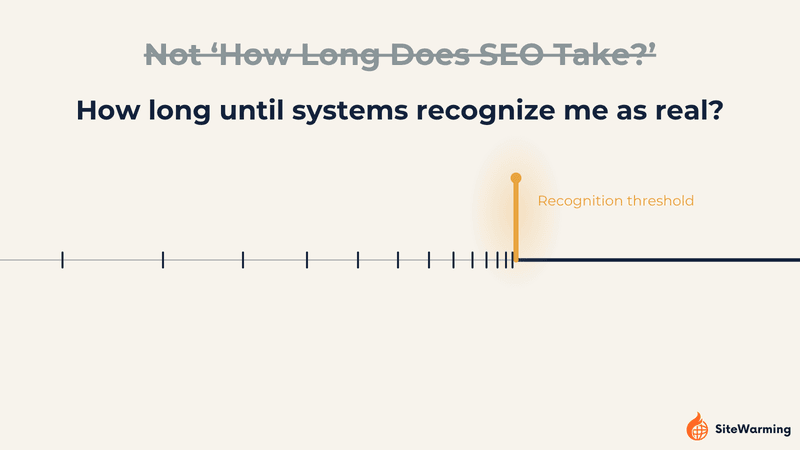
How long until discovery systems recognize you as real?
Founders usually ask this as "how long does SEO take?" That's the wrong question, or at least an incomplete one. The better version is: how long until discovery systems recognize me as real?
Pattern beats event. Invisibility compounds negatively the same way visibility compounds positively, every month without a signal is a month a discovery system has nothing to add to what it already believes about a domain, which is usually nothing. Starting the pattern, even in the smallest possible way, is what changes that.
Frequently asked questions
Why does starting early matter more than starting big? Discovery systems reward repeated patterns over single events. An early, small signal gets observed multiple times and compounds; a late, large launch is a single event a system has no prior pattern to weigh it against.
How long does it take for search engines to notice a new site? There's no fixed number, but the more useful framing is that recognition comes from a pattern of updates over time, not from any single moment, including the moment a site first goes live.
What is the Matthew Effect? The Matthew Effect, named by sociologist Robert K. Merton in 1968, describes how existing visibility tends to generate more visibility: once a domain has a bit of attention or credibility, systems and people tend to give it more, which creates further visibility. The reverse is also true for domains with none.
Why do small, consistent updates work better than one big launch? Because discovery systems infer trust and relevance from repetition: is this place active, does it change in ways that suggest stewardship, is it referenced elsewhere. A single launch, however polished, only answers those questions once.
Does updating a page actually help it rank? Updating for its own sake doesn't. Google's freshness work targets queries where recency genuinely matters, not every page on the web. What compounds is a pattern of substantive updates over time; changes that alter what the page actually says, rather than cosmetic edits or a changed date stamp.
Share this article
Ready to Transform Your Domain Portfolio?
Start building real value with your domain investments today.