Trust Is a System, Not a Feeling
 Bret Siers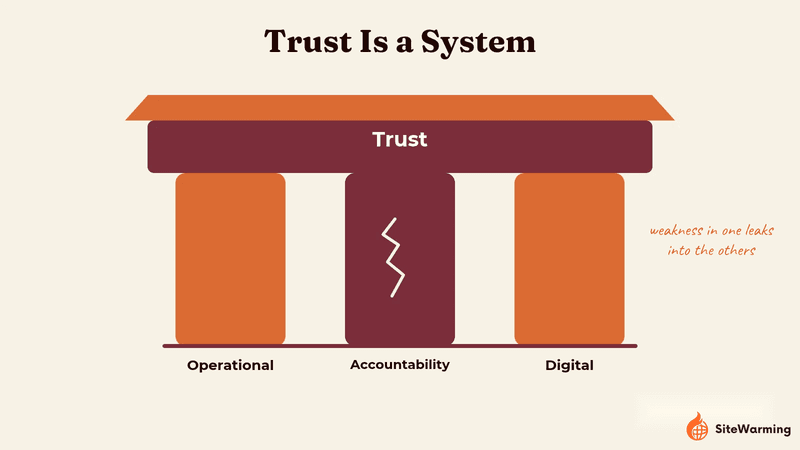
Trust online isn't earned through character, it's constructed through signals systems and people can verify: consistent design, clear provenance, and third-party validation. Humans decide whether to trust a domain in about 50 milliseconds, based almost entirely on presentation, not content. That means trust has to be built deliberately into how a domain looks and verifies itself.
You can be the most trustworthy person in your industry.
Honest. Competent. Reliable. A decade of satisfied customers who swear by you.
And your domain can still look untrustworthy to every system that matters.
That's the part founders miss, especially early. We treat trust as a character trait, something you earn by doing the right thing over time. In the real world, that's usually true.
In the digital layer, trust isn't earned through character. It's constructed through signals.
If the signals aren't there, neither is the trust, regardless of who you actually are.
Google's documentation is unusually blunt about this. In their E-E-A-T framework, they say: "Of these aspects, trust is most important." Experience, expertise, and authoritativeness contribute to trust. Trust is the outcome state. Not the vibe. (Source: Google Search Central)
That line matters because it sets the constraint.
Google can't know your intent. It can't measure your sincerity. It can't call your best customers and ask if you're "a good one."
It can only observe what's legible in public.
So can your visitors.
What trust actually means in digital systems
We need to strip the emotion out of this word.
To a founder, "trust" often means integrity. To a visibility system, and to a user's fast subconscious scan, "trust" means predictability based on verifiable patterns.
That's not cynical. It's mechanical.
A system can't access your character. It can only infer reliability from repeatable signals: consistency, clarity, provenance, external validation, and the absence of obvious risk markers.
PwC calls this "trust architecture," and frames it across three interdependent dimensions: operational trust, accountability trust, and digital trust. The key phrase is that leaders cannot pick and choose. Weakness in one dimension leaks into the others. (Source: PwC : The New Architecture of Trust)
That framing applies cleanly to domains.
Your domain is not a brochure. It's a trust collection point. It's where signals accumulate, conflict, or go missing.
And there's a precursor most people skip.
Micro-recap: Visibility creates the conditions where trust signals can be detected at all.
I wrote more on this here: Why You Should Launch Your Domain Before It's Ready
Trust judgments happen before conscious thought
Here is the stat that should keep you honest about how this works.
When a human lands on your domain, they decide whether to trust you in 50 milliseconds. (Source: NIH/PMC summary citing Lindgaard et al.)
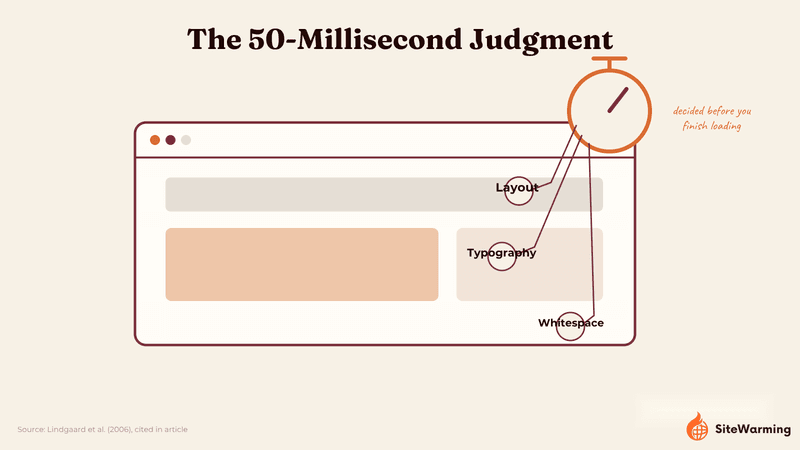
That's 0.05 seconds. Faster than reading your headline. Faster than reaching your "About" page. It's the first scan, not the first argument.
This is why trust online often feels unfair. You don't get graded on what you meant to do. You get graded on what you shipped, and how it presents in the first instant.
So what drives that instant judgment?
It's not your copy.
Research summarized from Stanford's web credibility work reports that nearly 75% of credibility judgments were based on content presentation, including "design and look" and "information design," rather than factors like perceived authority or reputation. (Source: NIH/PMC summary of Fogg et al. credibility research)
That's the mechanism: trust is often decided by how information is presented before anyone evaluates the information itself.
You don't have to love that. You just have to build for it.
Design signals are trust signals
Once you accept the 50-millisecond reality, "design" stops being aesthetic and becomes structural.
This is not "make it pretty." It's "make it legible."
Legibility is what the brain reads as safety: coherence, hierarchy, stability, and cues that someone is maintaining the space.
A messy layout, confusing navigation, broken pages, or an abandoned-feeling surface aren't small issues. They are trust leaks, because they break predictability.
Here are the most common trust leaks I see on founder domains that are otherwise legitimate, and what actually closes each one:
| Trust leak | What it signals | The fix |
|---|---|---|
| Messy layout that feels unstable | Nobody is maintaining this | A clean, consistent template, doesn't need to be custom-designed |
| Confusing navigation, unclear next step | Disorganization, low competence | One clear primary action per page |
| Broken pages or dead links | Neglect | A basic link check on every update |
| Abandoned-feeling surface, no recent activity | Nobody's home | A visible last-updated date or a light, regular cadence |
| Generic, context-free template | No real provenance | A real name, a real contact path, a specific description of what this is |
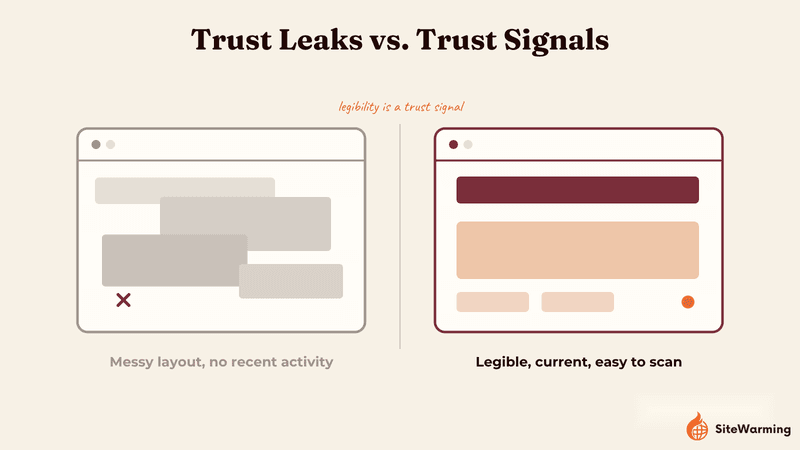
A founder can do everything right operationally, and still lose the trust decision at the front door.
That's not a moral judgment. It's an interface judgment.
You don't get credit for being trustworthy in private. You get credit for being trustworthy in public, in ways machines and humans can recognize.
The gap between perceived trust and actual trust
Founders are usually optimistic. We assume that because we know we're trustworthy, everyone else can tell.
We are wrong more often than we'd like.
PwC's trust survey data captures this mismatch cleanly: 90% of executives thought customers highly trusted their company, while only 30% of customers said they did. (Source: PwC : Trust Survey data)
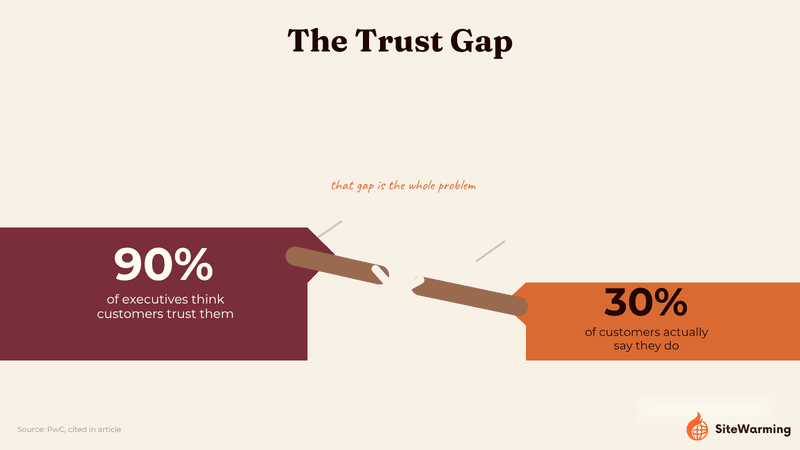
That's not a brand problem. That's an instrumentation problem.
We judge ourselves by our intentions and our internal context. The market judges us by what it can verify from the outside.
Call it a delusion gap if you want. The important part is the consequence: if you're not actively managing trust signals, you're probably overestimating them.
And this is where social proof stops being a tactic and becomes a bridge between two realities.
Micro-recap: You can't declare yourself trustworthy. You need echoes from the outside.
Related: Why a Domain Without Social Proof Is Half an Asset
How trust transfers through verification
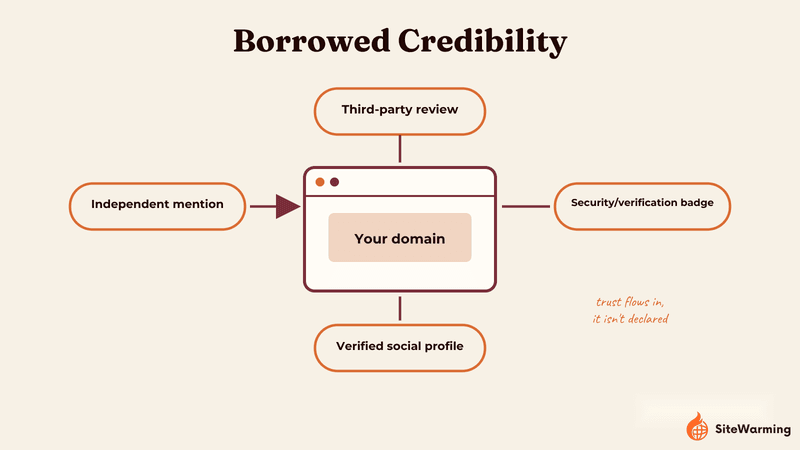
If you can't simply claim trust, how do you get it?
You borrow it.
Trust is transferable. When a verifiable third party points to you and says "this is real," their credibility flows into your domain.
Bazaarvoice's research shows the direction of that flow: 70% of consumers said they would trust an industry-leading third-party authentication provider to verify trustworthiness across sites, versus 47% who would trust a site verifying itself. (Source: Bazaarvoice : Trust Signals Research Report)
Self-verification ("I promise I'm legit") is structurally weaker than independent verification.
This is why certain markers keep repeating across the web, even across industries. In practice, that usually means things like:
- A visible, valid HTTPS/security indicator: the baseline, not a differentiator, but its absence is an instant leak.
- Third-party reviews and ratings that a visitor can click through and check independently.
- A social profile (LinkedIn, X) that uses the same name and links back to the domain, and vice versa.
- Certifications or memberships that can actually be verified, not just named.
- A visible "last updated" date or changelog, so the domain doesn't read as abandoned.
None of these are magic. They're simply easier to verify than your intentions.
And in a world where content is cheap, verification becomes the scarce signal.
Micro-recap: Verification transfers trust in ways self-assertion can't.
What this means for your domain
Your domain is not just an address. It's a visible trust surface.
Every element is either building trust or leaking it:
- Design signals: Is the layout coherent? Is the hierarchy clear? Does it feel maintained?
- Verification markers: Can claims be checked externally, or are they self-contained assertions?
- Consistency: Does the domain show repeated life over time, or does it look like a placeholder?
Here's the interpretation I'd put plainly:
A parked or empty-feeling domain isn't a neutral state. It's a public state. It creates ambiguity, and ambiguity reads as risk.
You can be legitimate and still look illegitimate if the signal layer is missing.
This is doubly true for a brand-new domain. A fresh registration isn't just fighting the human trust gap above: it's also moving through the period where search engines themselves treat new domains with extra scrutiny before ranking them normally. You're building credibility with two different audiences on two different timelines at once. We go deeper on the search-engine side of that in Google Sandbox Effect: Why New Domains Take Months to Rank.
So the work isn't "be more trustworthy." The work is "make your trustworthiness legible."
The bottom line
Trust isn't given. It's constructed.
In 50 milliseconds, systems and humans decide whether you're worth more attention. That judgment isn't based on your character, your intentions, or your private track record.
It's based on the signals they can see right now.
Digital trust is architecture. Build it deliberately, or it will leak through every gap you didn't know existed.
Trust is where visibility becomes value. Warming is making your trustworthiness legible before you feel ready. The signals you build now determine whether systems and humans give you a chance.
Frequently asked questions
How long does it take to build trust online? The first, fastest judgment happens in about 50 milliseconds based purely on presentation, but that's only the entry gate; deeper trust, built through consistency, verification, and repeated observation over time, typically compounds over weeks and months rather than being won in a single visit.
What makes a website look untrustworthy? The most common trust leaks are a messy or unstable-feeling layout, confusing navigation, broken links, an abandoned-feeling surface with no recent activity, and a generic template with no real provenance (no name, no contact path, no specifics about what the site actually is).
Does website design really affect how much people trust a business? Yes. Research on web credibility judgments found that nearly 75% of credibility decisions were based on presentation (design and information layout) rather than the reputation or authority of the source. Design isn't decoration here; it's the primary evidence people use to judge legitimacy in the first instant.
How do I verify my website is legitimate to visitors? Borrow credibility from outside sources rather than asserting it yourself: a valid security indicator, third-party reviews a visitor can check independently, a consistent social profile that links back to your domain, and a visible sign of recent activity like a last-updated date.
What is digital trust architecture? A framework (used by firms like PwC) for thinking about trust as built from interdependent layers; operational reliability, accountability and digital presentation, rather than a single feeling. Weakness in one layer leaks into the others, so trust has to be managed as a system, not a slogan.
Share this article
Ready to Transform Your Domain Portfolio?
Start building real value with your domain investments today.