Why a Domain Without Social Proof Is Half an Asset
 Bret Siers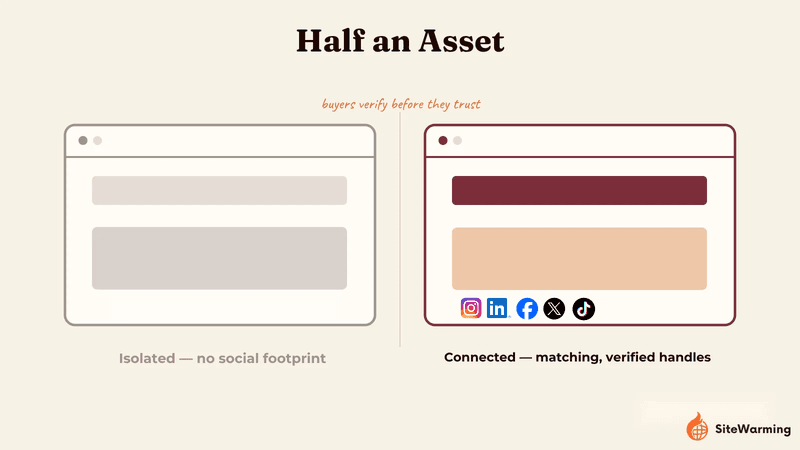
A domain without matching social handles is functionally incomplete because buyers and visitors verify identity before they trust it. Fragmented naming across platforms reads as uncertainty, while consistent handles let recognition compound. Claiming and aligning your handles is free, low-effort, and turns a naked domain into something that already looks like it's in motion.
You bought the domain. You built the site. The copy is solid.
Then someone does what modern buyers do before they take you seriously.
They try to verify you.
Not in a dramatic way. In a quiet way. A few searches. A few clicks. A scan of whatever shows up when your name leaves your mouth and becomes text.
That's when the cracks appear.
Your domain points one direction. Your LinkedIn Company Page is close but not exact. Your handle on one platform has an underscore because the real one was taken. Another platform has a different root name entirely.
None of this feels fatal in isolation.
But stacked together, it reads like uncertainty.
And uncertainty is the tax you pay when your identity doesn't resolve.
When names don't match, people wonder if they've landed on a copycat and back out. Vodien describes this exact "copycat" doubt pattern and how fast it can show up in the decision window people give you when they're scanning profiles (Vodien).
If you own the domain but the identity around it is scattered, you don't own a brand yet.
You own half an asset.
Why handles are infrastructure, not marketing
Operators usually hate "social" because it sounds like a treadmill.
Post more. Perform more. Stay loud.
But handles aren't content. They're coordinates.
They're the way humans and systems confirm that all these mentions, profiles, bios, and links point to the same underlying entity. When the naming matches, the verification cost drops. People don't have to think. They just recognize.
Vodien's phrasing is useful here because it's literal: carry the same root phrase through your domain and every social handle. They also make a strong claim that unified naming helps systems "connect the dots" around authority (Vodien).
Here's the operator translation: fragmented naming creates fragmented recognition. You can build something great and still feel invisible because the identity graph doesn't collapse into one obvious thing.
Domains work the same way. A name is not a lottery ticket. It's a piece of a system.
Parking pages are not a pause state, they're a public state. If you want the deeper mechanics behind that idea, I wrote more on it here: Domain Investing vs. Domain Building: Which Strategy Wins?
When naming is consistent, the asset holds water.
When it's fragmented, you leak legibility everywhere people try to confirm you.
What if your ideal handle is already taken?
This is the first wall almost everyone hits, so plan for it rather than treating it as a failure. In order of preference: try the same root with your specific niche or product line appended (namewarehouse instead of warehouse if the bare word is gone), use a consistent, minimal modifier across every platform where you're blocked (always _hq, or always .co, never a mix), and avoid underscores or numbers that vary by platform: pick one variation and use it everywhere, even on the platforms where the clean handle was available, so a visitor never has to guess which version is really you.
The verification layer you're missing
We tend to dismiss verification as a status symbol.
But verification is better understood as a checksum. It tells the system, and the human, "this node resolves to a real identity."
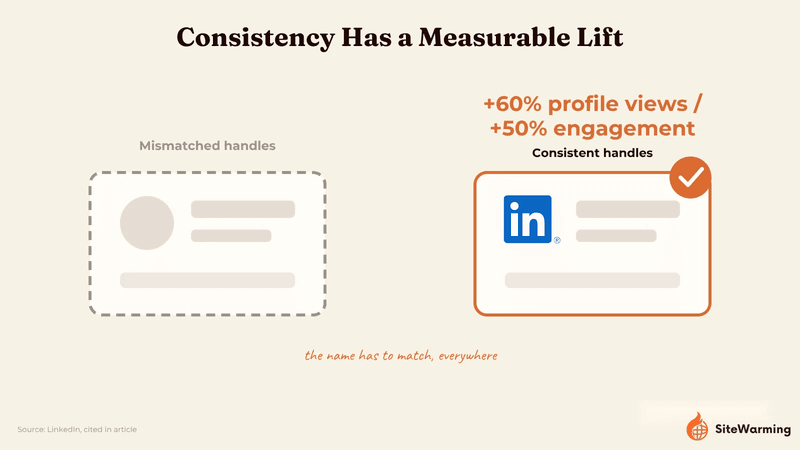
LinkedIn is unusually explicit about the measured effect. In their own announcement, they say verification helps members stand out with up to 60% more profile views and up to 50% more engagement on posts (LinkedIn).
Read that again, slowly.
Those lifts are not coming from better writing or a better domain.
They come from adding a trust signal the system can read quickly.
If you've been treating verification as "later," you've been treating a multiplier like decoration.
Trust isn't a feeling. It's a stack of checks. If you want the conceptual model behind that, here's the deeper cut: Trust Is a System, Not a Feeling.
What buyers actually evaluate
If you treat domains as assets that may someday be acquired, licensed, or sold, you have to look at what a buyer is actually buying.
They're not only buying a URL.
They're buying how easily an identity resolves when someone goes looking.
MediaOptions makes the market-facing argument directly: social signals like followers and engagement are read as indicators of popularity and influence, and they can be interpreted as clues about future growth potential (MediaOptions).
You don't have to accept every implication to take the operator lesson: sophisticated buyers evaluate the footprint, not the name alone.
And the end-user world has been trained the same way.
The Forbes piece claims that review-checking is nearly universal for online purchases, citing one survey as high as 99.9% while noting other data is lower, and it also reports that positive reviews and testimonials increase trust among a large share of consumers (Forbes).
Don't anchor on the ceiling number. Anchor on the expectation: people look for corroboration before they commit attention, money, or reputation.
| Isolated domain | Connected domain | |
|---|---|---|
| First impression | Reads like a cold start, nothing to verify against | Reads like something already in motion |
| Verification cost for a visitor | High, they have to take your word for it | Low, they can cross-check in seconds |
| Buyer/investor read | Name alone, no footprint signal | Footprint + name, more evaluable |
| Trust source | Self-asserted | Borrowed from platforms and cross-references |
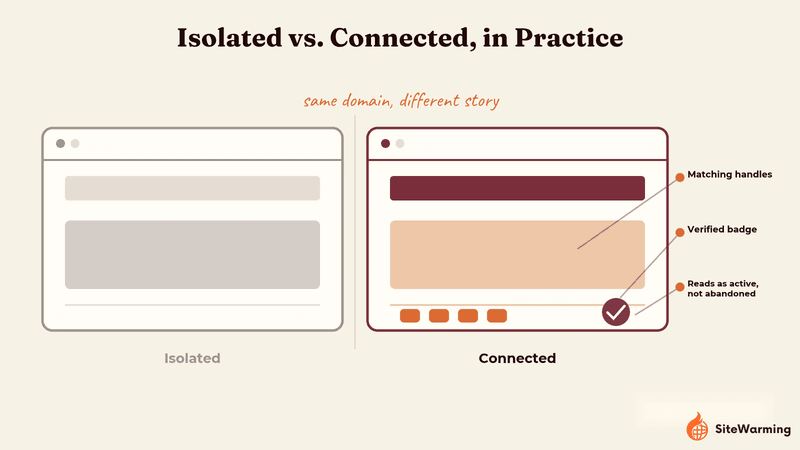
A naked domain with no matching identity reads like a cold start.
A domain with matching handles and visible continuity reads like something already in motion.
That difference is value.
The multiplier effect of connected identity
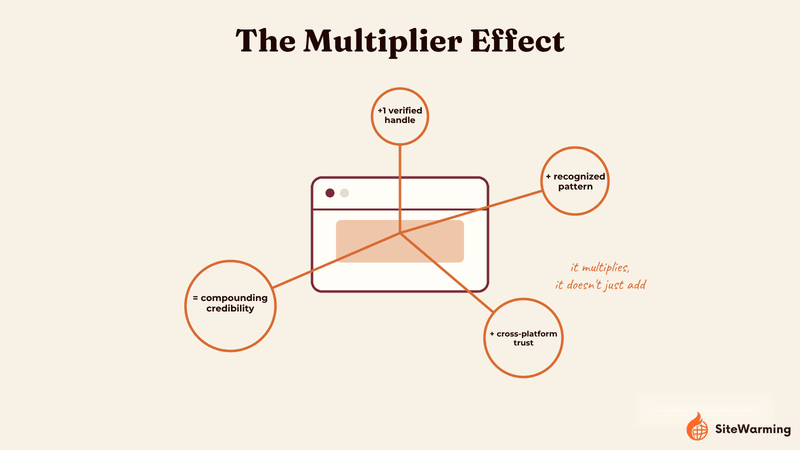
Trust transfers. That's the physics of the social web.
The same Forbes piece cites survey data suggesting many consumers trust influencer recommendations and that these voices can sway purchase decisions and help people discover new brands (Forbes).
Again, don't worship the exact percentages. Notice the mechanism.
When your domain is isolated, it has to earn trust entirely inside its own walls.
When your domain is connected to consistent, verifiable handles, the trust work is shared across the identity graph.
People don't need to "believe" you.
They need to recognize you.
And recognition compounds.
This is a visibility problem disguised as a domain problem. Discovery systems learn from repeated observation, and empty space becomes a durable signal. Warming turns ownership into presence early. The domain is the anchor, but the recognition network is what makes that anchor legible across the places people actually verify you.
What this means for your domain collection
If you own one domain, you can brute force inconsistency. You can explain it away in DMs.
If you manage ten, twenty, fifty, you can't.
At scale, fragmented identity becomes operational debt.
Every missing handle creates an impostor-shaped hole someone else can occupy.
Every mismatch creates a dead end where recognition should have been compounded.
So the work is not "become a content creator."
The work is asset completion.
A simple operator checklist:
- Claim the matching root handle everywhere you can, even if you don't plan to post yet.
- If the clean handle is gone, pick one consistent fallback pattern and use it on every platform, not just the ones where you were blocked.
- Make the domain and profiles mutually referential: bios point to the domain, the domain points to the canonical profiles.
- Reduce variation: drop underscores, extra suffixes, and alternate spellings whenever possible.
- Add a heartbeat signal: one light continuity post on a predictable cadence so accounts don't read as abandoned.
- Use verification where it fits, because it's increasingly a routing signal, not a flex (LinkedIn).
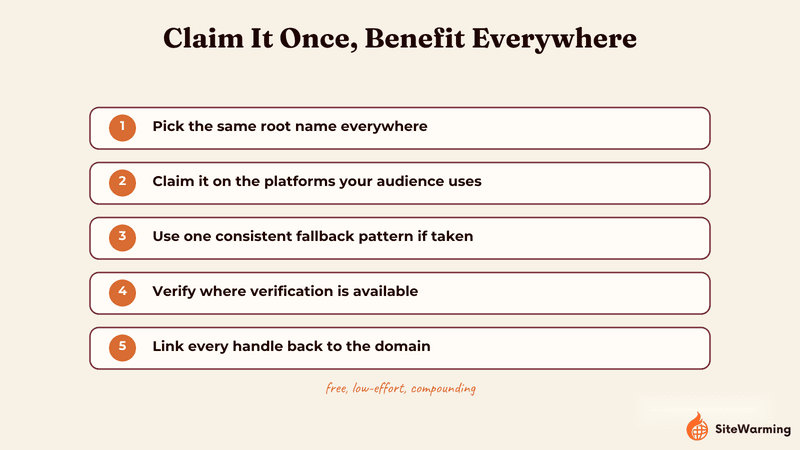
Static pages don't build trust, continuity does. If you want the mechanics behind that idea, here's the deeper cut: Continuity Builds Trust.
A domain without social proof isn't worthless.
It's incomplete.
Every missing handle is a verification gap. Every inconsistent name is a trust leak. Every isolated profile is a multiplier set to zero.
Half an asset isn't a failure.
It's unfinished work.
Frequently asked questions
Why does my domain need matching social media accounts? Because modern visitors and buyers verify identity before they trust it, they cross-check your domain against your social profiles and a mismatch (different names, inconsistent handles) reads as uncertainty even when your business is completely legitimate.
Does social proof actually affect how much a domain is worth? Yes, indirectly but meaningfully; buyers evaluating a domain look at its footprint, not just the name, and a domain with consistent, verifiable handles signals more evaluable, active ownership than a bare name with no corroborating presence.
What handles should I claim first for a new domain? Start with the same root name as your domain on whichever platforms your actual audience uses (not every platform that exists), prioritizing consistency of the root phrase over claiming every network at once.
What if my domain name is already taken as a handle on social media? Pick one consistent fallback pattern (a niche-specific extension, or a single modifier like _hq) and use that exact same variation across every platform, including the ones where the clean handle was actually available; the goal is one predictable identity, not the cleanest possible handle on each individual platform.
Do I need to be verified on every platform to build trust? No: verification helps where it's available and cheap to get (LinkedIn reports meaningful lifts in profile views and engagement from it), but the more foundational requirement is simply that your naming is consistent and cross-referential across the domain and whatever handles you do hold.
Share this article
Ready to Transform Your Domain Portfolio?
Start building real value with your domain investments today.