Content Is Not Marketing. It's Memory.
 Bret Siers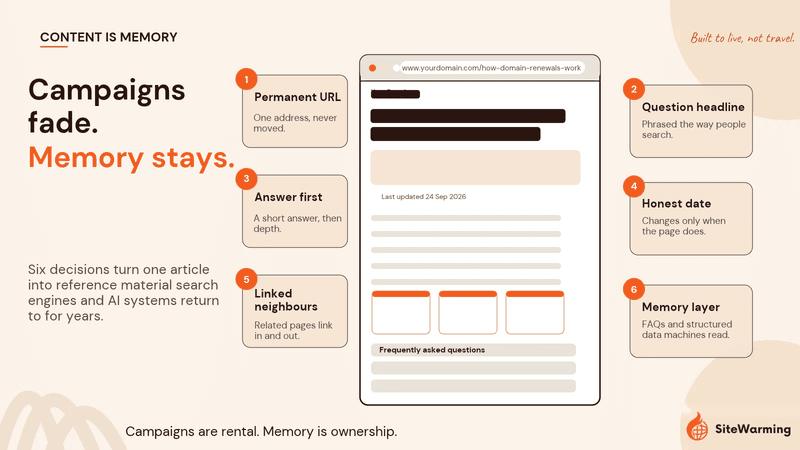
Content becomes memory when a page answers a question people keep asking and stays at the same URL long enough for search engines and AI systems to learn it. Campaign content is built for a spike and fades. Memory-shaped, evergreen content keeps getting found, which matters because most of the web decays: the median web page lasts 2.3 years.
You're in your analytics dashboard looking for the spike from yesterday's announcement when you notice something you didn't expect.
A steady stream of visitors landing on an article you wrote three years ago.
You'd almost forgotten it existed.
It wasn't your best work. It wasn't part of a launch. You wrote it because someone kept asking the same question, so you answered it once, linked it to a few related pieces, and moved on.
Three years later, it's still working. Still answering. Still being found.
That isn't marketing.
That is memory.
Why does most web content disappear?
We tend to treat the web like a feed. Something is consumed in the moment, then buried. But the data points to a different truth: the default state of the internet is not memory. It is decay.
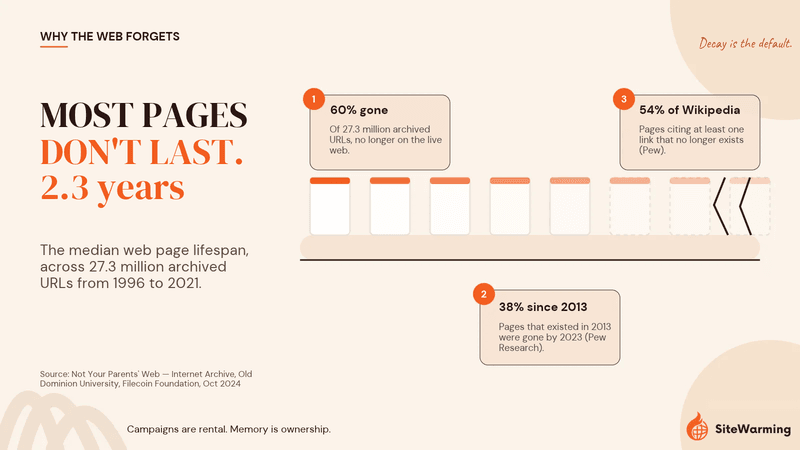
The clearest measurement comes from the Not Your Parents' Web project, a collaboration between the Internet Archive, Old Dominion University's Web Science & Digital Libraries Research Group and the Filecoin Foundation. It analysed 27.3 million archived URLs across 7 million hosts, spanning 1996 to 2021. The median lifespan of a web page was 2.3 years, and about 60% of those URLs are no longer accessible on the live web (Filecoin Foundation, October 2024).
Pew Research Center found the same pattern over a shorter window. A quarter of all webpages that existed at some point between 2013 and 2023 were no longer accessible as of October 2023, and 38% of the pages that existed in 2013 were gone (Pew Research Center, May 2024).
| Study | What was measured | Finding |
|---|---|---|
| Not Your Parents' Web (Internet Archive, Old Dominion University, Filecoin Foundation, 2024) | 27.3 million archived URLs, 1996–2021 | Median page lifespan of 2.3 years; about 60% of URLs no longer accessible |
| When Online Content Disappears (Pew Research Center, 2024) | Webpages that existed 2013–2023 | 25% no longer accessible by October 2023; 38% of 2013 pages gone |
| When Online Content Disappears (Pew Research Center, 2024) | Wikipedia reference sections | 54% of Wikipedia pages cite at least one link that no longer exists |
| When Online Content Disappears (Pew Research Center, 2024) | News webpages | 23% contain at least one broken link |
What is link rot?
Link rot is what happens when a URL that once led to a working page stops resolving. The page was deleted, moved without a redirect, or the domain behind it lapsed. Every link and citation that pointed to it now leads nowhere, and whatever the page had earned goes with it.
Tim Berners-Lee named the cause in 1998: "Cool URIs don't change," and "URIs don't change: people change them" (W3C, Cool URIs don't change). Link rot is rarely an accident of the medium. It is usually a decision someone made during a redesign, a rebrand or a cleanup.
That means most of what gets published never survives long enough to become reference material. The pieces that do survive pass through a filter most people don't plan for.
They stay put.
And staying put turns writing into something discovery systems can learn from.
What is the campaign delusion?
Founders rarely say "I'm building campaigns." They say "I'm publishing content." But the structure tells the truth.
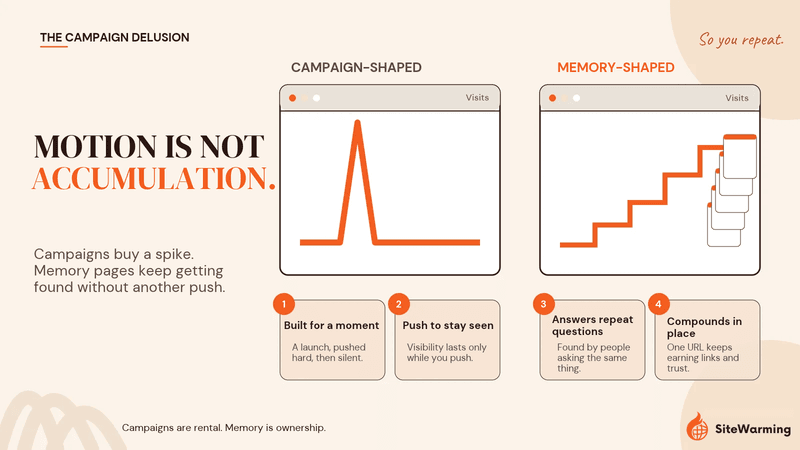
Campaign-shaped writing is built for a moment. It assumes urgency. It leans on novelty. It often stands alone, because the point is the spike. It gets pushed, it gets a short burst of attention, then it collapses back into silence.
So you repeat.
This becomes a treadmill that looks like progress because it produces motion. But motion is not the same thing as accumulation.
The campaign delusion is the belief that visibility comes from repeated bursts. That discovery is something you buy or manufacture on demand. That your work "works" only when you are actively pushing it.
The problem is not effort. It's architecture.
The same delusion shows up on domains. Parking pages are not a pause state, they're a public state. Empty space becomes a durable signal. I wrote more on this here: Static Pages Don't Build Trust. Continuity Does.
What do search engines and AI systems actually remember?
Let's make one key distinction that clears up most of the confusion.
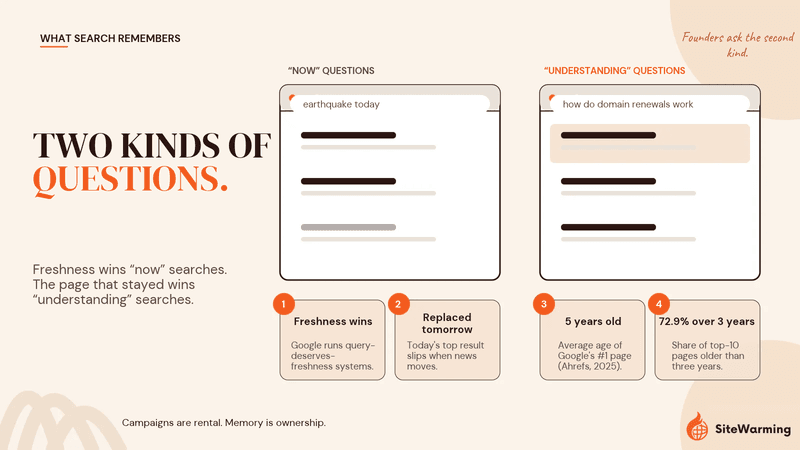
Some queries are time-sensitive. People want "what happened today," "latest update," "current price," "this week's change." For those queries, freshness is the point.
Google says so directly: it runs "query deserves freshness" systems designed to show fresher content for queries where it would be expected, such as a new film release or a breaking earthquake (Google Search Central, ranking systems guide).
But most founder queries are not like that.
Most founder queries are closer to: What is this? Why does this happen? How does this work? What should I do instead?
Those are not "now" questions. They are "understanding" questions.
Discovery systems can learn from "understanding" pages because the underlying question repeats over years. But they can only learn if the page remains reachable in the same place, with the same meaning, long enough to become a stable reference.
The ranking data reflects this. Ahrefs' 2025 study, updated August 2026, looked at 1.3 million keywords and found the average page ranking #1 in Google is 5 years old, up from 2 years when Ahrefs first ran the study in 2017. 72.9% of pages in the top 10 are more than 3 years old, and of 1 million newly published URLs tracked, only 1.74% reached the top 10 within a year (Ahrefs, Patrick Stox, updated August 2026). That is the long game I make the case for in why six years of content beats six months of marketing.
The internet doesn't remember effort. It remembers what stays put long enough to be referenced.
Does AI search only cite fresh content?
No, but it rewards content that is kept current, and that nuance matters.
Seer Interactive analysed 7,683 pages and 47,097 citations across ChatGPT, Gemini and Perplexity from March to June 2026. It found 75% of the pages LLMs cite were updated in the last year, and 88% in the last two. But more than a quarter of those "fresh" pages were first published over two years ago (Seer Interactive, July 2026).
Read that carefully. AI systems are not asking for new URLs. They are citing old URLs that someone kept tending.
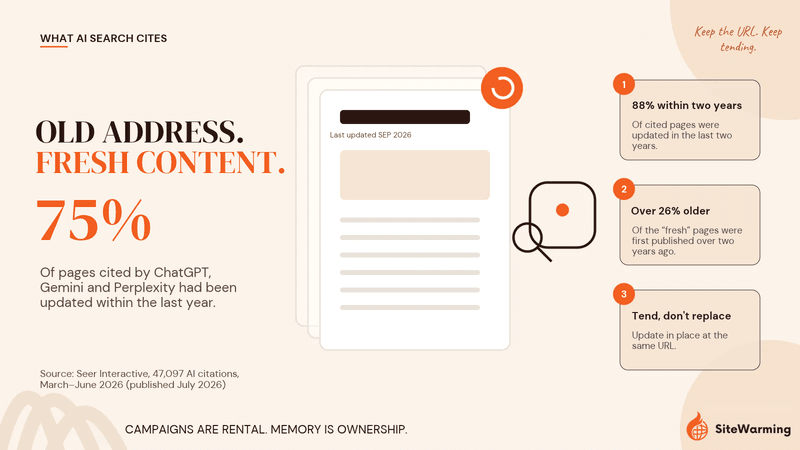
That sharpens the idea rather than breaking it. Staying put is necessary, not sufficient. The address stays the same so the page can accumulate memory. The content inside it gets cared for so the memory stays accurate. Treating a page as publish-and-leave is its own mistake, which is the argument in the myth of set-and-forget digital assets.
What is the difference between campaign content and evergreen content?
If you want a simple test, look at the headline and the structure.
Campaign-shaped pages are about time. They anchor themselves to the moment. They are designed to be consumed once and replaced.
Memory-shaped pages are about utility. They answer a question that will be asked again. They are designed to be returned to. Most people call this evergreen content. I prefer "memory," because evergreen describes the topic and memory describes what the page becomes once it has stayed in place long enough.
The curve matters less than the reason the curve exists.
A campaign page tends to be "complete" at publish time. It doesn't need neighbors. It was built to travel, not to live.
A memory page becomes more complete as the constellation fills in around it. It links outward to neighboring concepts. It earns internal pathways that keep visitors moving through the library.
| Campaign-shaped page | Memory-shaped (evergreen) page | |
|---|---|---|
| Built for | A moment: a launch, an announcement, a promotion | A question that will be asked again |
| Headline anchors to | Time: "introducing," "this week," "now live" | Utility: "what is," "why does," "how do you" |
| Complete when | It is published | Its neighboring pages fill in around it |
| Links | Stands alone | Links out to related concepts and receives links back |
| Traffic shape | A spike, then silence | Lower, steady, returning |
| URL | Often disposable or changed later | Permanent |
| What keeps it working | Another push | An occasional update in place |
Articles still matter because they are one of the simplest formats for stable reference material. Related: Why Articles Still Matter in an AI World.
How can you tell if a page is campaign-shaped or memory-shaped?
Ask five questions of any page you are about to publish:
- Will someone ask this question again next year? If not, it is a campaign page, which is fine, as long as you know it.
- Does the headline depend on a date or an event? "Our spring launch" expires. "How domain renewals work" doesn't.
- Does it link to at least two related pages, and will related pages link back? Pages that stand alone are harder for readers and crawlers to place.
- Will the URL still be the same in five years? If your slug contains a year, a campaign name or a version number, probably not.
- Could someone quote one paragraph and have it make sense on its own? Reference material is made of self-contained answers.
Three or more "no" answers and you have written a campaign page, whatever you call it.
How do you build content that stays put long enough to be remembered?
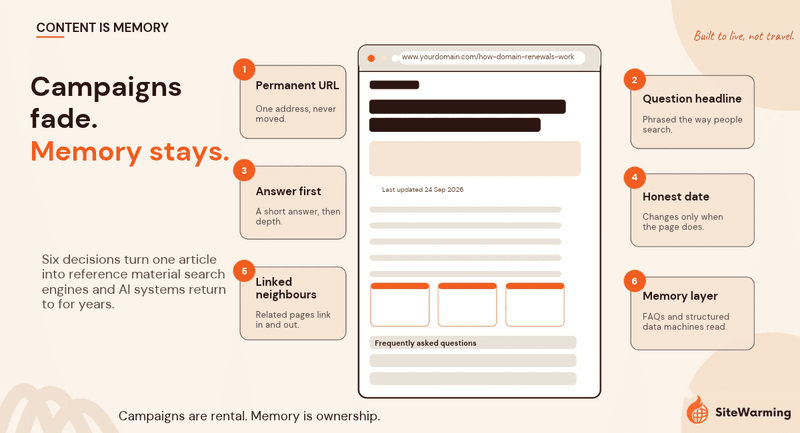
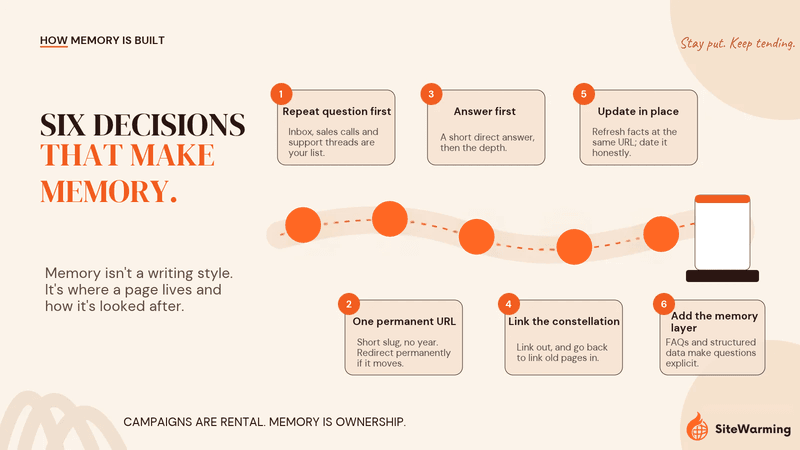
Memory is not a writing style. It is a set of decisions about where a page lives and how it is looked after. These are the six I use.
- Start with a question that repeats. The best reference pages begin the way the article in the opening did: someone kept asking the same thing, so you answered it once. Your inbox, sales calls and support threads are the source list.
- Give it one permanent URL, and don't move it. Keep slugs short and free of years or campaign names. If a URL genuinely has to change, redirect it. Google recommends "a permanent server-side redirect whenever possible," and treats the redirect as a signal that the new URL should be canonical (Google Search Central, redirects).
- Answer first, then explain. Put a short, direct answer under each question-shaped heading, then the depth. Machines and skimming readers both take the first clean answer they find, which is the core of making a website machine-readable.
- Link it into a constellation. Link out to the neighboring concepts, and go back to older related pages to link in. A page with no internal links pointing to it is hard to find, however good it is.
- Update in place, and date it honestly. Refresh facts inside the same URL instead of publishing a near-copy at a new one. Show a visible "last updated" date and match it in your structured data (Google Search Central, publication dates). Google's own helpful-content checklist asks whether you are "changing the date of pages to make them seem fresh when the content has not substantially changed" (Google Search Central, creating helpful content). Change the date when you change the page.
- Add the memory layer. FAQs and structured data make the recurring questions explicit, so a crawler doesn't have to infer them. If you are unsure whether a small site needs it, read why schema markup matters for small websites.
What mistakes erase content memory?
- Changing slugs in a redesign without redirects. The most common cause of self-inflicted link rot.
- Deleting old posts to look tidy. If a page still answers a real question, update it. Deleting it throws away everything that pointed to it.
- Republishing the same topic at a new URL. Two half-remembered pages compete with each other. One maintained page accumulates.
- Putting the year in an evergreen slug. The title can carry a year when it helps. The URL shouldn't.
- Leaving pages orphaned. Nothing links in, so nothing flows in.
- Bumping the date without changing the content. Google explicitly asks about this in its helpful-content guidance.
- Letting the domain lapse or sit dark. When a domain expires, every page and every inbound link on it rots at once. Here is what happens when a domain expires. If your names are spread across several registrars, keeping every renewal date in one view is the cheapest protection you have.
What does content as memory mean for founders sitting on unbuilt domains?
If you are a founder, this is not a content strategy decision. It's an identity decision.
You can treat writing as a series of pushes meant to create short-term attention. If you do that, the work expires, and you stay on the treadmill. Each new push replaces the last.
Or you can treat writing as infrastructure.
Infrastructure is not glamorous. It is patient. It is designed to hold meaning over time, even as everything around it changes.
When you build infrastructure, you stop thinking in "updates" and start thinking in reference.
FAQs aren't "support content." They're the memory layer for recurring questions that block understanding. If you want the mechanics behind that idea, the deeper cut is the beginner's guide to making your website machine-readable, which covers FAQ markup in detail.
The same physics applies to the domains you own. A domain with nothing on it has nothing to be remembered for. It doesn't quietly accumulate value while it waits; unused domains don't gain SEO value on their own, and a domain with no content is invisible to AI search rather than penalised. Every year it sits dark is a year of memory that never starts, on top of the hidden cost of an unused domain you already feel at renewal time. Putting a small, real page live at the address, with a clear story and a way to reach you, is what starts the clock.
We've lived the loop: buy the domain in clarity, then renew it while the idea stays dark. Warming is choosing to make an idea legible before you feel ready. Quietly. On purpose. Discovery systems learn from repeated observation, and empty space becomes a durable signal. Warming turns ownership into presence early. (What is SiteWarming?)
How do you apply this across every domain you own?
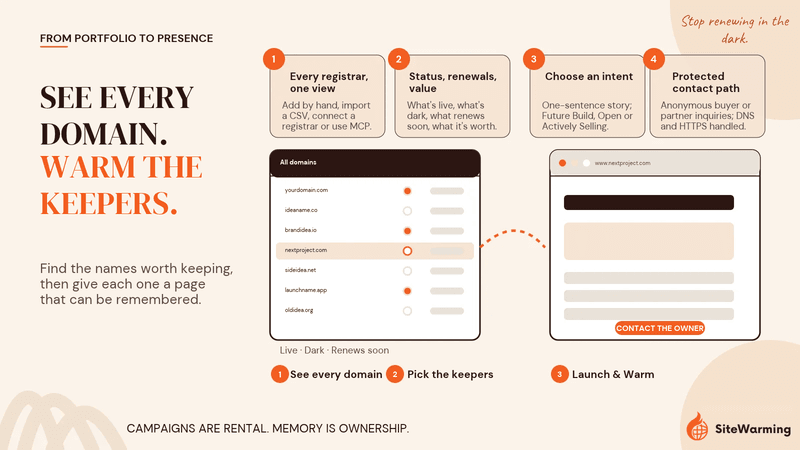
The same rules hold whether you own one name or four hundred. At portfolio scale, though, you can't make the memory decision until you can see what you have.
Most founders we talk to bought names faster than they could build on them. The domains sit dark at three or four registrars, each renews quietly on its own date, and anyone who searches for the idea finds nothing and moves on. Domainers have the same problem at larger scale: hundreds of names, renewal dates scattered across dashboards, and no clear way to decide what to keep and what to drop.
So we split the work into two steps.
See the whole portfolio. Our domain portfolio management tool puts every domain from every registrar in one view. You add names by hand, bulk-import a CSV, connect a registrar or use the MCP server. It shows which names are live, which lead nowhere and which are approaching renewal, with a HumbleWorth valuation fetched automatically for each name and appraisals from 15+ sources stacked alongside. That is where keep, warm, sell or drop becomes a decision instead of a renewal-day guess.
Act on the names worth keeping. Launch & Warm gives each one an address worth remembering. You tell the domain's story in one sentence and choose an intent: Future Build, Open, or Actively Selling. A warm site goes live with a domain analysis, AI-readable FAQs and structured story data, plus a protected, anonymous path for buyers or partners to reach you. DNS, HTTPS, hosting and ongoing DNS and SSL checks are handled, and the site gets monthly content updates. That is exactly what memory needs: one stable address, tended over time.
The web forgets most of what gets published. That isn't a tragedy. It's just the physics of the medium.
The decision in front of you is whether your work is built to survive long enough to be remembered.
Campaigns are rental. Memory is ownership.
Frequently asked questions
What is evergreen content? Evergreen content is content that answers a question people keep asking, so it stays useful long after it is published. Guides, definitions, explanations and "how does this work" pages are typical examples. It only becomes reference material if it stays at the same URL and is kept accurate, because search engines and AI systems learn from pages they can find in the same place over time.
What is the difference between evergreen content and campaign content? Campaign content is tied to a moment, such as a launch, promotion or announcement, and is designed to be consumed once and replaced. Evergreen content is tied to a recurring question and is designed to be returned to. Campaign pages spike and fade; evergreen pages grow steadier as related pages link to them and they keep answering the same question year after year.
How long does a web page last on average? Not long. A study of 27.3 million archived URLs by the Internet Archive, Old Dominion University and the Filecoin Foundation found the median lifespan of a web page is 2.3 years, and about 60% of those URLs are no longer accessible. Pew Research Center found 38% of webpages that existed in 2013 were gone by 2023.
What is link rot? Link rot is when a link stops working because the page it points to was deleted, moved without a redirect, or its domain expired. Pew Research Center found 54% of Wikipedia pages cite at least one link that no longer exists. You prevent it on your own site by keeping URLs permanent and using permanent redirects when a URL genuinely has to change.
Does old content still rank on Google? Yes, for questions that don't need the latest news. Ahrefs' 2025 study of 1.3 million keywords, updated August 2026, found the average page ranking #1 in Google is 5 years old, and 72.9% of top-10 pages are more than 3 years old. Google applies freshness systems to time-sensitive queries, so older pages win mainly on "understanding" questions.
Does AI search prefer fresh content? AI search prefers recently updated content, not necessarily new content. Seer Interactive's 2026 study of 47,097 citations found 75% of pages cited by ChatGPT, Gemini and Perplexity were updated within a year, yet more than a quarter of those were first published over two years ago. Keep the URL, and keep the page current.
Do unused domains gain SEO value? Not on their own. Search engines and AI systems learn from content they can crawl and cite at a stable address, and a parked or empty domain gives them nothing to learn. Holding the name keeps the option open, but no memory builds until a real page goes live, such as a warm site with a clear story, an FAQ and a way to reach the owner.
Share this article
Ready to Transform Your Domain Portfolio?
Start building real value with your domain investments today.