Signals: How to Tell When Someone Wants Your Domain
 Bret Siers
Photo by Brett Jordan on Unsplash
Signals: How to Tell When Someone Wants Your Domain
It usually arrives on a Tuesday. A short message in your inbox, the subject line just the name of a domain you registered three years ago and mostly stopped thinking about. "Is this available?" Or, "Would you consider an offer on this?"
For a second, something shifts. A name you half-forgot is real to someone else. They went looking. They found you. Then the doubt arrives right behind it. Is this real? A person, or a script? Worth answering, or the kind of thing you delete?
Here is the direct answer underneath all of it. If your domain is dark, you can't tell. There is no signal in a void. A parked page with no contact path absorbs every visit, every lookup, every typed address, and reports nothing back. The person who wanted your name picks something else and moves on, and you never know it happened. If the domain is Open, the signals find their way in. And once they do, you can read them.
Learning to read them, calmly, is the whole skill. You don't have to want to sell anything to want to understand what just knocked.
What a Real Signal Actually Looks Like
Interest in a domain is more common than most owners think, and it shows up in a handful of recognizable shapes. Once you know them, the noise sorts itself out.
A make-offer inquiry. Someone fills out a form on the domain, or sends a note to the address attached to it, asking about the name. This is the clearest signal there is. The good ones are specific. They mention what they would use it for. They write like a human who has a reason. A real person typed your name on purpose and put their email behind the question. That is effort, and effort is intent. The catch is that it only reaches you if there was somewhere to leave the message in the first place.
A WHOIS lookup spike. A registration record getting pulled once is routine. The same record getting pulled several times in a short window is a person doing homework before they reach out. Not always a buyer. Sometimes a competitor, sometimes pure curiosity. But a quiet name you have not promoted anywhere drawing repeated lookups is someone doing their homework. That is a precursor, not a transaction.
A broker reaching out. A third party contacts you on behalf of a client they will not name, and your domain is not listed anywhere. Handled well, this is how much of the real, high-value interest actually moves: someone wanted a specific name badly enough to pay a person to find the owner and open a conversation. Handled badly, it is the front end of a low-ball. More on telling those apart in a second.
A repeated direct-navigation pattern. The same domain getting typed straight into a browser, again and again, is not random. One visit is nothing. The same name drawing repeat visits over months means someone remembers it and keeps checking whether anything has changed. It is often the truest signal of all, because nobody is performing it for your benefit. People just keep arriving, on their own, looking for something they hope is there.
Some signals are obvious because they arrive as messages. Others are only visible if the domain is active enough to observe them.
You will notice none of these look like a sale. They look like attention. A name you believed in once is being noticed by people who think the way you did when you registered it. Whether you can see any of it depends entirely on whether the domain is reachable or hidden.
Telling the Real Signal From the Noise
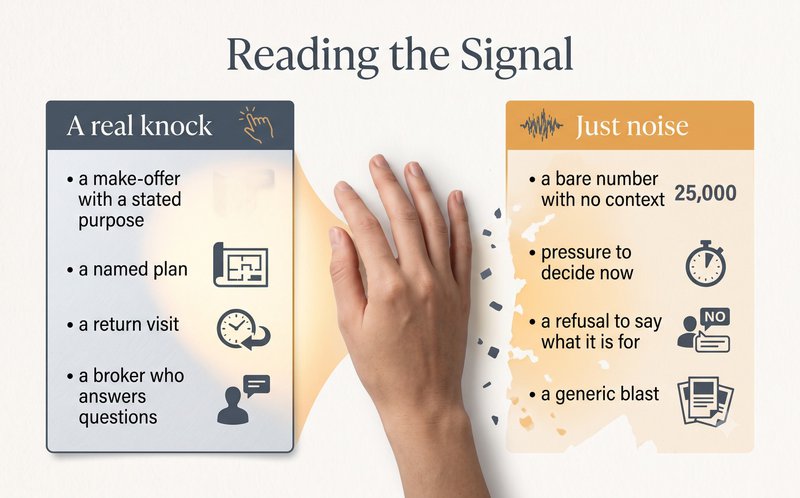
Not every inquiry is a person who values your idea. Some are fishing. Some are anchoring. Knowing the tells keeps you calm and in charge.
The blast is easy. A vague message sent to a thousand owners at once, no mention of your name, your idea, or any use. It is a volume strategy with a low probability floor. Delete it and feel nothing.
The low-ball is the one that stings a little, so it is worth naming plainly. A weak signal asks you to react quickly to a number. A real signal gives you enough context to decide calmly. It is not an insult and it is not an opportunity. It is an opening move in a game you never agreed to play. That is exactly the path the Open approach routes around.
A genuine signal looks different. A real buyer tends to tell you what they want the name for. They have a plan. They will answer questions instead of dodging them, and they can wait for a reply. That does not mean every serious approach comes with a return address. Plenty arrive through a broker, and that is normal. The red flag was never anonymity. It is pressure with no substance behind it: a bare number, a clock with no reason, a refusal to say what the name is for. Once you can tell purpose from pressure, an offer stops being something that happens to you and becomes something you read.
The SiteWarming perspective
A signal you cannot hear is not an opportunity. It is a missed one you will never know about. The point of keeping a domain reachable is not to collect offers. It is to make sure that when the right person knocks, the sound reaches you, and the decision stays yours. What is SiteWarming?
How Open Lets You Hear the Knock Without Becoming a Seller
You do not have to put your name on a shelf to hear when someone wants it. That is the difference between Open, Not Listed and going to market. Listed means a price tag and a catalog. Open means a quiet, credible way for the right person to start a conversation, with no "for sale" sign anywhere.
The mechanism is real, and it is not a SiteWarming invention. The domain world has used quiet make-offer pages for years. A simple one asks for nothing but a name and an email, so anyone who types the domain and wants to ask can, and the message lands with you. If you would rather filter harder, a version that asks for a little more screens out the idle curiosity before it gets far. Same domain, two modes. One opens the door wide, the other adds a doorman.
Broker-led interest runs on a parallel track for the names that draw serious, quiet attention. A broker can keep the buyer anonymous through the conversation, which is structural, not a warning sign. It means a serious buyer can pursue a name without revealing identity, and you can receive that interest without the domain ever appearing in a public catalog. This is how the who owns this domain problem gets solved from your side. You do not need to be listed to be reachable. You just need to not be hidden.
Does a quiet path actually carry real signals? It does, and not because of any trick. A name people can actually reach is a name that can hear back. A reachable domain gives genuine interest somewhere to land. A bare parking page usually does not.
The Choice Stays Yours
So someone wants your domain. Now what?
Honestly, the answer is usually nothing dramatic. A signal is not an obligation. An offer is not a deadline. Most signals just tell you the idea you believed in is still alive in someone else's head too. That is what signals are the asset actually means. Not that signals lead to sales, but that they are feedback you get to keep whether or not you ever act on it.
Open is only useful if you can hear the knock, and hearing it is where the real point lives. When you can hear who is knocking, you get to do the one thing a dark domain takes away from you. You get to decide, cleanly, whether the original idea behind that name still matters more than any offer someone might make for it. You can answer and start a conversation. You can read the signal, decide the idea matters more, and let it sit. Both are wins, because both are yours.
That is what being Open really protects. Not a sale. The choice. The name still means what it meant the day you bought it, and now you can tell when the world comes looking. A signal isn't a demand. It's the door staying open, and you standing on your own side of it, deciding.
Share this article
Ready to Transform Your Domain Portfolio?
Start building real value with your domain investments today.