Do You Actually Own Your Domain? What ICANN Says
 Bret Siers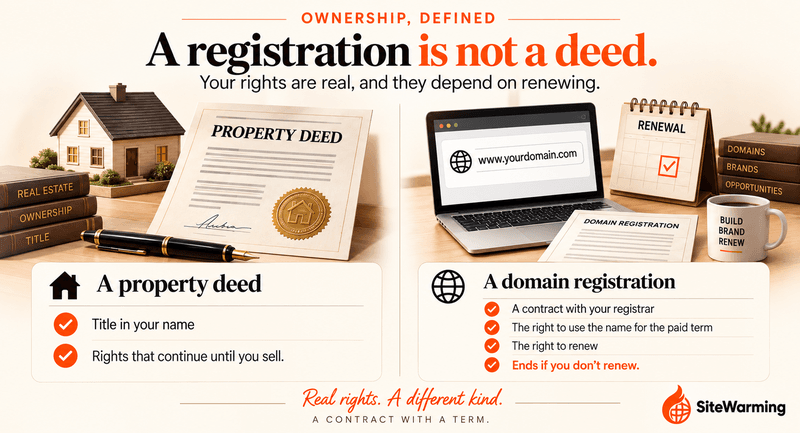
Not the way you own a house. Registering a domain gives you a contract with an ICANN-accredited registrar: the exclusive right to use the name for the term you pay for, and to renew it. There is no deed or title, and whether a court treats the name as property depends on where you are.
Picture a domain owner trying to sell. The interested buyer has an attorney involved, the way buyers do when the domain has real value. The attorney asks a plain question: can you produce the title?
There is no title. There is no deed. There is a registration record at a registrar, which points back to a registry, which operates under an agreement with ICANN. The owner has a receipt from the year they registered and a recurring annual charge on their credit card.
Now imagine the attorney uses the word "lease." The seller has never heard it described that way, and pushes back. They registered it themselves. They have paid for it every year. They have never transferred it to anyone.
All of that matters. None of it produces a deed. The attorney's word is blunt, and it points at something real: what you hold is a registration, and it behaves like a contract with a term.
Here's the thing most domain owners never encounter until they need to act on it: when you register a domain, you are not buying a deed. You are entering a contract with a private intermediary, under rules set through ICANN, the Internet Corporation for Assigned Names and Numbers, a California nonprofit. The terms of that agreement determine what you can do with the domain, when you can lose it, and who ultimately controls the rules.
What does it mean to own a domain name?
It depends which meaning of "own" you have in mind. Several are in play, and they don't line up.
| What "own" could mean | Do you have it? | Where it comes from |
|---|---|---|
| The exclusive right to use the name for a set term | Yes, while the registration is paid and in good standing | Your registrar's agreement |
| The right to renew it | Yes. Registrars must send renewal reminders and allow a domain in the redemption period to be redeemed or renewed | ICANN renewals FAQ |
| A deed or title issued by ICANN, the registry or the registrar | No such document exists | The structure of the system |
| Rights that survive non-renewal | No. If you don't renew, the right ends | Your registrar's agreement and ICANN's expiry process |
| Recognition as property in court | It varies by jurisdiction | Case law, for example Kremen v. Cohen |
The courts haven't treated the label as settled. In Kremen v. Cohen, decided in 2003, the US Court of Appeals for the Ninth Circuit held that a domain name, in that case sex.com, is intangible property under California law. It also held that the registrar, Network Solutions, could be liable for conversion after it transferred the name on a forged letter without contacting the owner. The district court had awarded Kremen $40 million in compensatory and $25 million in punitive damages against the man who forged the transfer. That ruling applies in California. Other jurisdictions decide for themselves. What doesn't change anywhere is the structure underneath: your domain exists as a registration record inside a system run by registries, registrars and ICANN.
So a flat "you don't own it, not legally" overstates the case. The safer statement is the one the attorney was pointing at. What you hold is a registration, and it behaves like a contract with a term.
What did you actually sign when you registered a domain?
When you register a domain, you agree to at least two sets of terms without usually reading either.
The first is your registrar's registration agreement. This is the contract between you and the company you paid. It covers renewal terms, acceptable use policies, dispute resolution procedures, and the registrar's rights to suspend or terminate your registration.
The second is ICANN's Registrants' Benefits and Responsibilities, a short page that defines what registrants (that is, you) are entitled to and what you are obliged to do. It is the floor beneath your registrar's specific terms. Registrars of generic domains such as .com must comply with ICANN's requirements because they operate under ICANN accreditation. Without it, they cannot register those names.
ICANN's page uses neither the word "own" nor the word "license." It talks about registering, managing, transferring, renewing and restoring. What you gain is the exclusive right to use a domain name for the period you have paid for. When the period expires and you do not renew, that right ends.
This is not a technicality buried in fine print to trap you. It reflects how domain names work. Names have to be unique, so someone has to coordinate them. ICANN coordinates the system, registries run each top-level domain, and registrars sell you the right to use a name for a set term. That design gives you stable, usable rights. It just doesn't hand you a deed.
What rights do you have as a registrant?
ICANN's page lists what you are entitled to and what you owe. Other ICANN policies add the rest.
| Right | What it means | Source |
|---|---|---|
| A registration agreement | Your registration must be subject to an agreement with an ICANN-accredited registrar, which you can review and download | Registrants' Benefits and Responsibilities |
| Clear information | Your registrar's identity, terms, fees, support and dispute process, and instructions for registering, managing, transferring, renewing and restoring | Registrants' Benefits and Responsibilities |
| Protection from deceptive practices | You can't be subject to false advertising or deceptive practices by your registrar or its privacy services | Registrants' Benefits and Responsibilities |
| The right to transfer | You can move a domain to another registrar, subject to the Transfer Policy's rules, including its 60-day windows | ICANN Transfer Policy |
| Renewal reminders | Registrars must send reminders one month and one week before expiry, and within five days after | ICANN renewals FAQ |
| Redemption | A domain in the redemption period can be redeemed or renewed | ICANN renewals FAQ |
The transfer rules, including the 60-day windows, are covered in how to transfer a domain without breaking everything.
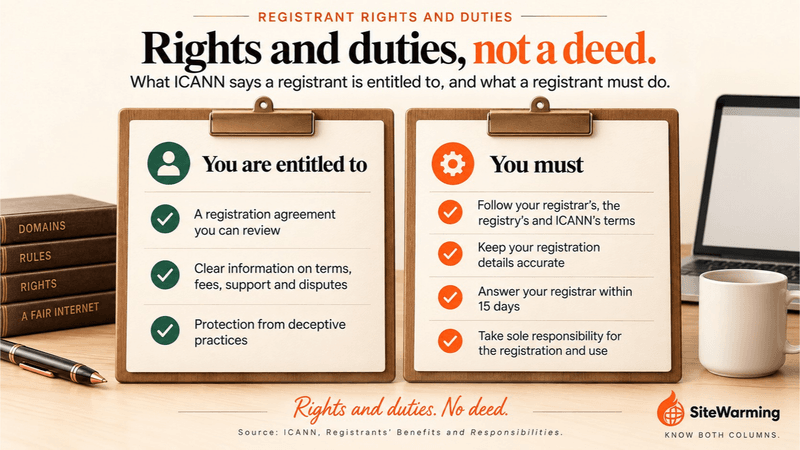
You owe things back. You must comply with the terms of your registrar, the registry and ICANN. You must review your registrar's current agreement and any updates. You must provide accurate information for WHOIS and update it promptly. You must respond to your registrar's inquiries within 15 days and keep your account data current. And in ICANN's words, "You will assume sole responsibility for the registration and use of your domain name."
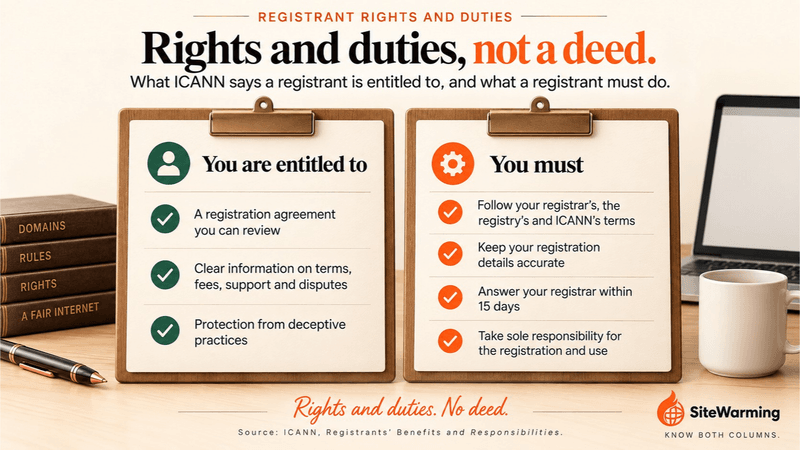
Those are the rights of a registrant inside a framework. They are not the rights of a deed holder. That is a specific and meaningful thing. But it is not what most people picture when they think about paying for something.
What are the three layers: the registry, the registrar and the registrant?
Understanding what you actually have requires understanding the system you are operating inside.
ICANN is a nonprofit public-benefit corporation organized under California law. It coordinates the domain naming system and accredits registrars. It does not keep your registration.
The registry is the organization that runs a top-level domain. Verisign operates .com and .net. Public Interest Registry operates .org. Your country's relevant government or designated authority operates your country-code TLD. The registry is the authoritative database for every domain in its TLD. It is not your registrar. You have no direct relationship with the registry unless something goes wrong.
The registrar is the company you pay to register a domain. GoDaddy, Namecheap, Porkbun, Cloudflare Registrar, and thousands of others are ICANN-accredited registrars, and ICANN publishes the full list. They are access points to the registry system. They handle the registration transaction, maintain your contact information, and manage the channel through which you can make changes to your domain.
You are the registrant. You are the third layer. You interact with the registrar. The registrar interacts with the registry. You have no direct relationship with the registry, and no direct relationship with ICANN, except through the rules your registrar must follow because ICANN holds their accreditation.
This is why the answer to "do I own my domain?" depends on what you mean by "own." You have a registered name, the exclusive right to use it for the period paid, and the legal standing to defend against bad-faith challenges. What you do not have is a property deed, fee-simple title, or rights that survive the expiration of your registration agreement.
What is the UDRP, and can someone take your domain?
The Uniform Domain-Name Dispute Resolution Policy, known as the UDRP, is one of the most significant practical implications of the registration-not-ownership structure.
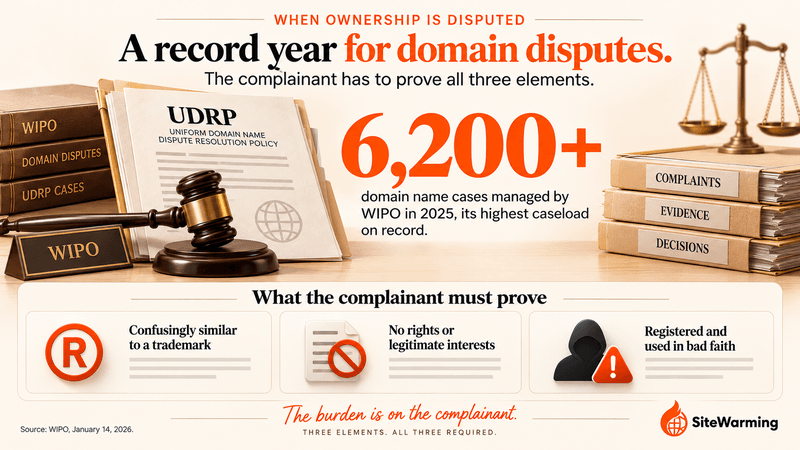
If a third party believes your domain infringes their trademark, they can file a UDRP complaint. According to WIPO's guide to the UDRP, the complainant has to establish all three of these:
- The domain name is identical or confusingly similar to a trademark or service mark in which the complainant has rights.
- You have no rights or legitimate interests in the domain name.
- The domain name has been registered and is being used in bad faith.
A panel of one or three people appointed by WIPO decides, not a court, and cases normally finish within two months. If the panel finds for the complainant, it can order the domain transferred or canceled. It cannot award money judgments or legal costs. Neither side loses access to the courts: the UDRP does not stop either party from taking the dispute to court, and a registrar implements a panel's decision after ten business days unless you show you have challenged it in court.
The UDRP exists because domain names can create trademark conflicts in a way that physical property rarely does. A single string of characters can match a brand name in multiple countries, industries, or contexts. ICANN built an arbitration mechanism to resolve those conflicts without requiring national court proceedings in every case.
It is rare for owners who registered names for legitimate purposes, and it is real. WIPO reported that it managed over 6,200 domain name cases in 2025, its highest caseload on record, and has resolved over 80,000 in 25 years.
For most domain owners who registered names for legitimate purposes, the UDRP is not a daily concern. But it is a concrete illustration of the limits of "ownership." A panel of arbitrators can order your registration to move to someone else, though only after the complainant proves bad-faith registration and use. That is a different kind of risk from the one a house deed carries.
Can you lose a domain you have held for years?
Yes. There are five mechanisms.
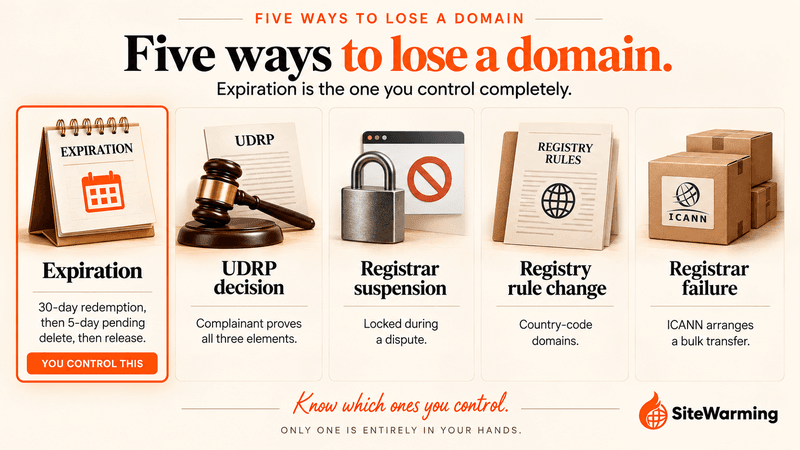
Expiration. If you do not renew, your right to use the domain ends. ICANN says an expired domain that is not restored enters a 30-day redemption period, then five days of pending delete, and is then released for first-come, first-served registration. Registrars must send renewal reminders one month and one week before expiration, and within five days after. Years of holding offer no protection once the renewal lapses. For the full timeline, read what happens when a domain expires.
UDRP decision. As described above, a panel can order a transfer or cancellation if the complainant proves all three elements, including that the domain was registered and is being used in bad faith.
Registrar dispute. If your registrar suspends your account for a terms-of-service violation, real or alleged, your domains may be suspended or locked while the dispute is resolved. This is distinct from a transfer. Your domain does not go away, but you may not be able to use it. We cover that pattern in Can Your Registrar Hold Your Domain Hostage.
Registry policy changes. Country-code TLDs are run under national rules, and those rules can bite. In October 2010, Libyan authorities removed the vb.ly domain, and a Libya Telecom spokesman said adult material is not allowed under Libyan law, according to the .ly entry on Wikipedia. The same entry says the registry's regulations require that domains not be "obscene, scandalous, indecent, or contrary to Libyan law or Islamic morality." If you hold domains in country-code TLDs, you are subject to both the registry's rules and the relevant national authority's power to revise them.
Registrar failure. If an ICANN-accredited registrar's accreditation ends, ICANN runs a process to bulk-transfer its domains to another accredited registrar, and the registration data is held in escrow and released to the receiving registrar. ICANN's FAQ says you do not need to act at first, and that the receiving registrar will contact you with instructions. Check renewal arrangements if your domain is due soon. How a registrar exit plays out is in what happens when a registrar shuts down.
None of this means your domain is insecure if you manage it attentively. It means the security comes from the relationship you maintain with the registration system, not from a deed you hold.
Why is stewardship a more accurate mental model than ownership?
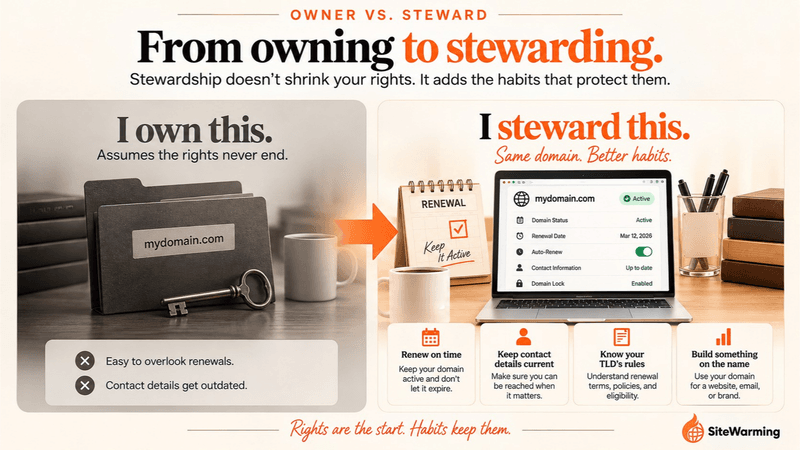
Here is the reframe that changes how you think about this.
If you do not own your domain in the deed sense, but you can hold it indefinitely as long as you comply with applicable rules and renew consistently, then the useful mental model is stewardship, not ownership.
A steward manages something of value on behalf of an ongoing relationship. The steward's rights are real. The protections are real. The ability to use and direct the asset is real. But the steward understands that the rights come with responsibilities and operate inside a framework they did not create and cannot unilaterally change.
This is actually how domain management works in practice for anyone who has held domains for a long time. You maintain contact information. You renew. You monitor for disputes. You understand the rules of the TLDs you operate in. You build something on the name that creates value regardless of the registration framework.
Domains are infrastructure. Infrastructure is leased or licensed, not owned outright, more often than we like to admit. Your office space is leased. Your software is licensed. Your domain is registered, which is its own version of the same basic structure.
Shifting from "I own this" to "I steward this" does not diminish the value of the domain or your rights to it. It makes your relationship to it more accurate. And more accurate is more useful when something goes wrong and you need to know what leverage you actually have.
For a longer treatment of this reframe and why it matters for how you build on domains over time, read From Ownership to Stewardship and Domains Are Infrastructure, Not Lottery Tickets.
What does this mean in practice?
None of this is meant to alarm you. Most domain owners who register names for legitimate purposes, renew consistently, and use their domains for the purposes they registered them for will never encounter the edge cases described above. The framework mostly works.
But there are practical implications worth holding.
Succession is a registrar process, not a deed. If a domain has meaningful value to your estate, record the registrar, the account email and how to recover access somewhere your executor can find it, and check how your registrar handles account access after a death.
You can be a responsible steward, build significant value on a name, and still be subject to an arbitration process that could transfer it if a trademark dispute arises. If a name could collide with an existing trademark, think about that before you register it, and get legal advice if the stakes are high.
And the registrar you choose matters more than most domain owners realize. They are the intermediary between you and the registry. Their policies, their practices during disputes, their transfer processes when you want to leave. All of it shapes how easy or hard it is to exercise the rights you do have.
The independent analysis of which registrars suit long-term ownership is in Best Domain Registrars for Long-Term Ownership in 2026. The question of what happens when a registrar operates against your interests is the subject of Can Your Registrar Hold Your Domain Hostage.
How do you protect a domain you only hold by registration?
- Renew early and on a schedule. Expiration is the one way to lose a domain that is entirely in your hands.
- Keep your contact details accurate. ICANN lists accurate WHOIS information and responding to your registrar within 15 days among your responsibilities.
- Read your registrar's agreement and its updates. It is the contract that governs your rights.
- Know the rules of your TLD. Country-code domains answer to national rules.
- Track every domain in one place. If you hold names across several registrars, SiteWarming's domain renewal tracking shows every domain and its renewal date in one view.
The underlying architecture of trust as a system starts here: with an honest understanding of what you hold, what you do not, and how the framework you operate inside actually works.
Related reading
- How to Transfer a Domain Without Breaking Everything: the transfer rules and the 60-day windows.
- Can Your Registrar Hold Your Domain Hostage: what to do when a registrar works against you.
- From Ownership to Stewardship: the longer case for stewardship.
- Domains Are Infrastructure, Not Lottery Tickets: why a domain is a working asset.
- Best Domain Registrars for Long-Term Ownership in 2026: which registrar to trust going forward.
Frequently asked questions
Do you own your domain name?
Not the way you own a house. You hold a registration: a contract with an ICANN-accredited registrar that gives you the exclusive right to use the name for the term you pay for, and to renew it. There is no deed or title, and the right ends if you don't renew.
Does the law treat a domain name as property?
It depends on where you are. In Kremen v. Cohen (2003), the US Ninth Circuit held that a domain name is intangible property under California law. Other jurisdictions decide for themselves, so the label varies even though the registration structure stays the same everywhere.
What is the difference between a registry, a registrar and a registrant?
The registry runs a top-level domain and keeps its master database; Verisign runs .com and .net, and Public Interest Registry runs .org. The registrar is the ICANN-accredited company you pay to register the name. The registrant is you. You deal with the registrar, and the registrar deals with the registry.
What rights does ICANN give domain registrants?
ICANN's Registrants' Benefits and Responsibilities page entitles you to a registration agreement, clear information about your registrar's terms, fees, support and dispute process, and protection from deceptive practices. Transfer and expiry rights come from separate ICANN policies, including three renewal reminders around expiration and the right to transfer.
Can someone take my domain through the UDRP?
Yes, but only if a complainant proves three things: your domain is identical or confusingly similar to their trademark, you have no rights or legitimate interests in it, and it was registered and is being used in bad faith. The remedy is transfer or cancellation, not damages, and either side can go to court.
Who has to prove what in a UDRP case?
The complainant. WIPO's guide says the complainant must establish all three elements: a confusingly similar trademark, no rights or legitimate interests, and registration and use in bad faith. A panel of one or three decides, and cases normally finish within two months. Panels can order transfer or cancellation, not money judgments.
What happens to my domain if I don't renew it?
Your right to use it ends. ICANN says an expired domain enters a 30-day redemption period, where it can be restored, then five days of pending delete, then it is released for first-come, first-served registration. Registrars must send renewal reminders one month and one week before expiry, and within five days after.
What happens to my domain if my registrar shuts down?
ICANN runs a process to bulk-transfer the registrar's domains to another accredited registrar, and the registration data is held in escrow and released to the receiving registrar. ICANN says you don't need to act at first; the new registrar will contact you with instructions and renewal arrangements.
Is it more accurate to say I own a domain or steward it?
Steward. You hold real rights: exclusive use, renewal and legal standing to defend the name. Those rights depend on renewing, keeping contact details current and following the rules of the registrar, the registry and ICANN. Stewardship describes that relationship more accurately than ownership, and it points to the right habits.
Share this article
Ready to Transform Your Domain Portfolio?
Start building real value with your domain investments today.