What Happens When a Domain Registrar Shuts Down?
 Bret Siers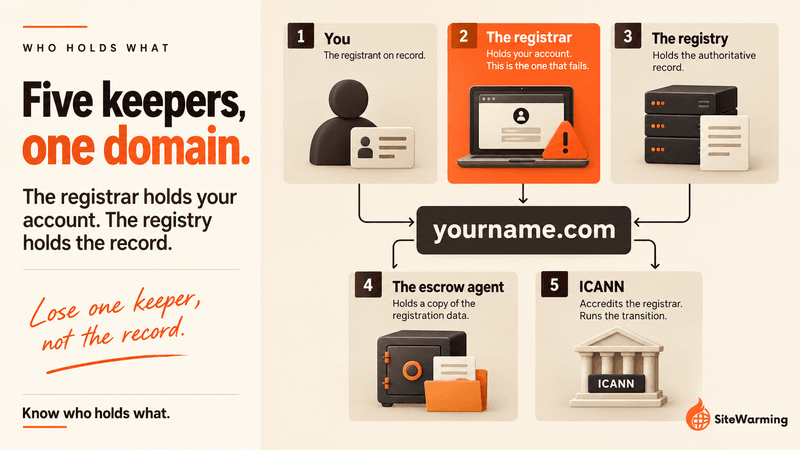
When an ICANN-accredited registrar shuts down, your domain does not disappear. ICANN can end the registrar's accreditation, retrieve the escrowed registration data and move its domains to another accredited registrar, which then contacts you. The risk is lost control during the move. Country-code domains such as .ly and .io sit outside this process.
You open your browser one morning and try to log in to your registrar. The page doesn't load. Not a slow load. Not a 503 error. Just nothing. You refresh. Still nothing. You check your email for a maintenance notice. There isn't one.
Your domain still resolves. Your site is still up. But the company that holds your registration account, the one you've paid every year, is unreachable.
Here's the question nobody thinks about until that moment: what actually happens to your domain now? The answer above is the short version. The longer one depends on three things: which registrar you use, what kind of domain you hold, and whether you wrote anything down beforehand.
What did the Google Domains exit teach us?
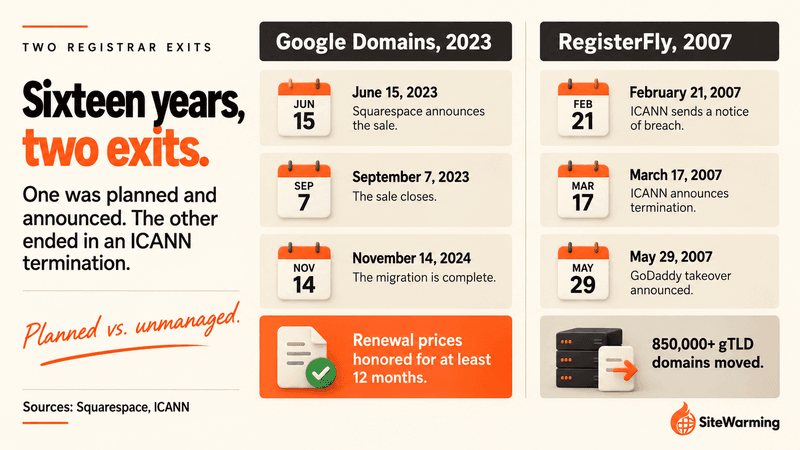
On June 15, 2023, Squarespace announced a definitive agreement to acquire the Google Domains assets, approximately 10 million domains spread across millions of customers. The deal closed on September 7, 2023, and on November 14, 2024 Squarespace announced that the migration was complete.
Most people who got that email were confused. Some were frustrated. A few panicked, not because anything broke immediately, but because they realized they had never thought about what their registrar relationship meant. They'd registered with Google because it felt safe. Google was permanent. Google was everywhere. Then one day it wasn't their registrar anymore.
Google Domains didn't fail. It was a planned, announced sale, and it went about as well as a transition can. Squarespace said it would honor existing renewal prices for at least 12 months after closing, and its FAQ says migrated domains moved to standard rates on September 7, 2024. Google's FAQ says Squarespace committed to keep using Google Cloud DNS so DNS reliability and performance would stay unchanged during the move.
It wasn't seamless for everyone. Squarespace's help center ties broken domain and email forwarding to custom nameservers, and its FAQ says Dynamic DNS and the ACME DNS API are not supported.
If this had to happen, it happened about as well as it could. But what if it hadn't been orderly?
What does ICANN require when a registrar fails?
ICANN, the nonprofit that coordinates the domain name system, accredits the registrars that sell generic top-level domains such as .com, .net and .org. Accreditation comes with a contract, the Registrar Accreditation Agreement (RAA), and three parts of the system matter when a registrar fails.
Escrow. Under section 3.6 of the 2013 RAA, a registrar must deposit an electronic copy of its registrant and registration data with ICANN or with an escrow agent that both sides approve. ICANN's escrow specification requires full deposits weekly, plus daily deposits of changes from large registrars, and requires the escrow agent to release the records to ICANN within 24 hours of ICANN's written notice.
De-accreditation. ICANN's De-Accredited Registrar Transition Procedure says the registrations of a de-accredited registrar "must be transitioned to a competent accredited registrar." ICANN picks the gaining registrar, through an open application for larger portfolios or from a pre-qualified pool.
Bulk transfer. ICANN's bulk transfers page says former customers "should receive a notice of the transfer and instructions for continued management of their names from the gaining registrar." The transfer costs registrants nothing, and "the registration terms will not be extended by a year."
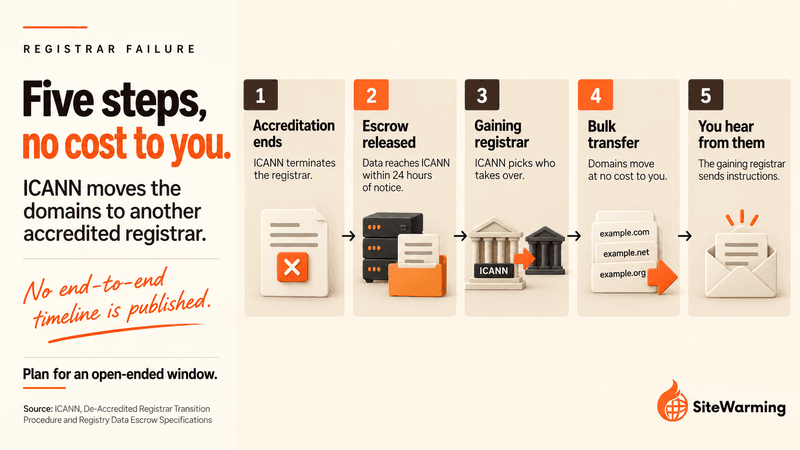
That's the rule. Now the reality. Neither ICANN procedure publishes a timeline from failure to finished, so how long you are in transition is not something you can look up in advance. Because the registry holds the authoritative record of your name servers, a domain normally keeps resolving on its existing configuration while it moves. What you can change during the move, such as DNS records or a renewal, depends on the state of the failing registrar's systems and on how quickly the gaining registrar onboards you.
For a personal site, that's an inconvenience. For a business running on that domain, it can be a crisis.
Who can do what when a registrar fails?
| Party | What it can do | What it can't do | Source |
|---|---|---|---|
| You (the registrant) | Keep your own records, renew on time, request your transfer code, file a complaint | Choose the gaining registrar in a bulk transfer | ICANN DARTP |
| ICANN | End accreditation, order the escrow release, name a gaining registrar, take compliance complaints | Return a lost domain to you; act on country-code domains | ICANN complaints page |
| Escrow agent | Hold a copy of registration data; release it to ICANN within 24 hours of notice | Run your DNS or renew your domain | ICANN escrow specification |
| Registry (Verisign for .com) | Hold the authoritative record | Deal with registrants: "we are not a registrar" | Verisign support |
| Gaining registrar | Contact you and onboard the domains | Extend your term by a year | ICANN bulk transfers |
What does an unmanaged registrar failure look like?
Google Domains is not the right cautionary tale. It was too clean.
RegisterFly is. ICANN sent the registrar a notice of breach dated February 21, 2007, demanding that it act within 15 working days to cure the breaches. On March 17, 2007, ICANN issued a notice of termination effective March 31 and told RegisterFly to unlock domains and provide the authorization codes needed for transfers before then. Meanwhile customers were describing support tickets that went unanswered and a company they could barely reach by phone. By April 3, ICANN's FAQ for RegisterFly customers said it had fielded thousands of inquiries.
On May 29, 2007, ICANN announced that GoDaddy would take over the entire portfolio of more than 850,000 gTLD names RegisterFly held. The Register reported that RegisterFly had once controlled about two million domains.
What sticks with me about this story is how much of the scramble was preventable. Not the registrar's failure. That is outside your control. The scramble was not: a customer with a copy of their DNS records, their nameservers and their expiry date could rebuild at a new registrar once the domain moved. A customer with none of it had to reconstruct everything under pressure.
There is a case between the two poles. In 2019 ICANN suspended Net 4 India Limited's ability to register or initiate inbound transfers of domain names for 90 days and published guidance for affected registrants.
This was almost 20 years ago, and ICANN's process has been formalized since: the De-Accredited Registrar Transition Procedure was adopted in 2008 and revised in 2013. The structural vulnerability hasn't changed. If your registrar goes dark, you depend on ICANN and the registry to run the transition on their timeline, not yours.
How do Google Domains and RegisterFly compare?
| Google Domains (2023) | RegisterFly (2007) | |
|---|---|---|
| What happened | Planned, announced sale to Squarespace | ICANN breach notice, then termination of accreditation |
| Key dates | Announced June 15, 2023; closed September 7, 2023; migration complete November 14, 2024 | Notice of breach February 21, 2007; termination announced March 17, 2007; GoDaddy takeover announced May 29, 2007 |
| Scale | About 10 million domains | More than 850,000 gTLD domains at the takeover; about two million at its peak |
| Customer experience | Notice by email; renewal prices honored for at least 12 months; some custom-nameserver problems | Thousands of complaints; unanswered tickets; hard to reach by phone |
| Who took over | Squarespace | GoDaddy |
Does ICANN protect country-code domains like .ly and .io?
Registrar failure is one kind of problem. Country-code domains carry a different kind, one level up.
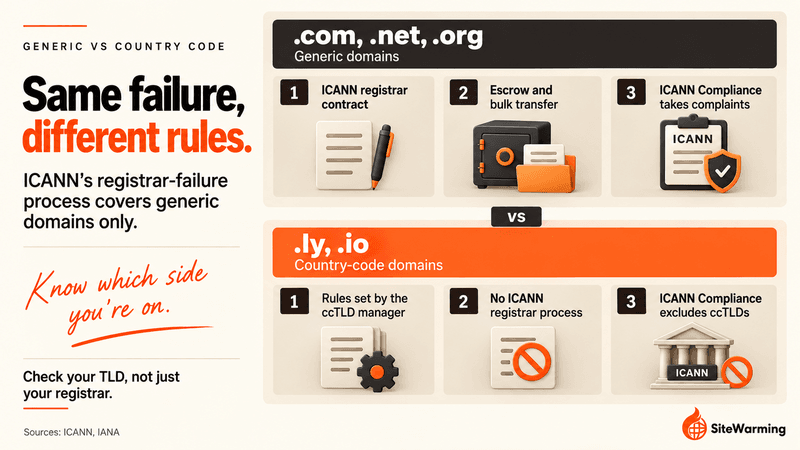
ICANN's registrar rules, including escrow and de-accreditation, apply to generic top-level domains. Country-code domains such as .ly, .io and .ai are delegated by IANA to managers who run them under local rules. RFC 1591 calls those managers "trustees for the delegated domain" with "a duty to serve the community," and ICANN's complaints page says Contractual Compliance does not take complaints about country-code domains.
The clearest example is .ly. In 2010 Libya's registry removed vb.ly, a URL shortener co-owned by Ben Metcalfe and Violet Blue, after saying that pornography and adult material aren't allowed under Libyan law. The domain was not moved to another registrar or placed in an escrow window. It was removed.
The question people ask now is about .io. The United Kingdom and Mauritius signed a treaty on May 22, 2025 that would hand the British Indian Ocean Territory to Mauritius once it enters into force. As of October 2, 2026, it had not.
What that means for .io is narrower than the headlines suggest. A country-code domain is tied to the ISO 3166-1 standard. ICANN has said it relies on that standard to decide what is eligible, and under IANA's retirement process a code removed from the standard is retired after a transition that by default lasts five years and can be extended by up to five more. No change to the standard has been reported, and no .io retirement has begun. In October 2024 Identity Digital, the registry service provider, said it continues to support .io. IANA's root zone record lists Internet Computer Bureau Limited as the sponsoring organization.
How do generic and country-code domains differ when a registrar or registry fails?
| Question | .com, .net, .org | .ly, .io and other country codes |
|---|---|---|
| Who sets the rules? | ICANN, through registry and registrar contracts | The ccTLD manager, under local rules |
| Is there a registrar-failure process? | Yes: de-accreditation, escrow release and bulk transfer | Set by the ccTLD manager |
| Does ICANN Compliance take complaints? | Yes, about registrar and registry obligations | No, country-code domains are outside its scope |
| Example of the risk | RegisterFly (2007) | vb.ly removed by the .ly registry (2010) |
Can a registrar suspend your domain without warning?
Registrar shutdown is dramatic. A quieter version is more common: the registrar keeps operating and takes your domain offline.
Registrars can suspend domains. Since April 5, 2024, ICANN's agreements require registrars to "promptly take appropriate mitigation actions" against domains for which they have actionable evidence of DNS abuse. ICANN's advisory defines DNS abuse as malware, botnets, phishing, pharming and spam used to deliver them, and lists suspension as one possible action and notifying the registrant as another. I could find no ICANN rule that requires notice before a suspension, and none that forbids it.
From the outside, a suspended domain looks like an outage. It stops resolving, though it hasn't expired and there is no DNS fault. From the inside, you get an email, or you don't. The process for disputing a suspension is your registrar's own. ICANN's Contractual Compliance team takes complaints about registrar obligations, including abuse handling, transfers, renewals and registration data, but its complaints page says it does not resolve ownership disputes or return lost domains.
The practical implication: your domain's uptime depends partly on a compliance team you have never met. Read the acceptable-use and suspension clauses in your registrar's terms, keep your contact email current so you see any notice, and keep your site clean. A compromised site that hosts malware or phishing, even one you don't know about, falls inside the abuse definition. How to check if your domain is blacklisted covers how to find out.
How do you prepare for a registrar failure?
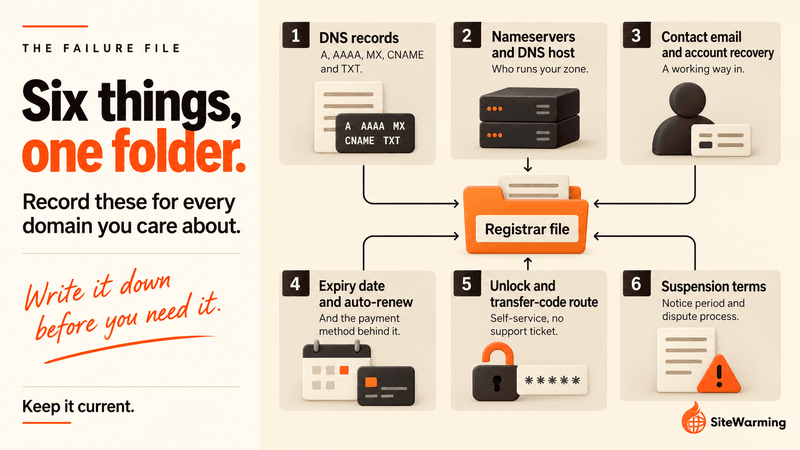
A registrar failure is survivable if you keep a short file for every domain you care about. I call it the registrar-failure file. It takes minutes per domain.
| What to record | What exactly | Why it matters |
|---|---|---|
| DNS records | Every A, AAAA, MX, CNAME and TXT record, exported or copied by hand | If you have to rebuild at a new registrar, you need the full set. Most people don't have it. |
| Nameservers and who runs your DNS | The nameserver addresses, and whether the zone lives at your registrar or at a separate DNS provider | Nameservers answer DNS queries for the domains they are authoritative for, so DNS at a separate provider is unaffected if only the registrar fails. |
| Contact email and account recovery | The registrant email on file, and a working way into the registrar account | A bulk transfer ends with a notice from the gaining registrar. If the email is dead, you miss it. |
| Expiry date and auto-renew | The expiry date and the payment method behind it | A bulk transfer does not extend your term, and ICANN's renewal policy gives you reminders and a 30-day redemption window, not a rescue. |
| Your transfer route | Where you unlock the domain and generate the authorization (EPP) code yourself, without support | Registrars that don't offer self-service must provide the code within five calendar days. Self-service means you never wait. |
| Suspension and acceptable-use terms | What can get a domain suspended, the notice period and the dispute process | Unclear or missing terms tell you something about the registrar. |
Two habits sit on top of the file. First, keep registration and hosting at different companies, so one failure can't take both offline. The difference, and what bundling costs, is in Domain Registrar vs Web Host. Second, enable auto-renew and keep payment details current. For why the price you pay changes year to year, see why domain renewals cost more, and for which registrars hold up over time, see best domain registrars for long-term ownership.
An authorization code is a one-time credential for a transfer, and most registrars generate it on request. What's worth knowing in advance is where you generate it and whether you can do it without opening a support ticket. The full sequence is in how to transfer a domain without breaking everything.
What should you do if your registrar is unreachable right now?
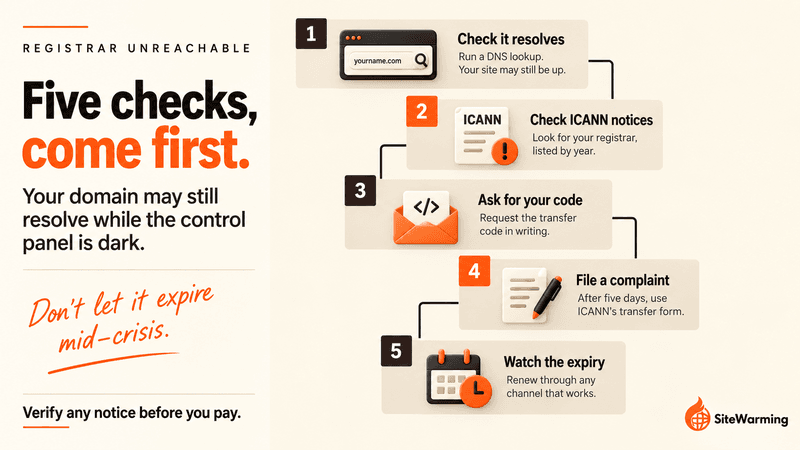
If your registrar is unreachable today, work through these in order.
- Check that the domain still resolves. Run a DNS lookup on the domain. If it returns the right records, your site is still up even though the control panel is dark. That buys time. ICANN's lookup tool shows the current registration data for a domain, so you can check it against your records.
- Check ICANN's notices page. ICANN publishes notices of breach, suspension, termination and non-renewal, organized by year. If your registrar is on it, you have your answer and ICANN's process has started.
- Ask for your transfer code in writing. Email your registrar. A written request gives you a timestamp, and ICANN says that if a registrar does not unlock the domain or give you a reasonable way to do it within five days, you can submit a transfer complaint.
- File the complaint. Use ICANN's Contractual Compliance complaint page and choose the transfer form. ICANN enforces the registrar's contract. It will not return a lost domain to you, so file early.
- Watch the expiry date. An expired domain moves into a redemption period and is harder to recover than a live one. If the date is close, flag it in your complaint and renew through any channel that still works.
- Verify any notice before you pay. A registrar transition is when a fake renewal email is most believable. Check any message against ICANN's notices page and your registrar's own site first. How to spot a domain renewal scam shows what to look for.
Skip one step you may have seen elsewhere: contacting the registry. Registries work through registrars. Verisign's support page says it is "not a registrar" and sends domain owners back to theirs.
How do you keep track of registrars across a portfolio?
If your domains sit at five registrars, everything above multiplies by five. That is where portfolios fail: nobody can say, on a given morning, which registrar holds which name, who the registrant contact is, and which renewals are close.
SiteWarming's domain renewal tracking puts every domain across every registrar in one view. Add domains singly, import a CSV, or connect a registrar, and it shows what is live, what leads nowhere and what is approaching renewal. The free plan tracks up to 1,000 domains. The guide to managing domains across multiple registrars explains how to centralize visibility without moving any domain.
Frequently asked questions
What happens to my domain if my registrar shuts down?
If the registrar is ICANN-accredited and ICANN ends its accreditation, its domains are transitioned to another accredited registrar, which should contact you with instructions. Your registration data is held in escrow, and the domain normally keeps resolving meanwhile. The risk is control, because you may not be able to make changes during the move.
Can I lose my domain if my registrar goes bankrupt?
A failed registrar does not by itself end your registration. ICANN's procedure moves the domains to another accredited registrar, and the registration term is not extended, so your expiry date still applies. You can lose the domain if it expires during the disruption and is not redeemed, which makes renewal dates the thing to watch.
Does ICANN keep a copy of my registration data?
Registrars must deposit their registrant and registration data with ICANN or an approved escrow agent under section 3.6 of the 2013 Registrar Accreditation Agreement. ICANN's specification requires full deposits weekly, with daily deposits of changes from large registrars. The escrow agent must release the records to ICANN within 24 hours of ICANN's written notice.
How long does a registrar bulk transfer take?
ICANN does not publish an end-to-end timeline. Its transition procedure and bulk transfer page describe how a gaining registrar is chosen and the notice you should receive, but give no total duration. Plan for an open-ended window, keep your records current, and watch your expiry date until the new registrar contacts you.
What happened to Google Domains customers?
Squarespace announced an agreement to acquire Google Domains on June 15, 2023, completed the acquisition on September 7, 2023 and announced the migration complete on November 14, 2024. It said it would honor existing renewal prices for at least 12 months after closing. Squarespace's help center ties some broken forwarding to custom nameservers.
What happens to .io domains if the British Indian Ocean Territory changes hands?
Nothing has changed yet. The UK and Mauritius signed a treaty on May 22, 2025, and as of October 2, 2026 it had not entered into force. If the code ever left ISO 3166-1, IANA's process retires a country-code domain after a transition that by default lasts five years and can be extended by up to five more.
Can a registrar suspend my domain without warning?
Registrars can suspend domains, and since April 5, 2024 ICANN's agreements require prompt mitigation when they have actionable evidence of DNS abuse. ICANN's advisory lists suspension and notifying the registrant as possible actions. Neither document requires notice first, so read your registrar's suspension terms and keep your contact email current.
Can I contact Verisign if my registrar is down?
Not usefully. Registries work through registrars, and Verisign's support page says it is not a registrar and directs domain owners to their own. The route for registrants is your registrar first, then an ICANN Contractual Compliance transfer complaint if the registrar does not unlock the domain or provide a transfer code within five days.
What should I do first if my registrar's website is down?
Check that your domain still resolves, then look for your registrar in ICANN's notices of breach, suspension, termination and non-renewal. Ask for your transfer code in writing. If the registrar does not unlock the domain or give you a way to do it within five days, file an ICANN transfer complaint and watch your expiry date.
Related reading
- Can Your Registrar Hold Your Domain Hostage?: what to do when a registrar blocks your exit.
- How to Transfer a Domain Without Breaking Everything: the transfer rules and the 60-day windows.
- Do You Actually Own Your Domain?: what your registration is, and what ICANN's rules cover.
- What Actually Happens When Your Domain Expires: the expiry timeline, day by day.
- Domain Registrar vs Web Host: why registration and hosting belong at different companies.
- Best Domain Registrars for Long-Term Ownership in 2026: which registrar to move to.
Share this article
Ready to Transform Your Domain Portfolio?
Start building real value with your domain investments today.