Why Domain Renewals Cost More Every Year (And What You Can Do)
 Bret Siers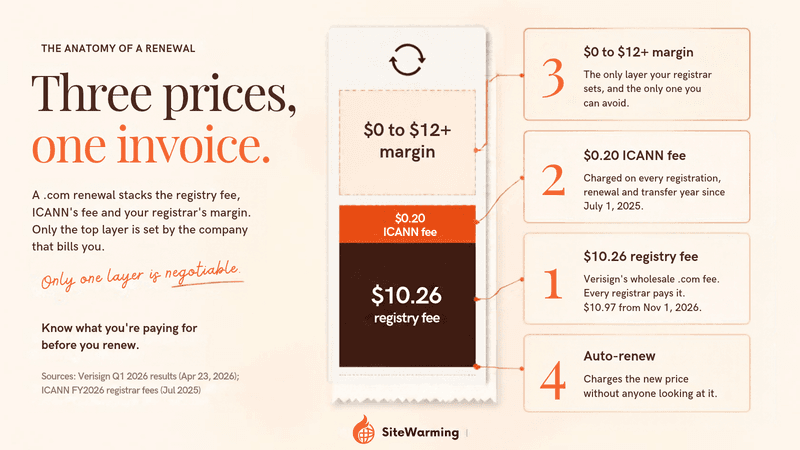
Domain renewals cost more than the first year for two reasons. The first year is usually a promotional price the registrar subsidizes to win you, and renewals revert to full list price. Underneath both, the wholesale .com fee Verisign charges registrars rose from $7.85 to $10.26 between 2021 and 2024, and rises to $10.97 on November 1, 2026.
Say your .com renewal was $12.99 last year and $16.49 this year. You didn't upgrade anything. You didn't add services. You didn't even log in. The domain sat there, same as always, and the price went up anyway.
You probably assumed it was inflation, or a vague "cost of doing business" increase buried in a terms update you didn't read. The truth is simpler and more frustrating than that.
Renewal prices rise because the company that sets the wholesale price is allowed to raise it on a schedule, and the companies that sell you domains have learned you won't leave over a few dollars. There's a specific story behind the numbers. Once you see it, you can't unsee it.
What actually goes into a domain renewal price?
Every .com renewal is built from three layers. Only the top one is under your registrar's control.
A registry is the organization that runs a top-level domain such as .com and keeps the master list of names in it. Verisign is the sole registry operator for .com. A registrar is the company you actually buy from, GoDaddy, Namecheap, Cloudflare and so on, which pays the registry for every name-year it sells. ICANN (the Internet Corporation for Assigned Names and Numbers) coordinates the domain system and contracts with both. If the difference between owning and renting a name is still fuzzy, what you actually own when you register a domain covers it.
| Layer | Who sets it | .com amount today | Can you avoid it? |
|---|---|---|---|
| Registry wholesale fee | Verisign, within limits set by its ICANN and U.S. government agreements | $10.26 per year, rising to $10.97 on Nov 1, 2026 (Verisign Q1 2026 results) | No. Every registrar pays it. |
| ICANN fee | ICANN, approved by accredited registrars | $0.20 per domain-year since July 1, 2025 (ICANN FY2026 registrar fees) | No. It applies to every registration, renewal and transfer year. |
| Registrar margin | Your registrar | Anything from $0 to more than $12 on a .com renewal (see the table below) | Yes. This is the part you control by choosing where your domains live. |
That third row is also why a registrar and a web host are not the same purchase. Bundled hosting companies often price the domain low in year one and recover the difference at renewal, which is covered in registrar vs host: the difference that costs you.
Why is the first year so much cheaper than the renewal?
Because the first year is a customer-acquisition price, not a domain price. ICANN says so directly in its registrant FAQ: "a common practice... is to offer promotions for new customers, which is why your initial registration fee may be less than the cost to renew" (ICANN, Domain Name Renewals and Expiration FAQ). Registrars set their own renewal prices, terms and conditions.
You can see the gap on registrars' own pricing pages. These are the list prices shown on September 28, 2026:
| Registrar and extension | First year | Renewal | Source |
|---|---|---|---|
| GoDaddy .com | $0.01 (with a 3-year purchase) | $22.99 per additional year | GoDaddy .com pricing |
| Namecheap .com | $11.28 | $18.48 | Namecheap domain pricing |
| Namecheap .xyz | $2.00 | $21.48 | Namecheap domain pricing |
A $0.01 first year sits more than $10 below what the registrar itself pays Verisign and ICANN for that year. Nobody sells at a $10 loss without planning to recover it, and renewals are where it comes back.
The .xyz line is the pattern at its most extreme: $2.00 to get in, $21.48 to stay, a renewal more than ten times the entry price. Stories of a $2 .xyz turning into a $20 renewal circulate in homelab and developer communities for exactly this reason. The first-year price was the hook. The renewal price was the trap.
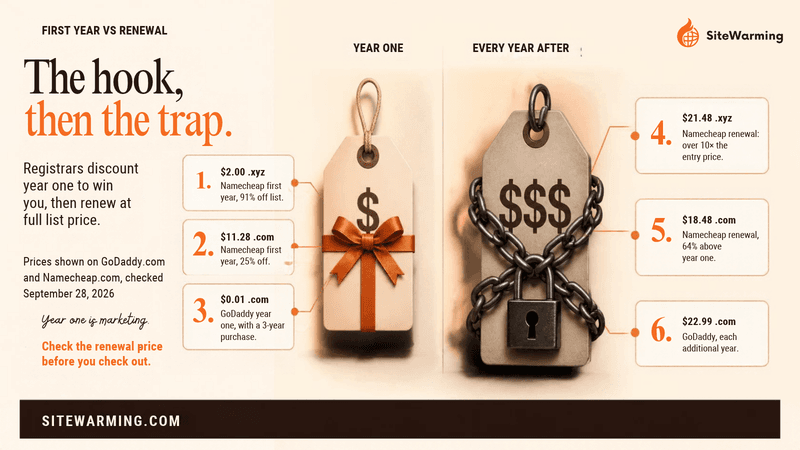
That pattern is everywhere: cheap first year, quiet renewal increase. Because most people set domains to auto-renew and forget them, the higher price is charged without anyone looking at it. The real cost of "set it and forget it" domain management covers what else auto-renew quietly lets through.
Why does the .com wholesale price keep going up?
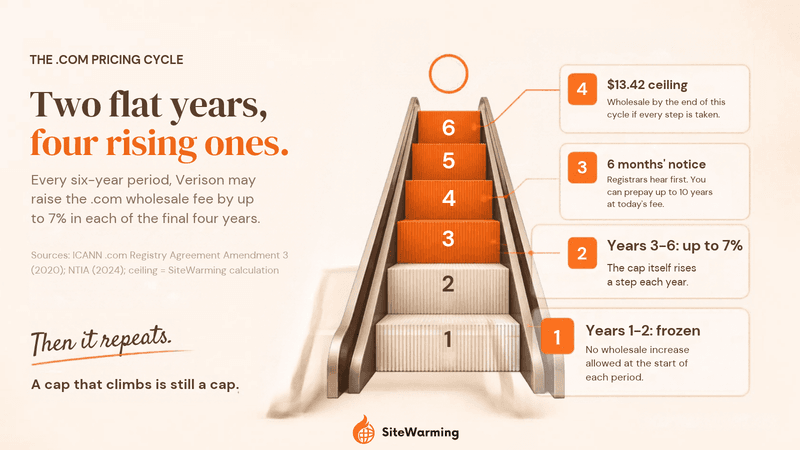
Because the agreements that govern .com allow Verisign to raise it by up to 7% a year in four of every six years, and Verisign has used every one of those increases so far. There is no alternative wholesaler: Verisign is the only operator of the .com registry, so registrars cannot shop around for a cheaper supply.
What did the 2012 price freeze do?
In November 2012, the U.S. Department of Commerce's National Telecommunications and Information Administration (NTIA) approved a renewal of the .com agreement that fixed the maximum wholesale price at $7.85 per year through November 30, 2018 (NTIA Cooperative Agreement Amendment 32, Nov 29, 2012). The freeze came from NTIA's Cooperative Agreement with Verisign, not from ICANN acting alone.
The price then stayed at $7.85 until September 1, 2021, more than eight years (Verisign Q4 2020 results). Registrars competed on margins, bundles and first-year discounts, but the underlying cost stayed flat.
What changed in 2018 and 2020?
On November 1, 2018, NTIA signed Amendment 35, which let Verisign pursue with ICANN "an up to 7 percent increase in the prices for .com domain names, in each of the last four years of the six-year term" (NTIA statement on Amendment 35). ICANN then added that permission to the .com Registry Agreement through Amendment 3, approved on March 27, 2020 (ICANN decision paper on Amendment 3).
A common misreading is that the 2020 deal removed the price cap. It didn't. The cap still exists; what changed is that it now moves up by up to 7% in each of the final four years of every six-year period, with the first period starting October 26, 2018 (ICANN public comment on Amendment 3). That's not a ceiling anyone bumps into occasionally. It's a scheduled escalator.
The Cooperative Agreement renewed automatically on November 30, 2024. NTIA said it would prefer lower .com prices but that the two parties "have been unable to agree how wholesale .com pricing should change," so the existing terms carried forward: no increases until September 1, 2026, then up to 7% in four of the next six years (NTIA, The .com Cooperative Agreement, 2024).
How has the .com wholesale price changed since 2012?
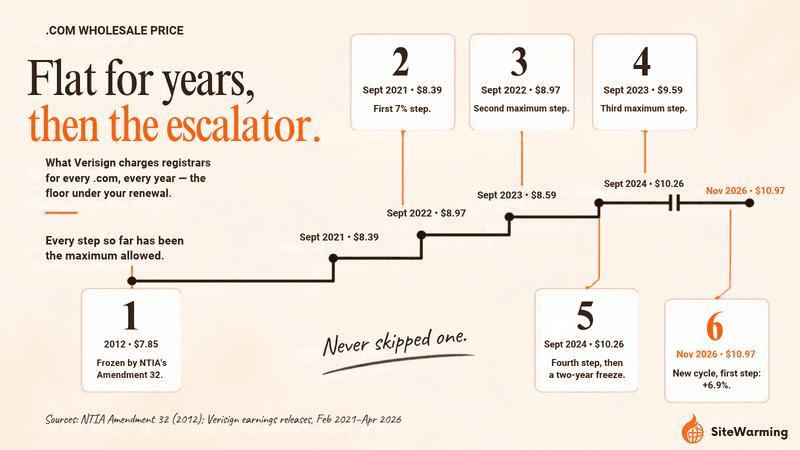
| Effective date | .com wholesale price per year | Change | Source |
|---|---|---|---|
| Dec 1, 2012 (agreement effective) | $7.85 (maximum, frozen) | n/a | NTIA Amendment 32 |
| Sept 1, 2021 | $8.39 | +6.9% | Verisign Q4 2020 results |
| Sept 1, 2022 | $8.97 | +6.9% | Verisign Q4 2021 results |
| Sept 1, 2023 | $9.59 | +6.9% | Verisign Q4 2022 results |
| Sept 1, 2024 | $10.26 | +7.0% | Verisign Q4 2023 results |
| Nov 1, 2026 | $10.97 | +6.9% | Verisign Q1 2026 results |
Has Verisign ever skipped an increase it was allowed to take?
No. Each of the four increases in the first six-year period was the full 7%, rounded down to the cent: $7.85 x 1.07 is $8.3995, and Verisign charged $8.39; $9.59 x 1.07 is $10.2613, and it charged $10.26. The November 2026 step from $10.26 to $10.97 is the maximum again. Not 3%. Not 5%. The maximum, every time it was on the table.
Taken together, the wholesale price will be $3.12 higher on November 1, 2026 than it was in August 2021, an increase of 39.7% on the part of the price no registrar can discount away.
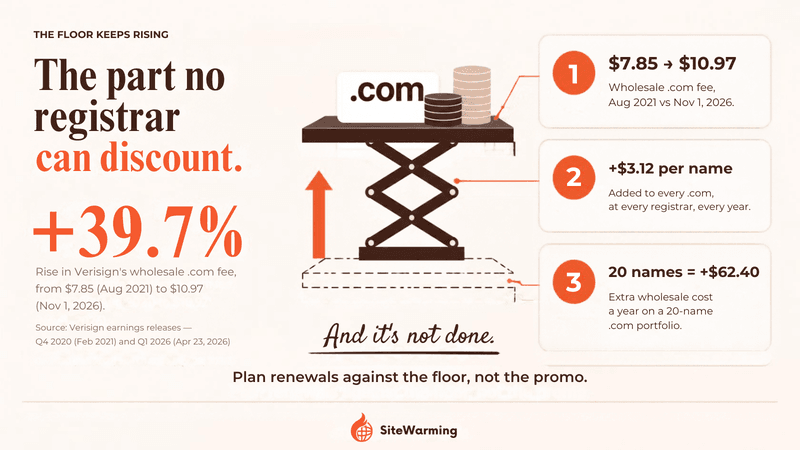
That might not sound like much on a single domain. On five, ten or twenty names, the compound math gets real.
How much could a .com renewal cost by 2030?
If Verisign takes the maximum in every remaining year of the current period and keeps rounding down as it has, the wholesale price would step to about $11.73, then $12.55, then $13.42 by the end of the cycle (our calculation, applying the 7% limit in the .com Registry Agreement Amendment 3 terms to the $10.97 price). Domain Name Wire reached the same $13.42 figure (Domain Name Wire, April 23, 2026).
Treat that as a ceiling, not a forecast. Verisign could take less. Its record says plan for the ceiling.
Who marks up .com renewals, and by how much?
Not every registrar passes the wholesale price along the same way. Some add a thin margin. Some add more than the wholesale fee itself. Some have built entire business models around the gap between what they pay and what you pay.
Here's what a standard .com renewal costs at three well-known registrars, checked on their live pricing pages on September 28, 2026, before the November 1 wholesale increase, so expect retail prices to move after that date.
| Registrar | .com renewal price | Registry + ICANN cost | Registrar margin | Source |
|---|---|---|---|---|
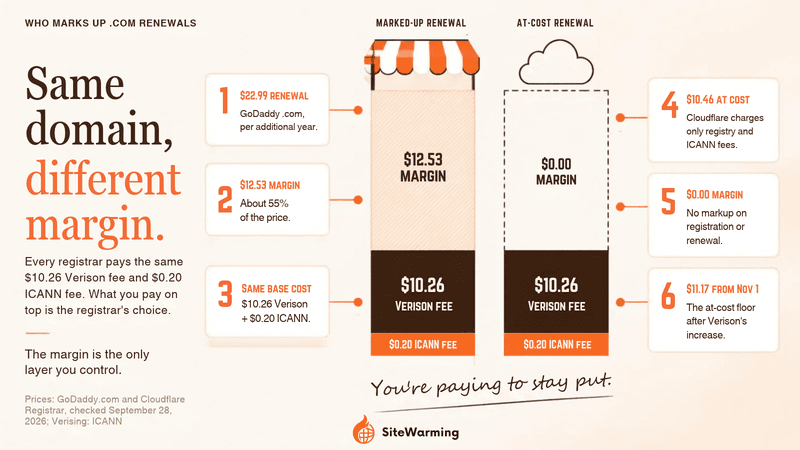
| GoDaddy | $22.99 | $10.46 | about $12.53 (55% of the price) | GoDaddy .com pricing |
| Namecheap | $18.48 | $10.46 | about $8.02 (43% of the price) | Namecheap domain pricing |
| Cloudflare | Registry + ICANN cost only | $10.46 | $0.00 | Cloudflare Registrar |
Registry + ICANN cost = $10.26 Verisign wholesale fee + $0.20 ICANN fee. From November 1, 2026 it becomes $10.97 + $0.20 = $11.17.
Cloudflare states that it "does not mark up domain prices at all" and that customers "only pay the price charged by registries and ICANN" (Cloudflare Registrar). Registration is a loss leader for its infrastructure products, but the effect is the same: you pay the registry and ICANN fees and nothing more.
That makes Cloudflare a useful benchmark. When a registrar charges $22.99 for a .com renewal, more than half of it is the registrar's margin. You're not paying for the domain. You're paying for the privilege of staying where you already are.
Registrars justify the markup as covering DNS management, customer support and security features. Many of those services are automated or available free elsewhere. The markup is less about what it pays for and more about what you'll tolerate before you bother switching.
On a portfolio, that tolerance adds up. Twenty .com names renewed at $22.99 cost $459.80 a year; the same twenty at registry-plus-ICANN cost come to $209.20 today and $223.40 after November 1. That's roughly $236 to $250 a year for staying put. Which registrars hold up over a decade of renewals is covered in the best domain registrars for long-term ownership.
Do other domain extensions follow the same pricing rules?
No. The .com rules above are unusually strict. Other extensions fall into three groups, and they behave very differently at renewal.
New gTLDs and most legacy extensions (.xyz, .online, .org, .info and similar). These registries are not bound by a 7% cap. Their contracts with ICANN do protect you in three ways (ICANN Base Registry Agreement, Section 2.10):
- The registry must give registrars at least 180 calendar days' notice of any renewal price increase.
- The registry must let registrars renew at the current price for one to ten years.
- Renewal pricing must be uniform: one name cannot be singled out for a higher renewal, unless the higher renewal price was clearly disclosed and you agreed to it when you first registered.
ICANN removed the old price caps from .org in 2019 so its agreement would "better conform with the base registry agreement" (ICANN, Proposed Renewal of .org Registry Agreement). In practice, notice and a ten-year prepay window are the main protections outside .com.
Registry premium names. That disclosure exception is how premium pricing works. A name the registry itself sells as premium often renews at a premium price every year, not only on purchase. Namecheap's help center spells out the split: "Registry premiums have special pricing not only for acquisition but also for renewal and transfer," while premium names bought from a previous owner renew at the standard rate for their extension (Namecheap, How to get a premium domain). Check which kind you're buying before you pay. Tracking premium renewals separately is part of domain renewal management.
Country-code domains (.io, .co, .ai, .uk and others). These are outside ICANN's registry contracts altogether. ICANN states that "ICANN does not have contract authority to take compliance action against ccTLD operators" and that their registration policies are set within each country (ICANN, About ccTLD Compliance). None of the notice or uniform-pricing rules above are guaranteed. Read that registry's own policy.
How can you pay less for domain renewals?
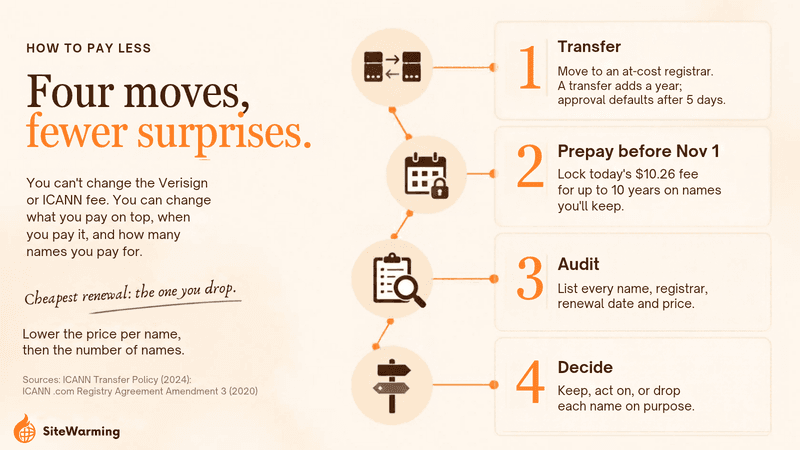
You can't change the wholesale fee or the ICANN fee. You can change what you pay on top of them, when you pay it, and how many names you pay for.
- Transfer to a transparent registrar. Cloudflare's zero-markup model is the clearest example, but any registrar that publishes its renewal prices upfront and doesn't inflate them year over year beats one that buries increases in terms updates. Under ICANN's Transfer Policy, a transfer is approved by default if the losing registrar doesn't respond within five calendar days, and a completed transfer adds one year to the registration, capped at ten years in total (ICANN Transfer Policy). So for most gTLDs the transfer fee is your next renewal, paid at the new registrar's rate. Your registrar may refuse a transfer within 60 days of registration or a previous transfer (ICANN, Transferring Your Domain Name FAQ). Plan the move with how to transfer a domain without breaking anything, and if your current registrar makes leaving hard, see when a registrar holds your domain hostage.
- Prepay multiple years before November 1, 2026. Renewing now locks today's $10.26 wholesale fee for every year you prepay, up to ten years of total registration. ICANN notes that registrars get at least six months' notice of .com increases precisely so customers can lock in current prices for up to ten years (ICANN public comment on Amendment 3). If the maximum increases keep coming, that's real money. Do it only for names you're sure you'll keep.
- Audit what you're actually renewing. This is the one most people skip. You can optimize your per-domain cost all day, but if you're spending $50, $100 or $200 a year renewing domains you haven't touched since you registered them, the price per domain isn't the real problem. A domain portfolio spreadsheet template is the minimum: every name, registrar, renewal date and renewal price in one list.
- Decide each name on purpose. Keep, act on, or drop. Should you renew a domain you're not using? walks through that decision for the names that have sat still.
Is the renewal fee the real cost of an unused domain?
For most founders with a drawer full of names, no. The real problem is that you're paying to hold ideas you're not doing anything with. Every renewal is a small vote of confidence in an idea that hasn't moved. At some point, the question shifts from "how do I pay less for this?" to "what am I actually paying for?"
If that domain is connected to something you're building, the renewal is the cheapest part of the investment. Pay it, keep building, don't think twice.
If it's connected to an idea you believe in but haven't started, that's a different situation, and one a cheaper registrar doesn't solve. The cost isn't the $16. The cost is the year of invisibility between this renewal and the next one: the year your idea sits dark, undiscoverable, accumulating nothing while you wait for the right moment. That is the invisible cost of sitting on an idea, and parking the name doesn't fix it either, the real cost of parking a domain goes well beyond the renewal fee.
How does SiteWarming help you control renewal costs across a portfolio?
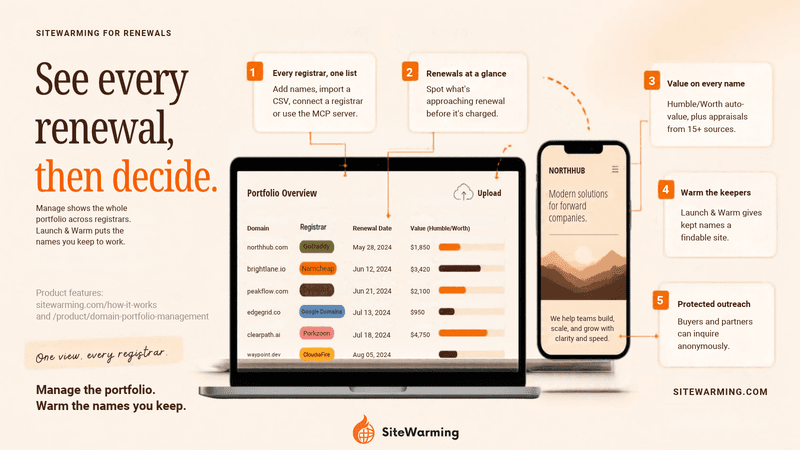
Most renewal overspend comes from not seeing the whole portfolio at once. Names sit at three or four registrars, each with its own dashboard, prices and dates, so nobody notices that the same .com costs $10.46 in one account and $22.99 in another.
The SiteWarming domain portfolio management tool puts every registrar in one place. You can add names one at a time, bulk-import a CSV, connect a registrar, or use the SiteWarming MCP server. It shows what's live, what leads nowhere and what's approaching renewal at a glance, and it attaches a value to each name, auto-fetched from HumbleWorth, with appraisals from 15+ sources you can stack. That's the view you need to decide which names deserve a ten-year prepay, which should move to a cheaper registrar, and which to drop. For the wider method, see how to manage domains across registrars.
For the names worth keeping, Launch & Warm turns a dormant domain into a warm site: a one-sentence story, structured data, AI-readable FAQs, clear availability context ("Future Build", "Open: open, not listed" or "Actively Selling"), and protected outreach so a would-be buyer or partner can make an anonymous inquiry. Hosting, HTTPS, DNS and SSL checks and monthly content updates are handled. The renewal stops paying for a dark page and starts paying for a name that builds worth and can be found.
When the renewal price gets too high and you let a domain expire, the consequences are more staged and more expensive than most people expect. And the scam emails that flood your inbox around renewal time? They work precisely because legitimate pricing has become so unpredictable that nothing looks trustworthy anymore.
Frequently asked questions
Why is my domain renewal more expensive than the first year?
Your first year was almost certainly a promotional price. Registrars discount the first year to win new customers and charge full list price at renewal; ICANN's own FAQ says this is why "your initial registration fee may be less than the cost to renew." On .com, GoDaddy currently offers $0.01 for the first year with a three-year purchase, then charges $22.99 for each additional year.
How much does it cost to renew a .com domain in 2026?
The floor is the $10.26 Verisign wholesale fee plus ICANN's $0.20 fee, or $10.46, until October 31, 2026. From November 1, 2026 the floor is $11.17. Retail renewals on September 28, 2026 ranged from that at-cost price at Cloudflare to $18.48 at Namecheap and $22.99 at GoDaddy.
When is the next .com price increase?
Verisign raises the .com wholesale fee from $10.26 to $10.97 on November 1, 2026. Its agreements allow up to 7% a year in four of every six years, so further increases are possible each year of the current cycle. If Verisign takes the maximum each time, the wholesale price would reach about $13.42.
Can I lock in a domain price for 10 years?
Yes, for most gTLDs. You can prepay renewals so the total registration runs up to ten years, and each prepaid year is charged at today's price. For .com, ICANN notes that the six months' notice registrars receive before increases exists so customers can lock in current prices for up to ten years. You pay your registrar's current retail price for each prepaid year, up front.
Is it cheaper to transfer a domain than to renew it?
Often, yes. For most gTLDs, a transfer adds one year to your registration, so the transfer fee works like a renewal at the new registrar's price. Moving a .com from a $22.99 renewal to an at-cost registrar saves about $12.50 a year. You can't transfer within 60 days of registering or a previous transfer if your registrar refuses.
Do premium domains cost more to renew?
It depends who sold the premium. A registry premium name usually renews at a premium price every year, and that higher renewal price must be clearly disclosed when you register. A premium name bought from a previous owner on the aftermarket normally renews at the standard price for its extension. Check the renewal price before you buy.
How does SiteWarming help with domain renewals?
The SiteWarming domain portfolio management tool shows every domain across every registrar in one place, including what's approaching renewal and what each name is worth, so you can see where you're overpaying and which names to keep, move or drop. For names you keep, Launch & Warm gives each one a warm, findable site with a protected contact path.
Share this article
Ready to Transform Your Domain Portfolio?
Start building real value with your domain investments today.