Should You Renew a Domain You're Not Using?
 Bret Siers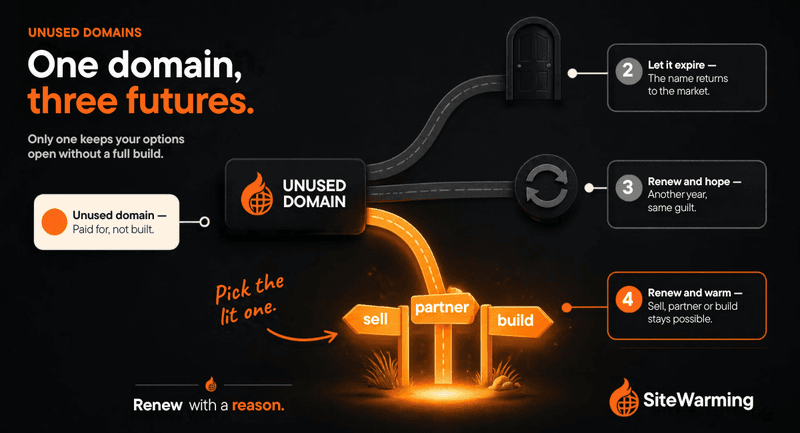
Renew an unused domain only if the idea still matters and you will act on it within about a year, or if someone else could plausibly want the name. Otherwise, let it expire. The renewal fee is rarely the deciding factor. What you do with the domain after you pay is.
The question people type into forums and search boxes is some version of this one: "If I don't want a domain anymore, do I just let it expire?" The mechanics are easy to look up. The tension isn't about mechanics. It's about sitting with something you bought because the idea felt real, and not knowing what to do now that you haven't done anything with it.
If you're reading this, you probably have at least one domain like that. Maybe more. The renewal email is either sitting in your inbox right now or coming soon, and you're trying to work out whether another year is a smart move or just a habit.
The answer isn't yes or no. The question itself is the problem. This guide turns it into a decision: what each path really costs, five questions that settle it, and a middle option most people never hear about.
What does it really cost to renew a domain you're not building?
On paper, it's a small number. A .com renews for $18.48 at Namecheap and $22.99 at GoDaddy. Underneath those retail prices sits a wholesale fee: Verisign, which runs the .com registry, charges registrars $10.26 a year today and $10.97 from November 1, 2026. It's easy to click. It's easy to forget.
| What you pay for a .com | Renewal per year | Source |
|---|---|---|
| Verisign wholesale (what registrars pay the registry) | $10.26, rising to $10.97 on November 1, 2026 | Domain Name Wire, April 23, 2026 |
| Namecheap retail | $18.48 | Namecheap .com page, checked October 2, 2026 |
| GoDaddy retail | $22.99 (first year $0.01 with a three-year purchase) | GoDaddy .com page, checked October 2, 2026 |
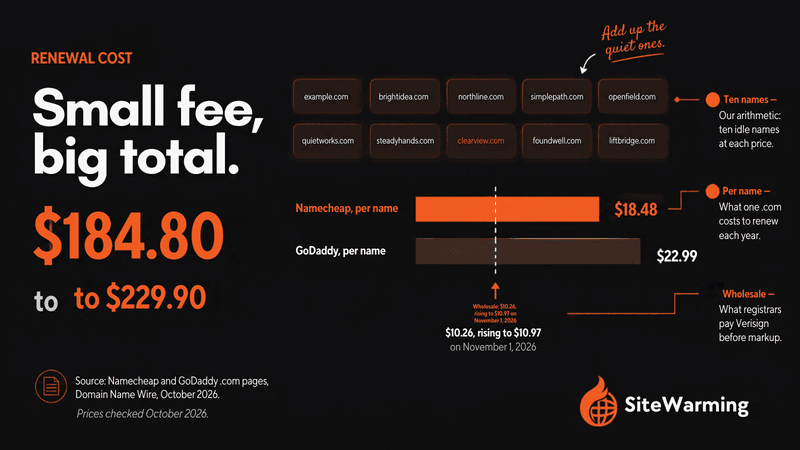
Multiply those numbers across a portfolio and the quiet cost shows up. Our arithmetic: ten idle .com names at $18.48 cost $184.80 a year, and at $22.99 they cost $229.90. Over five years, that is roughly $924 to $1,150 for names that are doing nothing. Prices differ by registrar and extension, and they change, so treat these as a snapshot.
Auto-renew makes this worse. Most registrars offer it, and once you've stopped paying attention to a domain, a charge that renews itself every year is easy to miss. The pricing mechanics behind it are covered in why domain renewals cost more every year.
But the dollar amount isn't the real cost.
There's the other cost. The one you feel every time you see the charge on your card or the confirmation email in your inbox. That small pulse of guilt. You're paying for something that isn't moving. You know it isn't moving. And every renewal is a quiet reminder of the gap between what you intended and what actually happened.
That's the real price. Not $18 or $23. The weight of carrying something you're not using. We looked at that weight in the hidden cost of unused domains.
What does it cost to let a domain expire?
So you stop renewing. Let it expire. Problem solved, right?
Not exactly.
When you don't renew a domain, it doesn't just disappear. It moves through a fixed sequence, and each stage gives you less control than the last. ICANN's guidance for registrants sets out the stages below. Registrars can add their own grace periods and fees, so check yours.
| Stage | What happens | Can you still get the name back? |
|---|---|---|
| Before expiry | Registrars must send two renewal reminders, about a month and about a week before the expiry date, and a third within five days after it. | Yes. Renew normally. |
| Expiry day | The registration lapses. Some registrars add their own grace period. | Yes, on your registrar's terms. |
| Redemption grace period (30 days) | The domain can be restored. Fees for restoring an expired domain vary by registrar and may include a redemption charge. | Yes, at a higher price. |
| Pending delete (5 days) | The name is queued for deletion. | Treat it as lost. |
| Released | The name becomes available for registration on a first-come, first-served basis. | Only if no one registers it first. |
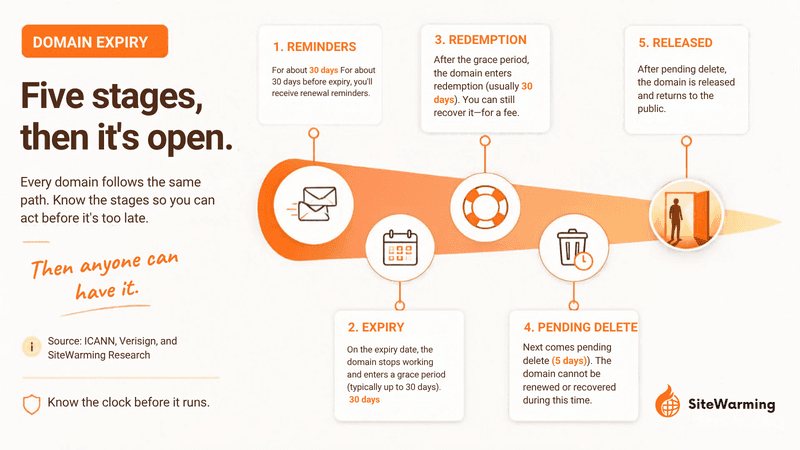
Sometimes "anyone" is fine. Sometimes it isn't. Your old domain, the one tied to your name or your idea, can be registered by a stranger the moment it is released, and any link, bookmark or email address that still pointed to it now points to them.
Even without that risk, there's a finality to letting a domain go that people underestimate. You can register a new one. But you can't get back the one you had if someone else grabs it. And the specific combination of words you chose, the thing that made sense to you at 2 a.m. when the idea was fresh, that's gone.
Letting go solves the renewal guilt. It introduces a different kind. The "I had that" kind. The wondering.
How do you decide whether to renew or let a domain go?
"Should I renew this domain?" sounds like a financial question. It isn't. Not really.
What you're actually asking is: does this idea still matter to me?
If the answer is a clean no, let it go. Some ideas run their course. Some domains were impulse buys at 1 a.m. and you know it. There's no guilt in releasing something you've moved past.
If you hesitate, if part of you still sees something in it, if the reason you haven't built anything isn't that the idea is dead but that life got complicated, then "just renew and hope" isn't a strategy. Warming is different from hoping. It's an actual practice with a name, and renewing without it is a holding pattern. Holding patterns have a way of lasting years.
Five questions settle most renewals. Answer them for each domain, not for your portfolio as a whole.
- Does the idea still matter to you?
- Will you build, sell or partner on it within about 12 months?
- Could someone else plausibly want this exact name?
- Does anything still depend on it: email addresses, account logins, links or printed material?
- Would you pay to register this name again today?
| Your answers | What to do |
|---|---|
| Every answer is no | Let it expire. |
| Yes to question 2 | Renew and build. |
| Yes to question 1, 3 or 5, but no to question 2 | Renew and warm it, so the option stays usable. |
| Yes to question 4 | Renew until you've moved what depends on it, then run the test again. |
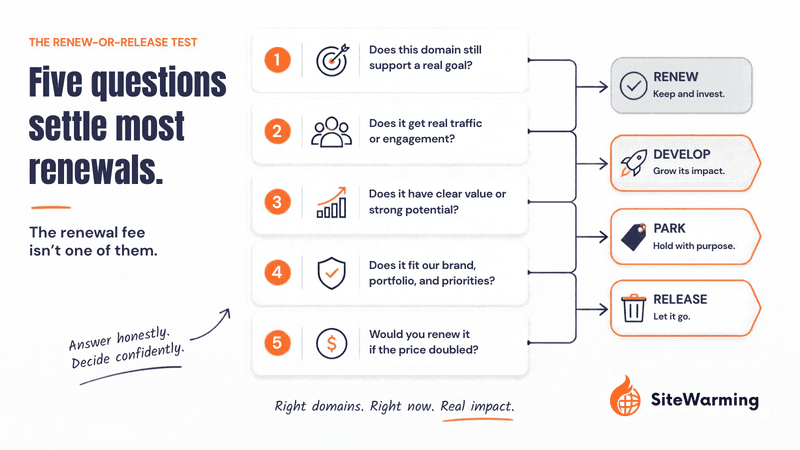
The question isn't whether to renew. It's what happens after you do. Renewing without a plan is just buying yourself another year of the same guilt, and it adds up in ways that go beyond money.
You don't want to know if you should renew. You want to know if there's something between paying-and-hoping and walking away.
Is there a middle ground between renewing and letting a domain expire?
Yes, and almost nobody mentions it. The internet makes the choice feel binary: build the thing or let it go. But most ideas don't die because they were bad. They die because there was no space between "not ready" and "gone."
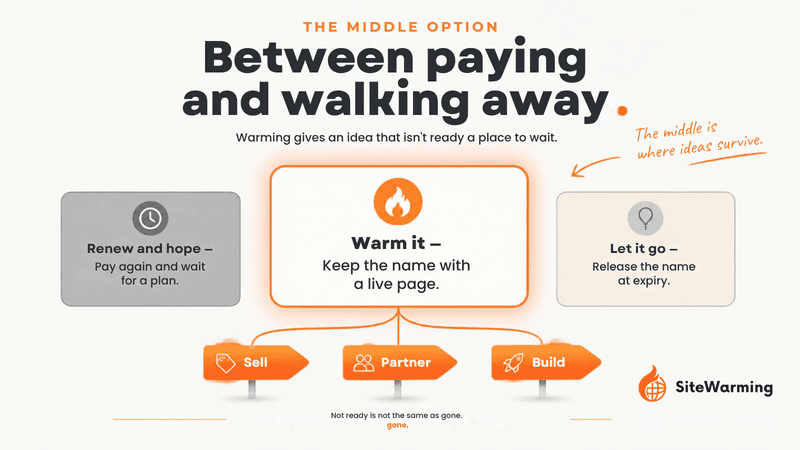
That space is warming. Warming a domain means putting real, current content and a way to reach you on a name you aren't ready to build, so people, search engines and AI systems can find it and understand it. It is a different thing from email warming, which is about sender reputation.
Here's the logic. You bought the name because you saw value in it. The odds are good that someone else would see the same value. If that person can't find you, or can't tell the name is available, they move on, and you never learn what it cost you. You keep paying the renewal and get nothing back.
Content on the domain builds real worth and makes it findable. A contact path means the option can actually be exercised when the moment comes: sell it, partner on it or build it. Which one you choose is your business.
How does Launch & Warm keep an unused domain alive?
SiteWarming's Launch & Warm works in four steps: tell the domain's story, choose an intent template (Future Build, Open or Actively Selling), launch the warm site, and add structured context such as FAQs. It handles DNS configuration, HTTPS certificates, hosting and AI-readable FAQs, plus monthly updates. The How It Works page walks through each step, and the Free plan includes one warmed domain.
It doesn't replace the decision. It lets you renew with a reason. The shift from owning a name to looking after it is the subject of from ownership to stewardship.
How can you review every domain before the renewal date?
One unused domain you can decide on in an afternoon. Thirty names across three registrars is a different problem: the renewal email becomes the first time you've thought about a name in a year, and you decide under deadline pressure. Managing 10 vs. 50 domains covers why that happens and how to sort a long list.
SiteWarming's domain management shows every domain across every registrar in one view. You can add domains one at a time, bulk-import a CSV, connect a registrar or use the MCP server, and it shows what is live, what leads nowhere and what is approaching renewal. It also fetches a HumbleWorth valuation automatically and lets you stack appraisals from 15+ sources. The Free plan tracks up to 1,000 domains. If you only want a quick sort, the free Domain Renewal Analysis takes up to 150 domains from a pasted list or a CSV.
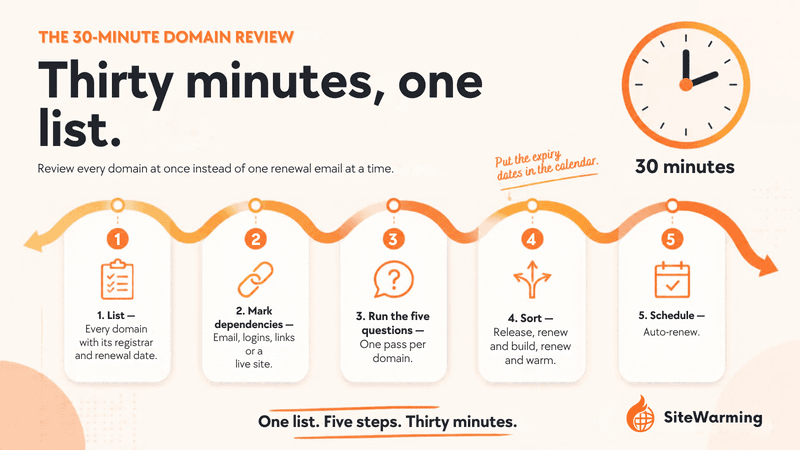
Here is a 30-minute review you can run before the next renewal email:
- List every domain you own, with its registrar and renewal date.
- Mark any name that has email, logins, links or a live site attached.
- Run the five questions on each name.
- Sort the names into three groups: release, renew and build, renew and warm.
- Turn off auto-renew on the release group, and put the expiry dates in your calendar so the decision stays yours.
If a renewal email arrives that doesn't match your list, don't click anything in it. Check whether it's real first.
What mistakes should you avoid when deciding?
- Renewing by default. A low fee makes saying yes feel free. Decide on the idea, not the invoice.
- Letting a name expire without checking what depends on it. Email addresses, account logins and old links all break when a domain is released. Move them first.
- Waiting for the renewal email. Reminders arrive about a month ahead. Decide earlier, so you have time to sell, move or warm the name.
- Treating the fee as the only cost. A name you can't act on costs attention even when it's cheap.
- Releasing a name you would buy again. If question five is a yes, pause before you let it go.
If you're staring at a renewal email right now, the fact that you're thinking about it this hard means something. The idea isn't dead. You're looking for a reason to believe it's worth protecting. And protecting an idea isn't just paying the renewal. It's treating the domain like something that deserves attention, not just money.
It probably is. The question is what you do next.
Frequently asked questions
Should I renew a domain I'm not using?
Renew it only if the idea still matters to you and you will build, sell or partner on it within about a year, or if someone else could plausibly want the name. If neither is true and nothing depends on the domain, let it expire. Renewing without a plan buys another year of the same decision.
What happens if I let my domain expire?
It moves through a fixed sequence. Registrars send reminders about a month and a week before expiry. After expiry, a 30-day redemption period lets you restore the name, usually for an extra fee. A five-day pending-delete stage follows, and then the name is released for registration, first come, first served.
Can someone else register my domain after it expires?
Yes. Once the redemption and pending-delete stages end, ICANN says the name is released and made available for registration on a first-come, first-served basis. Anyone can register it, so check what still points to the name before you let it go.
How much does it cost to keep an unused domain?
At current prices, a .com renews for $18.48 at Namecheap and $22.99 at GoDaddy, against a $10.26 wholesale price that rises to $10.97 on November 1, 2026. Ten idle .com names cost roughly $185 to $230 a year at those two registrars. Prices vary by registrar and extension.
How do I decide if a domain is worth renewing?
Ask whether the idea still matters, whether you will act within 12 months, whether someone else could want the name, and whether anything depends on it. If every answer is no, release it. If any answer is yes, renew, then decide whether to build the name or warm it.
Is it better to sell a domain than let it expire?
Often, if the name has any appeal. A lapsed name returns nothing, while a findable one keeps the option open. But a buyer has to be able to find you and reach you. A warm site with a contact path makes that possible without committing you to a full build.
What should I check before letting a domain expire?
Check what still depends on it: email addresses, account logins that use it, links pointing to it, printed materials and DNS records for other services. Move or update each one first. Once the domain is released, anyone can register it, and anything still pointing at it points at them.
How can I keep an unused domain without building a full site?
Warm it. A warm site puts real content and a contact path on the domain, so people, search engines and AI systems can find and understand it. SiteWarming's Launch & Warm walks you through four steps and handles DNS, HTTPS and hosting. The Free plan includes one warmed domain.
How can I see which of my domains are worth another year?
Put every domain in one view. SiteWarming shows each name across every registrar, what's live, what leads nowhere and what's approaching renewal, with a HumbleWorth valuation and appraisals from 15+ sources. The Free plan tracks up to 1,000 domains, and the free Domain Renewal Analysis checks up to 150.
Share this article
Ready to Transform Your Domain Portfolio?
Start building real value with your domain investments today.